


This guide focuses specifically on how reverse osmosis compares with ultrafiltration and microfiltration for microplastic reduction. It explains how the technologies differ, what an NSF/ANSI 401 Microplastics Reduction claim means, how to verify supporting evidence and which format may fit different household uses.
For a broader comparison of pitcher, faucet, countertop, under-sink and other filter formats, see the main guide to water filters for microplastics .
Compare membrane-based drinking-water systems by filtration stages, output, installation requirements, maintenance and model-specific performance claims.
Compare Reverse Osmosis Water Filter SystemsDoes Reverse Osmosis Remove Microplastics?
The Quick Answer
- RO provides a fine membrane barrier. It should not be described as a simple screen with one universal pore size, but its dense membrane structure is designed to separate water from many particles and dissolved substances.
- Complete-system evidence matters. Check the exact model, membrane, test conditions and listed reduction claims rather than relying only on a generic statement that all RO systems remove a fixed percentage.
- RO may address more than particles. Depending on the model and its verified claims, an RO system may also reduce TDS, fluoride, nitrate, metals or other dissolved substances.
- Maintenance affects performance. Prefilters, membrane condition, water pressure, source-water quality and replacement schedules can all affect system output.

RO vs. UF vs. MF for Microplastic Reduction
Reverse osmosis, ultrafiltration and microfiltration are all membrane-based processes, but they do not provide identical treatment. The correct comparison includes particle performance, dissolved-contaminant treatment, flow, drain water, installation and the evidence available for the complete system.
| Comparison | Reverse Osmosis | Ultrafiltration | Microfiltration |
|---|---|---|---|
| Primary separation method | Dense semipermeable membrane | Porous membrane filtration | Larger-pore mechanical membrane filtration |
| Particle reduction | Strong barrier when the membrane and complete system are working correctly | Can provide strong particle reduction when the absolute rating and membrane integrity are documented | Depends heavily on the absolute pore rating and test conditions |
| Dissolved substances | Can reduce many dissolved substances, depending on the system and listed claims | Usually limited compared with RO | Usually limited compared with RO |
| Drain water | Normally produces a concentrate stream | Often little or no continuous drain flow | Often little or no continuous drain flow |
| Flow | Depends on membrane area, pressure, pump and system design | Often higher than RO | Often higher than RO |
| What to verify | Complete-system listing, NSF/ANSI 58 information and exact claims | Absolute pore rating, integrity and system-level test data | Absolute pore rating and system-level particle test data |
| Typical role | Drinking and cooking water with multiple treatment goals | Particle-focused treatment with higher flow | Larger-particle control or prefiltration |
Ultrafiltration
UF products are commonly offered with ratings in the approximate range of 0.01 to 0.1 micron, but ratings and test methods vary. A UF membrane may provide strong reduction of microplastic particles when its absolute pore rating, membrane integrity and complete-system performance are documented.
UF usually does not provide the same dissolved-solids reduction as RO. It can be useful when particle control, higher flow and minimal drain water are higher priorities.
Microfiltration
MF products commonly have larger rated pores than UF. Tighter MF elements may reduce many microplastic particles, but a nominal rating does not guarantee that every particle at that size will be captured.
When comparing MF products, prioritize an absolute rating and a clear third-party report showing the tested particle-size range, challenge concentration, flow and reduction result.
A micron number alone is not enough. “Nominal” and “absolute” ratings can describe different performance levels, and the complete filter housing, seals, bypass control and maintenance condition also matter.
What an NSF/ANSI 401 Microplastics Claim Means
Certification under NSF/ANSI 401 does not automatically mean that every claim available under the standard applies to the product. The official listing must explicitly show Microplastics Reduction for the exact model.
How to Verify the Claim
- Record the complete system model and replacement-filter model.
- Open the official NSF drinking-water treatment unit database .
- Search by manufacturer, brand or exact model.
- Confirm that NSF/ANSI 401 appears in the listing.
- Confirm that the claim specifically states “Microplastics Reduction.”
- Confirm the approved replacement element, flow and service information.
- Check that the listing is current.
Related Standards
- NSF/ANSI 42: Covers defined aesthetic or non-health-related claims, including chlorine, taste, odor and certain particulate claims when listed.
- NSF/ANSI 53: Covers specific health-related contaminant-reduction claims when listed for the model.
- NSF/ANSI 58: Applies to point-of-use RO systems and includes TDS reduction, material safety, structural integrity, efficiency, recovery and optional contaminant claims.
- NSF/ANSI/CAN 372: Addresses lead content in product materials. It does not prove lead or microplastic reduction from source water.
Limits of Certification and Laboratory Testing
- Laboratory testing uses defined water conditions, flow rates and challenge particles. Household conditions may differ.
- A microplastics claim does not automatically prove reduction of every particle shape, polymer or particle size.
- Certification for microplastics does not automatically include PFAS, lead, nitrate, fluoride or microbial reduction.
- Overdue filters, damaged seals, low pressure, membrane fouling or incorrect replacement elements can affect performance.
When No Certification Listing Is Available
The report should identify:
- The exact system and replacement element tested
- The particle material and size distribution
- The starting and ending particle concentrations
- The flow rate and total test volume
- The testing method and laboratory
- The reduction result throughout the stated service period
Looking for a membrane-based system that can also address dissolved treatment goals? Compare the complete system, not just the membrane label.
Compare Reverse Osmosis Water Filter SystemsHow the Main Filtration Technologies Work
Reverse Osmosis Membranes
RO uses water pressure and a dense membrane to separate treated water from a concentrate stream. It should not be described only as mechanical straining through fixed holes.
Typical RO stages may include:
- A sediment prefilter that protects later stages from larger particles
- A carbon stage that helps reduce chlorine, odor and selected organics
- The RO membrane
- A post-carbon stage for final taste polishing
- An optional remineralization stage
The exact stages, membrane design, output and contaminant claims vary by model. Verify each system rather than assuming that every multi-stage RO product has identical performance.

Ultrafiltration and Microfiltration
UF and MF use porous membranes. Water passes through the membrane while particles larger than the effective openings are retained.
When comparing UF or MF, check:
- Whether the rating is absolute or nominal
- The complete-system particle test data
- The rated flow and pressure range
- Whether the membrane has an integrity or bypass-control design
- The cleaning, flushing and replacement instructions
- Whether the system treats only particles or also includes carbon or specialty media
UF and MF can be practical when the goal is primarily particle reduction and the user wants higher flow with minimal drain water. They should not be assumed to reduce dissolved salts or every chemical contaminant.
Where Carbon and Ion Exchange Fit
For a detailed explanation, see what activated carbon removes from water .
Multi-stage systems combine technologies because no single stage performs every treatment function. The claims for each stage should still be verified.
Can Boiling Reduce Microplastics?
Boiling alone should not be treated as a standardized replacement for membrane filtration. However, research has found that boiling calcium-containing tap water can cause calcium carbonate deposits to form around some nano- and microplastic particles.
In the reported experiment, the effect was stronger in hard water. The water was boiled, cooled and then separated from or filtered to remove the resulting scale. The result therefore depended on water hardness and a post-boiling separation step.
This method may reduce some free-floating particles under suitable conditions, but it does not provide the standardized, model-specific performance information available from a tested membrane system.

Microplastics in Drinking Water: What Is Known and Unknown
Definitions and Particle Sizes
- Microplastics are generally described as plastic particles smaller than 5 millimeters.
- The definition of nanoplastics varies among studies and organizations.
- Plastic particles may appear as fibers, fragments, films, beads or other shapes.
- A filter’s performance can vary with particle size, shape, polymer type and surface properties.
| Item | General Description | Practical Meaning |
|---|---|---|
| Reverse osmosis | Dense semipermeable membrane process | Strong option when particle and dissolved-substance treatment are both desired |
| Ultrafiltration | Fine porous membrane with model-specific ratings | Can provide strong particle control with higher flow |
| Microfiltration | Larger porous membrane with model-specific ratings | Performance depends strongly on the absolute rating and particle size |
| NSF/ANSI 401 | Standard containing multiple specific emerging-compound claims | The model listing must explicitly show Microplastics Reduction |
| Activated carbon | Adsorptive media often used for chlorine, taste and odor | Do not assume sub-micron particle reduction without a specific claim |
Where Microplastics Come From
- Synthetic textile fibers
- Tire wear and road runoff
- Breakdown of packaging and larger plastic items
- Wastewater effluent and stormwater
- Industrial and household plastic use
- Plastic components used during bottling, storage or distribution
Microplastics have been reported in both bottled and municipal water. One source should not automatically be described as containing more particles than the other because study methods and detection limits vary.
What Treatment Plants Remove
Drinking-water treatment processes designed for coagulation, settling and particle filtration can reduce microplastics. Reported performance varies with particle size, shape, source-water quality and treatment design.
A point-of-use membrane system can provide an additional barrier at the kitchen tap, but it should not be described as proof that the public water supply is unsafe.
What Is Known About Health Effects?
- Research on human exposure and potential health effects is still developing.
- Studies use different definitions, particle sizes, polymers and analytical methods.
- Smaller particles are more difficult to detect and characterize consistently.
- Current evidence does not support making a simple claim that filtered water eliminates a proven health risk from microplastics.
A household may still choose to reduce unnecessary particle exposure, but filtration decisions should be presented as water-treatment choices rather than guaranteed health protection.
How to Choose the Right System
Selection Checklist
- Define the use: drinking and cooking, whole-house prefiltration, rental housing, travel or off-grid use.
- Define the treatment goal: particle reduction alone or particles plus dissolved substances.
- Verify evidence: exact certification claim, absolute rating or complete third-party report.
- Check source-water conditions: sediment, chlorine, hardness, pressure and other treatment concerns.
- Check installation: space, drain connection, electricity, faucet and plumbing requirements.
- Plan maintenance: rated capacity, replacement elements, flushing and sanitizing instructions.
Under-Sink vs. Countertop RO
Under-sink RO may suit users who want:
- Filtered water at a dedicated kitchen faucet
- Higher daily output for drinking and cooking
- A system hidden inside the cabinet
- A permanent connection to the cold-water line and drain
Countertop RO may suit users who want:
- Little or no permanent plumbing modification
- A portable or rental-friendly format
- Manual filling and wastewater handling
- A smaller daily storage capacity
Tanked and tankless designs can both be effective. Compare actual output, first-draw performance, cabinet space, noise, electrical requirements and maintenance rather than assuming one format is always better.

Point-of-Use vs. Whole-House Treatment
A point-of-use system treats water at the kitchen tap used for drinking and cooking. This is often the most practical location for RO.
Whole-house treatment may use sediment filtration, UF or other stages to treat water for multiple fixtures. Whole-house systems require higher flow and should not be assumed to carry the same microplastic claims as a point-of-use product.
Travel and Off-Grid Use
Portable UF or MF products can be practical where electricity and plumbing are unavailable. Check the absolute rating and complete test report. A product designed for treated tap water should not automatically be used for microbiologically unsafe surface water.
| Situation | Technology to Compare | Key Evidence | Practical Consideration |
|---|---|---|---|
| Particles plus dissolved treatment goals | RO | Complete-system listing, NSF/ANSI 58 and model-specific claims | Drain connection, pressure, output and maintenance |
| Strong particle control with minimal drain water | UF | Absolute rating and system-level particle test | Dissolved substances usually remain |
| Prefiltration or larger-particle control | MF | Absolute rating and tested particle-size range | May need additional treatment stages |
| Rental or limited plumbing access | Countertop RO or countertop membrane filter | Exact model claims and laboratory evidence | Storage, refilling and wastewater handling |
| Travel or off-grid use | Portable UF/MF or compact RO where power is available | System-level particle and microbial claims | Source-water safety and cartridge capacity |
Compare Under-Sink RO Formats
These products represent two under-sink RO formats for users comparing flow, electricity requirements, tankless installation and remineralization. Review each product page for current certifications, reports, filtration claims and installation requirements.
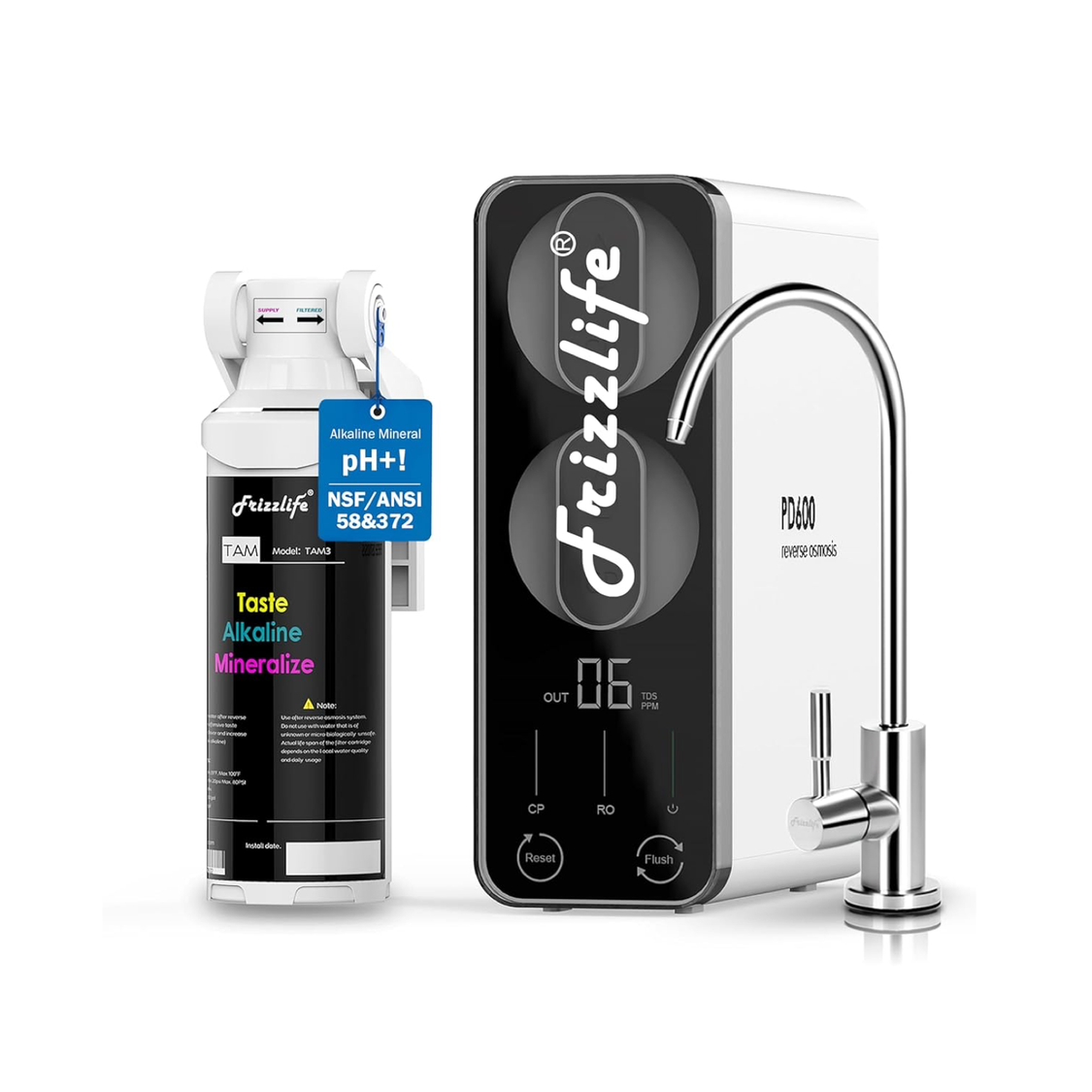
PD600-TAM3 Reverse Osmosis System
A 600 GPD tankless under-sink RO option with alkaline remineralization and real-time TDS monitoring for daily drinking and cooking water.
Review the current product report and listing for exact reduction claims. Do not assume that an NSF/ANSI 401 Microplastics Reduction claim applies unless the exact model is listed for it.
View PD600-TAM3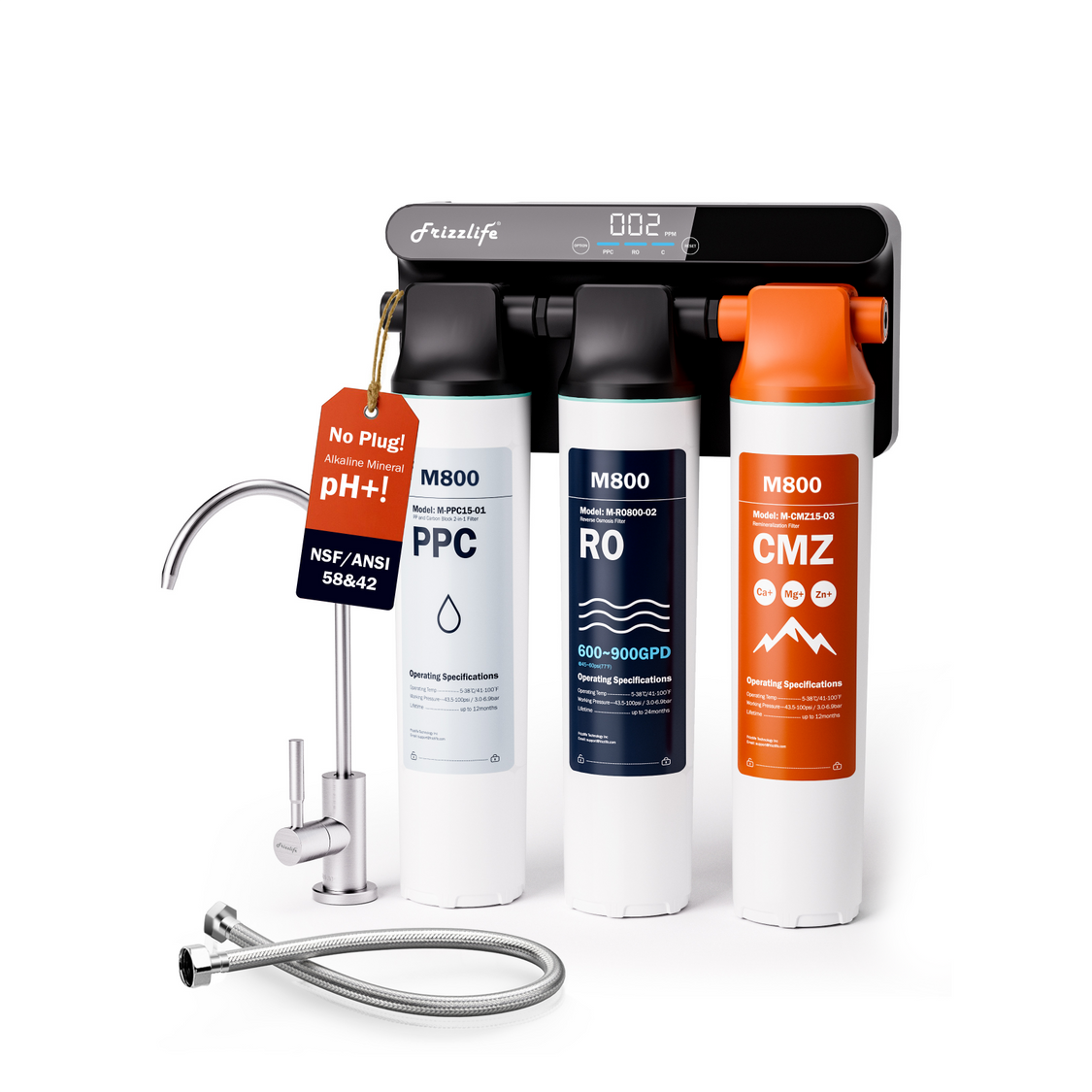
M800 Non-Electric Reverse Osmosis System
A non-electric tankless RO option with alkaline remineralization and output rated up to 900 GPD, using household water pressure rather than an electric pump.
Confirm feed-pressure requirements, current certifications, filter configuration and model-specific contaminant claims before ordering.
View M800
Maintenance, Efficiency and Ownership Cost
What to Check
- Rated capacity in gallons and months
- Approved prefilter, membrane and post-filter models
- Rated flow and daily production
- Source-water pressure and temperature requirements
- Efficiency rating and recovery information for RO systems
- Pure-water-to-drain-water information
- Flushing and sanitizing procedures
- Replacement-filter cost and availability
Follow the manufacturer’s replacement instructions. High sediment, chlorine exposure, scaling, low pressure and high daily use can change filter life.
RO Drain Water and Pressure
RO systems separate treated water from a concentrate stream. Do not confuse a stated pure-water-to-drain-water ratio with an NSF recovery or efficiency rating.
Low feed pressure can reduce output and affect efficiency. Some systems use an electric booster pump, while non-electric designs rely on adequate household water pressure.
Materials and Storage
- Review material-safety certifications for the complete product.
- NSF/ANSI/CAN 372 addresses lead content but does not establish microplastic reduction.
- Keep tanks, carafes, faucets and housings clean according to the instructions.
- Do not use replacement cartridges that are merely described as compatible without confirming system requirements.
Key Takeaways
- RO can provide a strong membrane barrier for microplastic particles while also addressing many dissolved treatment goals.
- UF and tight MF can also provide particle reduction, but the absolute rating and complete-system evidence matter.
- NSF/ANSI 401 alone does not prove microplastic reduction. The official listing must show a model-specific Microplastics Reduction claim.
- NSF/ANSI 58 applies to RO system performance but does not automatically provide a microplastics claim.
- Activated carbon and ion exchange are useful supporting technologies, not automatic substitutes for a verified membrane barrier.
- Maintenance, pressure, replacement elements and installation can affect real-world system performance.
FAQs
Does reverse osmosis remove microplastics?
Do any water filters remove microplastics?
What micron filter removes microplastics?
Are pitcher filters enough for microplastics?
Is bottled water safer than tap water for microplastics?
Does boiling water remove microplastics?
Is NSF/ANSI 401 certification required?
Certification is not the only possible form of evidence, but it provides a clear third-party method for verifying a model-specific claim. When certification is unavailable, review a complete independent laboratory report with clear particle sizes, test conditions and results.
Does activated carbon remove microplastics?
Activated carbon is primarily used for chlorine, taste, odor and selected organic compounds. Some carbon-based products may also have verified particulate or Microplastics Reduction claims, but the claim should not be assumed from the carbon media alone.
Can ultrafiltration remove microplastics?
UF can provide a strong particle barrier when the membrane has an appropriate absolute rating and the complete system controls bypass. Verify the system-level test rather than relying only on the generic term “ultrafiltration.”
Can a home water filter remove nanoplastics?
Nanoplastic definitions and testing methods are still developing. A standard microplastics claim should not automatically be extended to every nanoparticle size. Dense RO membranes may provide a stronger barrier than larger-pore filters, but model-specific nanoplastic claims require suitable testing.
Compare RO systems by filtration stages, output, installation, electrical requirements, maintenance and model-specific performance claims.
Compare Reverse Osmosis Water Filter SystemsReferences
- NSF. Certified Drinking Water Treatment Units: NSF/ANSI 401 Microplastics Reduction Listings
- NSF. NSF/ANSI 42, 53 and 401 Filtration Systems Standards
- NSF. NSF/ANSI 58 Reverse Osmosis Drinking Water Treatment Systems
- World Health Organization. Microplastics in Drinking-Water
- American Chemical Society. Want Fewer Microplastics in Your Tap Water? Try Boiling It First