Standard Fixed Spout
A fixed faucet with removable aerator threads may accept a faucet-mounted filter when the thread size and supplied adapter match.


A faucet-mounted filter is not compatible with every kitchen faucet. Pull-out, pull-down, sensor and designer faucets often need a different filtration path. Identify the faucet first, then choose between a faucet-mounted filter, direct-connect under-sink filter or system with a dedicated drinking-water faucet.
Look at both the spout design and the connection point before buying an adapter or filter.
A fixed faucet with removable aerator threads may accept a faucet-mounted filter when the thread size and supplied adapter match.
The filter would add weight and interfere with the hose and docking system. Standard faucet-mounted filters are commonly unsuitable for this design.
Wide waterfall spouts, rectangular outlets, hidden aerators and unusual threads may not accept common faucet adapters.
A separate small faucet can serve an under-sink filter or RO system without attaching a filter to the main kitchen spout.
Use this as a first compatibility screen, then review the exact product instructions.
| Kitchen setup | Faucet-mounted filter | Direct-connect under-sink filter | Under-sink RO with dedicated faucet |
|---|---|---|---|
| Standard faucet with compatible threads | Often possible after adapter check | Often possible after plumbing check | Possible when installation requirements are met |
| Pull-out or pull-down faucet | Usually not suitable | Often the simplest alternative | Possible with space for a separate faucet |
| Touchless or sensor faucet | Compatibility may be limited | Model and plumbing dependent | Possible with independent drinking-water faucet |
| Non-standard designer spout | Often difficult or unsupported | May avoid spout compatibility issue | Possible with countertop drilling or an existing accessory hole |
| Rental kitchen | Possible when compatible and removable | Depends on lease and plumbing access | Countertop RO may be a more flexible alternative |
These four products represent different compatibility paths: a filter attached to a compatible standard faucet, a direct-connect system that keeps the main faucet, a non-RO system with a separate filtered-water faucet and an RO system with its own dedicated faucet.

A faucet-mounted option for compatible fixed-spout faucets with a removable threaded aerator. It should not be selected from appearance alone.

A non-RO under-sink alternative when attaching a filter to a pull-out or pull-down spray head is unsuitable. Filtered water continues through the main kitchen faucet.

A non-RO filtration system with a separate filtered-water faucet, allowing the main pull-out or designer faucet to remain unchanged.
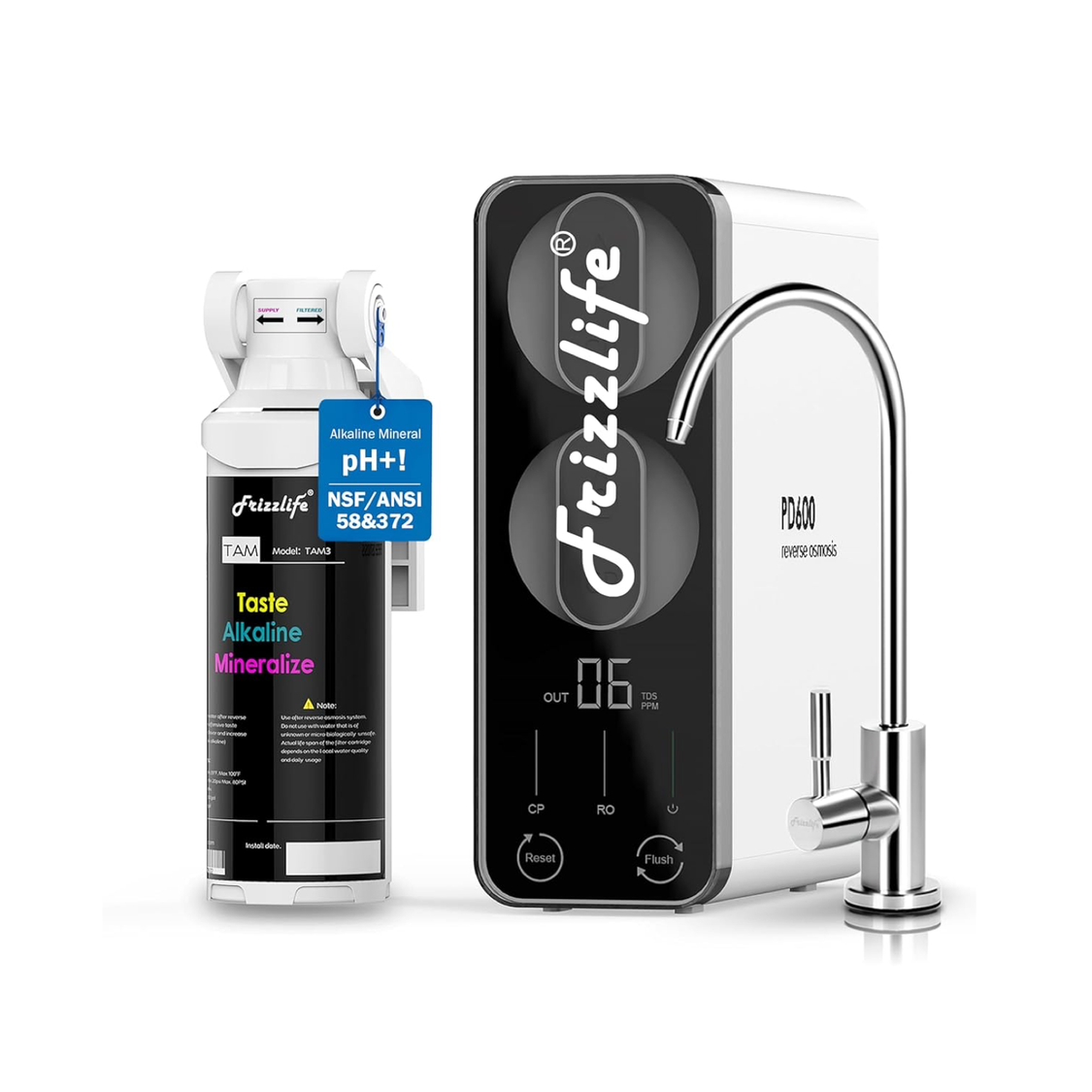
A permanent under-sink RO path for users who want broader dissolved- solids reduction and a separate drinking-water faucet rather than filtering through the main kitchen faucet.
Compatibility reminder: Do not assume universal faucet fit. Confirm the faucet outlet, aerator thread, supplied adapters, cold-water line size, cabinet clearance, electrical access, drain connection and dedicated-faucet opening required by the exact product before purchasing.
A few measurements can prevent most faucet-fit problems.
Determine whether the faucet has visible male threads, female threads, a hidden aerator or no removable threaded section.
Compare the faucet specification with the filter’s included adapters. Do not force an adapter that does not seat cleanly.
Make sure the filter body can rotate or hang without hitting the sink, backsplash, handles or window ledge.
For direct-connect or RO systems, locate the cold-water valve, drain, electrical outlet and available cabinet space.
Check for an unused soap-dispenser hole or confirm whether countertop drilling is acceptable.
A pull-out faucet does not prevent kitchen filtration—it changes where the filter should be installed.
Connects below the sink and can preserve the normal pull-out faucet experience, depending on the model and plumbing setup.
Shop Under-Sink Filters →Uses a separate drinking-water faucet and is the stronger path when RO filtration or TDS reduction is the goal.
Shop Under-Sink RO →Avoids attaching a filter to the pull-out spout and can reduce the need for permanent under-sink changes.
Shop Countertop RO →Pairs a separate filtered-water tap with a compatible under-sink system while leaving the main faucet unchanged.
Compare RO Systems →Faucet shape, thread type, aerator design, water pressure and available adapters vary widely. Compatibility should be confirmed from the exact faucet and filter instructions rather than from a product photo alone.
A faucet-mounted filter attaches to the end of the main faucet. A filtered-water faucet is a separate tap supplied by an under-sink filter or RO system. The second setup requires more installation but avoids adding weight or bulk to a pull-out faucet.
Standard faucet-mounted filters are commonly unsuitable because they interfere with the hose and docking design. An under-sink filter or separate filtered-water faucet is usually the better path.
Remove the aerator and identify the thread type and size. Compare it with the filter’s adapter list or the faucet manual.
Often, because the system connects below the sink rather than to the spout. Exact plumbing and model compatibility still need to be checked.
Many under-sink RO systems use a dedicated drinking-water faucet. Confirm whether drilling, an accessory hole, a drain connection and power are required.
A recessed aerator may require a special key and adapter, and some designs remain incompatible with faucet-mounted filters.
It can be, especially when permanent plumbing changes are restricted. Review the model’s water connection, footprint and setup method.
Identify the faucet design first, then select the installation path that preserves normal kitchen use.