


Choosing a tap water filter for an apartment starts with the rental conditions—not with a list of the most advanced filtration features.
Before comparing products, check four things: whether your lease permits plumbing changes, whether you have usable counter or cabinet space, which water concern you want to address, and how much maintenance you are willing to manage.
A countertop, pitcher, gravity-fed, refrigerator, or under-sink system may all work in an apartment, but they solve different problems. A portable filter may be the safer choice when plumbing changes are prohibited, while an under-sink system may provide better daily convenience when installation is permitted and the cabinet is compatible.
No filter type automatically reduces every contaminant. Review your local water-quality report or test the water when necessary, then verify the exact reduction claims for the individual model.
Already considering a hidden point-of-use system for drinking and cooking? Compare installation styles, filtration technologies, faucet configurations, and maintenance requirements.
Compare Under-Sink Water FiltersWhich Filter Type Fits Your Apartment Setup?
The most practical filter type depends on what the apartment allows and what you need the system to do.
| Apartment Situation | Practical Starting Point | Main Limitation |
|---|---|---|
| No plumbing changes allowed | Pitcher, gravity-fed, refrigerator, or countertop system | Uses counter, refrigerator, or floor space |
| Counter space available but no drilling allowed | Countertop filtration or countertop RO | May require refilling, electricity, or processing time |
| Existing cold-water connection is accessible | Direct-connect under-sink filter | Uses cabinet space and requires plumbing compatibility |
| Separate drinking-water faucet is permitted | Dedicated-faucet under-sink filter | May require an available sink opening or drilling |
| TDS reduction is a priority | Countertop or under-sink reverse osmosis | Check drain water, power, faucet, space, and maintenance |
| Frequent moves or short leases | Pitcher or portable gravity-fed system | Lower capacity or slower dispensing |
| High daily drinking and cooking use | Compatible under-sink system | Requires installation approval and service clearance |
For many renters, the first decision is whether plumbing changes are permitted. The second is whether the main concern is taste and odor, a specific tested contaminant, or TDS reduction.
Do not choose from the filter category alone. Confirm the exact product label, official certification listing, daily capacity, installation requirements, and replacement schedule.
Match the Water Concern to a Verified Product Claim
Avoid assigning a universal “strong,” “moderate,” or “limited” rating to an entire filter category. Two systems that use the same basic technology may have very different verified performance claims.
| Water Concern | Technology Commonly Considered | What to Confirm |
|---|---|---|
| Chlorine taste or odor | Activated carbon | A model-specific chlorine taste and odor claim |
| Lead | Carbon, specialty media, or reverse osmosis | An explicit lead-reduction claim for the exact model |
| Sediment or rust particles | Sediment or fine physical filtration | Particle size, capacity, and pressure requirements |
| Selected emerging compounds | Carbon, specialty media, or reverse osmosis | The specific compound listed for the exact system |
| TDS or selected dissolved substances | Reverse osmosis | RO performance and the exact dissolved-substance claims |
| Microorganisms | Membrane, disinfection, or another suitable treatment | Pore rating or verified claim for the specific organism |
| Hardness and scale | Softening, scale control, or RO depending on the goal | Whether the objective is hardness removal, scale control, or drinking-water treatment |
A standard number is not a blanket contaminant-removal promise. The exact product must be listed for the specific claim that matters to you.
How to Read Water Filter Certifications Correctly
Certification numbers are useful only when you understand what the exact product has been certified to do.
- NSF/ANSI 42: Covers aesthetic effects such as specific chlorine, taste, odor, or particulate claims.
- NSF/ANSI 53: Covers specific contaminant-reduction claims associated with health effects.
- NSF/ANSI 58: Applies to reverse osmosis systems and includes RO performance requirements. Individual contaminant claims still vary by model.
- NSF/ANSI 401: Covers specified emerging compounds or incidental contaminants. It does not mean every listed product reduces every compound.
- NSF/ANSI/CAN 372: Addresses lead content in product materials. It does not certify that a filter removes lead from water.
Check three things before relying on a certification:
- The exact system or cartridge model appears in the official listing.
- The contaminant you care about is included in that model’s claims.
- The certification applies to the complete system or cartridge you intend to use.
Do not rely only on a standard number printed in marketing copy.

What If Your Lease Does Not Allow Plumbing Changes?
When the lease prohibits drilling or plumbing changes, start with a portable system.
Possible options include:
- A water pitcher for low-volume use
- A gravity-fed system for larger portable capacity
- A refrigerator filter when the appliance already supports one
- A countertop filtration or countertop RO system when counter space and electrical access are available
A no-plumbing system is easier to move and restore, but it may require refilling, use visible space, or dispense water more slowly.
Do not assume that every countertop RO system is completely installation-free. Some use a refillable reservoir, while others connect to a faucet or need a specific drain-water arrangement. Check the exact setup before purchasing.
When a reversible cold-water connection is acceptable, an under-sink filter may still be possible. Get written permission, confirm the supply-line compatibility, and keep all original plumbing parts.
Not sure whether an under-sink installation is realistic in your rental? Check cabinet clearance, plumbing type, lease restrictions, faucet requirements, and move-out restoration steps.
Read the Apartment Installation ChecklistCompare Apartment Water Filter Types by Daily Use
Each filter type offers a different balance of portability, installation, flow, capacity, and maintenance.
| Filter Type | Best Fit | Main Trade-Off |
|---|---|---|
| Countertop filtration or RO | Renters who cannot modify plumbing but have counter space | Refilling, electricity, processing time, or visible footprint |
| Direct-connect under sink | Renters with compatible plumbing who want to use the existing faucet | Cabinet space and a reversible plumbing connection |
| Dedicated-faucet under sink | Users who want a separate filtered-water outlet | Sink opening, drilling, or landlord approval |
| Gravity-fed | Portable use without plumbing or electricity | Slower flow and visible storage space |
| Pitcher | Low-volume use, dorms, and smaller households | Frequent refilling and limited capacity |
| Refrigerator filter | Convenient filtered water and ice through a compatible appliance | Limited to the claims and connection supported by the exact cartridge |
Compare the exact product by:
- Model-specific verified claims
- Daily capacity
- Dispensing speed
- Installation requirements
- Available counter, refrigerator, or cabinet space
- Replacement cartridge availability
- Annual maintenance cost
- Ease of removal when moving

When Does Countertop Reverse Osmosis Make Sense in an Apartment?
Countertop reverse osmosis can be considered when TDS or selected dissolved substances are a priority and the lease does not allow an under-sink installation.
Advantages for Renters
Depending on the design, a countertop RO system may offer:
- No under-sink plumbing modification
- Easier portability when moving
- RO membrane filtration
- A refillable reservoir or countertop water source
- Less dependence on cabinet space
Questions to Check Before Buying
- Does the system use a refillable reservoir or faucet connection?
- Does it require an electrical outlet?
- How is concentrate or drain water handled?
- How much counter and upper-cabinet clearance is needed?
- How much water can it process at one time?
- Which substances is the exact model tested or certified to reduce?
- How much do its replacement filters cost?
Basic Setup and Maintenance
- Place the system on a stable, level surface with suitable ventilation.
- Install or rinse the filters exactly as directed.
- Fill the reservoir with cold water if the unit uses a refillable design.
- Complete the required first-use flushing cycles.
- Keep the base and surrounding counter dry.
- Replace filters according to the model’s actual schedule.
- Drain, clean, and store the system correctly before moving.
Is RO Necessary for City Tap Water?
Not automatically. If the main concern is chlorine taste or odor, an appropriate carbon filter may be simpler.
RO is more relevant when TDS reduction or a specific dissolved-substance claim is important. Review the water-quality report or targeted test results before deciding that broader filtration is necessary.

When Is an Under-Sink Filter the Better Apartment Setup?
An under-sink filter may be the better apartment option when you want filtered water directly from a faucet, use a larger amount of drinking and cooking water, and have permission for a reversible installation.
Direct-Connect Systems
A direct-connect system connects to the cold-water supply and sends filtered water through the existing kitchen faucet.
This may be practical when:
- You want to avoid a separate drinking-water faucet
- The cold-water line is compatible
- The shutoff valve is easy to reach
- The cabinet has enough service clearance
- The lease permits a reversible connection
It may not be appropriate when the plumbing is rigid, damaged, nonstandard, or difficult to access.
Dedicated-Faucet Systems
A dedicated-faucet system sends filtered water through a separate drinking-water faucet. It may preserve normal flow at the main kitchen faucet but can require:
- An available sink or countertop opening
- Drilling permission
- Additional tubing
- More cabinet clearance
- Restoration when moving
Under-Sink Reverse Osmosis
Under-sink RO is designed for different filtration goals than a standard carbon or ultrafiltration system. It commonly requires:
- A dedicated faucet
- A drain connection
- Suitable feed-water pressure
- Electrical power for many powered tankless models
- Space for tubing and filter changes
Before purchasing, compare installation style, filtration goal, flow rate, filter life, and long-term maintenance rather than choosing only from the headline product claims.
Landlord-Safe Installation Steps
- Get written approval when the lease requires it.
- Confirm the cold-water connection and adapter size.
- Shut off the cold-water valve before disconnecting anything.
- Avoid cutting existing pipes.
- Reuse an available sink opening only when permitted.
- Keep the shutoff valve accessible after installation.
- Check every fitting for leaks.
- Save all original plumbing parts for move-out restoration.

Compare systems that use the existing faucet, a dedicated faucet, ultrafiltration, or reverse osmosis.
Explore Under-Sink Water FiltersTwo Under-Sink Options for Different Apartment Setups
MK99 uses the existing kitchen faucet for a simpler direct-connect setup, while PD600-TAM3 is a complete tankless RO system for apartments that can support power, drain access, and a dedicated faucet.

A compact 0.5-micron direct-connect system that uses the existing kitchen faucet and requires no electricity.
View MK99 →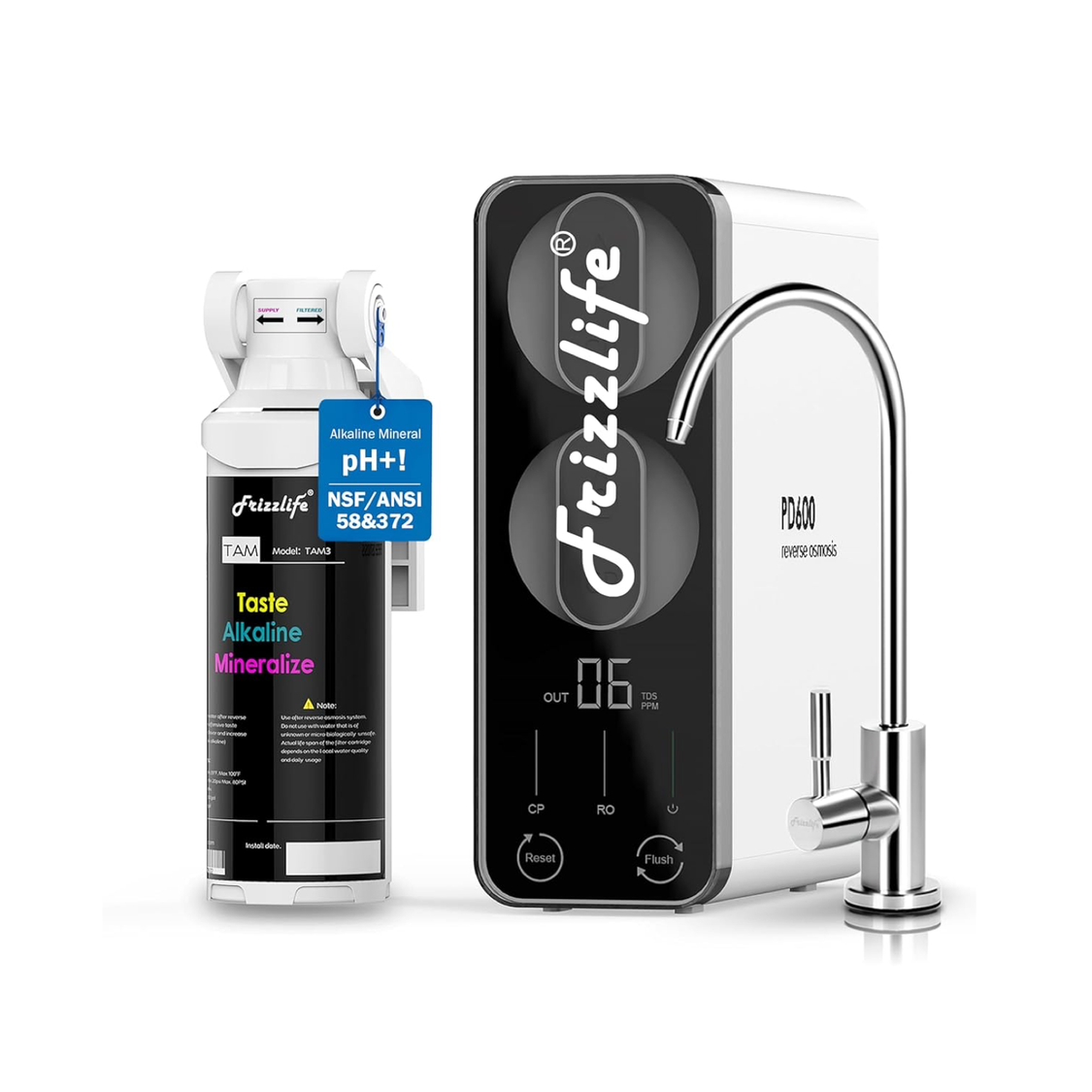
A 600 GPD tankless RO system with alkaline remineralization and real-time outlet TDS monitoring.
View PD600-TAM3 →Portable Alternatives When Under-Sink Installation Is Not Practical
Gravity-Fed Filters
Gravity-fed systems require no plumbing and usually no electricity. They may be practical for renters who need more capacity than a pitcher but still want a portable setup.
Check:
- The exact verified reduction claims
- Filter priming requirements
- Dispensing speed
- Counter or stand space
- Reservoir cleaning requirements
- Replacement element availability
Do not use a gravity filter as a substitute for official boil-water instructions unless local guidance and the system’s verified microbiological performance support that use.
Prime the filter elements exactly as directed, keep the chambers clean, avoid overfilling, and dry the system according to the manual before extended storage.

Water Pitcher Filters
Pitchers are useful for smaller households, dorms, and renters who prioritize low setup effort.
They are generally best for:
- Low-volume drinking water
- Refrigerator storage
- Taste and odor improvement when supported by the cartridge claim
- Easy moving
Their main limitations are smaller capacity, frequent refilling, and slower dispensing. Some cartridges have additional verified reduction claims, but those must be checked for the exact cartridge.
Follow the manufacturer’s gallon or time limit, whichever comes first. Slower flow or a noticeable taste change may also indicate that the cartridge needs attention, but these signs should not replace the stated replacement schedule.

Refrigerator Water Filters
A refrigerator filter is convenient when the apartment already includes a compatible refrigerator water and ice system.
Most buying decisions should focus on:
- The exact replacement cartridge number
- Official certification listings
- Lead or other specific claims when relevant
- Replacement reminders
- Flow and taste changes
- Original versus third-party cartridge compatibility
Original cartridges may provide more predictable fit and documentation. Third-party cartridges may cost less, but their fit and verified performance can differ.
A refrigerator filter should not be assumed to reduce lead, PFAS, fluoride, or another substance unless the exact cartridge has the relevant verified claim.
Delaying replacement may reduce flow and affect taste. Follow the appliance and cartridge instructions rather than relying only on a standard six-month estimate.

Check Your Water Before Choosing a Filter Type
Start with the water problem rather than the product category.
Read the Local Water-Quality Report
If the apartment receives public water in the United States, review the latest Consumer Confidence Report. It can identify the source water, detected regulated contaminants, violations, and utility contact information.
The report reflects the public water system. It may not identify a problem introduced by the building’s service line or internal plumbing.
Use Targeted Testing When Needed
Consider certified laboratory testing when:
- The building has older plumbing
- Lead or another health-related contaminant is suspected
- The water remains discolored
- Taste or odor changes suddenly
- A home test produces an unexpected result
- The property uses a private well
Do Not Use a TDS Meter as a Safety Test
A TDS meter estimates the concentration of dissolved conductive substances. It does not identify which substances are present and cannot determine whether the water is safe.
Use the local report or targeted laboratory testing to identify a specific concern, then choose a filter with a verified claim for that concern.
Need help checking reports, warning signs, household plumbing, and testing options before choosing a filter?
Read the Tap Water Safety GuideCompare Total Ownership Cost, Not Just Purchase Price
The lowest purchase price does not always produce the lowest long-term cost.
Before buying, calculate:
- The system purchase price
- Required adapters or installation parts
- Professional installation when necessary
- The price of each replacement cartridge
- The number of cartridges or stages
- The expected replacement schedule
- Electricity use for powered systems
- Drain water for reverse osmosis
- Replacement filter availability
- Move-out removal or restoration costs
Manufacturer capacity figures are useful for comparison, but actual filter life can change with feed-water quality, sediment level, household use, and cartridge condition.
Plan for Maintenance, Permission, and Moving
Maintenance Planning
- Confirm every replacement cartridge number.
- Check whether different stages use different schedules.
- Calculate one year of estimated replacement costs.
- Confirm whether tools are required.
- Check whether the system needs flushing or sanitizing.
- Make sure replacement filters remain available.
- Leave enough access around the system for maintenance.
Lease-Friendly Installation
- Get written permission when required.
- Avoid cutting existing pipes.
- Use compatible reversible adapters.
- Reuse an existing sink opening only when permitted.
- Keep the shutoff valve accessible.
- Take photos before installation.
- Save all original fittings and hardware.
- Check every connection for leaks.
Moving Checklist
- Shut off the water.
- Disconnect and drain the system.
- Restore the original plumbing.
- Turn the water back on.
- Check carefully for leaks.
- Clean and dry portable components according to the manual.
- Transport or dispose of used cartridges according to the manufacturer’s instructions.
A low-maintenance product is not just one with a long advertised filter life. It must also be easy to access, replace, restore, and support with compatible cartridges.

Final Apartment Filter Decision Checklist
- What does the lease allow?
- Can you use the plumbing, or must the system remain portable?
- What water concern are you trying to address?
- Is that concern supported by a local report or testing?
- Does the exact model have a verified claim for it?
- Is there enough counter, refrigerator, or cabinet space?
- Will the flow and capacity support daily use?
- What will the replacement filters cost each year?
- Can the system be maintained without blocking plumbing access?
- Can it be removed and the apartment restored when you move?
There is no single best tap water filter for every apartment. The best match is the system that fits the water concern, rental rules, available space, daily use, and maintenance tolerance.
When an under-sink installation is practical, compare direct-connect, dedicated-faucet, ultrafiltration, and reverse osmosis options in the Frizzlife Under-Sink Water Filter Collection.
Frequently Asked Questions
1. What Is the Best Tap Water Filter for an Apartment?
The best type depends on the lease, available space, water concern, daily capacity, and maintenance requirements. Portable filters are easier when plumbing changes are prohibited, while a compatible under-sink system may provide more convenient daily use.
2. What Filter Can I Use Without Changing Apartment Plumbing?
Pitchers, gravity-fed systems, refrigerator filters, and many countertop systems require no under-sink plumbing changes. Check whether a countertop unit needs a faucet connection, refillable reservoir, electrical outlet, or drain-water container.
3. Are Countertop Reverse Osmosis Systems Effective?
Countertop RO systems can reduce TDS and selected dissolved substances, but performance varies by model. Verify the exact tested or certified claims, reservoir design, power requirements, processing capacity, drain-water handling, and replacement filters.
4. Do Under-Sink Water Filters Work in Apartments?
They can work well when the cold-water connection is compatible, cabinet space is sufficient, and the lease permits installation. Direct-connect systems may use the existing faucet, while dedicated-faucet and RO systems may require more modifications.
5. Do Water Pitcher Filters Really Work?
Pitchers can improve taste and odor and may provide additional reduction claims depending on the cartridge. They have limited capacity and require frequent refilling, so check the exact certification and replacement schedule.
6. Are Refrigerator Water Filters Enough?
A refrigerator filter may be enough when the main goal is convenient filtered water and ice and the cartridge has suitable claims. Do not assume it reduces lead, PFAS, fluoride, or another substance unless the exact cartridge is verified for that claim.
7. Are Gravity-Fed Water Filters Good for Apartments?
Gravity-fed systems can be useful when portability, no plumbing, and no electricity are priorities. Their flow, capacity, maintenance, and reduction capabilities vary, so review the exact element specifications and verified claims.
8. What Are the Main Disadvantages of an Under-Sink Filter?
An under-sink system uses cabinet space, requires compatible plumbing, may need landlord permission, and must remain accessible for maintenance. Dedicated-faucet and reverse osmosis systems may also require drilling, drain access, electrical power, or more complicated move-out restoration.
9. How Do I Verify a Water Filter Certification?
Find the exact model in the certification organization’s official database and check the specific contaminant-reduction claim. A standard number alone does not mean the model reduces every contaminant covered by that standard.