


A countertop water filtration system for an office can provide filtered drinking water without the installation work required by many under-sink systems or bottleless coolers. It can be especially practical in a private office, small workplace, leased suite, or break room where permanent plumbing changes are restricted.
The main question is not simply whether a countertop filter fits on the counter. It is whether the system can keep up with office demand without creating a constant cycle of waiting, refilling, cleaning, and emptying reject water.
Before choosing an office countertop water filter, evaluate four things: usable water capacity, peak-hour demand, installation requirements, and maintenance responsibility. A system that works well for two people may become frustrating when ten employees try to fill bottles before a meeting.
Decision Snapshot: Is a Countertop System a Good Fit for Your Office?
A strong fit: small teams, leased offices, and spaces without plumbing access
A tank-fed countertop reverse osmosis system is often a strong option when an office:
-
Cannot drill into a countertop or cabinet
-
Cannot add a dedicated faucet or drain connection
-
Has a suitable electrical outlet
-
Has convenient access to a sink for filling and cleaning
-
Has modest, predictable drinking-water demand
-
Can assign someone to refill and maintain the unit
Self-contained countertop RO systems generally use a removable feed-water tank. Users fill the tank with tap water, place it in the machine, and connect the system to power. Because the system does not tap directly into the building’s water line, it may avoid many of the approval and installation issues associated with permanent plumbing.
A conditional fit: shared break rooms with moderate demand
A countertop system can also serve a shared break room, but the fit depends on throughput rather than employee count alone.
For example, six employees who drink mostly coffee made elsewhere may use less filtered water than three employees who repeatedly fill large reusable bottles. Visitors, meetings, tea preparation, and coffee machines can raise demand further.
In a shared space, check whether the system can:
-
Store or produce enough water for busy periods
-
Dispense water without long pauses between users
-
Be refilled without disrupting the break room
-
Fit beside coffee equipment, microwaves, or other appliances
-
Handle reject water conveniently if it uses reverse osmosis
A poor fit: high-volume offices where refilling disrupts use
A manually filled countertop RO system may be the wrong choice for a high-volume workplace. Warning signs include:
-
The feed tank would need to be filled repeatedly throughout the day
-
Employees regularly find the unit empty
-
The system cannot recover quickly enough after several bottle fills
-
No one is clearly responsible for refilling or maintenance
-
Reject water accumulates without being emptied
-
The office needs continuous hot, cold, or high-flow dispensing
In these situations, an under-sink RO system or a higher-capacity bottleless office drinking water system may be more practical.
The four go/no-go factors
Before buying, confirm these four requirements:
-
Capacity: Can the unit meet both total daily use and short periods of heavy demand?
-
Counter space: Is there room for the machine, removable tank, drip tray, and bottle-filling clearance?
-
Power: Does the system need a grounded outlet, and is one safely available?
-
Wastewater handling: If the unit uses RO, where does its reject water go, and who will empty it?
If any of these creates daily friction, a different office water system may be a better investment.
Frizzlife RO Options for Different Office Setups
Once you know whether your office prioritizes portability or continuous water access, compare the installation style and daily workflow of these two RO options.

Frizzlife WB99-C Countertop RO System
A plug-and-play countertop option for offices that want reverse osmosis filtration without permanent under-sink plumbing or drilling.
- No permanent plumbing installation required
- Removable 4.5 L feed-water tank
- Portable pitcher for flexible serving
- Well suited to leased offices and shared workspaces where manual refilling is manageable
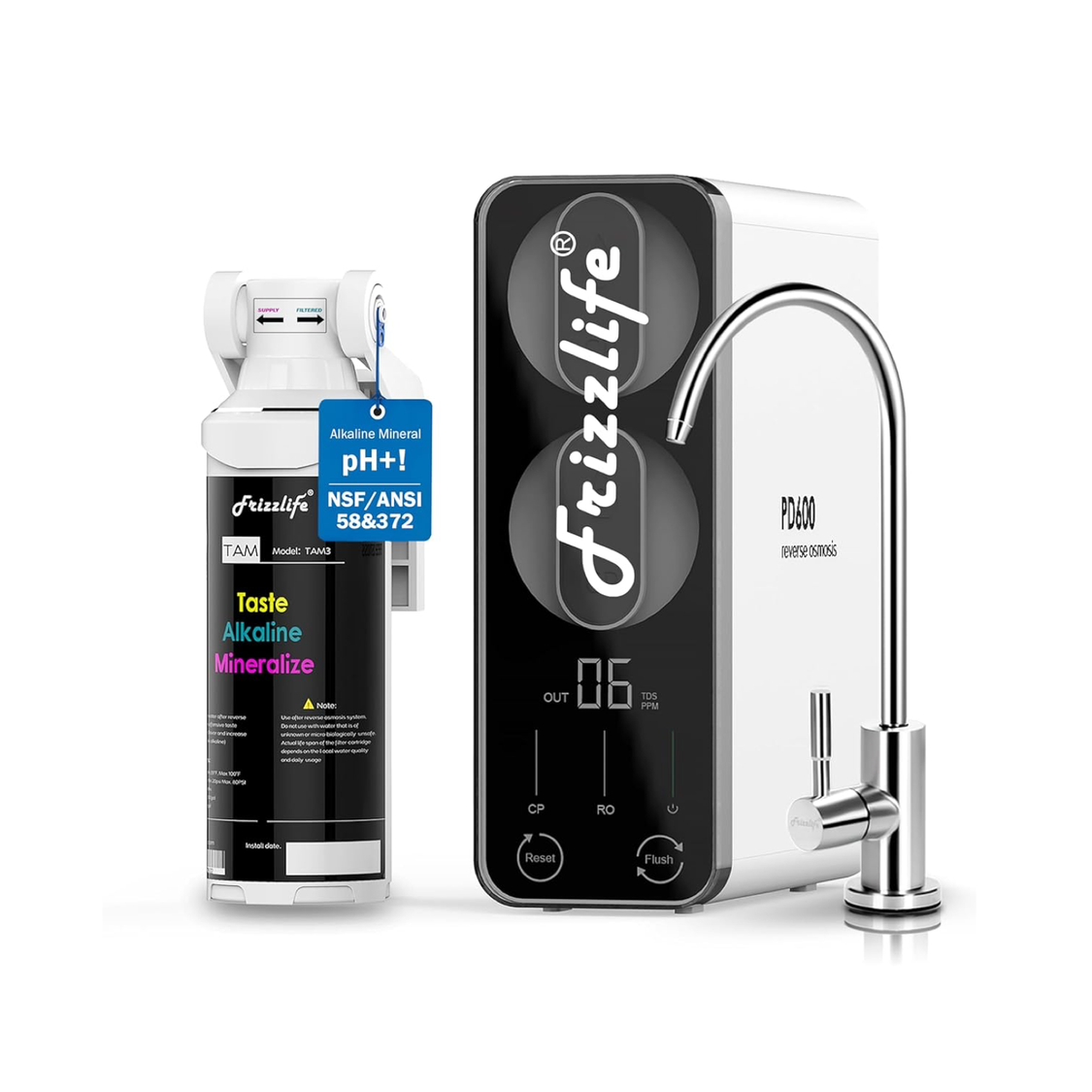
Frizzlife PD600-TAM3 Under-Sink RO System
A tankless under-sink alternative for workplaces where permanent installation is allowed and repeated countertop tank refilling would create unnecessary daily work.
- 600 GPD tankless RO design
- Direct under-sink water connection
- No manual feed-tank refilling during normal use
- Better suited to offices prioritizing continuous water access over portability

Plan for Routine Filter Replacement
Already using a Frizzlife system? Find replacement cartridges by system model so office maintenance can stay on schedule.
Types of Office Countertop Water Filtration Systems
“Countertop water filter” describes several different product categories. Their plumbing, power, capacity, and maintenance requirements are not interchangeable.
Tank-fed countertop RO
A tank-fed countertop RO for office use is typically a powered appliance with a removable raw-water tank. The normal workflow is:
-
Place the unit on a stable counter.
-
Fill the feed tank with an approved water source.
-
Insert the tank correctly.
-
Plug in the machine.
-
Run any initial flushing procedure required by the manual.
-
Dispense filtered water.
Many of these units require no permanent water or drain connection. They are attractive for leased offices because they can often be installed without drilling or modifying the sink.
The trade-off is manual work. Someone must fill the tank, monitor the filtered-water supply, and manage the concentrated reject water according to the model’s design.
Faucet-connected countertop filters
Faucet-connected systems receive water through a diverter attached to the sink faucet. They do not require manual feed-tank refilling, but they are not completely independent of plumbing.
Compatibility depends on:
-
Faucet thread type and size
-
Whether the aerator can be removed
-
Availability of a suitable adapter
-
Water pressure requirements
-
Cold-water access
-
Whether the connected unit blocks normal sink use
Commercial, pull-out, sensor-operated, and nonstandard faucets may not accept common diverter fittings. Confirm compatibility before ordering rather than assuming an adapter will solve every faucet mismatch.
A faucet-fed RO system must receive cold water only. Hot water can damage RO membranes and other components.
Gravity-fed filters and dispensers
Gravity systems use no pump and usually require no electricity. Water passes through filter media under gravity from an upper chamber to a lower reservoir.
Their advantages include simple operation and no outlet requirement. Their limitations may include slower processing, manual refilling, and less predictable availability during busy periods.
A gravity filter may suit a private office or low-demand reception area. It can be less convenient for a break room where several people need water at once.
Countertop water dispensers for an office
A countertop water dispenser for office use may provide filtration, heating, cooling, or a combination of these features. Do not assume that every dispenser provides the same level of filtration.
Heating and cooling functions can affect:
-
Electrical demand
-
Appliance dimensions
-
Heat released into the room
-
Noise from pumps, compressors, or fans
-
Cleaning needs
-
Dispensing speed
-
Required safety precautions
Separate the water-treatment question from the temperature question. First verify what the filter is designed and tested to reduce. Then decide whether instant hot or chilled water is worth the additional space, energy use, and complexity.
Comparison of countertop system types

|
System type |
Permanent plumbing |
Power |
Manual refilling |
RO reject water |
Typical office fit |
|
Tank-fed countertop RO |
Usually no |
Usually yes |
Yes |
Yes; handling varies by model |
Private offices, small teams, leased spaces |
|
Faucet-connected countertop RO |
Temporary faucet connection |
Model-dependent |
No feed tank in many designs |
Yes; discharge method varies |
Offices with compatible sink faucets |
|
Faucet-connected carbon filter |
Temporary faucet connection |
Often no |
Usually no |
Generally no RO reject stream |
Offices seeking model-verified carbon filtration |
|
Gravity-fed filter |
No |
No |
Yes |
No RO reject stream |
Low-demand offices and reception areas |
|
Heated or cooled countertop dispenser |
Model-dependent |
Usually yes |
Model-dependent |
Depends on filtration method |
Offices prioritizing temperature options |
Countertop RO versus carbon filtration
Reverse osmosis and carbon filtration should not be treated as equivalent.
RO systems use a semipermeable membrane as part of the treatment process and create a concentrated reject-water stream. Carbon filters rely primarily on adsorption and do not normally produce RO reject water. Some products combine sediment, carbon, and membrane stages.
Performance remains model-specific. Review the product’s performance data, testing, and certifications rather than assuming that every RO or carbon system reduces the same substances. “Tested,” “certified,” and “designed to reduce” are not interchangeable claims.
Does a Countertop RO System Require Plumbing?
Many tank-fed countertop RO systems require no permanent plumbing. They use a removable feed tank and internal pump, so installation may require only counter space, an approved water source, and an electrical outlet.
However, not every countertop RO system is plumbing-free.
Why many tank-fed systems need no water or drain connection
In a self-contained system, users manually add tap water to the feed tank. The appliance processes that water internally and stores or dispenses the filtered output.
Because the unit is not connected to the building’s supply line, it does not depend on normal faucet pressure in the same way as a faucet-fed system. It may also avoid the need for:
-
A feed-water valve
-
A dedicated drinking-water faucet
-
A cabinet hole
-
A drain saddle
-
Permanent tubing under the sink
RO still separates part of the incoming water into a concentrated stream. Depending on the model, that water may remain in a removable reservoir or be handled through another self-contained method. Follow the manual when emptying it; do not assume every countertop RO manages reject water identically.
When a faucet diverter or adapter is required
Faucet-connected countertop systems attach to a sink after the faucet aerator is removed. These systems may need a diverter valve and thread adapter.
Before buying, inspect the office faucet and verify:
-
The aerator is removable
-
The threads match the supplied fitting or an approved adapter
-
The faucet can provide cold water
-
Building water pressure falls within the model’s specified range
-
The connection will not interfere with essential sink use
Some faucet-fed RO manuals specify a pressure range, but the acceptable range is model-dependent. Do not apply one product’s pressure requirement to another.
Installation-free versus plumbing-free
These terms are often used loosely.
-
No permanent installation may mean the system attaches temporarily to a faucet.
-
Plumbing-free generally means it does not connect to a water line or faucet.
-
Plug-and-play usually indicates a simple setup, but the unit may still need initial flushing, filter installation, or tank preparation.
Read the actual installation instructions instead of relying only on a marketing label.
What to verify in a leased or commercial office
Even if a unit needs no permanent plumbing, verify:
-
Lease or building rules for countertop appliances
-
Electrical requirements
-
Approved feed-water source
-
Commercial-use or warranty terms
-
Cleaning and sanitation procedures
-
Any applicable workplace or building policies
-
Whether a faucet connection is permitted in a shared sink
A portable appliance can be easier to approve than a plumbed system, but “portable” does not automatically mean it is approved for every commercial environment.
How Much Filtered Water Does an Office Need per Day?
There is no reliable universal number for office water demand. Employee count is a useful starting point, but actual drinking habits are more important.
Estimate demand from real workplace behavior
Include filtered water used for:
-
Direct drinking
-
Reusable bottle filling
-
Coffee and tea
-
Conference-room service
-
Visitors and clients
-
Employee meals
-
Reception or waiting areas
The most accurate method is to measure current use over several normal workdays. If the office currently uses bottled water, count the bottles or containers consumed. If employees use a sink dispenser, track approximate fills rather than relying on memory.
Season, workplace attendance, and remote-work schedules can all affect demand.
Daily office demand formula
Use this planning formula:
Daily filtered-water demand = number of users × average filtered-water use per user
Then add water used for shared purposes:
Total demand = employee drinking water + coffee and tea + meetings + visitor use
For example, suppose an office uses a planning estimate of 0.5 gallon per person and has six regular users:
6 users × 0.5 gallon = 3 gallons per day
If coffee, meetings, and visitors add another gallon, estimated total demand becomes 4 gallons. These numbers are only an example; substitute measured consumption from your workplace.
Add a peak-hour buffer
Daily capacity alone can hide an important problem. Employees often use water at the same times:
-
At the start of the workday
-
Before meetings
-
During lunch
-
After exercise or commuting
-
Near the end of the day when bottles are refilled
A system might produce enough water over 24 hours but still leave users waiting at 9:00 a.m. Evaluate both total output and the amount ready to dispense at once.
A practical buffer allows several users to fill cups or bottles without exhausting the available filtered supply.
Production rate versus ready-to-dispense capacity
These specifications answer different questions:
-
Production rate describes how much filtered water a system can process under specified conditions.
-
Feed-tank volume is the amount of raw water the removable tank holds.
-
Filtered output per fill is the usable treated water obtained from one feed-tank cycle.
-
Ready-to-dispense capacity is the water immediately available before the system must process more.

A gallons-per-day rating does not mean that amount is stored and ready at one time. It also does not eliminate manual refilling. A high theoretical production rate can still be inconvenient if the feed tank is small or the unit pauses to process water.
Capacity planning by office type
Solo office: A countertop filter is often manageable when one person can refill it as needed and consumption is predictable.
Small team: Compare measured daily use with usable output per feed-tank fill. Also check whether several people tend to fill bottles at the same time.
Shared office or break room: Focus on peak-hour availability, refill ownership, dispensing speed, and recovery time. A system that technically meets daily demand may still create queues.
Signs that demand has outgrown the system
Consider a higher-capacity or plumbed alternative when:
-
The tank is empty several times per day
-
Users routinely wait for processing
-
Employees avoid the system because it is frequently unavailable
-
Coffee preparation consumes most of the stored water
-
Refilling and reject-water disposal are regularly neglected
-
The office needs continuous service during meetings or customer hours
How Often Will an Office Countertop RO Need Refilling?
Refill frequency depends on actual demand and usable filtered output per feed-tank fill—not feed-tank size alone.
Use this formula:
Estimated refills per day = daily filtered-water demand ÷ usable filtered output per feed-tank fill
Always round up for planning. If the calculation produces 2.3 fills, the office should expect at least three filling cycles under similar conditions.
Feed-tank volume is not the same as filtered output
An RO system does not convert every unit of feed water into filtered drinking water. Some water carries concentrated dissolved material away from the membrane.
For that reason, a feed tank holding a certain volume does not necessarily produce the same volume of dispensed water. The relationship depends on the specific system, operating conditions, and design.
Look for model documentation covering:
-
Feed-tank capacity
-
Usable filtered output
-
Pure-to-drain or recovery information, if provided
-
How and when reject water must be emptied
-
Whether the unit stops before the feed tank is completely empty
Do not estimate refill frequency from the raw tank volume alone.
Peak use may matter more than the daily average
A system may need only two full feed tanks over a day but still run short during a morning rush. If multiple employees fill large bottles within a few minutes, ready capacity and processing time become the limiting factors.
Observe when water is used, not just how much is used.
Assign refill and reject-water responsibility
Shared ownership often becomes no ownership. Assign one person or a rotating schedule for:
-
Refilling the feed tank
-
Emptying reject water
-
Wiping the dispensing area
-
Cleaning the drip tray
-
Checking filter alerts
-
Recording filter changes
A simple opening or closing checklist can prevent employees from finding an empty or poorly maintained unit.
Reduce refill friction
Position the system close enough to a sink that the removable tank can be carried safely, but not so close that it blocks the faucet or dishwashing area.
A workable routine might include:
-
Filling the feed tank at the beginning of the day
-
Checking it before lunch or meetings
-
Emptying reject water as directed
-
Wiping spills immediately
-
Leaving the unit ready for the next workday
If this routine requires repeated interruptions, the office may be better served by a plumbed system.
Office Placement and Compatibility Checklist
Countertop dimensions alone do not show whether a system will fit. Measure the full operating space.

Measure footprint and access
Allow room for:
-
The appliance body
-
Feed-tank removal
-
Filter access
-
Drip-tray removal
-
Power cord routing
-
Bottle or carafe placement
-
Ventilation required by the manual
Check vertical clearance beneath cabinets. Some tanks lift upward, so a unit can fit physically while still being impossible to refill or service in place.
Confirm safe power access
Powered countertop RO systems generally require a suitable grounded electrical outlet. Avoid unsafe extension-cord arrangements or locations where the plug could be exposed to spills.
If the dispenser heats or cools water, check its electrical specifications separately. Temperature-control features may have different power requirements from filtration-only models.
Plan the sink and reject-water workflow
The office should have a practical route for:
-
Removing the feed tank
-
Carrying it to the sink
-
Filling it to the specified line
-
Returning it without spilling
-
Emptying reject water as directed
-
Washing removable parts
A distant sink can make a technically plumbing-free unit operationally inconvenient.
Consider noise, heat, and processing time
Powered RO systems may use pumps, fans, heating elements, or cooling components. The amount of sound and heat varies by model.
Avoid placing a powered dispenser:
-
In a quiet conference room without reviewing noise expectations
-
Beside temperature-sensitive equipment
-
In an enclosed cabinet unless the manufacturer permits it
-
On an unstable cart or narrow shelf
-
Near the edge of a counter
Pre-purchase checklist
Before selecting an office countertop water filter, confirm:
-
Counter width and depth
-
Cabinet and tank-removal clearance
-
Space for bottles and cups under the dispenser
-
Grounded outlet availability
-
Required ventilation
-
Sink proximity
-
Faucet compatibility, if applicable
-
Approved cold-water source
-
Reject-water disposal method
-
Expected daily and peak demand
-
Assigned refill and maintenance responsibility
-
Commercial-use and warranty conditions
Maintenance for an Office Countertop Water Filter
Office maintenance is not necessarily difficult, but it must be assigned and documented. A neglected filter system can develop dirty tanks, overflowing drip trays, expired cartridges, or persistent alerts.

Follow model-specific filter instructions
Countertop RO systems may include sediment, carbon, and RO membrane components. Each cartridge can have a different replacement trigger or schedule.
Use the product manual and filter-life indicators rather than a generic online timetable. Actual service needs can depend on:
-
Water usage
-
Feed-water quality
-
Cartridge capacity
-
Time in service
-
Office demand
-
Manufacturer instructions
Do not extend filter use simply because the water still tastes normal. Taste alone does not confirm filter condition.
Flush at first use and after filter changes
Many systems require an initial flushing process to remove trapped air or loose filter media. Some also direct users to discard the first full tank of filtered water.
Repeat the prescribed flushing procedure after cartridge replacement when required. The correct volume and sequence are model-specific, so follow the manual rather than improvising.
Clean tanks, reservoirs, and dispensing surfaces
Include these areas in the office cleaning plan:
-
Removable feed-water tank
-
Filtered-water reservoir, if accessible and approved for cleaning
-
Tank lid and seals
-
Dispensing nozzle area
-
Drip tray
-
Exterior controls
-
Reusable office carafes
Use only cleaning methods and materials permitted by the manufacturer. Avoid touching the dispensing outlet with bottle rims or hands.
Manage long office closures
Water should not be left sitting indefinitely during holidays, seasonal shutdowns, or extended remote-work periods. Before a closure, follow the manufacturer’s storage or shutdown instructions. When the office reopens, complete any required draining, cleaning, flushing, or sanitizing steps before normal use.
Keep maintenance records and supplies accessible
A simple log should include:
-
Installation date
-
Filter replacement dates
-
Cleaning dates
-
Alert or error history
-
Replacement cartridge inventory
-
Person responsible
Keep the correct replacement filters on hand where practical. Waiting until a cartridge is exhausted can create avoidable downtime.
Common office maintenance mistakes
The most frequent operational problems are preventable:
-
Assuming someone else will refill the tank
-
Ignoring filter-change indicators
-
Letting reject water remain in the system
-
Cleaning the exterior but not removable water-contact parts
-
Failing to flush after installation or cartridge replacement
-
Using an unapproved water source
-
Leaving water stagnant during long closures
-
Buying replacement cartridges without confirming model compatibility
Also verify whether commercial use affects the warranty or service terms. Product requirements designed for residential use should not automatically be assumed to apply unchanged in a high-use workplace.
Countertop RO Versus Other Office Drinking Water Systems
The right choice depends on installation freedom, demand, available space, and how much ongoing handling the office will accept.
Countertop RO versus under-sink RO
A countertop RO system emphasizes portability and minimal installation. An under-sink RO system emphasizes direct water supply and reduced manual refilling.
|
Decision factor |
Countertop RO |
Under-sink RO |
|
Permanent plumbing |
Often unnecessary for tank-fed models |
Usually required |
|
Manual feed-tank refilling |
Yes for tank-fed models |
No |
|
Counter space |
Required |
Main system is below the sink |
|
Sink-cabinet access |
Usually unnecessary |
Required |
|
Dedicated faucet or faucet connection |
Model-dependent |
Commonly required |
|
Drain connection |
Often self-contained on tank-fed models |
Commonly required |
|
Best fit |
Leased spaces and small offices |
Higher regular demand with approved plumbing |
Under-sink installation commonly involves the cold-water line, a drinking-water faucet, and a drain connection. That may be worthwhile for a busy office, but it is more invasive.
Countertop RO versus bottleless coolers
A bottleless cooler can be better suited to sustained shared use and may provide hot and cold water. However, it generally requires a direct water connection and more installation planning.
Countertop RO is more compact and may avoid plumbing, but the office accepts feed-tank refilling and potentially lower ready-to-dispense capacity.
Countertop RO versus bottled-water delivery
Bottled delivery avoids filter changes inside the office but introduces bottle storage, delivery scheduling, lifting, and empty-container management.
Countertop RO filters water on-site and can reduce reliance on stored bottles. Its trade-offs are appliance maintenance, filter replacement, electricity use, refilling, and reject-water handling.
Countertop RO versus gravity filters
Gravity filters are simpler and do not usually need power. They may also be quieter. Countertop RO systems use powered processing and may offer different treatment capabilities, but they require more operational attention.
Choose according to verified model performance and office workflow—not the assumption that one filtration category is universally preferable.
After confirming that the office can accommodate the required space, power, refilling, and wastewater workflow, you can compare Frizzlife countertop reverse osmosis systems by their verified model specifications.
Is a Countertop RO System Good for an Office?
For a small team or leased workplace, a self-contained countertop RO system can provide a convenient office drinking-water setup without permanent plumbing. For a busy break room, repeated refilling and limited ready capacity may outweigh that convenience. Choose by measured office demand and verified product specifications—not an unconfirmed claim about how many employees a system can serve.