


Reverse osmosis does not inherently need electricity. The RO membrane works when water pressure pushes feed water through a semipermeable membrane. However, a home system may use electricity to operate a booster pump, UV lamp, electronic valve, sensor, display, or other powered component.
That distinction explains why RO electricity consumption varies so widely. A basic pressure-driven, tank-based system may use no electricity, while a pump-assisted or tankless system usually requires an outlet and draws power during water production. Actual energy use depends on the model’s wattage, runtime, household water demand, incoming pressure, and standby behavior.
This guide explains how to estimate reverse osmosis electricity consumption, compare tank-based and tankless designs, troubleshoot unexpectedly high usage, and decide how much power dependence should matter when choosing a home RO system.
RO Electricity Consumption: What Homeowners Need to Know
Does a reverse osmosis system use a lot of electricity?
Most residential RO systems that require power do not consume electricity on the scale of major household appliances. Their electrical components are generally much smaller, and pumps often run only while the system is producing water.
Still, there is no universal figure for RO system power consumption. The correct answer depends on the system design:
-
A basic tank-based RO system without a pump, UV stage, or electronics may consume zero electricity.
-
A pump-assisted system draws power when its booster pump operates.
-
A UV-equipped system uses electricity for the UV lamp and possibly its controller.
-
A tankless RO system typically uses a pump, sensors, valves, and controls during on-demand production.
-
A system with displays or monitoring may have a small standby load even when it is not actively filtering.
Reported ranges for residential booster pumps are often around 20–40 watts, while some tankless RO pumps are reported in the 25–45-watt range. UV lamps in residential water-treatment equipment may be approximately 5–11 watts. These are general component-level ranges, not specifications for every system. Always use the label or manual for the model being evaluated.
Runtime matters as much as wattage. A 40-watt pump running intermittently can consume less energy over a month than a lower-wattage device that operates continuously.
Does an RO system draw power all the time?
No. Many powered RO systems draw their highest wattage only while producing filtered water or refilling a storage tank.
A pump-assisted tank-based system may start when tank pressure falls and stop when the tank reaches its shutoff condition. A tankless system usually activates when the faucet is opened and may continue briefly according to its programmed operating cycle. The exact behavior depends on the model.
There are three possible power states to consider:
-
Active filtration: The pump, valves, display, and controls may be operating.
-
Standby: Filtration has stopped, but sensors, indicators, or control boards may remain energized.
-
Fully off: A mechanical, non-electric system draws no power, or a powered system has been disconnected.
A product’s rated wattage usually describes active or maximum power draw. It does not necessarily mean the system consumes that amount 24 hours a day. To understand actual RO system energy usage, you need both the wattage and the number of hours the powered components run.
Unexpected continuous pump noise is not normal operating behavior for many residential systems. If a unit appears to be producing water constantly when no filtered water is being used, check for leaks, low pressure, a shutoff problem, or another model-specific fault.
Which RO components use electricity: booster pumps, UV lamps, sensors, and displays
The membrane itself is not an electrical component. Electrical demand comes from equipment added to create pressure, provide an additional treatment stage, or manage system operation.
Booster pumps
A booster pump raises feed-water pressure before water reaches the membrane. It may be integrated into a tankless unit or added to a tank-based system where incoming pressure is insufficient or variable. The pump is often the largest electrical load in a residential RO system.
UV lamps
An ultraviolet treatment stage requires electricity to energize its lamp. Depending on the design, the lamp may operate continuously or according to a model-specific control cycle. Because operating patterns differ, do not estimate UV energy use from wattage alone.
Electronic valves and controls
Powered solenoid valves can regulate feed water, flushing, production, and shutoff. Their individual loads may be small, but they are part of the system’s total energy use.
Sensors and displays
Some systems monitor filter status, water quality indicators, leaks, flow, or operating conditions. Displays and control boards may draw a small amount of standby power between filtration cycles.
Other powered accessories
A system may include additional features that require electricity. Check whether the published wattage covers the entire unit or only one component.
RO electricity consumption by system type
The following table provides practical decision support. It describes typical design behavior, not a guarantee for every model.
|
RO system type |
Main pressure source |
Typical electrical demand |
When power is used |
Practical considerations
|
|---|---|---|---|---|
|
Pressure-driven tank-based RO |
Household water pressure |
None if there is no pump, UV stage, or electronics |
No electrical runtime |
Does not need an outlet, but production rate and tank recovery depend on incoming pressure |
|
Pump-assisted tank-based RO |
Household pressure plus an electric booster pump |
Pump power, and possibly controls |
Usually while making water or refilling the tank |
Can support operation where pressure is insufficient, but becomes dependent on electricity for pumped production |
|
UV-equipped RO |
Household pressure or a pump, plus a UV lamp |
UV lamp and controller; possibly a booster pump |
Lamp behavior varies by model |
Adds an electrical treatment component and requires attention to outage instructions |
|
Tankless RO |
Usually an integrated pump with electronic controls |
Pump, valves, sensors, display, and standby electronics |
Primarily during on-demand production, with possible standby use |
Compact and designed for direct delivery, but generally requires an outlet and cannot provide normal powered filtration during an outage |
The labels “tank-based” and “tankless” do not reveal every electrical detail. A tank-based system can have a booster pump, while a tankless system’s wattage and standby behavior can vary by model. Compare the actual electrical specifications rather than assuming every system in a category behaves identically.
If RO electricity consumption seems unusually high, check runtime, water pressure, leaks, and pump cycling
A residential RO system’s energy use can rise when the pump runs longer or more often than expected. If electricity consumption, pump noise, or runtime changes suddenly, inspect the operating conditions before assuming that the rated wattage is the problem.
Start with these checks:
-
Confirm whether water demand has increased. More drinking, cooking, ice making, or connection to another appliance means more production.
-
Listen for continuous operation. A pump that rarely stops may indicate a leak, low inlet pressure, or a shutoff issue.
-
Inspect visible tubing and connections. Even a small downstream leak can repeatedly trigger water production.
-
Check the filtered-water faucet. A faucet that does not close completely can keep the system active.
-
Review incoming water pressure. Low or unstable pressure can extend production time and increase pump runtime.
-
Look for frequent starts and stops. Short cycling may point to pressure changes, storage-tank conditions, sensor behavior, or another model-specific problem.
-
Check filter status. Restricted prefilters can reduce flow into the membrane and change how long the pump runs.
-
Consult the troubleshooting instructions. Flush cycles, delayed shutoff, and standby behavior vary by system.
If the cause remains unclear, use a plug-in electricity meter to monitor the complete system for several typical days. Include active filtration, standby periods, and any automatic flushing cycles, then compare the observed behavior with the model manual.
Do not open powered equipment or modify electrical controls unless the manufacturer’s instructions specifically permit it. Disconnect power and water as directed before performing user-serviceable maintenance.
How to Calculate RO System Energy Usage and Electricity Cost
Power draw vs. energy use: watts, watt-hours, and kWh per day are not interchangeable
Watts and kilowatt-hours measure different things.
-
Watts (W) measure power draw at a particular moment.
-
Watt-hours (Wh) measure energy consumed over time.
-
Kilowatt-hours (kWh) are the units commonly used on residential electricity bills.
-
1 kWh equals 1,000 Wh.
A 40-watt pump does not automatically consume 40 watt-hours per day. It consumes 40 watt-hours only if it operates for one full hour. If it runs for 15 minutes, it uses approximately 10 Wh, excluding other system components.
This distinction prevents a common estimating error: treating a system’s rated wattage as if it were continuous daily energy consumption.
How to calculate daily and monthly RO electricity consumption
Use this formula:
Daily kWh = Total operating watts × operating hours per day ÷ 1,000
Then calculate monthly use:
Monthly kWh = Daily kWh × number of days in the billing period
For an illustrative example, assume an RO system draws 40 watts during active production and operates for a combined one hour per day:
-
40 W × 1 hour = 40 Wh per day
-
40 Wh ÷ 1,000 = 0.04 kWh per day
-
0.04 kWh × 30 days = 1.2 kWh per month
This example is not a specification for a particular product. A household’s actual result may be lower or higher because the system may have a different power draw, runtime, standby load, UV operating schedule, or flushing behavior.
If the system has several separately rated components, estimate each one:
Pump kWh + UV kWh + standby/control kWh = estimated total kWh
For example, a UV lamp that remains on continuously must be calculated using 24 hours per day, while an intermittent pump should be calculated using only its estimated active runtime.
How to estimate operating cost using your local electricity rate
Once monthly kWh is known, multiply it by the electricity rate shown on the utility bill:
Monthly electricity cost = Monthly kWh × local cost per kWh
Using the illustrative 1.2 kWh-per-month calculation and a hypothetical electricity price of $0.18 per kWh:
1.2 kWh × $0.18 = $0.216 per month
Rounded, that would be about $0.22 per month under those assumptions. Changing the runtime, wattage, or utility rate changes the result.
When reading the utility bill, use the effective rate that best reflects what the provider charges for added consumption. Depending on the utility, the bill may separate generation, delivery, taxes, and tiered rates.
Where to find pump, UV lamp, and system wattage information
Check the following sources in order:
-
The system’s electrical label or nameplate
-
The power adapter label
-
The pump or UV component label
-
The product manual
-
The manufacturer’s official specifications
-
Technical support for the exact model and version
Pay attention to whether the label shows watts directly or lists voltage and current. If only voltage and current are shown, multiplying them can provide a rough apparent-power figure, but that may not equal exact real-world energy use for every electrical design. A plug-in electricity meter is more useful when an accurate household measurement is needed.
Also verify what the published number represents. It may be:
-
Maximum system wattage
-
Normal active draw
-
Pump-only wattage
-
Adapter capacity
-
UV lamp wattage
-
Standby draw
These values should not be treated as interchangeable.
Why rated wattage alone does not reveal actual energy consumption
Two systems with the same rated wattage can have very different monthly electricity consumption.
One may produce water efficiently and run for 20 minutes a day. Another may run for several hours because of higher demand, lower pressure, restricted flow, or a continuous UV stage. Their maximum wattage may match, but their monthly kWh will not.
Rated wattage also may represent a maximum rather than a constant draw. Pump speed, flushing cycles, standby electronics, and electronic valve activity can change power use throughout an operating cycle.
For the most useful comparison, evaluate:
-
Active wattage
-
Estimated production runtime
-
Standby wattage
-
UV operating schedule, if applicable
-
Household filtered-water demand
-
Incoming pressure
-
System efficiency and flushing behavior
-
Whether the wattage applies to the complete system
How System Design Affects Reverse Osmosis Electricity Consumption
How pressure-driven tank-based RO systems can operate without electricity
A traditional non-electric under-sink RO system uses household water pressure to move water through its prefilters and RO membrane. Filtered water is collected in a pressurized storage tank and delivered through a separate faucet.
If the unit has no booster pump, UV lamp, powered valve, or electronic monitor, it does not need an electrical outlet. Its production rate still depends on adequate feed pressure, water temperature, filter condition, membrane condition, and storage-tank backpressure.
The storage tank changes how the system operates. Instead of making all water at the moment the faucet opens, the system gradually refills the tank after water is used. This can reduce the need for a high instantaneous production rate, allowing many systems to rely on line pressure alone.
When a tank-based RO system still needs an electric booster pump
A storage tank does not guarantee non-electric operation. Some tank-based systems include or require a booster pump to compensate for insufficient or inconsistent feed pressure.
A pump may be appropriate when:
-
Incoming pressure is below the system’s specified operating needs.
-
Pressure varies enough to affect production.
-
The water source uses equipment that creates changing pressure conditions.
-
The selected membrane and system design are intended to operate with powered pressure assistance.
-
Faster tank recovery is needed and supported by the system design.
The decision should be based on measured pressure and the model’s published requirements, not on a generic pressure threshold. Pressure can also change during the day or when other fixtures operate, so a single reading may not show the full pattern.
Homeowners who want a compact installation but prefer the possibility of pressure-driven operation can review the design details of available under-sink reverse osmosis systems. Confirm outlet requirements, pressure specifications, and included components for the individual model before choosing.
Why tankless RO power consumption behaves differently from tank-based systems
A tankless RO system produces filtered water on demand rather than slowly accumulating it in a conventional storage tank. To deliver useful flow directly from the faucet, these systems commonly use an integrated booster pump and electronic controls.
As a result, tankless RO electricity usage tends to follow faucet activity:
-
The faucet opens.
-
Sensors detect flow or pressure changes.
-
The pump and electronic valves activate.
-
Water passes through the filtration stages and membrane.
-
The system stops or completes a programmed cycle after the faucet closes.
Some models may also perform automatic flushing or maintain powered monitoring in standby. These behaviors are model-specific and can affect total kWh.
Tankless operation should not be confused with constant power draw. The system may require a permanent electrical connection while still using its main operating power only intermittently. A small standby load, where present, is different from active pump consumption.
Do tankless RO systems use more electricity than tank-based systems?

Tankless RO systems generally use more electricity than a basic non-electric tank-based system because zero consumption is lower than any powered operation. However, that comparison does not mean every tankless system has high energy use.
A more useful comparison separates three cases:
-
Non-electric tank-based vs. tankless: The tank-based system has no electrical demand, while the tankless system typically does.
-
Pump-assisted tank-based vs. tankless: Both use electricity, so actual kWh depends on pump wattage, runtime, demand, pressure, controls, and standby behavior.
-
UV-equipped systems: A UV stage can add electrical consumption regardless of whether the RO design uses a tank.
Tankless designs trade some power dependence for direct production, compact installation, and model-specific convenience features. Whether that trade-off is worthwhile depends more on installation needs and preferred water delivery than on category labels alone.
When comparing tankless reverse osmosis system options, check the exact model’s electrical input, outlet needs, pressure range, standby behavior, and outage limitations.
Electricity requirements vary by system design. Compare two under-sink RO options or find replacement filters for your existing Frizzlife system.
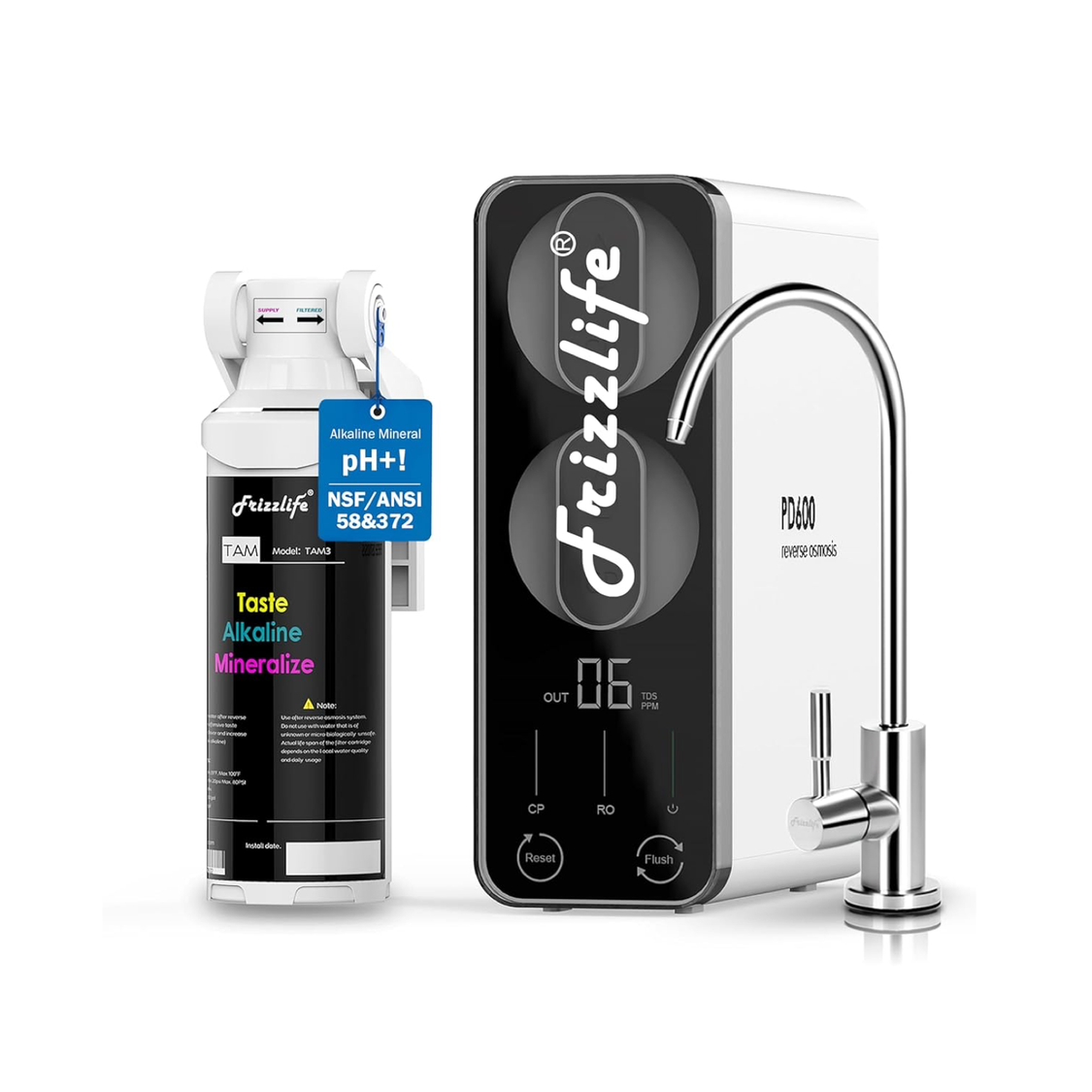 Tankless RO
600 GPD tankless reverse osmosis system with alkaline remineralization and real-time TDS monitoring.
View PD600-TAM3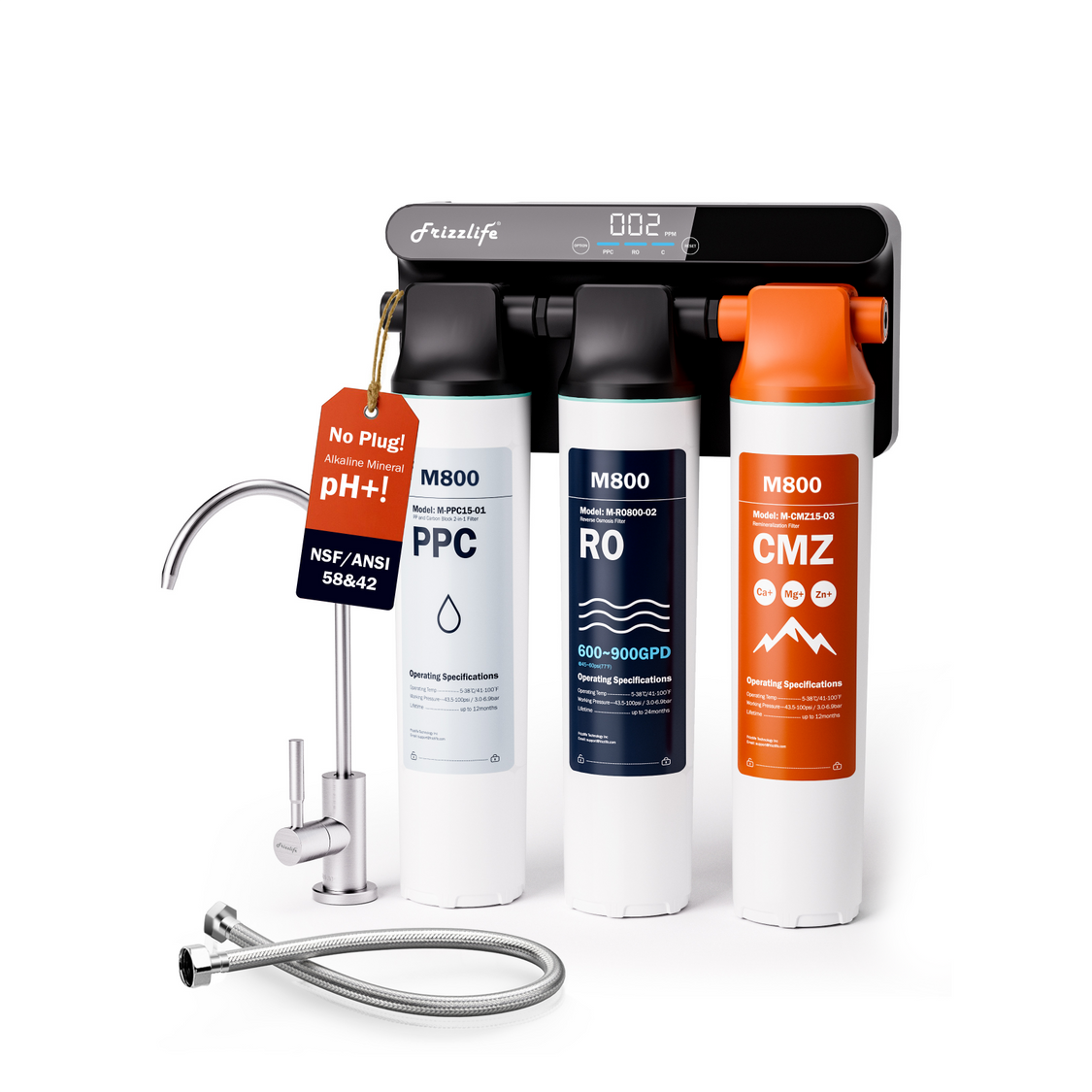 Non-Electric Tankless RO
Non-electric tankless reverse osmosis system designed for users who want RO filtration without relying on an electrical outlet.
View M800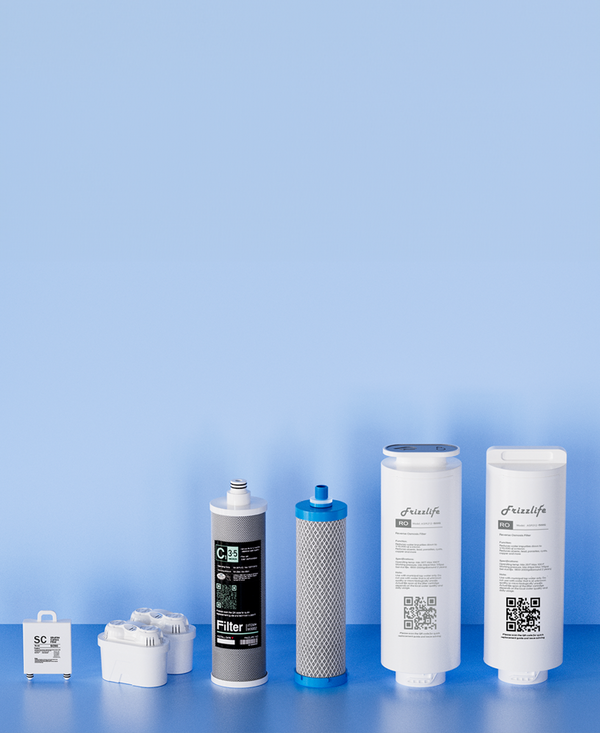 Maintenance
Find compatible replacement filters and cartridges for Frizzlife RO and water filtration systems.
Find Replacement FiltersHow UV treatment and smart features change RO system power consumption
UV treatment and smart controls should be evaluated separately from the pump.
A UV lamp can create a predictable additional load, but its energy use depends on whether it remains energized continuously or cycles according to the system design. Smart indicators and monitoring electronics may consume little power individually, yet they can remain active longer than the pump.
These features can offer operational information or provide functions required by a particular system design. Their value should be weighed against:
-
The need for a nearby outlet
-
Added standby or continuous electricity use
-
Replacement and maintenance requirements
-
Operation during outages
-
Dependence on electronic controls
-
Model-specific instructions if a powered stage is unavailable
Never assume that water can safely bypass a required UV or electronic treatment stage during a power loss. Follow the instructions for the exact system.
How Much Should Electricity Matter When Choosing an RO System?
For most households, electricity cost is only one selection factor. Outlet access and outage operation may be more important than the amount added to the utility bill.
Check outlet access, incoming pressure, expected water use, and power-outage priorities
Before choosing a system, answer four practical questions:
-
Is there a suitable electrical outlet near the installation location?
-
Does measured incoming pressure meet the model’s requirements?
-
How much filtered water will the household use on a typical day?
-
Must the system continue supplying or producing water during an outage?
Also consider storage space, desired faucet flow, installation requirements, filter access, and the manufacturer’s maintenance instructions.
Compare verified model specifications instead of relying on generic wattage claims
When comparing reverse osmosis filter systems, use the checklist below to separate non-electric designs from models with pumps, UV stages, or standby electronics.
Generic online estimates cannot replace model-specific data. Before purchasing, verify:
-
Whether electricity is required
-
Input voltage and rated power
-
Whether wattage covers the pump or the complete system
-
Standby power, if published
-
Pressure requirements
-
Presence of UV or other continuously powered stages
-
Storage capacity, if applicable
-
Outage behavior
-
Recommended operating and maintenance procedures
If a listing does not make these points clear, consult the official documentation for the exact model.
Can a Reverse Osmosis System Work During a Power Outage?
The answer depends on whether the system relies on electrical components and whether household water pressure remains available.
What happens to a non-electric tank-based RO system during an outage
A fully mechanical tank-based RO system can potentially continue producing water without household electricity because it uses line pressure rather than an electric pump.
That does not guarantee normal operation in every outage. If household water comes from an electrically powered well pump or building pressure system, feed pressure may fall or stop. Municipal water pressure can also be affected by local conditions.
What happens to tankless, pump-assisted, or electronically controlled RO systems
A system that relies on a booster pump generally cannot provide normal powered filtration when electricity is unavailable. Tankless models may stop producing water because their pumps, sensors, and valves require power.
The same concern applies to UV-equipped systems. Even if water can move through part of the system, a required UV stage cannot operate without electricity. Do not assume partial flow is equivalent to normal treated-water operation.
Whether stored RO water remains available when power is unavailable
A tank-based system may still dispense water already stored in its pressurized tank, even if an electric booster pump cannot run. How much remains available depends on the tank and system conditions at the start of the outage.
Once stored water is depleted, a pump-dependent system may be unable to replenish it until power returns. A pressure-driven system may continue refilling only if feed-water pressure remains adequate.
Why household water pressure still matters during an outage
“Non-electric” describes the RO unit, not necessarily the home’s water supply. A private well commonly depends on electrical pumping, and some buildings use powered pressure equipment. If that upstream equipment stops, a mechanical RO system cannot produce water without feed pressure.
Outage planning should therefore consider both the RO system and the source of household water pressure.
Check model instructions before relying on bypass or partial operation
Do not improvise a bypass around pumps, UV equipment, sensors, or electronic valves. A bypass could change treatment performance, create leaks, or violate operating instructions.
Review the manual for:
-
Shutdown procedures
-
Restart and flushing requirements
-
Stored-water availability
-
Alerts after power restoration
-
UV restart instructions
-
Whether any operation is permitted without power

Home RO Energy Use Is Not the Same as Industrial Desalination Energy Use
Why industrial RO is often described as energy intensive
Industrial desalination systems process large volumes of high-salinity water and require substantial pressure. Their energy use is commonly discussed in kilowatt-hours per cubic meter of produced water.
Those figures involve large pumps, seawater conditions, pretreatment, recovery systems, and plant-scale operations. They explain why reverse osmosis may be described as energy intensive in discussions about municipal or industrial desalination.
Why desalination kWh-per-volume figures should not be applied directly to under-sink systems
A home under-sink system usually treats pressurized freshwater rather than seawater. Its feed conditions, production volume, equipment, recovery behavior, and operating purpose are different.
Applying a desalination plant’s kWh-per-volume figure directly to a kitchen RO system can produce a misleading estimate. Residential energy use should instead be calculated from the home unit’s actual electrical components and runtime.
Why residential RO electricity consumption must be evaluated by system design and runtime
For a home system, the practical questions are straightforward:
-
Is the unit pressure-driven or pump-assisted?
-
Does it include UV treatment?
-
Is it tank-based or tankless?
-
What is its active wattage?
-
Does it have standby consumption?
-
How long does it operate each day?
-
How much filtered water does the household use?
These factors provide a more accurate picture than industrial energy data or an unsupported universal wattage claim.
Key Takeaways for Evaluating RO System Power Consumption
-
The RO membrane uses water pressure; pumps, UV lamps, sensors, displays, and electronic valves create the electrical demand.
-
A basic pressure-driven tank-based system may use no electricity.
-
Powered systems normally draw their highest wattage during filtration, although some have standby or continuous electrical loads.
-
Tankless RO electricity usage is typically intermittent, but most tankless designs remain dependent on power for normal operation.
-
Watts measure power, while kWh measure energy consumed over time. You need wattage and runtime to estimate cost.
-
Higher-than-expected consumption can result from increased water demand, low pressure, leaks, continuous production, short cycling, or restricted filters.
-
During an outage, stored RO water may remain available, but powered production can stop. Even a non-electric system still needs household water pressure.
-
Electricity cost should be considered alongside outlet access, storage space, water demand, pressure, desired delivery, and outage priorities.
RO electricity consumption is therefore not one fixed number. Identify the system’s powered components, check verified specifications, estimate realistic runtime, and apply the local electricity rate. That approach provides a far more useful answer than comparing generic wattage claims alone.
Reference
https://www.epa.gov/watersense/point-use-reverse-osmosis-systems