Your glasses look cloudy, the kettle crusts over, and tap water tastes minerally even after chilling. Now you’re deciding whether an
RO system for hard water will actually solve the problem—or whether you’re about to buy the wrong fix. The key question is not simply whether reverse osmosis works, but whether it fits your water hardness, home setup, budget, and willingness to maintain another water-treatment system.
Reverse osmosis is very good at improving water at one drinking-water tap. Hard water, though, is often a whole-house problem. That difference matters. If you buy an
under-sink RO system expecting your shower doors, water heater, dishwasher, and faucets to stop scaling, you will be disappointed. If you buy it for drinking water, coffee, cooking, and ice, it can make a lot more sense.
Is an RO System Right for Hard Water?
Decision Snapshot
Does reverse osmosis work for hard water? Yes. Reverse osmosis can reduce calcium, magnesium, total dissolved solids, and many dissolved contaminants in the treated water coming from the RO faucet. However, hardness alone does not determine whether RO is the right choice. Before buying, check factors such as hardness level, TDS, iron, manganese, sediment, nitrate, bacteria risk, and water pressure to confirm that RO alone can handle your water conditions.
Here is the plain buying judgment:
- You should choose an RO system for hard water if your main goal is better drinking, cooking, coffee, tea, and ice water at one tap.
- You should not rely on RO alone if your main goal is to stop scale in showers, water heaters, dishwashers, washing machines, fixtures, or plumbing.
- An RO system only makes sense if you accept point-of-use treatment, filter changes, some wastewater, possible slower flow, and possible pretreatment.
- You should avoid RO as the only fix if you want a whole-home hard-water solution without adding a softener or another scale-control system.
- A water softener is a better fit when your main problems are soap scum, dry skin, appliance scale, white crust on fixtures, and buildup throughout the house.
A simple decision matrix helps:
| Option |
Best fit |
Weak spot |
| RO alone |
Better drinking and cooking water at one tap |
Does not fix whole-home scale |
| Softener alone |
Whole-home hardness control |
Does not broadly filter drinking-water contaminants |
| Softener + RO |
Scale control plus refined drinking water |
Higher cost and more maintenance |
| Countertop RO |
Renters or no-drill kitchens |
Lower capacity and more refilling |
| Skip RO |
Only chlorine taste is the issue, or whole-home scale is the only concern |
May need carbon filtration or softening instead |
Best Buyer Profiles
An RO system fits best when the problem is the water you drink, not every gallon used in the house.
City-water homeowners with moderately hard water are common buyers. They may not like the mineral taste, chlorine smell, or cloudy ice. Many are not sure if they need a softener, a carbon filter, a gravity pitcher, or RO. In real homes, the first complaint is often, “I just don’t trust the tap water,” or “My coffee tastes better with bottled water.” That is a drinking-water concern, and RO is built for that kind of use.
Families may also use RO water for cooking pasta, soups, coffee, tea, pet bowls, humidifiers, and refrigerator ice makers. If the household uses a lot of filtered water each day, flow rate and storage become more important than the number of filter stages on the box.
RO can also make sense for buyers concerned about dissolved contaminants that a simple carbon filter may not handle well.
Drinking water quality depends on the specific contaminants present, so choosing a treatment system based on tested water conditions is usually more effective than relying on general filtration claims. Depending on the specific RO system and available performance data, reverse osmosis may help reduce certain dissolved substances, including some levels of lead, nitrate, fluoride, arsenic, PFAS, and total dissolved solids (TDS). Always review the manufacturer’s test data and reduction claims for the contaminants you want to address. The key is to match the system’s tested reduction claims to your actual water test, not just buy the system with the longest contaminant list.
An RO membrane alone does not guarantee the same level of reduction for every contaminant, so always check the system’s tested performance for the specific issue you want to address.
Renters are a special case. A standard under-sink RO system may need a faucet hole, drain connection, and changes under the sink. If that is not allowed, a countertop RO unit or another non-permanent filter may be the safer route.
Is RO Overkill
RO can be more system than you need. If your city water is already treated and your only complaint is chlorine taste or odor, a good under-sink carbon filter may be simpler. It usually costs less, has faster flow, wastes no water, and has fewer parts to maintain.
RO becomes more defensible when you want to reduce dissolved solids, calcium, magnesium, fluoride, nitrate, lead, PFAS, or high TDS, assuming the system is certified or tested for the reductions you care about.
This is also where a common question comes up: does reverse osmosis reduce water hardness or just TDS? RO can reduce hardness-related minerals such as calcium and magnesium in treated water. However, hardness and TDS measure different things. Hardness mainly refers to calcium and magnesium minerals, while TDS measures the total amount of dissolved substances in water. A lower TDS reading does not always mean the same thing as lower hardness.
If your goal is only better taste, RO may or may not be worth the extra cost. If your goal is low-mineral drinking water with broader contaminant reduction, it becomes easier to justify.
Better Alternative Scenarios
There are times when another treatment choice fits better.
A water softener belongs first when the problem is scale across the house. If you see crust on showerheads, film on glass doors, soap that will not lather well, or appliance scale, RO at the kitchen sink will not solve those problems.
Carbon filtration fits better when the only issue is chlorine taste or odor. Many city-water homes fall into this group. A carbon system can improve taste with less maintenance and no wastewater.
Countertop RO can fit renters or people who cannot drill a faucet hole. The trade-off is daily use. You may need to refill a tank, wait for batches of water, or give up counter space.
A full treatment train is often needed for wells. Hard well water may also contain iron, manganese, sediment, bacteria, sulfur odor, or high TDS. In that case, RO is only one piece of the plan.
RO versus softening trade-offs
Drinking Versus Whole Home
The biggest difference in the RO system vs water softener for hard water decision is scope.
An under-sink RO system treats water at one faucet. That faucet is usually used for drinking and cooking. Some people also connect it to a refrigerator ice maker. The rest of the house still receives the original hard water.
A softener treats the water as it enters the home. It helps reduce scale symptoms in plumbing, fixtures, water heaters, dishwashers, washing machines, and showers. It does not give the same type of drinking-water refinement as RO.
So the practical split is this: RO is about drinking-water quality. Softening is about whole-home hardness control. Many hard-water homes use both, but for different reasons.
Softening Versus Filtration
A softener and an RO system do different jobs.
A traditional softener exchanges hardness minerals, mainly calcium and magnesium, for sodium or potassium ions. That process helps reduce scale, but it does not broadly remove many dissolved contaminants.
RO uses a membrane that allows water molecules to pass while rejecting many dissolved substances. So, does reverse osmosis remove calcium and magnesium? Yes, RO membranes can reduce calcium and magnesium significantly in the treated water. That is one reason RO water can taste very different from tap water.
However, RO only reduces hardness minerals at the treated faucet. It does not provide whole-home scale control because showers, appliances, fixtures, and other outlets still receive untreated water.
Taste Safety Scale
Most people are trying to solve one of three problems: taste, safety confidence, or scale.
| Problem |
RO helps? |
Softener helps? |
Need both? |
| Mineral taste |
Yes |
Sometimes indirectly |
Sometimes |
| Chlorine taste |
Yes, through carbon stages |
No |
Usually no |
| High TDS |
Yes |
No |
Sometimes |
| Lead, nitrate, fluoride, PFAS |
May help if certified |
No |
Depends on water test |
| Shower scale |
No |
Yes |
If drinking-water quality also matters |
| Water heater scale |
No |
Yes |
If drinking-water quality also matters |
| Cloudy ice |
Yes |
Sometimes |
Sometimes |
| Soap scum |
No |
Yes |
Usually no |
Vague “hard water” thinking leads to bad purchases. A homeowner may say, “My water is hard,” but that could mean bad coffee, white stains, dry skin, or fear about contaminants. Each of those points to a different fix.
RO helps most with the water you consume. A softener helps most with the water your house uses.
White Residue Concerns
A common doubt is: why RO water still leaves white residue if the system is supposed to reduce minerals.
There are several possible reasons.
The water may be bypassing the membrane because of a bad installation, loose tubing, or a failed seal. The membrane may also be exhausted. If the RO membrane is no longer rejecting dissolved solids well, the water may still contain enough minerals to leave residue.
A remineralization cartridge can also add minerals back after the RO membrane. That may improve taste, but it can leave some trace residue if drops dry on a surface.
Sometimes the residue does not come from the RO water itself. A glass may already have hard-water film from the dishwasher. A countertop may have minerals from tap-water splashes. Drops can also pick up dust or surface deposits before drying.
The simplest check is to test RO output TDS and compare it with tap-water TDS. A healthy RO system should show a large drop. TDS is not the same as hardness, but it is a useful sign that the membrane is working.
Do not expect zero residue in every real-world situation. Expect a clear reduction if the system is installed and maintained well.
Budget and hidden ownership costs
Upfront Price Bands
RO systems vary widely in cost. Instead of shopping only by purchase price, think about the type of system and what it adds to your home.
| System type |
Purchase cost |
Install cost |
Ongoing cost |
Best fit |
| Basic under-sink RO |
Lower |
DIY or plumber |
Filters and membrane |
Budget drinking-water upgrade |
| Tankless under-sink RO |
Higher |
Often more involved |
Filters, membrane, possible power use |
Small cabinets, higher flow needs |
| Countertop RO |
Moderate to high |
Low |
Cartridges, possible smaller capacity |
Renters, no plumbing changes |
| Whole-house RO |
Very high |
Professional |
High service and pretreatment |
Severe water-quality cases |
The whole house RO vs under sink RO for hard water question is mostly about scope. Under-sink RO is the normal choice for drinking water. Whole-house RO is a specialized system. It can be expensive, complex, and rarely makes sense for ordinary hard water alone.
Whole-house RO may require pretreatment, storage tanks, pumps, drain planning, and post-treatment. It is closer to a custom water-treatment project than a simple appliance purchase.
What Are Hidden Costs
The price on the product page is not the full cost. After buying an RO system, you may pay for:
- Sediment prefilters
- Carbon prefilters
- RO membrane replacement
- Post-carbon filters
- Remineralization cartridges, if used
- Plumber installation
- Booster pump, if pressure is low
- Leak detector, fittings, tubing, or faucet upgrade
- More frequent replacement in hard-water homes
So, how often to replace RO filters with hard water? General schedules often place sediment and carbon prefilters around 6–12 months. RO membranes often last several years. Post-filters may be changed yearly. But hard water, chlorine exposure, sediment, iron, high usage, and low pressure can shorten those ranges.
Before comparing two systems, check the manufacturer’s rated hardness limits, pressure requirements, filter life, membrane cost, and cartridge availability. A cheap system with costly filters can become the more expensive choice after two years.
Wastewater And Efficiency
Reverse osmosis produces two streams: filtered water and reject water. Reject water carries away concentrated dissolved solids from the membrane.
Efficiency varies by design. Some older or basic systems waste more water per gallon produced. Some newer systems use improved recovery designs or pumps to reduce waste. Efficiency claims can help you compare systems, but they are not guarantees in your home. Feed pressure, temperature, TDS, and membrane condition affect real performance.
Wastewater is usually more acceptable when RO water is used only for drinking and cooking. It becomes more noticeable for large families, heavy cooking, aquariums, hydroponics, or homes in drought-sensitive areas.
Compare these specs before buying:
- Gallons wasted per gallon produced
- Daily production rate
- Tank size or flow rate
- Recovery speed after heavy use
- Minimum water pressure
- Filter and membrane life
Do not buy only on contaminant claims. A system that reduces many contaminants but cannot keep up with your household will feel frustrating.
How Hard Water Affects RO Costs?
Hardness changes the cost of ownership.
As a general guideline, water hardness in the higher range (for example, around 7–10 grains per gallon or above) may require additional evaluation before choosing RO alone. The appropriate limit depends on the RO model, membrane design, water pressure, temperature, and source water conditions. The actual limit depends on the RO model, source water conditions, pressure, and membrane specifications. Before buying, check the manufacturer’s hardness limits, consider whether pretreatment is needed, and test the water source to confirm the system is suitable.
This brings up another common question: can hard water damage an RO membrane? Yes. Calcium and magnesium can form scale on the membrane surface. That scale can reduce production, increase wastewater, lower contaminant rejection, and raise replacement costs.
Actual performance depends on the RO model and overall water conditions, including pressure, temperature, TDS, and other factors. That is why hardness is an important starting point, but not the only number to review.
Space installation and rental fit
Under Sink Fit
Before buying an under-sink RO system, open the cabinet and measure. This sounds basic, but it prevents many returns.
Check:
- Cabinet width, depth, and height
- Garbage disposal clearance
- Hot and cold water line layout
- Shutoff valve access
- Space for a storage tank, if included
- Drainpipe access for the drain saddle
- Faucet hole availability
- Countertop material if drilling is needed
- Electrical outlet, if the system needs power
A tank system needs room for both the filter assembly and the tank. A tankless system may save space, but it can be taller or require an outlet. A crowded cabinet with a disposal, pull-out trash bin, and cleaning supplies may not have usable space even if the cabinet looks large from the outside.
If the cabinet is shallow, packed, or oddly plumbed, choose by physical dimensions first. Performance does not matter if the unit cannot be installed cleanly.
Will It Fit
The real question is, “Will this fit my kitchen, or will I be stuck returning it?”
For under-sink systems, pay close attention to the faucet. Some systems include a dedicated RO faucet. If your sink has no spare hole, drilling may be needed. Stone countertops can make that harder and more expensive.
Drain access also matters. Many RO systems send reject water to the sink drain through a drain saddle. If the drain layout is unusual, tight, or old, installation can get harder.
Countertop systems have their own fit issues. You need counter space, clearance under upper cabinets, and a place to pour or dispense water. Some connect to a faucet, so faucet compatibility matters. Others use a refill tank, which means you trade plumbing work for a routine of filling and emptying containers.
If cabinet space is limited, tankless under-sink systems can be worth comparing because they remove the storage tank. Still, check dimensions, power needs, minimum pressure, and filter access before buying.
Renter Friendly Options
Renters should be careful with permanent changes. Drilling a countertop, swapping faucets, cutting into a drain line, or mounting equipment may violate a lease unless the landlord approves it.
Countertop RO is often a better fit when approval is uncertain. It can give RO-treated water without a permanent under-sink install. The trade-off is daily friction. You may need to refill a reservoir, wait for water production, or give up counter space.
A gravity filter or non-RO carbon filter may also be enough if the renter only wants better taste and cannot modify plumbing. It will not perform the same job as RO, but it may fit the living situation better.
For renters, the buying decision often comes down to this trade: fewer plumbing changes usually means more hands-on use.
Real Installation Difficulty
Some homeowners can install an under-sink RO system themselves. DIY is more realistic if you are comfortable using shutoff valves, connecting tubing, mounting a faucet, and making a drain connection.
A plumber is the safer choice when the cabinet is cramped, drilling is needed, plumbing is old, shutoff valves are stuck, or a leak would cause costly damage. If the system is tankless or uses a pump, electrical access may also matter.
Installation difficulty is not an afterthought. A highly rated RO system can still be the wrong purchase if it does not match your home’s sink, cabinet, plumbing, and skill level.
One practical tip from real homes: check whether you can still remove and replace filters after the system is installed. A tight install may work on day one, then become annoying every time service is due.
Daily flow and water demand
Low Flow Symptoms
Hard water can affect how much water an RO system produces. If you are wondering why does my RO system have low water flow with hard water, the likely causes include:
- Scaled or fouled RO membrane
- Clogged sediment prefilter
- Clogged carbon prefilter
- Low feed pressure
- Cold water temperature
- High TDS
- Very hard source water
- Undersized storage tank
- Low tank pressure in a tank system
Low flow is one of the first symptoms people notice when hard water affects reverse osmosis performance. At first, the faucet may seem slower. Later, the tank may take longer to refill, or the system may waste more water.
Before buying, check your home’s water pressure. If pressure is already low at the kitchen sink, do not ignore the RO system’s minimum pressure requirement.
What If Pressure Is Low
RO membranes need adequate pressure to work well. Low pressure can reduce production rate, increase reject water, and make the faucet feel slow.
This matters most in homes with private wells, older plumbing, pressure-reducing valves, or weak city pressure. Tankless systems and high-output systems may have specific pressure needs. Some include or support a booster pump.
Not every home needs a pump. But low-pressure homes should verify pressure before buying, not after installation. If you already complain that the kitchen tap is weak, an RO system without a pump may make that complaint worse.
Water temperature also affects production. Cold winter feed water can slow an RO membrane. That does not mean the system is broken, but it can affect daily use.
Drinking Cooking Ice
Size the system by how you will actually use it.
A single person who drinks a few glasses a day may be fine with a smaller under-sink or countertop unit. A family that uses RO water for drinking, cooking, coffee, tea, pets, and ice needs more capacity.
Think through daily habits:
- Drinking only for one or two people
- Drinking plus cooking
- Coffee and tea every morning
- Filling pet bowls
- Humidifiers or small appliances
- Refrigerator ice maker connection
- Large bottles for school, sports, or work
- Aquariums or hydroponics, if applicable
Daily production rate and recovery speed matter more when RO water is used beyond drinking glasses. If a tank system runs out during cooking, you may have to wait. If a countertop unit makes small batches, you may refill it often.
An ice maker connection is useful, but it adds installation steps. You may need extra tubing, a shutoff valve, and enough pressure to feed the refrigerator.
Tank And Tankless
Tank and tankless RO systems feel different in daily use.
| Feature |
Tank RO |
Tankless RO |
| Space |
Needs room for tank |
Saves cabinet space |
| Flow at faucet |
Fast at first from stored water |
Depends on system output |
| Heavy use |
Can run out and refill slowly |
Can keep producing if sized well |
| Power |
Often no power needed |
Often needs electricity |
| Install |
More parts under sink |
May need outlet and pressure check |
| Cost |
Often lower |
Often higher |
| Best buyer type |
Budget buyer with cabinet room |
Space-limited kitchen or higher demand |
A tank system can provide stored water quickly, but the tank takes space and may empty during heavy use. A tankless system can save cabinet room and may provide fresher on-demand water, but it often needs power and adequate pressure.
Tank size and recovery rate affect satisfaction more than many first-time buyers expect.
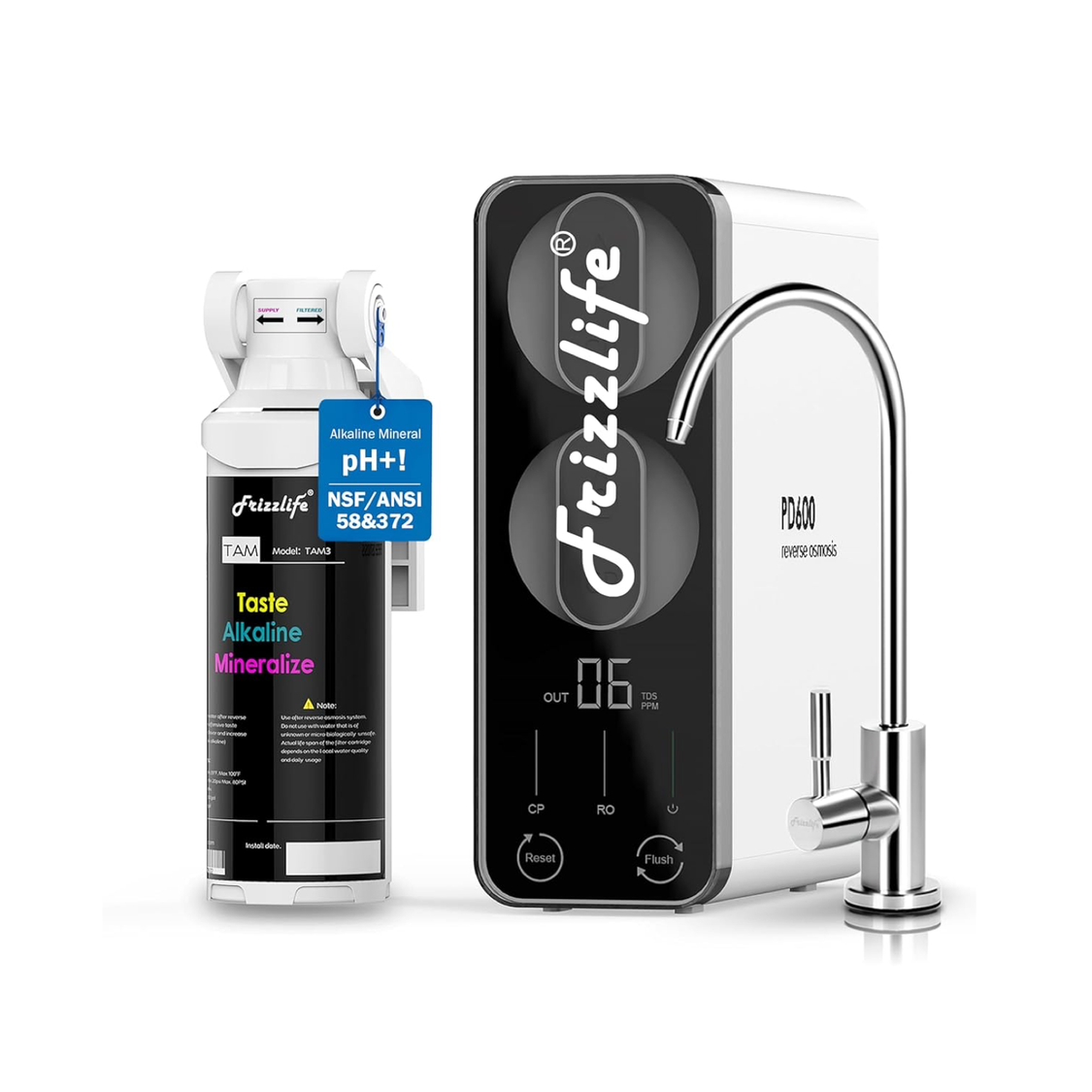
Frizzlife PD600-TAM3
A 600 GPD tankless under-sink RO option with alkaline remineralization for households that want on-demand drinking and cooking water from a dedicated faucet.
Check current inlet-water requirements, cabinet dimensions, pressure needs, drain connection, filter schedule, and product-specific reduction claims before purchase.
View PD600-TAM3
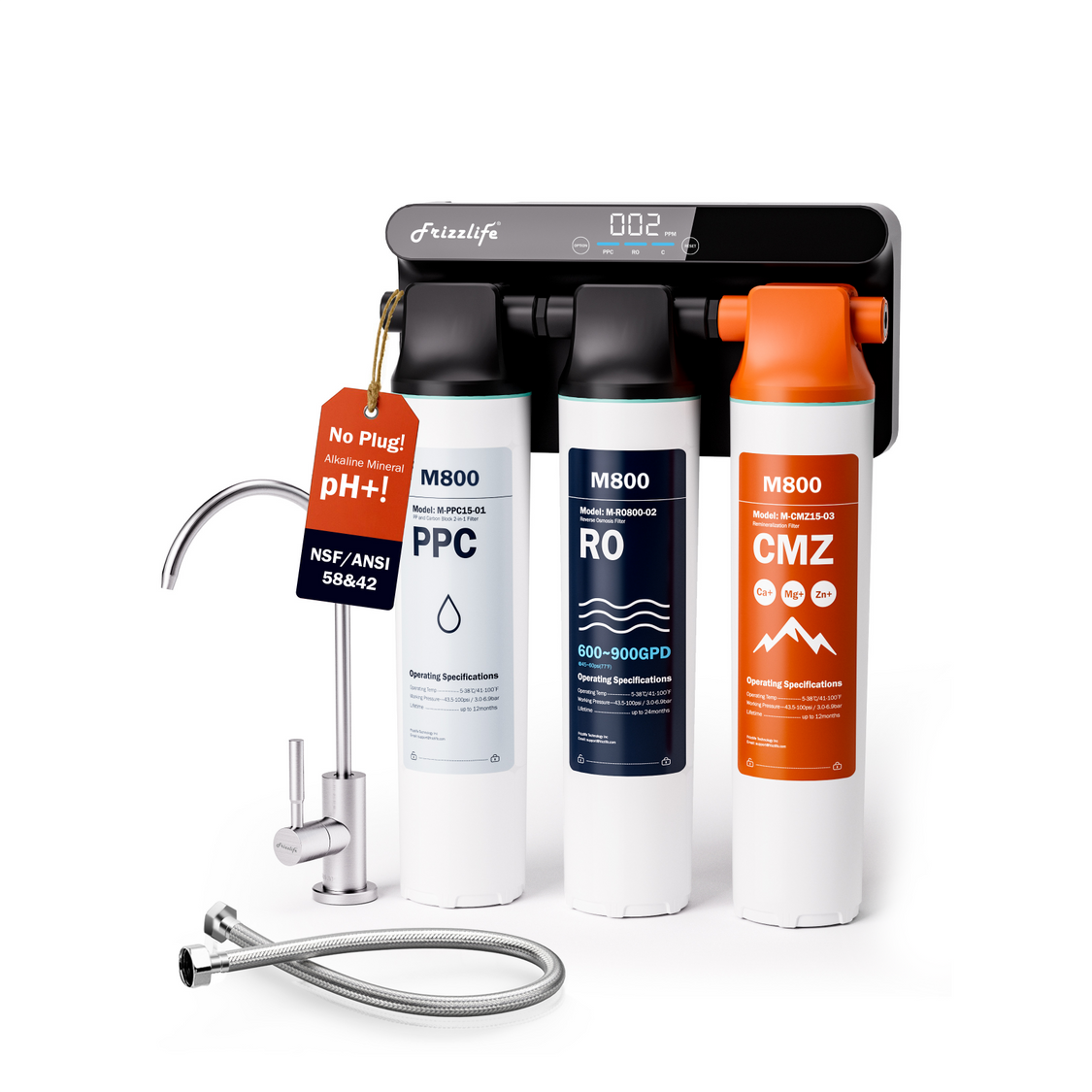
Frizzlife M800
A non-electric tankless RO option listed for high-output use with alkaline remineralization. It may suit kitchens that want greater daily capacity without depending on an electrical outlet.
Confirm current output, required feed pressure, source-water suitability, cabinet clearance, flushing method, installation details, and filter replacement plan on the product page.
View M800
Hard well water pretreatment needs
Test Before Buying
Testing is a buying prerequisite, especially for wells. Hardness is only one part of the decision.
Private wells can have different water-quality challenges depending on local conditions, which is why testing before choosing treatment equipment is an important step.
Test for:
- Hardness in grains per gallon or mg/L
- TDS
- Iron
- Manganese
- Sediment or turbidity
- pH
- Nitrate
- Arsenic, fluoride, lead, or local concerns
- Bacteria, especially for well water
City water reports are useful, but they may not show what reaches your kitchen tap. Local blending, old pipes, and home plumbing can change water quality. A simple tap test gives a better view of what your RO system will face.
This is the core of how hard water affects reverse osmosis performance: the membrane is not working with an average city report. It is working with the water in your kitchen line, at your pressure and temperature.
Useful Hardness Thresholds
A practical way to think about hardness:
- Moderately hard city water may work with RO alone if it is within the system’s limits.
- Hard or very hard water, higher hardness levels can increase scaling risk, especially when calcium and magnesium levels are elevated. The impact depends on the RO system design and overall water conditions.
- Very hard well water usually needs pretreatment before RO.
The harder the water, the more RO becomes part of a system rather than a standalone purchase.
So, what pretreatment is needed for RO with hard water? It depends on the test. Common pretreatment includes sediment filtration, carbon filtration, softening, iron or manganese treatment, and sometimes UV disinfection for wells.
The goal is to protect the membrane. Replacing a fouled membrane early costs more than preventing the fouling in the first place.
Iron Sediment Bacteria
An RO system for hard well water decision is not only about hardness.
Well water may contain iron, manganese, sediment, sulfur odor, bacteria, high TDS, or low pH. These issues can create taste problems, stains, clogging, fouling, or health risks.
RO membranes are not the first line of defense for heavy sediment, iron fouling, or microbiological contamination. RO should not be treated as the primary barrier for bacteria, heavy sediment, or iron fouling unless the complete treatment train is designed for those conditions. A sediment filter belongs before RO when particles are present.
Iron and manganese treatment may be needed before RO when levels are high enough to foul the system or stain fixtures. UV may be needed when bacteria risk is present, based on testing.
Wells should be tested regularly, and contamination should be handled at the correct point in the treatment train.
Pretreatment Train Choices
Common setups look like this:
| Water situation |
Common treatment path |
Why |
| City water, moderate hardness |
Sediment/carbon prefilters + RO |
Drinking-water refinement |
| Hard city water with scale complaints |
Softener + under-sink RO |
Home scale control plus drinking water |
| Hard well water with sediment |
Sediment filtration + other needed pretreatment + RO |
Protects membrane |
| Hard well water with iron/manganese |
Iron/manganese treatment + softener if needed + RO |
Reduces fouling and staining |
| Well water with bacteria risk |
Disinfection plan, often UV, plus RO for drinking water if needed |
Addresses microbiological risk |
| Severe whole-home quality issue |
Professional whole-house design |
Complex water chemistry |
For whole house RO vs under sink RO for hard water, under-sink RO is the normal residential choice for drinking water. Whole-house RO is expensive and complex. It is usually reserved for severe water-quality problems, not ordinary hardness alone.
A whole-house RO system may need pretreatment, storage, repressurization, and post-treatment to stabilize water. That is why it should be professionally designed.
Maintenance risks and ownership reality
Membrane Scaling Risk
Hard water can damage an RO membrane in a practical sense. Calcium and magnesium can form scale on the membrane surface. That scale blocks water flow and lowers performance.
When scaling starts, you may see slower flow, more wastewater, worse TDS rejection, and shorter membrane life. The system may still produce water, but not as well as it should.
Here is how to prevent scale buildup in an RO system:
- Test hardness before buying.
- Add a softener or approved antiscalant when the system requires it.
- Replace sediment and carbon prefilters on schedule.
- Keep carbon filters fresh to protect the membrane from chlorine on city water.
- Maintain adequate pressure.
- Monitor TDS rejection.
- Sanitize and service the system as directed in the manual.
Prevention is cheaper than replacing a fouled membrane early.
Filter Replacement Timing
RO maintenance has several parts:
- Sediment prefilter
- Carbon prefilter
- RO membrane
- Post-carbon filter
- Remineralization cartridge, if included
For RO system maintenance for hard water homes, track more than the calendar. Watch water use, flow rate, taste changes, pressure changes, and TDS readings.
As a general range, prefilters may be replaced every 6–12 months. Post-filters are often replaced around yearly. Membranes may last several years under good conditions. Hardness, sediment, iron, chlorine, high TDS, and heavy use can shorten those intervals.
If your water is hard, do not stretch prefilter life to save a few dollars. A clogged or exhausted prefilter can make the more expensive membrane fail earlier.
Before buying, price the replacement filters and membrane. Also check whether cartridges are easy to find. A low purchase price is less attractive if replacements are costly or hard to source.
Preventing Scale Buildup
A simple ownership checklist can keep the system from becoming a headache.
| Timing |
What to check |
Why it matters |
| Monthly |
Flow from RO faucet |
Slow flow can signal clogging or scaling |
| Monthly |
Taste and odor |
Changes may point to exhausted carbon or post-filter |
| Every 6 months |
Prefilter age |
Protects membrane from sediment and chlorine |
| Yearly |
TDS reduction |
Shows whether membrane is still rejecting solids |
| Yearly |
Leaks and tubing |
Prevents cabinet damage |
| As directed |
Sanitize system |
Helps keep storage tank and lines clean |
| When flow drops |
Pressure and tank charge |
Low pressure can mimic filter failure |
Low flow is often the first sign that hard water is hurting RO performance. Rising TDS is another warning. If both happen, the membrane may be scaling or fouled.
A good habit is to record tap TDS and RO TDS after installation. Later, you have a baseline instead of guessing.
RO Remineralization Decision
RO water can taste flat because minerals are reduced. Some people like that clean taste. Others prefer water with a little mineral character.
This leads to the question: should you remineralize RO water after removing hardness?
Remineralization can improve taste and raise pH. It may add calcium, magnesium, or other minerals back into the final water. That can make water taste less flat and may improve coffee or tea for some households.
Because remineralization intentionally adds dissolved minerals after filtration, it can increase TDS and may leave trace mineral residue compared with standard RO water.
There is a trade-off. If you want the lowest possible TDS from the system, remineralization works against that goal. It adds some dissolved minerals after the membrane. If you see residue after adding a remineralization stage, test the output water and compare it with the non-remineralized RO water if possible.
Use remineralization for taste preference, not because every RO system must have it.
Before You Buy
Use this checklist before choosing a system:
- Test your water first. Hardness, TDS, and other water conditions help determine whether RO alone is suitable or pretreatment is needed.
- Decide if the problem is drinking water or whole-home scale. RO treats one tap; softening treats the house.
- Check cabinet space and faucet access. Measure before buying, especially if you have a garbage disposal or no spare faucet hole.
- Verify water pressure. Low pressure can cause slow flow, poor efficiency, and higher wastewater.
- Price the replacement filters and membrane. Hard water can shorten replacement intervals.
- Check for well-water issues beyond hardness. Iron, sediment, bacteria, manganese, and nitrate can change the whole plan.
- Compare tank vs tankless by daily use. Storage, recovery speed, power needs, and cabinet space matter in real life.
- Decide on remineralization before buying. It can improve taste but may raise TDS and leave trace minerals.
FAQs
Does reverse osmosis work for hard water?
Yes. Reverse osmosis can reduce calcium, magnesium, TDS, and many dissolved substances in the treated water. It does not soften the entire home.
Do I need a water softener before reverse osmosis?
It depends on the water conditions and RO system limits. Moderate city water may work with RO alone if the system is designed for that hardness level. Very hard water or well water may need softening or other pretreatment to protect the membrane. Check hardness, source water quality, and manufacturer requirements before buying.
Why is my RO flow slow with hard water?
Common causes include membrane scaling, clogged prefilters, low pressure, cold water, high TDS, or a storage tank issue. Test pressure and TDS before replacing parts at random.
Why does my RO water still leave white residue?
The membrane may be exhausted, water may be bypassing it, or a remineralization cartridge may be adding minerals back. Residue can also come from surfaces already exposed to hard tap water.
Is whole-house RO better than under-sink RO for hard water?
Not for ordinary hard water. Under-sink RO is usually for drinking water. Whole-house RO is costly and complex, and it is mainly used for severe water-quality problems with professional design.
References