


When evaluating water quality, turbidity vs TDS is not an either-or comparison. The two measurements describe different properties of water and answer different questions.
Turbidity indicates how particles and other light-scattering material affect water clarity. Total dissolved solids, or TDS, describes the combined concentration of dissolved substances such as minerals, salts, and ions. One measurement is primarily optical; the other reflects dissolved content.
That distinction explains why cloudy water can have a relatively low TDS reading—and why completely clear water can have high TDS. It also explains why a handheld TDS meter cannot tell you whether water contains sediment, microorganisms, or specific harmful contaminants.
Understanding what each test measures, how readings are obtained, and where each test falls short can help you choose the right water analysis and treatment approach.
Turbidity vs TDS: Comparison Snapshot
Is turbidity the same as TDS?
No. Turbidity is not the same as TDS.
Turbidity measures the optical effect of material that scatters or absorbs light in water. It is commonly associated with suspended and colloidal particles such as silt, clay, rust, algae, and organic matter.
TDS measures—or, with most consumer meters, estimates—the total concentration of dissolved substances. These may include calcium, magnesium, sodium, chloride, sulfates, and other dissolved ions.
A simple way to remember the difference is:
-
Turbidity: How clearly light passes through the water
-
TDS: How much dissolved material the water contains
Turbidity and total dissolved solids at a glance
|
Comparison point |
Turbidity |
Total dissolved solids |
|
Meaning |
An optical measure of water clarity |
The combined concentration of dissolved substances |
|
Material commonly involved |
Silt, clay, rust, algae, organic matter, microorganisms, and other suspended or colloidal material |
Dissolved minerals, salts, metals, ions, and some organic substances |
|
Common units |
NTU, or nephelometric turbidity units |
mg/L or ppm |
|
Typical test method |
A turbidimeter measures light scattering |
Laboratory residue analysis or conductivity-based estimation |
|
Visible signs |
Water may appear cloudy, hazy, muddy, or discolored |
Usually invisible, although it may affect taste or deposits |
|
Practical concerns |
Filtration performance, sediment, cloudiness, and possible microbial-risk indicators |
Mineral load, salinity, taste, scale, corrosion tendencies, and treatment trends |
|
Main limitation |
Does not identify the particles or specific contaminants present |
Does not identify individual dissolved substances or prove water is safe |
The core difference: optical clarity vs dissolved content

The central difference between turbidity and TDS is the physical state of the material being evaluated.
Suspended particles remain dispersed in water rather than dissolving into it. These particles can scatter incoming light, creating turbidity. The effect depends not only on the amount of material but also on particle size, shape, color, and optical properties.
Dissolved substances separate into ions or remain present at a molecular scale. They generally do not scatter enough visible light to make water cloudy. A glass of water can therefore look perfectly clear while containing a substantial concentration of dissolved minerals or salts.
Why neither reading alone proves water is safe
Neither turbidity nor TDS is a complete drinking-water safety test.
A low-turbidity result means the sample transmits light with relatively little scattering. It does not rule out dissolved metals, nitrate, pesticides, or other substances that may be invisible.
A low TDS reading also does not establish safety. A TDS meter reports an overall estimate of conductive dissolved material, not a list of contaminants. Some contaminants may be significant at concentrations too low to produce a notable change in total TDS, while non-harmful minerals can produce a comparatively high reading.
If the goal is to identify specific contaminants, laboratory analysis is more informative than either measurement alone.
What Turbidity Tells You About Water
Turbidity is an optical measure of water clarity
Turbidity describes how suspended, colloidal, and certain other materials cause light to scatter or be absorbed instead of traveling directly through a water sample.
It is often treated as a measure of cloudiness, but turbidity is not simply a visual judgment. A calibrated instrument can detect light scattering at levels that may not be obvious to the eye. Conversely, water color and lighting conditions can influence how cloudy a sample appears without fully describing its measured turbidity.
Turbidity is also not a direct measurement of the weight of particles in the water. Two samples containing the same mass of suspended material can produce different turbidity readings if their particles differ in size, shape, color, or reflectivity.
Common sources of turbidity
Possible causes of elevated turbidity include:
-
Silt and clay introduced by runoff or disturbed soil
-
Rust and corrosion products from pipes
-
Sediment disturbed in plumbing, wells, or storage tanks
-
Finely divided organic matter
-
Algae and plankton
-
Microorganisms
-
Colloidal particles too small to settle quickly
-
Certain colored or light-absorbing substances
A sudden increase after heavy rain may point to source-water disturbance or runoff. Cloudiness at one faucet may instead indicate a localized plumbing issue. The reading shows that clarity has changed, but it does not identify the cause by itself.
How suspended and colloidal particles scatter light
Larger particles may settle if a sample is left undisturbed. Very small suspended and colloidal particles can remain dispersed much longer. Both can redirect light as it passes through the sample.
A turbidimeter evaluates this optical behavior under controlled conditions. Because the instrument responds to scattered light, its reading can change based on:
-
Particle concentration
-
Particle diameter and shape
-
Particle color
-
Light wavelength and instrument design
-
Air bubbles in the sample
-
Scratches, fingerprints, or residue on the sample vial
This is why careful sampling and instrument calibration matter when precise results are needed.
Turbidity vs total suspended solids
Turbidity and total suspended solids, or TSS, are related but not interchangeable.
TSS is a mass-based measurement of suspended material retained during a defined filtration and laboratory procedure. It is generally reported in mg/L.
Turbidity is an optical measurement reported in NTU. It indicates how strongly the sample scatters light.
As suspended material increases, turbidity will often increase too, but there is no universal conversion between NTU and mg/L. Fine clay may scatter light differently from coarse sand, algae, or rust particles. A turbidity result should therefore not be treated as a direct TSS concentration unless a validated, source-specific relationship has been established.
What a high turbidity reading may indicate
Elevated turbidity may suggest:
-
Sediment entering the water supply
-
Disturbed pipe scale or rust
-
Inadequate particle filtration
-
Changes in source-water conditions
-
Organic growth or microbial activity
-
A problem with treatment or distribution
In regulated public water treatment, turbidity is important partly because particles can interfere with filtration and disinfection. Some particles may shelter microorganisms from disinfectants, so turbidity is used as an operational indicator of treatment performance and microbial-risk control.
However, turbidity does not prove that pathogens are present. It signals a condition that may require investigation.
What low turbidity cannot reveal
Clear, low-turbidity water may still contain dissolved substances, including:
-
Hardness minerals
-
Sodium and chloride
-
Nitrate
-
Dissolved metals
-
Dissolved organic chemicals
-
Other substances that do not noticeably scatter light
Visual clarity is useful information, but it is not a substitute for chemical or microbiological testing.
What TDS Tells You About Water
What total dissolved solids include
Total dissolved solids represent the combined dissolved content of water. Depending on the source, TDS may include inorganic salts, minerals, metals, ions, and smaller amounts of dissolved organic material.
Common contributors include:
-
Calcium
-
Magnesium
-
Sodium
-
Potassium
-
Chloride
-
Sulfates
-
Bicarbonates
-
Other dissolved ionic substances
TDS is normally expressed in milligrams per liter (mg/L) or parts per million (ppm). In dilute water solutions, these units are commonly treated as approximately equivalent for practical household interpretation.
Why TDS is usually invisible
Dissolved ions and molecules are too small to behave like visible grains of sediment. They pass through water without producing the same light-scattering effect as suspended particles.
This is why high TDS does not necessarily create cloudy water. Dissolved salt is an everyday illustration: once fully dissolved, it can increase conductivity and TDS without making the water muddy.
Some water conditions can involve both dissolved and suspended material, but the two measurements should still be interpreted separately.
Can water have high TDS but look clear?
Yes. Water can have high TDS and still look completely clear.
Clear water with high TDS may contain elevated concentrations of dissolved minerals or salts without enough suspended material to affect visibility. This may occur in mineral-rich groundwater, harder water, or water influenced by salinity.
Instead of cloudiness, practical signs may include:
-
Mineral scale on fixtures or heating elements
-
Spots on glassware
-
Salty, bitter, or mineral-like tastes
-
Changes in how water interacts with plumbing or appliances
These signs are not specific enough to identify the dissolved substances. A laboratory test is needed to determine which minerals, salts, or contaminants make up the total.
How TDS can affect taste, scaling, and corrosion
TDS can provide useful context for aesthetic and operational water concerns.
High concentrations of certain dissolved minerals can contribute to scale. Other ion combinations may influence taste or the water’s corrosive tendencies. However, the total number alone does not predict these effects perfectly. Water chemistry, pH, alkalinity, hardness, temperature, and the identities of the dissolved ions all matter.
For example, two samples can show the same TDS reading but behave very differently:
-
One may contain mostly calcium and bicarbonate and produce scale.
-
Another may contain more sodium and chloride and taste salty.
-
A third may include a different blend of ions with fewer obvious household effects.
Why high or low TDS does not identify contaminants
A TDS number is an aggregate measurement. It does not tell you which substances are present.
High TDS may come largely from ordinary minerals. Low TDS does not rule out a specific contaminant present at a small but important concentration. A handheld meter also cannot identify microorganisms, pesticides, or individual metals.
TDS is therefore most useful for tracking overall dissolved load, salinity, mineral-related conditions, or changes in treatment performance—not for making a stand-alone safety determination.
TDS Meter vs Turbidity Test: How Each Measurement Works
How turbidity is measured in NTU
Turbidity is commonly measured using a nephelometric method. A light source passes through the sample, and a detector measures light scattered at a defined angle.
The result is reported in nephelometric turbidity units, or NTU. A higher NTU value generally means greater light scattering and lower optical clarity.
An NTU reading does not report:
-
The mass of suspended solids
-
The identity of the particles
-
The number of microorganisms
-
The concentration of dissolved minerals
-
Whether the water is safe to drink
It is a precise measurement of an optical effect, not a full contaminant analysis.
Laboratory TDS testing
A laboratory can determine TDS through a residue-based procedure. In simplified terms, the water sample is filtered according to the test method, a measured volume is evaporated, and the remaining residue is weighed.
This gravimetric approach measures the dissolved residue under defined laboratory conditions. It differs from the estimate displayed by most consumer TDS meters.
How consumer TDS meters estimate dissolved solids
Most handheld TDS meters do not directly collect and weigh dissolved solids. They measure electrical conductivity, or how readily the water conducts an electric current.
Dissolved ions increase conductivity. The meter applies a conversion factor to estimate TDS, often displaying the result as ppm or mg/L.
Common conversion factors fall roughly between 0.5 and 0.7, but the appropriate relationship depends on the mix of ions in the water. Because different ions conduct electricity differently, two samples with identical laboratory TDS may not generate identical conductivity-based estimates.
Temperature compensation, calibration, meter condition, and sampling practices can also affect the result. A consumer TDS meter is useful for trends and comparisons, but its reading should not automatically be treated as equivalent to a laboratory measurement.

Does a TDS meter measure turbidity?
No. A TDS meter does not measure turbidity.
A TDS meter responds primarily to electrical conductivity from dissolved ions. A turbidity test measures light scattering. Suspended particles can make water visibly cloudy without causing a proportionate increase in conductivity.
This is why a normal TDS reading does not explain—or dismiss—cloudy water. If cloudiness is the concern, use a turbidity test and investigate the source rather than relying only on a TDS pen.
Cloudy Water vs High TDS: Why the Readings May Not Match
Cloudy water and high TDS are sometimes discussed as though they describe the same condition. In practice, their readings may move independently.
What causes cloudy water if TDS is low?
The location and timing of the cloudiness can help narrow the possibilities.
Cloudiness throughout the property may point to source-water conditions, a treatment issue, or a change in the public supply. Cloudiness at only one fixture may be related to the faucet aerator, a local plumbing section, or disturbed deposits.
Rust, scale, or sediment may produce yellow, orange, brown, or gray particles. Organic matter can create color or haze. Because microorganisms may also be associated with turbidity, unexplained or persistent cloudiness should not be judged safe simply because the TDS reading is low.
Air bubbles can create temporary milky water without indicating suspended sediment. If the sample clears after standing, trapped air may be involved. Persistent particles, discoloration, odor, or cloudiness require a different investigation.
Four common turbidity and TDS scenarios
|
Turbidity |
TDS |
What the combination may suggest |
Useful next step |
|
Low |
Low |
Clear water with a relatively low dissolved load |
Consider broader testing if safety or a specific contaminant is the concern |
|
Low |
High |
Clear water containing more dissolved minerals or salts |
Test hardness and specific ions; evaluate dissolved-solids treatment if needed |
|
High |
Low |
Suspended particles, rust, organic matter, microorganisms, or air bubbles |
Perform a turbidity test and inspect the source, plumbing, and particle filtration |
|
High |
High |
Both suspended and dissolved material may be present |
Use both tests and obtain targeted laboratory analysis before choosing treatment |
These combinations are diagnostic clues, not final diagnoses.
Drinking-Water Standards and Health Context
U.S. EPA turbidity requirements
Under U.S. Environmental Protection Agency rules, turbidity is used as an important treatment-performance parameter for regulated public water systems.
For systems using conventional or direct filtration, EPA requirements generally state that:
-
Turbidity must not exceed 1 NTU at any time.
-
At least 95% of samples in a month must be at or below 0.3 NTU.
For public systems using certain other filtration technologies, requirements are determined within the applicable regulatory framework, and turbidity may not exceed 5 NTU at any time. Stricter requirements can apply based on treatment type and jurisdiction.
These are public-system treatment requirements, not a universal household rule for interpreting every individual sample. Water may also look clear to the eye at turbidity levels above treatment targets, so appearance alone cannot demonstrate regulatory compliance.
Why turbidity is tied to filtration and microbial-risk control
Turbidity can indicate whether particle-removal processes are working effectively. Suspended particles may also interfere with disinfection or provide protection for microorganisms.
For that reason, regulated systems use turbidity as an operational indicator. It is not a direct pathogen count, but an unexplained increase can be important—especially after flooding, heavy runoff, a well problem, loss of pressure, or treatment failure.
EPA’s secondary standard for TDS
The EPA lists TDS under its secondary drinking-water standards, with a secondary maximum contaminant level of 500 mg/L.
Secondary standards primarily address aesthetic and operational qualities such as:
-
Taste
-
Odor or appearance concerns
-
Mineral deposits and scale
-
Effects on plumbing or fixtures
The 500 mg/L value should not be interpreted as a universal line between safe and unsafe water. TDS does not reveal which dissolved substances are present, and individual contaminants may have separate health-based limits.
Private wells and broader testing needs
Federal public-water requirements do not apply to private wells in the same way. Well owners are generally responsible for testing and maintaining their water supply, subject to state and local requirements.
Broader testing is appropriate when:
-
A well is newly constructed or repaired.
-
Flooding or runoff may have affected the source.
-
Water changes suddenly in color, taste, odor, or clarity.
-
Plumbing corrosion is suspected.
-
An infant, pregnant person, older adult, or immunocompromised person may be exposed to questionable water.
-
A specific local contaminant is known or suspected.
-
Turbidity or TDS changes unexpectedly without a clear explanation.
If contamination is suspected, contact the local health department, water utility, a certified laboratory, or another qualified water professional for guidance.
How Turbidity and TDS Affect Water-Treatment Decisions
Testing matters because treatment designed for suspended particles may not reduce dissolved solids—and treatment intended to lower TDS may not address every source of cloudiness.
Sediment filtration for suspended particles
Sediment filtration is generally used to capture particulate material such as sand, silt, rust, and pipe debris. Depending on the particle size and system design, it may improve clarity and protect downstream equipment.
However, improving clarity does not necessarily lower TDS. Dissolved calcium, sodium, chloride, and similar ions can pass through particle filters because they are not suspended solids.
A sediment filter that makes water look clearer may be working as intended even if a TDS meter shows little or no change.
Dissolved-solids reduction

Reverse osmosis is commonly associated with reducing dissolved ionic content. Other treatment approaches may also be suitable depending on the substances present and the treatment objective.
Treatment selection should be based on water chemistry rather than the TDS number alone. For example, a hardness problem, salinity issue, or specific dissolved contaminant may require different design considerations.
Homeowners evaluating treatment for a confirmed dissolved-solids concern can review Frizzlife’s TDS-focused water filtration options as a next step. Verify each model’s stated performance, certifications, feed-water requirements, maintenance needs, and intended applications before deciding whether it fits the test results.
Explore RO Options for Dissolved-Solids Reduction
If testing confirms that dissolved solids are part of your water-treatment concern, compare system specifications, operating requirements, filtration performance, and maintenance needs before choosing a solution.
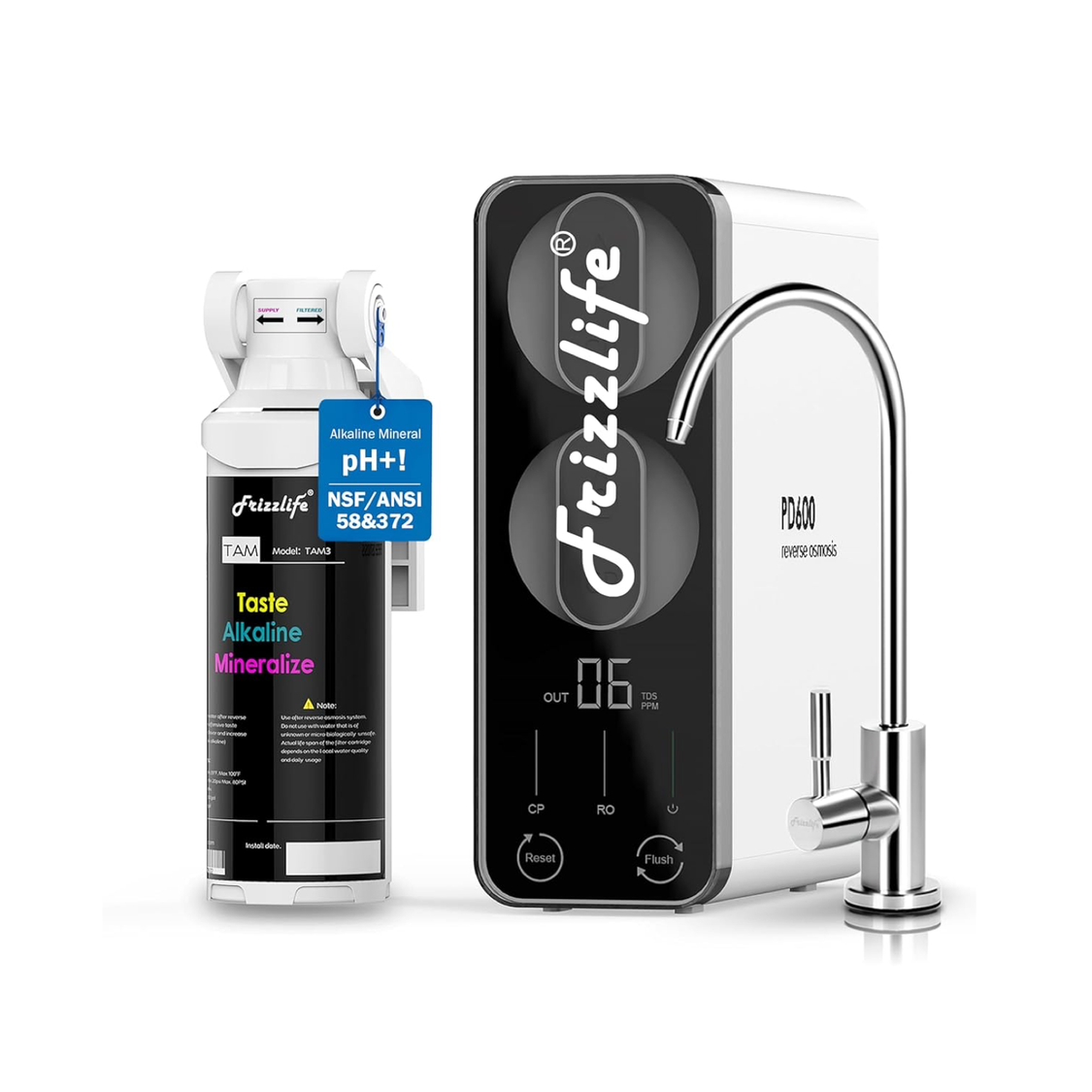
PD600-TAM3 Reverse Osmosis System
A 600 GPD tankless under-sink RO system with alkaline remineralization and real-time TDS display for monitoring treated-water trends.
View PD600-TAM3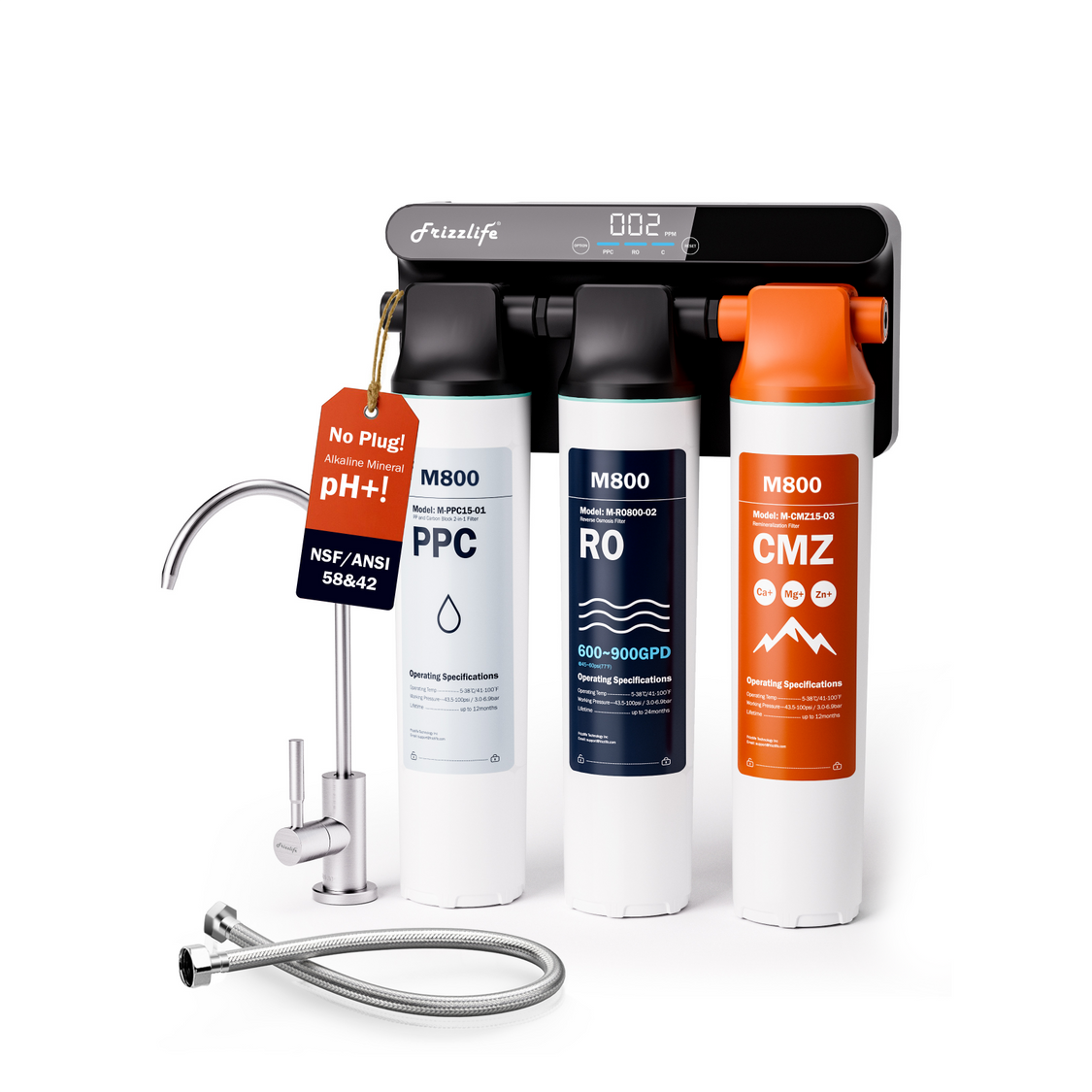
M800 Reverse Osmosis System
A 900 GPD tankless RO system with a non-electric filtration design, alkaline remineralization, and TDS monitoring for high-flow under-sink use.
View M800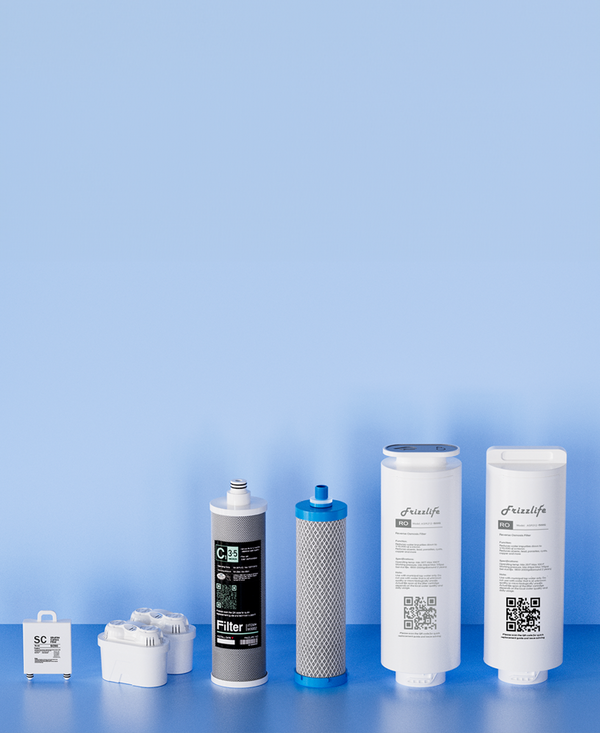
Replacement Filters
Already using a Frizzlife filtration system? Find compatible replacement cartridges by system model to support scheduled filter maintenance.
Find Replacement FiltersTreatment should be selected based on confirmed water conditions. A TDS reading alone does not identify individual contaminants or determine whether a specific filtration system is appropriate.
Why lowering TDS may not resolve cloudiness
A treatment process can lower dissolved solids while leaving a separate particle problem unresolved. Water could still look cloudy because of:
-
Sediment entering downstream of treatment
-
Rust or scale released from household plumbing
-
A depleted or unsuitable prefilter
-
Organic material
-
Air introduced at a faucet
-
Another source of suspended matter
Likewise, particle filtration can improve turbidity while leaving dissolved mineral concentrations largely unchanged.
Match treatment to confirmed conditions
Before selecting a system, ask:
-
Is the main concern suspended material, dissolved content, or both?
-
Is the issue present throughout the property or at one fixture?
-
Did it appear suddenly or develop gradually?
-
What do turbidity and TDS tests show?
-
Which specific contaminants or minerals does laboratory testing identify?
-
Is the proposed treatment designed and documented for those conditions?
-
What pretreatment, maintenance, and feed-water conditions does the model require?
No filter should be assumed to make water safe based solely on a TDS or turbidity claim. Product performance is model-specific and depends on proper application, installation, water conditions, and maintenance.
Which Water Test Should You Use?
Use a turbidity test for cloudiness and particulate concerns
A turbidity test is the more relevant choice when:
-
Water looks cloudy, muddy, or hazy.
-
Sediment is visible.
-
Particle filtration may not be working properly.
-
Source water changes after storms or runoff.
-
You need to monitor optical clarity.
-
A public or regulated process requires turbidity data.
The result can quantify the clarity problem, but additional analysis may still be necessary to identify its cause.
Use a TDS meter for dissolved-load trends
A TDS meter is useful when:
-
You want a general indication of dissolved mineral or salt content.
-
Salinity or mineral taste is a concern.
-
Scale is appearing on fixtures or appliances.
-
You are comparing feed and treated water.
-
You want to monitor changes in reverse-osmosis performance over time.
For treatment monitoring, use consistent sampling conditions and compare trends rather than placing too much confidence in one isolated reading. Conductivity-based TDS meters provide estimates influenced by temperature, calibration, conversion factors, and water chemistry.
Use both when the problems may be separate
Use both tests when appearance and dissolved content do not tell the same story. Examples include:
-
Clear water that leaves heavy mineral scale
-
Cloudy water with an ordinary TDS reading
-
Well water affected by both sediment and minerals
-
Treated water that has improved TDS but remains hazy
-
Water that becomes cloudy even though dissolved-solids readings remain stable
Testing both properties helps prevent the common mistake of treating a dissolved-solids problem with only a sediment filter—or treating cloudiness based only on TDS.
Choose laboratory analysis for specific answers

Use a qualified laboratory when you need to know whether water contains a particular substance or microorganism.
Depending on the source and concern, a targeted analysis may include:
-
Hardness and alkalinity
-
Iron and manganese
-
Sodium and chloride
-
Nitrate or nitrite
-
Lead, arsenic, or other metals
-
Bacteria or other microbiological indicators
-
Locally relevant agricultural or industrial contaminants
A laboratory report provides information that an NTU reading or TDS pen cannot.
A homeowner’s water-testing checklist
Before testing or choosing treatment:
-
Define the symptom. Is the issue cloudiness, taste, scale, discoloration, odor, or a safety concern?
-
Check where it occurs. Test more than one fixture when appropriate.
-
Note the timing. Record whether the change followed rainfall, plumbing work, filter replacement, or a supply interruption.
-
Use the correct meter. Do not use a TDS pen as a turbidity or safety test.
-
Compare repeat samples. One unusual reading may reflect sampling or instrument error.
-
Follow calibration instructions. Poorly maintained meters can produce misleading results.
-
Get laboratory testing when needed. Especially for private wells, sudden changes, or suspected contamination.
-
Match treatment to identified conditions. Confirm model-specific performance and requirements before purchase.
The Practical Takeaway
In the turbidity vs TDS comparison, turbidity describes optical clarity, while TDS describes dissolved content. A turbidimeter measures light scattering in NTU; a consumer TDS meter generally estimates dissolved solids from electrical conductivity and reports the result in ppm or mg/L.
Clear water can have high TDS, and cloudy water can have low TDS. Neither result identifies specific contaminants or proves that water is safe. Use the test that matches the property you need to understand—and use laboratory analysis when the question is what, specifically, the water contains.