


What maintenance is needed to keep alkaline water filters working well? The essentials are timely cartridge replacement, correct flushing, routine leak and seal checks, and attention to changes in taste, flow, odor, pH, or post-filter TDS trends. In a reverse osmosis system, maintaining the upstream pre-filters and membrane is equally important because the alkaline stage cannot compensate for a clogged or poorly performing filtration stage.
Alkaline water filter maintenance is not based on the calendar alone. Cartridge life depends on the system model, household water use, source-water conditions, upstream filter condition, and periods of inactivity. A commonly cited replacement range for remineralization cartridges is 6–12 months, but the product manual and model-specific cartridge life guidance should always take priority.
This guide explains how to recognize an exhausted alkaline filter, troubleshoot symptoms before replacing it, complete an alkaline water filter cartridge replacement, and avoid maintenance mistakes that can affect water taste, flow, and system reliability.
Maintenance Snapshot: What Owners Usually Get Wrong
The most common mistake is treating the alkaline cartridge as an isolated component. In many systems, especially reverse osmosis systems with remineralization, the alkaline filter is the final stage in a connected filtration process. A clogged sediment or carbon pre-filter, an aging membrane, low feed-water pressure, a tank issue, or a restricted faucet can change performance before the alkaline media is exhausted.
Owners also tend to rely on only one signal. A replacement reminder is useful, but it does not account for unusually heavy use. Taste is practical, but subjective. A pH or TDS meter can reveal trends, but neither measurement proves that water is safe or identifies specific contaminants. Effective maintenance combines the model’s schedule with several condition-based checks.
What maintenance is needed to keep alkaline water filters working well?
A practical maintenance plan includes the following:
-
Replace the alkaline or remineralization cartridge on schedule. Follow the interval or capacity listed for your model rather than assuming every cartridge lasts the same amount of time.
-
Watch for condition-based replacement signs. Flat, dull, chalky, or otherwise changed taste may indicate depleted media, incorrect flushing, buildup, or a problem elsewhere in the system.
-
Flush every new cartridge as directed. Flushing helps clear startup water, loose media particles, carbon fines where applicable, and other residues identified by the manufacturer.
-
Inspect connections after service. Check tubing, fittings, cartridge seating, O-rings, and housings for moisture or slow leaks.
-
Track changes in flow. Slow flow can result from an alkaline cartridge, but clogged upstream filters, a tank issue, or a restricted line may be more likely.
-
Maintain upstream filtration stages. In an RO system, pre-filter and membrane maintenance protects overall performance and helps the remineralization stage operate under its intended conditions.
-
Clean only approved surfaces and components. Reservoirs, faucets, housings, and exterior surfaces may have different cleaning instructions. Replace sealed or media-filled cartridges rather than attempting to wash their internal media.
-
Follow inactivity and storage instructions. A system left unused for an extended period may need flushing, cleaning, sanitizing, draining, or cartridge replacement depending on its design and the length of inactivity.
-
Keep a maintenance log. Record installation dates, cartridge changes, taste observations, flow changes, leaks, and optional pH or TDS readings taken under comparable conditions.
These tasks cover the broad maintenance pattern, but they do not replace the instructions for a specific pitcher, countertop unit, under-sink filter, or RO system.
Alkaline water filter maintenance decision table: warning sign, likely cause, and next action
|
Warning sign |
Possible cause |
Recommended next action
|
|---|---|---|
|
Water tastes flat or less balanced |
Exhausted remineralization media, overdue cartridge, or upstream performance change |
Compare the cartridge age with the manual, inspect upstream stages, and replace the alkaline cartridge if due |
|
Water tastes chalky or unusually mineral-heavy |
New cartridge not fully flushed, media change, incorrect cartridge, or altered water conditions |
Confirm compatibility and flow direction, then complete the required flush |
|
Flow has gradually slowed |
Clogged pre-filter, exhausted cartridge, scale, membrane decline, or tank-related issue |
Check upstream replacement dates and system flow before replacing the alkaline stage |
|
Flow drops immediately after replacement |
Closed valve, kinked tubing, incorrect orientation, poor cartridge seating, or installation obstruction |
Shut down safely and verify installation against the manual |
|
pH trends downward over repeated checks |
Mineral media may be depleting, source water changed, or testing conditions are inconsistent |
Retest consistently, review cartridge age, and inspect the rest of the system |
|
Post-filter TDS increase becomes smaller over time |
Reduced mineral contribution or changed feed/product water conditions |
Use the trend as a supporting clue, not a safety test; confirm with schedule, taste, and system checks |
|
Cloudy water appears just after replacement |
Startup flushing may be incomplete or air may still be moving through the system |
Continue the manual-specified flush; investigate if cloudiness persists |
|
Odor develops |
Stagnation, overdue filters, contaminated removable components, or another water-quality issue |
Stop using the water until the source is identified; follow cleaning, sanitation, or service instructions |
|
Moisture appears around a fitting or housing |
Damaged seal, loose fitting, tubing problem, or poor cartridge seating |
Shut off the feed water, depressurize, reseat or replace the affected part, and leak-test again |
|
Visible buildup appears on the faucet or reservoir |
Mineral deposits, cleaning neglect, or source-water conditions |
Clean approved surfaces according to the manual and inspect for restrictions |
|
Performance changes after a long idle period |
Stagnant water, dried components, expired cartridge, or improper storage |
Follow the model’s restart, flushing, sanitation, and replacement directions |
A symptom does not always identify one failing component. Use the table to narrow the cause, then confirm it with your system manual.
Routine maintenance vs symptom-triggered maintenance vs model-specific service
It helps to separate alkaline filter care into three categories.
Routine maintenance includes recording replacement dates, changing cartridges at the specified interval, flushing new filters, inspecting for leaks, and checking for noticeable changes in taste or flow.
Symptom-triggered maintenance begins when water tastes different, flow slows, odor develops, a leak appears, or measurements change. These situations require troubleshooting rather than waiting for the next scheduled service date.
Model-specific service includes procedures such as sanitizing a tank, checking tank air charge, resetting a filter-life indicator, draining a first tank, cleaning a reservoir, or preparing the system for storage. Perform these tasks only when the product instructions call for them.
How Often Should an Alkaline Water Filter Be Replaced?
An alkaline water filter should be replaced according to its model-specific service interval or rated capacity, or sooner if there is a persistent decline in taste or performance. Frizzlife maintenance guidance commonly uses a 6–12-month range for remineralizer cartridges, but that is a planning range rather than a universal cartridge life.
The correct interval may be shorter or longer for a particular product. Check the cartridge label, product documentation, replacement indicator, or owner’s manual before setting a reminder.
Why replacement intervals depend on the model, water use, and source-water conditions
Alkaline filters do not all contain the same media or use the same design. A pitcher cartridge, an inline under-sink remineralizer, and a post-RO alkaline stage may process water differently. Their replacement procedures and useful service lives are therefore not interchangeable.
Actual lifespan may be affected by:
-
Daily drinking and cooking water use
-
Number of people using the system
-
Cartridge size and media formulation
-
Source-water chemistry
-
Hard-water scale or sediment loading
-
Long periods of low use or inactivity
-
Condition of pre-filters and the RO membrane
-
Installation, flushing, and storage practices
A date-based reminder is still valuable. It prevents the cartridge from remaining in service indefinitely when performance changes are subtle. However, it should be paired with symptom tracking.
How water use, source water, and upstream maintenance affect service timing
Heavy use moves more water through the cartridge, so the alkaline media reaches its model-specific capacity sooner. A household using filtered water for drinking, cooking, ice, and multiple faucets may need a different service cadence than a household with limited use.
Challenging source-water conditions can also increase the maintenance burden. Sediment and scale may restrict water pathways or load upstream filters. If those filters are not replaced on time, reduced flow can make the alkaline stage appear to be failing even when its media is not the primary problem.
In an RO system, neglected pre-filters may also affect membrane operation. An alkaline cartridge is designed to condition or remineralize the water it receives; it is not a substitute for sediment filtration, carbon filtration, or the RO membrane. Coordinating all stages is usually more effective than replacing the final cartridge repeatedly.
Before shortening the alkaline filter schedule, check:
-
Whether the cartridge has reached its specified time or capacity.
-
Whether household water consumption recently increased.
-
Whether a sediment or carbon pre-filter is overdue.
-
Whether slow flow occurs before and after the alkaline stage.
-
Whether source-water conditions have changed.
-
Whether scale or buildup is visible on approved, accessible components.
-
Whether the replacement cartridge is installed in the correct stage and direction.
When a 6–12-month remineralizer range is useful—and why the product manual takes priority
A 6–12-month range is useful for creating a general maintenance calendar, particularly when coordinating pre-filter and remineralizer service. It should not override a model’s rated capacity, replacement indicator, or written instructions.
Replace earlier when the manual’s capacity is reached or when confirmed performance symptoms persist. Do not automatically extend service beyond the specified interval merely because pH or taste appears unchanged. The media may age in ways that a casual taste check does not reveal.
How to track installation dates, taste, flow, leaks, pH, and TDS trends
Keep a simple record in a phone calendar, spreadsheet, or note attached near the system. Record:
-
Cartridge model and installation date
-
Expected replacement date or capacity
-
Dates of upstream filter and membrane changes
-
Whether the system was flushed as directed
-
Changes in taste, odor, or appearance
-
Noticeable flow changes
-
Leaks or seal replacements
-
Periods of inactivity
-
Optional pH and TDS spot-checks
If you track pH or TDS, measure under similar conditions each time. Compare the same sampling points and allow the system to return to normal operation after maintenance. A trend is more informative than one isolated number.
TDS indicates the concentration of dissolved ionic material but does not identify which substances are present. A higher or lower reading does not, by itself, establish water safety or complete filter performance. Similarly, pH can help track the alkaline stage’s behavior, but it is not a comprehensive contaminant test.
Signs the Alkaline Filter—or Another System Component—Needs Attention
A changed taste, reduced mineral effect, or declining post-filter pH trend can suggest that an alkaline cartridge is reaching the end of its useful life. Slow flow, however, often requires broader troubleshooting because multiple filters, valves, tubes, tanks, and faucets can create the same symptom.
Signs your alkaline filter needs replacement vs signs another component is aging first
The alkaline cartridge is more likely to need replacement when:
-
It has reached the model’s replacement interval or capacity.
-
Water tastes consistently flat, dull, or different after normal flushing.
-
A repeated pH trend shows less change across the alkaline stage.
-
The expected post-filter TDS increase has gradually diminished.
-
Performance improves after upstream issues have been ruled out.
-
The cartridge was left installed beyond an extended idle period and the manual directs replacement.
Another component may be responsible when:
-
Flow is slow at every filtered-water stage, not only after remineralization.
-
A sediment or carbon pre-filter is overdue.
-
The system produces less RO water overall.
-
A tank fills slowly or delivers only a small amount of water.
-
Tubing is kinked or a valve is partly closed.
-
The problem started immediately after unrelated system service.
-
Odor or buildup appears in the faucet, reservoir, tank, or accessible water path.
-
A leak originates from a fitting, housing, or damaged O-ring.
When possible, isolate when and where the performance change occurs. This reduces unnecessary alkaline filter replacement and helps prevent the same problem from returning.
What flat, dull, chalky, or otherwise changed taste may indicate
Flat or dull taste may indicate that the remineralization media is contributing less than it did when new. It may also reflect a source-water change, an overdue post-filter, stagnant water, or reduced system performance.
A chalky or unusually strong mineral taste shortly after replacement does not always mean the cartridge is defective. First confirm that:
-
The replacement is compatible with the exact system.
-
The flow arrow points in the correct direction.
-
The cartridge is installed in the correct stage.
-
The required flushing procedure was completed.
-
The system was restarted according to its manual.
Persistent metallic, chemical, musty, or otherwise abnormal taste or odor should not be diagnosed by taste alone. Stop using the water until the source has been identified through appropriate maintenance, service, or water testing.
How to troubleshoot slower flow before replacing the alkaline cartridge

Start with the simplest checks:
-
Confirm that the feed-water and tank valves are fully open.
-
Look for kinked, pinched, or sharply bent tubing.
-
Review the replacement dates for all upstream cartridges.
-
Check whether the slow flow began gradually or immediately after service.
-
Verify cartridge orientation and seating.
-
Inspect accessible fittings and water lines for buildup or obstruction.
-
Follow the manual’s tank and pressure troubleshooting instructions if applicable.
If flow is normal before the alkaline stage but restricted after it, the remineralization cartridge becomes a more likely cause. If flow is weak throughout the system, investigate upstream filters, the membrane, feed conditions, tank operation, and faucet path first.
What declining pH or a reduced post-filter TDS change can—and cannot—tell you
A remineralization cartridge may raise pH or add dissolved minerals to RO water. If the difference between pre- and post-cartridge measurements shrinks consistently, the media may be depleting.
For a useful comparison:
-
Test at comparable times and sampling points.
-
Use the same calibrated meter and procedure.
-
Avoid judging a new cartridge before completing its flush.
-
Compare trends across several readings rather than one result.
-
Record source-water or RO-water changes that could affect the baseline.
These measurements cannot identify specific contaminants, confirm microbial condition, or prove that every filtration stage is operating correctly. They are maintenance clues, not stand-alone water-safety tests.
How leaks, cloudy startup water, odors, and visible buildup change the next step
A leak requires immediate attention. Shut off the feed water and depressurize the system as directed before adjusting a fitting or opening a housing. Replace damaged seals or components rather than trying to compensate by overtightening.
Cloudy startup water immediately after a filter change may clear during the required flushing process. If cloudiness persists after the full flush, or appears with unusual taste, odor, particles, or discoloration, stop and verify the installation.
Odors after an idle period can indicate stagnant water or a need for model-specific cleaning or sanitation. Visible buildup on a faucet, reservoir, or other approved accessible surface should be cleaned according to the manual. Do not disassemble sealed cartridges or expose filter media to unapproved cleaners.
Can poor maintenance affect the taste of remineralized water?
Yes. Overused media may produce flat or less balanced-tasting water, while incomplete flushing can cause unusual startup taste. Stagnation, dirty removable components, exhausted upstream filters, incorrect cartridge placement, and scale can also affect taste.
Because taste changes have several possible causes, replacing the alkaline cartridge should be part of a structured check—not an automatic response to every flavor change.
How to Complete an Alkaline Water Filter Cartridge Replacement
The following steps describe the general replacement pattern for many alkaline and remineralization filters. Exact procedures vary between quick-change cartridges, inline filters, traditional housings, pitchers, countertop systems, and tanked or tankless RO systems.
Check the manual and confirm cartridge compatibility before starting
Confirm the cartridge model, connection type, filtration stage, and flow direction. A cartridge that fits physically is not necessarily compatible with the system.
Have the replacement filter, approved tools, clean towels, and any required seals ready before shutting down the water. If your system has an electronic filter-life reminder, review the reset procedure as well.
Shut off the feed water and depressurize the system as directed
Close the feed-water valve. If the system has a storage tank, follow its instructions for the tank valve. Open the filtered-water faucet or use the model’s pressure-release procedure to relieve pressure before disconnecting tubing or opening a housing.
Do not assume pressure is gone simply because water flow slows. Follow the specified shutdown sequence.
Remove the old cartridge without damaging tubing, fittings, or housings
Place a towel under the system to catch residual water. For quick-connect tubing, use the fitting’s release mechanism rather than pulling forcefully. For a housing system, support the housing and use only the approved tool.
Avoid twisting tubing, putting side pressure on fittings, or using excessive force. Note the old cartridge’s position and flow-arrow direction before removal.
Install the replacement in the correct stage and flow direction
Multi-stage systems can use cartridges that look similar but perform different jobs. Match the replacement to the labeled alkaline, mineral, remineralization, or post-filter stage shown in the manual.
Check the flow arrow before connecting the cartridge. Installing an inline filter backward may reduce performance or prevent it from functioning as intended.
Inspect O-rings, seals, connections, and cartridge seating
Before reassembly:
-
Check O-rings for cracks, flattening, stretching, dirt, or twisting.
-
Clean only as directed by the manual.
-
Replace damaged seals with approved compatible parts.
-
Push tubing fully into quick-connect fittings.
-
Confirm that housings and cartridges are correctly seated.
-
Avoid overtightening threaded or plastic components.
A cartridge can be correct while the seal around it is not. Inspect both.
Flush the new alkaline filter and check every connection for leaks
Restore water slowly according to the startup instructions. Watch every serviced connection while the system pressurizes.
Complete the full manufacturer-specified flush before drinking the water. After the initial leak check, inspect again after the system has operated or filled its tank. Run a dry paper towel around fittings if necessary; small amounts of moisture can reveal a slow leak.
Should you drain the tank after changing an alkaline filter?
Only if the system manual directs you to do so. Some tanked systems require the first full tank after replacement to be drained and not consumed. Other systems use a timed faucet flush, and tankless designs follow a different procedure.
Do not apply one tank-draining rule to every RO system. The correct process depends on cartridge placement and system design.
Remineralization Filter Maintenance Beyond Cartridge Replacement
Replacing the mineral cartridge is only one part of remineralization filter maintenance. The surrounding water path, upstream filtration stages, faucet, tubing, tank, and approved removable parts may also require attention.
What can be cleaned safely and what should be replaced instead
Generally, only clean surfaces and components that the manual identifies as serviceable. Depending on the system, these may include a pitcher reservoir, countertop container, faucet aerator, exterior housing surface, or empty reusable housing.
Do not attempt to restore spent remineralization media by rinsing it with hot water, scrubbing it, soaking it in household chemicals, or opening a sealed cartridge. Replace exhausted disposable media.
Damaged tubing, cracked housings, deformed O-rings, and unreliable fittings should also be replaced with compatible parts rather than patched.
How upstream pre-filters and the RO membrane affect the alkaline stage
In a reverse osmosis filtration system, the remineralizer receives water produced by the stages before it. If pre-filters become clogged, flow may decline. If the RO membrane’s performance changes, the baseline water entering the alkaline stage may change as well.
Frizzlife guidance commonly uses planning ranges of 6–12 months for pre-filters and 2–5 years for an RO membrane, depending on the product, water quality, and use. These are general guidance ranges; follow the schedule for your specific model.
Coordinated maintenance helps distinguish a true alkaline-cartridge problem from a broader filtration issue.
Explore RO Systems and Replacement Filters
Keeping an RO system performing well means maintaining both the filtration stages and the remineralization stage. Explore compatible system and replacement options for your setup.
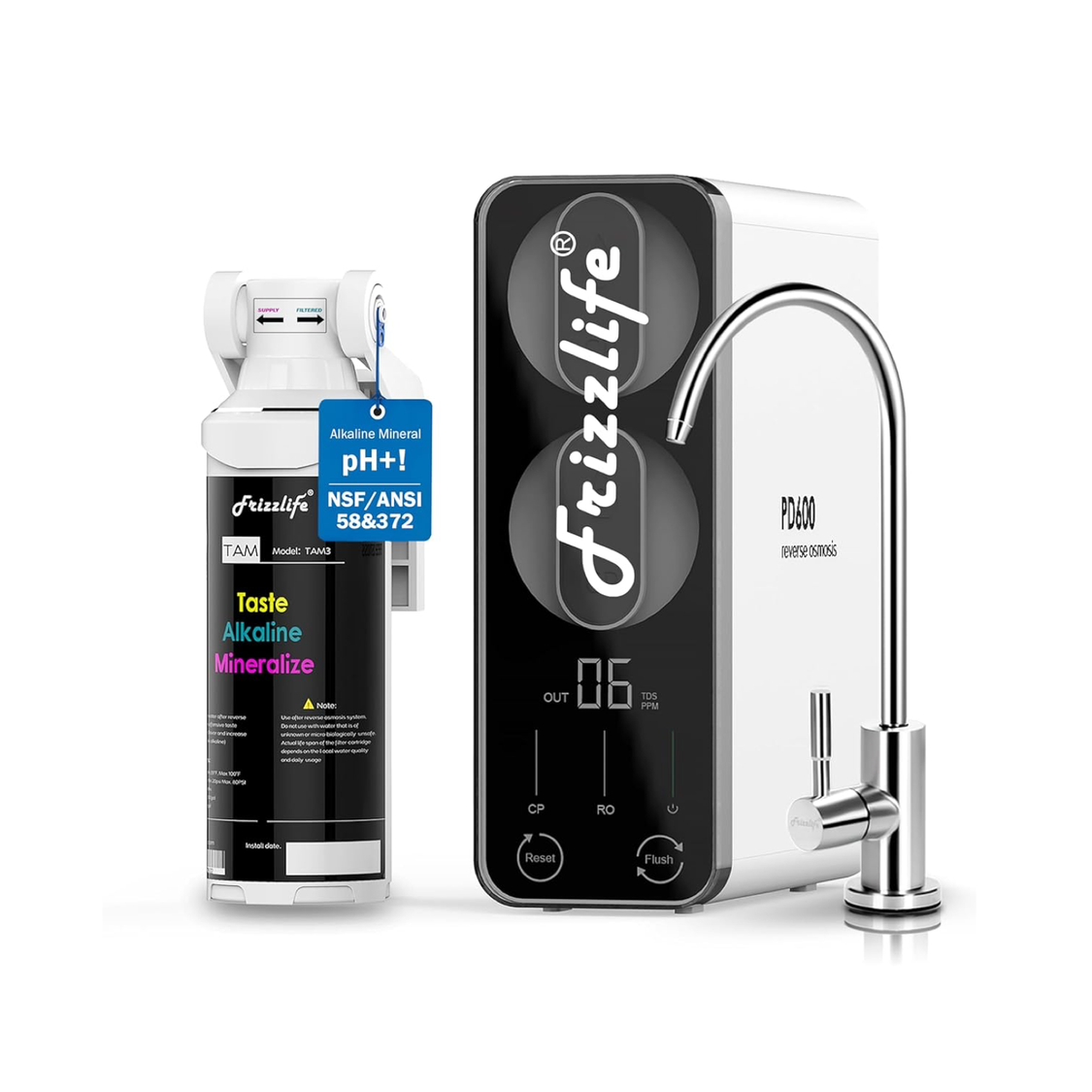
Frizzlife PD600-TAM3
Explore an under-sink reverse osmosis system with a remineralization stage for households looking for filtered RO water with mineral conditioning.
View PD600-TAM3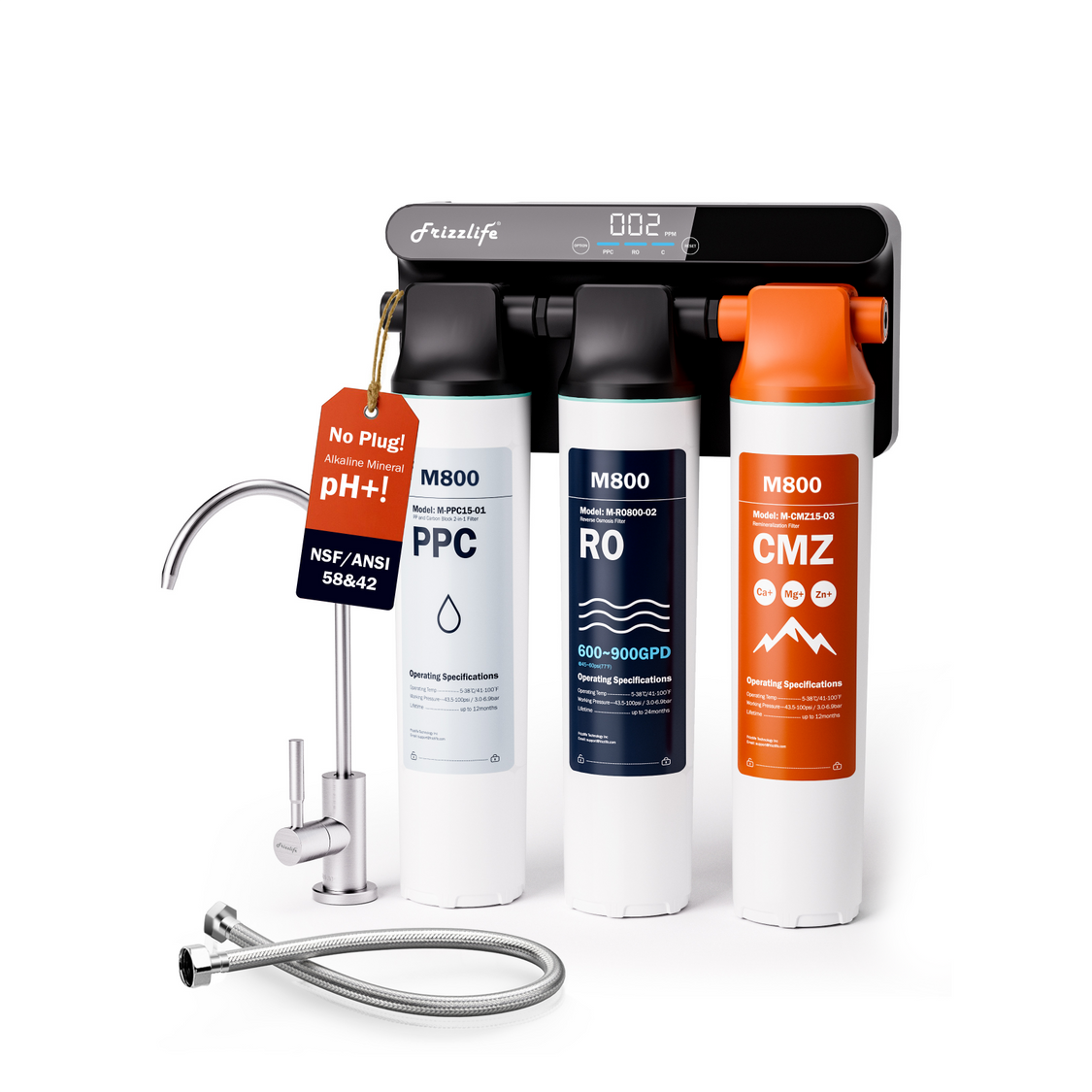
Frizzlife M800
Explore the M800 reverse osmosis system for a complete under-sink filtration setup when upgrading or replacing an existing RO configuration.
View M800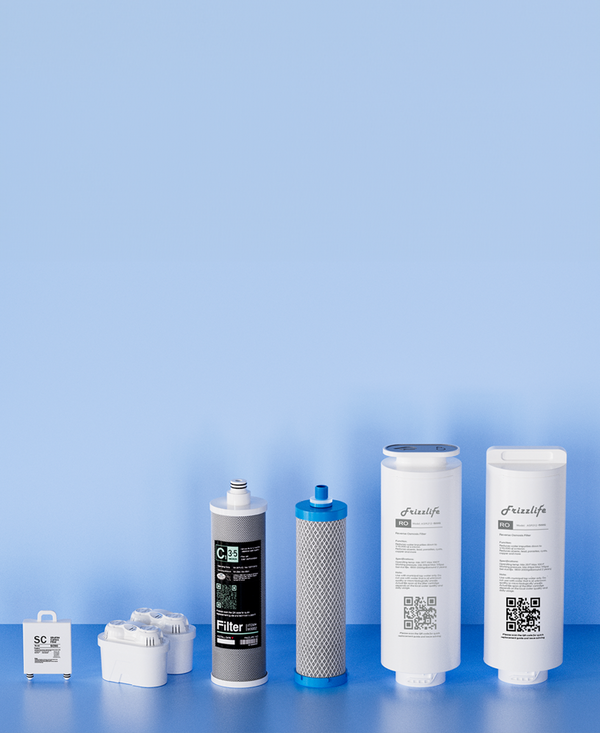
Replacement Filters
Find replacement filters for your Frizzlife system and confirm the correct cartridge for your model before your next scheduled filter change.
Find Replacement FiltersWhen sanitation, tank care, or faucet cleaning may be required by the system manual
Some systems specify periodic sanitation, storage-tank care, or tank air-charge checks. Others use sealed water paths that require different service procedures. Do not introduce chemicals or adjust a tank unless the instructions expressly direct you to do so.
Faucet outlets and removable reservoirs can accumulate deposits or residue over time. Clean them only with the method approved for the material and system. Rinse thoroughly before returning the unit to service.
What to do after extended inactivity, travel, or storage
After an extended idle period:
-
Check the manual’s storage or restart instructions.
-
Inspect tubing, reservoirs, housings, and connections.
-
Flush the system with clean feed water as directed.
-
Clean and dry approved removable parts if required.
-
Complete any specified sanitation procedure.
-
Replace cartridges when the manual calls for replacement after storage or when taste, odor, or flow remains abnormal.
-
Perform a complete leak check after restart.
How long a system can remain idle before special service is required depends on its design. Avoid creating a universal “safe” storage period.
When replacement—not cleaning—is appropriate
Replace a remineralization cartridge when it reaches the specified interval or capacity, its media performance has declined, it has been damaged, or the manual requires replacement after certain storage conditions. Sealed alkaline cartridges are generally not intended to be opened and cleaned internally.
Before ordering, confirm the exact system and cartridge number, connection style, stage position, and flow direction. Owners looking for compatible configurations can review Frizzlife alkaline remineralizer options after checking their model documentation.
Common Alkaline Filter Maintenance Mistakes and How to Avoid Them
Stretching the replacement schedule without checking performance
Extending cartridge use solely to reduce replacement frequency can allow performance to decline unnoticed. Use the model’s schedule as the baseline and watch condition-based signals such as taste, flow, odor, and repeated pH or TDS trends.
Treating taste, pH, or TDS as a stand-alone water-safety test
Taste cannot identify many water-quality problems. TDS measures dissolved ionic material but not specific contaminants, and pH indicates acidity or alkalinity rather than overall filtration performance.
Use these observations to support maintenance decisions, not to certify water safety. If source-water quality is uncertain or an unexplained change persists, appropriate water testing or qualified service may be needed.
Replacing the alkaline stage before checking clogged upstream filters
A new remineralizer will not correct a blocked sediment filter, an overdue carbon filter, restricted tubing, or a tank problem. Check the whole flow path before assuming the final stage has failed.
Skipping the required post-installation flush
Incomplete flushing can leave startup water with particles, cloudiness, or unusual taste. Follow the specified flush duration or volume even if the water appears clear immediately.
Installing the cartridge backward or in the wrong system stage
Always check the stage label and flow arrow. Photograph the original installation before disconnecting anything, especially in a multi-stage system with similar-looking inline cartridges.
Reusing damaged seals or failing to perform a leak check
Do not reuse a seal that is cracked, stretched, flattened, or unable to sit correctly in its groove. Check for leaks during startup and again after the system reaches normal operating conditions.
Cleaning replaceable media with hot water, abrasives, or unapproved chemicals
Unapproved cleaning can damage the media, housing, seals, or water-contact surfaces. Do not wash or regenerate disposable alkaline media unless the manufacturer specifically provides a procedure.
Assuming every tanked, tankless, countertop, and under-sink system uses the same procedure
Replacement steps differ by design. A countertop reservoir may need washing and air-drying, while an under-sink inline cartridge requires valve shutdown, depressurization, tubing checks, and leak testing. Tanked RO systems may have additional draining or refill instructions.
Treat the manual as part of the maintenance equipment.
Match the Maintenance Plan to the System Type
Alkaline pitchers and countertop filters: reservoir cleaning, flushing, and cartridge timing
For pitchers and reservoir-style countertop filters, focus on:
-
Replacing the cartridge on its model-specific schedule
-
Washing only removable, approved components
-
Preventing residue from accumulating in the reservoir
-
Completing the initial flush or soak procedure
-
Keeping clean components dry during storage when directed
-
Flushing and inspecting the unit after extended inactivity
Do not assume a pitcher cartridge can be cleaned internally or used indefinitely because flow remains acceptable.
Under-sink alkaline filters: tubing, fittings, faucet, seals, and flow checks
Under-sink maintenance should include cartridge replacement, tubing inspection, seal checks, faucet cleaning where approved, and a post-service leak test.
Because small leaks may not be visible from the front of a cabinet, inspect the system with a flashlight and check the cabinet base after repressurization. Investigate unexplained moisture promptly.
RO systems with remineralization: coordinated maintenance across every filtration stage

RO systems require a coordinated schedule. Record separate service dates for sediment filters, carbon stages, the membrane, post-filters, and the alkaline cartridge. Replacing every component at the same interval is not automatically correct; each stage may have its own service life and replacement trigger.
When troubleshooting, determine whether the symptom affects:
-
RO production
-
Tank filling or delivery
-
Faucet flow
-
Taste before remineralization
-
Taste after remineralization
-
pH or TDS change across the final stage
This stage-by-stage approach helps prevent unnecessary replacement and makes recurring problems easier to identify.
When recurring alkaline-stage problems point to a broader system issue
Repeatedly short cartridge life, continuing slow flow, persistent odor, or unstable water characteristics may indicate that the alkaline filter is not the root cause. Review source-water conditions, pre-filter maintenance, membrane performance, tank operation, installation orientation, and system sizing.
If an older configuration repeatedly requires piecemeal repairs, it may be useful to review how integrated Frizzlife alkaline RO systems coordinate reverse osmosis filtration and remineralization. Confirm installation requirements and model-specific maintenance details before making a system decision.
Keeping an alkaline water filter working well comes down to coordinated care: replace cartridges according to model guidance, flush them correctly, inspect seals and fittings, track taste and flow, and maintain every upstream stage. When symptoms appear, troubleshoot the entire water path instead of assuming the alkaline cartridge is always at fault.
References
https://www.cdc.gov/drinking-water/about/about-home-water-treatment-systems.html