

600 vs 800 vs 1000 vs 1200 GPD RO System: Which Should You Choose?
Best choice for most homes: 600–800 GPD
Best value: 600 GPD
Best family choice: 800 GPD
Only choose 1000–1200 GPD for high-demand or shared-use scenarios
600 vs 800 GPD is the real decision for most 2–4 person households. These two tiers cover almost all normal residential use without unnecessary oversizing. 1000–1200 GPD should only be considered for high-demand or shared-use scenarios, not typical home kitchens.
Who should choose each GPD option?
Comparison snapshot: 600 vs 800 vs 1000 vs 1200 GPD
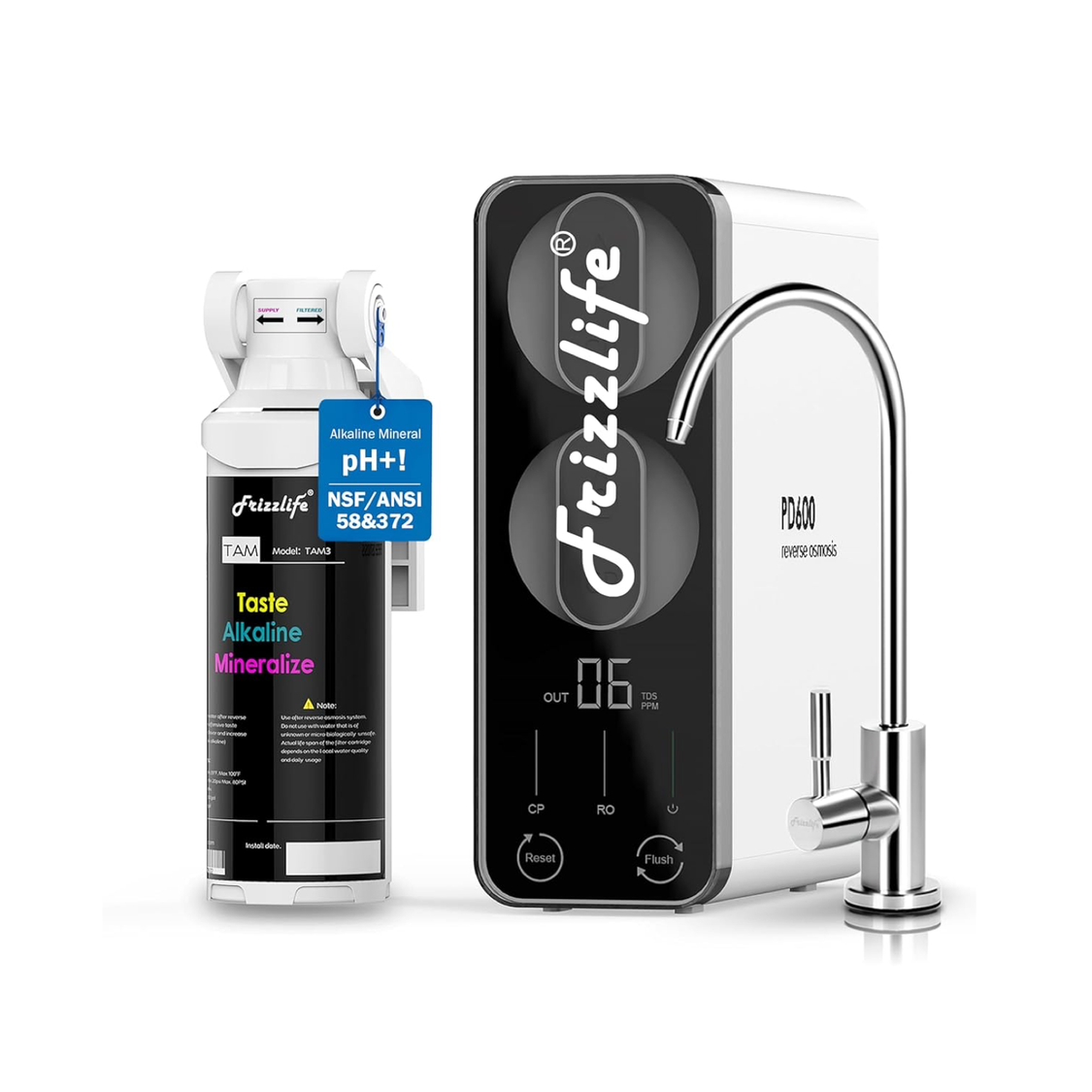


Choose 600 GPD if your home mainly uses RO water for drinking, coffee, cooking, pet bowls, and bottle filling, and you care more about value than shaving a little time off heavy-use moments.
Choose 800 GPD if your kitchen has busy windows where several people fill bottles, a coffee maker, and a pot back-to-back, and you want less slowdown and faster refill feel.
Choose 1000 GPD only if 800 GPD has already proven insufficient during repeated peak-use moments, but 1200 GPD is still beyond your budget or needs.
600 GPD fits steady and evenly distributed daily use, where water demand is not concentrated in short time windows.
800 GPD fits households where multiple people often use RO water back-to-back within the busiest 10–20 minutes of the day.
This distinction matters more than annual usage because performance is most noticeable during peak demand, not average consumption.
Choose 1200 GPD only if you have very high repeated demand, shared kitchen use, or semi-commercial style use at home.
Avoid 1000–1200 GPD if you are a normal 2–4 person household attracted mainly by the bigger number. Avoid 600 GPD if your main frustration is peak-time faucet speed, not daily volume.

Choose a 600 GPD RO system if your home uses moderate amounts of RO water and price matters more than maximum faucet speed
For most homes, 600 GPD is already far above actual daily drinking-water needs.
GPD ratings are measured under ideal test conditions, not under real kitchen usage patterns where flow is affected by pressure, temperature, and demand timing.
According to the EPA Drinking Water Filtration Fact Sheet, performance of home water treatment systems depends on operating conditions such as water quality and system environment, meaning rated capacity should be interpreted as a reference under controlled conditions rather than real-world constant output.
Actual output is lower because inlet pressure, water temperature, and feed water quality all affect membrane performance. Cold water and low pressure both reduce production speed, which means GPD should be treated as a performance range rather than a fixed promise.
That said, 600 GPD is still a strong entry-level tier for modern tankless RO systems. For couples and many families of four, it comfortably covers daily use without noticeable delay in normal conditions.
Choose 600 when your usage is steady rather than clustered. You drink filtered water throughout the day, but rarely have multiple people drawing water at the same time. You prioritize value and simplicity over peak-speed performance.
Do not choose 600 if your main issue is repeated back-to-back use during busy hours. In that case, 800 GPD is usually the best fit.
Choose an 800 GPD RO system if your family often fills bottles, coffee makers, and cooking pots back-to-back and you do not want morning lag
This is where the 600 vs 800 GPD RO system differences matter most. On paper, both can cover the daily needs of many homes. In real life, 800 often feels better during short busy windows. That is why many buyers see 800 GPD as the sweet spot.
If your household has 4–6 people, school bottles, gym bottles, coffee brewing, cooking, and frequent guest use, the issue is not average gallons per day. The issue is how the system behaves when demand stacks up in 10 to 20 minutes. That is where 800 GPD earns its higher price.
Choose 800 if you hate the feeling that the faucet is “keeping up, but barely.” It is also a smart pick if you want some future-proofing for a growing family without jumping into the cost of 1000 or 1200 GPD.
Do not choose 800 just because the number sounds safer. If your actual use is modest and your budget matters, 600 usually gives up very little.

Choose a 1000 GPD RO system only if you want extra headroom beyond 800 GPD but cannot justify jumping all the way to 1200
The 800 vs 1000 GPD RO system comparison is less dramatic than buyers expect. There is a step up in flow headroom, but for normal home use, it is often a small practical gain for a noticeable price increase.
So when does 1000 make sense? Mostly when you are a premium buyer who wants more than 800, expects heavier-than-average use, but still sees 1200 as too much. It can also fit a large household that wants strong faucet performance but is not crossing into office, shared suite, or restaurant-like demand.
The problem is that 1000 GPD often sits in an awkward middle. It is not the clear value choice like 600. It is not the common sweet spot like 800. It is not the obvious heavy-use answer like 1200. That does not make it bad. It just means you should only choose it for a clear reason.
Choose a 1200 GPD RO system only for very high-demand homes, shared-use setups, or premium buyers who value flagship flow over value
The 1000 vs 1200 GPD RO system differences matter only when your demand is already high enough to justify shopping in this tier. A 1200 GPD system is about maximum on-demand flow, more headroom, and often premium features. It is not usually about necessity for a normal family.
Choose 1200 if your kitchen use is unusually heavy, if multiple adults share one kitchen, if you regularly fill large containers, or if the system supports office or restaurant-like use. This is also the tier for buyers who know they are paying extra for flagship performance and are fine with that.
Do not choose 1200 “just in case.” That is how buyers overspend.
When does 800 GPD make more sense than 600 GPD for a 2–4 person household?
For a normal 2–4 person home, 800 GPD usually makes more sense only when water use is concentrated into busy windows. If you are a couple with moderate use, 800 is often unnecessary and 1000–1200 is hard to justify. If you are a family of four with busy mornings, 800 often makes more sense than 600. If you are a quiet family of four with steady use and price sensitivity, 600 still wins.
The key point is simple: for most 2–4 person homes, the real decision is 600 vs 800, not 1000 vs 1200.
The core trade-offs between options that actually matter
Why 600 GPD works better when your actual daily use is far below the rating
Many buyers ask what GPD means in an RO system and then make the wrong leap: “If I use 80 gallons a day, I should buy much more than that.” Some headroom is smart. Chasing a huge number is not.
A 600 GPD system is already oversized for the actual purified-water needs of many homes. That is not a flaw. That is why it works well. You are buying enough production to avoid waiting in normal use, not trying to match the rating to your exact daily total. NSF consumer guidance also emphasizes choosing water treatment systems based on household needs, water quality, and usage conditions.
If your household drinks, cooks, and fills bottles but stays far below even half of 600 GPD, the extra jump to 800, 1000, or 1200 often does not change your day much.
This is also where buyers confuse RO system flow rate vs daily water usage. Daily usage tells you whether a system is broadly adequate. Flow rate during peak moments tells you whether it feels convenient. If your daily use is low and your peak moments are mild, 600 is the better fit because it solves the problem without paying for a bigger one.
Why 800 GPD is often the sweet spot between speed, efficiency, and not overpaying
If you are choosing between 600 and 800, this is where the decision usually turns. The 800 GPD tier often improves the “busy kitchen” experience enough to be noticeable, but without the steep jump in cost that comes with 1000 or 1200.
It also tends to be where buyers get a better balance of water efficiency and speed. Some 800 GPD systems have a better pure-to-waste ratio than 600 GPD models. That does not always erase the higher purchase price, but it can narrow the long-term gap. More important, 800 often gives you the feeling of instant readiness that people wanted when they left older tanked systems behind.
Water efficiency differences between 600, 800, 1000, and 1200 GPD systems are also model-specific and should not be generalized by GPD tier alone.
Two systems with the same GPD rating can still perform differently depending on membrane design and internal flow optimization.
What do you give up by choosing 600 GPD over 800 GPD?
You give up some peak-time comfort. That is the honest answer.
In a quiet kitchen, you may barely notice the difference. In a busy kitchen, you might. The gap shows up when someone fills two large bottles, then a coffee maker, then a pot, and expects the faucet to stay equally strong through the whole sequence. An 800 GPD system is more likely to feel effortless there.
You may also give up a slightly better wastewater ratio, depending on the model. Some 600 GPD systems waste a bit more water per gallon of purified water than 800 GPD systems. But for many buyers, that trade is acceptable because the upfront savings are larger than the operating difference.
So the sacrifice is real, but narrow: less speed margin, not a huge loss in basic capability.
What do you really gain by moving from 800 GPD to 1000 or 1200 GPD in normal home use?
Usually, not much that changes daily life.
This is the part many buyers need to hear clearly. In a normal family kitchen, moving from 800 to 1000 or 1200 GPD often buys more spec-sheet comfort than real faucet benefit. Yes, the system may produce water faster during repeated draws. Yes, it may support heavier repeated draws. Yes, it may have a stronger premium feel. But if your household never pushes 800 hard, those gains stay mostly theoretical.
That is why 1000 vs 1200 GPD RO system differences matter less than 600 vs 800 for most homes. Once you are already in the high-flow range, the next jump helps only if your demand is also high.
Is 800 GPD worth it over 600 GPD if you mostly care about RO system flow rate at peak times?
Yes, often. If peak-time flow is your main pain point, 800 is the upgrade that usually makes sense. Not because 600 is weak, but because 800 is where many households stop noticing the system at all.
If your complaint is “our old unit runs out,” 600 may already fix it. If your complaint is “I never want to think about refill speed again,” 800 is the safer choice.
Cost differences and long-term ownership implications
Upfront price differences: where 600 GPD usually wins and where 1200 GPD becomes poor value
Upfront price is where 600 GPD usually has the clearest advantage. In many lineups, the jump from 600 to 800 is meaningful but still manageable. The jump from 800 to 1000 or 1200 is where value often starts to break down for normal households.
That is because the practical benefit does not rise as fast as the price. A 1200 GPD system may cost hundreds more than a 600 or 800 GPD unit, but it does not make your drinking water twice as useful. If your home never comes close to stressing an 800 GPD system, paying flagship money for 1200 is poor value.

Filter replacement and operating cost: how 600, 800, 1000, and 1200 GPD systems compare over time
Operating cost is usually less dramatic than buyers expect. In many cases, annual filter costs across 600, 800, and even higher tiers are closer than the purchase prices suggest. So the long-term cost gap often comes more from the initial buy-in than from maintenance.
That said, higher-GPD systems can use more specialized parts, and proprietary cartridges matter more than the GPD number itself. If replacement filters are hard to find or expensive, the “better” system becomes the worse ownership choice. This is one reason commercial vs residential high GPD RO system decisions should not be made on flow rate alone.
Water efficiency and wastewater trade-offs by GPD tier
Some higher-GPD systems are more water-efficient, with lower wastewater ratios. That can make 800 look better than 600 in some comparisons, and 1200 look attractive on paper. But do not overrate this unless your water costs are high or your usage is heavy.
A slightly better ratio is nice. It rarely justifies a major price jump by itself.
At what point does paying more for 800 or 1200 GPD become a waste of money?
Paying more for 800 becomes wasteful when your household is small, your use is moderate, and you rarely stack multiple water tasks at once. Paying more for 1200 becomes wasteful when you are buying reassurance, not solving a real bottleneck.
If your actual issue is habit-based, not capacity-based, more GPD will not fix it.
Fit, installation, or usage differences that change the choice
Why 600–800 GPD tankless systems are the practical upgrade from older 50–400 GPD tanked units
For most homeowners, the biggest real-world jump is not 800 to 1200. It is old tanked to modern 600–800 tankless. That is where you feel faster flow, less waiting, and no small tank running low during busy hours.
This is why many buyers asking how to choose the right RO system flow rate should start by asking what they are upgrading from. If you are coming from a low-GPD tanked system, 600 or 800 often feels transformative.
When under-sink space, power access, and plumbing layout make a higher-GPD system a worse fit
High-GPD tankless systems need power, and larger units can be less forgiving under tight sinks. If your cabinet is cramped, your outlet access is awkward, or your plumbing layout is messy, a bigger system can become a worse ownership experience even if the flow rate is better.
Inlet water pressure affects RO system output across all GPD tiers, not just high-capacity models. When pressure is low, actual production drops significantly and can reduce or even eliminate the expected advantage of higher GPD ratings. This means a 1000 or 1200 GPD system may perform closer to a lower-tier system in real household conditions.

Why a 1200 GPD RO system can be overkill in apartments, condos, and light-use kitchens
In smaller homes, the problem is rarely raw capacity. It is usually space, budget, and realistic use. A 1200 GPD system in a light-use condo kitchen is often like buying a commercial prep sink for a studio apartment. It works, but it solves the wrong problem.
Is a higher RO system flow rate still worth it if your bottleneck is faucet habits, not capacity?
Sometimes no. If people in your home fill one thing at a time and do not create heavy demand windows, you may not notice the jump from 600 to 800, much less 1000 or 1200. RO system flow rate vs tank refill speed matters most when demand is clustered. If your habits are spread out, higher GPD has less value.
Maintenance, risk, and regret patterns by option
Why buyers regret undersizing from low-GPD tanked systems more often than choosing 600 or 800 GPD tankless
Most regret stories come from people who stayed too small for too long, not from people who chose 600 instead of 800. Moving from very low-GPD tanked systems to 600–800 tankless usually removes the biggest frustration: slow recovery and running out during busy times.
That is why “Is 600 GPD RO enough for a small business?” and “Is 800 GPD RO enough for a large household?” need context. For a small business or restaurant, 600 may be too light if demand is repeated all day. For a large household, 800 is often enough because use is heavy but still intermittent.
When 600 GPD is the smarter low-regret choice over 800 GPD
600 is the smarter low-regret choice when you know your use is moderate, your budget matters, and you are not trying to solve a severe speed problem. In that case, paying more for 800 can create a different kind of regret: spending extra and never feeling the difference.
Why 1000–1200 GPD buyers risk paying for unused capacity
This is the main regret pattern at the top end. Buyers like the idea of “never outgrowing” the system, but many never come close to using that headroom. If your home is not office, restaurant, or shared-use heavy, the extra capacity often sits idle.
What maintenance and support risks matter more than GPD when comparing brands?
Certification, filter availability, support, and replacement part access matter more than the jump from 800 to 1000. A slightly smaller system with easy maintenance is usually the better buy than a bigger system with uncertain long-term support.
How to choose based on real household demand, not marketing numbers
Choose by peak-demand windows, not average daily gallons
This is the best rule for how many GPD RO systems you need. Do not size only by average daily gallons. Size by the busiest 10 to 20 minutes in your kitchen. That is when you notice whether the system feels fast enough.
Which GPD ranges are a poor fit for singles, couples, families of four, and 5+ person homes?
For singles and couples, 1000–1200 GPD is usually a poor fit unless use is unusual. For many couples, 600 is enough. For families of four, 600 or 800 is usually the real choice. For 5+ person homes, 800 becomes easier to justify, while 1000–1200 makes sense only if use is intense and repeated.
Will you actually notice the difference between 600 and 800 GPD at the faucet?
Sometimes yes, sometimes no. In light use, maybe not. In back-to-back use, yes, more often. That is why the 600 vs 800 GPD RO system differences are about convenience, not basic adequacy.
For a normal family, is there any real benefit to 1000 or 1200 GPD over 600–800 GPD?
Usually no. Not unless your normal family behaves more like a shared-use or semi-commercial kitchen. Also remember that actual RO output is lower than rated GPD, and temperature matters. Cold feed water can reduce production, so some buyers in colder climates may value extra headroom. Even then, 800 is often enough before 1000 or 1200 becomes necessary.
Which option is best for your buyer type
Best choice for budget-conscious couples: 600 GPD RO system
If you want tankless speed without paying for bragging rights, 600 is the cleanest value pick.
Best choice for most families: 800 GPD RO system
If your home has busy kitchen windows and you want fewer slowdowns, 800 is the most balanced family choice.
Niche choice for buyers who have outgrown 800 GPD: 1000 GPD RO system
1000 GPD is a niche step-up option that only makes sense when 800 GPD has already proven insufficient during repeated peak-use situations. In most residential cases, it does not provide a meaningful improvement over 800 GPD.
Best choice for heavy-use or semi-commercial households: 1200 GPD RO system
If your home use is unusually high, shared, or close to office or restaurant patterns, 1200 is the tier that fits.
Final decision rules: choose the smallest system that removes waiting without paying for unused capacity
Choose 600 GPD when value is the priority and your usage is steady, not intense
Choose 800 GPD when convenient during busy kitchen windows matters most
Skip 1000 GPD unless you have a clear reason it fits better than 800 or 1200
Avoid 1200 GPD unless your household can truly use the extra flow rate regularly
Before You Choose
-
If your home is 2–4 people and price matters, cross off 1000 and 1200 first.
-
If your main complaint is morning slowdown, cross off 600 before you cross off 800.
-
If you rarely fill large bottles, pots, and coffee makers back-to-back, cross off 800 as a “need.”
-
If your sink cabinet is tight or power access is poor, cross off the largest unit that barely fits.
-
If your inlet pressure is weak, do not pay for top-end GPD without checking expected real output.
-
If you want the lowest regret after upgrading from an old tanked unit, start with 600 or 800, not below.
-
If you are buying “just in case,” cross off 1200 unless your use already proves it.
FAQs
Is 600 GPD RO enough for a small business?
Usually not, unless it is very light use. A small office with occasional drinking-water use might get by, but a café, busy office kitchen, or restaurant-style setup can outgrow 600 fast. The issue is repeated peak demand, not just total gallons. If water is drawn all day by many people, 800 may still be light, and 1000 or 1200 becomes easier to justify.
Is 800 GPD RO enough for a large household?
Often yes. For many 5+ person homes, 800 GPD is enough because household demand comes in waves, not as constant all-day draw. It is usually the better answer than 1000 or 1200 unless your home has very heavy bottle filling, frequent guests, shared kitchen use, or semi-commercial habits. If your concern is busy mornings, 800 is often the practical ceiling before overspending starts.
Will most households notice a real daily-life difference between 800 GPD and 1000–1200 GPD RO systems?
For most 2–4 person households, the daily-life difference between 800 and 1000–1200 GPD systems is minimal. Higher ratings mainly improve peak-speed under repeated heavy use. Unless water demand is consistently high and back-to-back, 800 GPD already delivers nearly the same real-world experience.
Is a higher GPD membrane better?
Not by itself. A higher GPD membrane is better only if it solves a real speed or peak-demand problem. If your daily use is modest and your faucet habits are light, a higher GPD membrane can just mean higher upfront cost for little practical gain. Support, filter cost, efficiency, and fit often matter more than moving from 800 to 1000 or 1200.
References