


If you are asking how tankless RO systems work, the short answer is that they produce reverse osmosis water as you request it rather than filling a separate pressurized storage tank. When the dedicated faucet opens, the system detects demand, activates its internal components, and pushes incoming water through several filtration stages. Treated water goes to the faucet while the concentrate stream goes to the drain.
This on-demand design can free up under-sink space and avoid relying on a stored reserve. However, “tankless” does not mean the system has unlimited flow, produces no wastewater, or works without pressure. Most tankless reverse osmosis systems use an electric booster pump, and actual performance depends on the model, incoming water pressure, feed-water conditions, filter condition, and installation.
Understanding those details is essential when comparing tankless vs. traditional reverse osmosis for your kitchen.
How do tankless RO systems work?
A tankless RO system is generally a point-of-use water treatment system installed near a single fixture, usually under a kitchen sink. Like a traditional RO unit, it uses pressure and a semipermeable membrane to separate treated water from a concentrate stream. The defining difference is how the treated water reaches you: a tankless system produces it on demand instead of storing it in a pressurized tank.
The short answer: tankless RO filters incoming water in real time instead of storing treated water
When you open the RO faucet, sensors or controls inside the system detect water demand. A booster pump typically starts and supplies the pressure needed to move feed water through the filtration stages and RO membrane.
The membrane allows part of the water stream to pass through as treated water. Substances rejected by the membrane become more concentrated in the remaining water, which is directed toward the drain. Depending on the system design, treated water may then pass through a postfilter before reaching the faucet.
When you close the faucet, the system detects that demand has ended and stops producing water. This operating cycle is the basis of tankless reverse osmosis technology.
Step 1: Feed water enters the point-of-use system
A feed-water connection sends cold water from the home’s plumbing into the RO unit. Under-sink RO systems are point-of-use systems, meaning they treat water for a specific fixture rather than filtering every water line in the house.
Valves, sensors, and electronic controls may monitor the incoming supply and the faucet’s status. The exact component layout varies by model, but all RO systems need an adequate and compatible feed-water supply.
Tankless systems should normally be connected according to the manufacturer’s instructions. Connecting a system to an unsuitable supply or operating it outside its specified pressure and water-quality conditions may reduce flow or interfere with normal operation.
Step 2: Prefilters help protect the reverse osmosis membrane
Before water reaches the RO membrane, it typically passes through one or more prefiltration stages. These stages may be designed to capture sediment or condition substances that could interfere with membrane performance.
Prefiltration matters because the RO membrane has a more specialized job than a basic particulate filter. Allowing sediment or other problematic feed-water constituents to reach it without appropriate pretreatment may contribute to fouling, restricted flow, or shortened service life.
The number, type, and arrangement of prefilters are model-dependent. A system with an integrated filter cartridge may package several functions differently from a unit with separate housings. “Fewer cartridges” also does not necessarily mean fewer treatment functions; buyers should check what each cartridge is designed to do.
Step 3: Pressure pushes water through the semipermeable RO membrane
Reverse osmosis depends on pressure. The system applies pressure to feed water on one side of a semipermeable membrane. Some water passes through the membrane as the treated stream, while rejected material remains more concentrated on the feed side.
This pressure requirement explains why inlet conditions matter and why tankless systems typically use booster pumps. A traditional tank RO system can produce water gradually and store it for later use. A tankless design must produce water fast enough to supply the faucet during the draw, so active pressure support is commonly part of its operation.
The membrane does not make water vanish, nor does it convert the entire incoming stream into treated water. Reverse osmosis inherently creates two streams.
Step 4: Treated water and the concentrate stream follow separate paths
Water that passes through the membrane becomes the treated, or permeate, stream. Water carrying a higher concentration of rejected substances becomes the concentrate stream and is routed to a drain connection.
This means tankless reverse osmosis does not eliminate wastewater. Water efficiency can vary considerably among systems, and published ratios are not directly comparable unless they use consistent definitions and test conditions.
When evaluating a model, check how the manufacturer defines its efficiency or recovery claim. Inlet pressure, temperature, feed-water composition, production rate, and test procedure can all affect the result. A category-wide statement that all tankless systems have the same treated-to-drain ratio would be misleading.
Step 5: A postfilter conditions the treated water before dispensing
Many systems send treated water through a postfilter before it reaches the dedicated faucet. A post-carbon stage, for example, may be included to condition taste. Some models may use other finishing stages, but these should not be assumed to be present in every system.
A postfilter is not a replacement for the RO membrane. Each component has its own function, and filter maintenance should follow the instructions for the specific model rather than a generic schedule.
Step 6: Opening the faucet triggers on-demand water production
The defining part of tankless RO system operation occurs when the faucet opens:
-
The system detects a pressure or flow change.
-
An internal valve opens as needed.
-
The booster pump typically activates.
-
Feed water moves through the prefilters and membrane.
-
Treated water travels through any finishing stage to the faucet.
-
Concentrate water travels to the drain.
-
Closing the faucet signals the system to stop production.
Depending on the design and installation, there may be a brief startup response before full faucet flow develops. That does not necessarily indicate a defect. A persistent delay, weak flow, repeated stopping, or an error signal should be investigated using the model’s manual.
How a tankless system works without a pressurized storage tank
A conventional tank-based system produces treated water and accumulates it in a bladder-style pressurized tank. Air pressure inside the tank helps push stored water to the faucet when it is opened.
A tankless unit replaces that stored reserve with real-time production. To make this practical, it generally combines a higher-output membrane configuration with active pressure control and electronic demand sensing. The system is intended to continue delivering water while the faucet remains open, subject to its rated production and actual operating conditions.
“Continuous” does not mean unlimited. A tankless unit can only supply water at the rate its membrane, pump, filters, and plumbing conditions allow. If faucet demand exceeds real-time production capacity, the user may experience lower-than-expected flow.
Why tankless RO systems typically use a booster pump and electricity
EPA materials describe tankless RO models as providing treated water on demand, typically with help from a booster pump. That pump creates or stabilizes the pressure needed to move water through the membrane at a useful rate.
Because the pump, sensors, valves, indicators, and control board generally need electrical power, many tankless systems require a nearby outlet. The outlet location and electrical requirements must match the installation instructions for the particular model.
This creates an important trade-off. Pump-assisted operation makes real-time production possible, but it also introduces:
-
Dependence on electrical power
-
Some operating sound or vibration
-
Additional electronic and mechanical components
-
Installation requirements beyond water and drain connections
Do not assume that every tankless model has identical electrical needs. Confirm the product manual before planning the installation.
Production capacity versus actual faucet flow
A system’s production rating and its real-world faucet flow are related, but they are not interchangeable.
Production capacity indicates how much treated water the system can theoretically produce over a defined period under specified conditions. Faucet flow describes how quickly water actually comes out while you are using it. Real faucet delivery may be affected by:
-
Incoming pressure
-
Feed-water temperature and composition
-
Filter and membrane condition
-
Tubing length, diameter, or routing
-
Faucet and fitting restrictions
-
Pump performance
-
Drain-line condition
-
The test conditions used for the published rating
This distinction matters when comparing systems. A high production figure does not guarantee identical flow in every home. Check both the rated output and the conditions under which it was determined.
How inlet pressure, feed-water conditions, and filter condition affect operation
The RO membrane needs sufficient pressure to separate the treated stream from the concentrate stream. If inlet pressure is below the model’s operating range or varies substantially, the system may produce water slowly, start and stop, display an alert, or fail to operate.
Feed-water conditions also matter. Membrane production can change with water temperature and dissolved-solids concentration. Sediment loading or other feed-water characteristics may cause prefilters to become restricted sooner in one home than in another.
Filters add resistance as they collect material. When a prefilter becomes clogged, less water reaches the membrane. A fouled or aging membrane may also produce less treated water. Because these conditions can resemble pressure or pump problems, troubleshooting should begin with the simplest supply and maintenance checks.
Practical troubleshooting when tankless RO flow is slow, delayed, noisy, or interrupted
First consult the model’s manual and any displayed error code. Do not disassemble pressurized or electrical components unless the instructions specifically direct you to do so.
For common operating symptoms, check the following:
-
Slow faucet flow: Confirm that the cold-water feed valve is fully open, tubing is not kinked, filters are correctly installed, and replacement alerts have not been ignored. Low inlet pressure or restricted cartridges may also reduce flow.
-
Delayed startup: A short response may be part of normal demand detection. A new or worsening delay can point to restricted flow, sensor issues, low pressure, or an installation problem.
-
Pump noise or vibration: Some sound is expected when an electric pump runs. Check whether the unit and tubing are secured and not contacting the cabinet in a way that amplifies vibration. Grinding, rapid cycling, or a sudden change in sound warrants attention.
-
Frequent starting and stopping: Verify that the faucet is fully closed, connections are secure, and there are no leaks. Variable feed pressure, a restricted filter, or a control issue may cause cycling.
-
No water at the faucet: Confirm power, feed-water supply, valve position, and filter installation. Also check for a model-specific lockout or fault indicator.
-
Unexpected drain flow: Some drain flow is normal during RO production. Drain flow that continues outside the behavior described in the manual may indicate a valve, pressure, installation, or control problem.
-
Reduced performance after replacement: Recheck cartridge orientation, protective caps, seals, and reset procedures. New filters may also require flushing according to the manufacturer’s instructions.
Tankless RO operation at a glance
|
Stage or symptom |
What normally happens |
What can affect it |
Practical check
|
|---|---|---|---|
|
Feed-water entry |
Cold water enters the point-of-use unit |
Closed valve, low or variable pressure, kinked tubing |
Confirm the supply valve and tubing condition |
|
Prefiltration |
Prefilters help protect downstream components |
Sediment loading, expired or incorrectly installed cartridges |
Check filter status and installation |
|
Pump activation |
The pump typically starts when demand is detected |
Power loss, low-pressure protection, sensor or control issue |
Confirm power and review indicators |
|
RO separation |
Pressure produces treated and concentrate streams |
Pressure, temperature, feed-water condition, membrane condition |
Compare conditions with the model requirements |
|
Faucet delivery |
Treated water reaches the dedicated faucet |
Tubing restriction, filter condition, real-time capacity |
Inspect tubing and assess whether low flow is persistent |
|
Drain discharge |
Concentrate water goes to the drain during production |
Drain restriction, installation issue, model efficiency |
Check drain tubing without assuming normal flow should be zero |
|
System shutdown |
Production stops after the faucet closes |
Leak, incomplete faucet closure, valve or sensor issue |
Check for leaks and unusual continued operation |
Do the benefits of tankless RO systems actually outweigh the trade-offs in your daily use?

The principal tankless RO system benefits are compact installation and on-demand treatment. Whether those advantages outweigh the trade-offs depends on cabinet space, electrical access, incoming pressure, desired flow, and your preference for either active real-time production or a stored reserve.
More usable cabinet space without a separate storage tank
Removing the pressurized tank can free a meaningful portion of the under-sink cabinet. This is useful when the cabinet also contains a garbage disposal, plumbing connections, cleaning supplies, or other equipment.
Tankless does not mean equipment-free, however. The main unit, feed connection, drain connection, faucet tubing, power cord, and clearance for cartridge changes still require space. Measure the installation area and account for door swing, plumbing obstructions, ventilation guidance, and future maintenance access.
On-demand filtration instead of drawing from a stored reserve
A tankless system treats water when it is requested rather than repeatedly drawing from and refilling a storage tank. Users do not have to wait for a depleted tank to refill before another full-tank draw.
Some shoppers describe this as “fresher” water because it has not been held in a separate storage tank. That is a description of the delivery design, not proof that tankless water is automatically higher quality. Treatment performance depends on the membrane, other filter stages, maintenance, operating conditions, and verified model-level claims.
Water efficiency varies by model and test conditions
Some tankless systems are marketed with favorable water-efficiency claims, but the category itself does not guarantee a specific ratio. Reverse osmosis still creates a concentrate stream, and the amount sent to the drain varies by design and operating conditions.
When comparing claims:
-
Determine whether the ratio is expressed as treated water to concentrate water or the reverse.
-
Look for the stated test conditions.
-
Check whether the number is independently verified, certified, or only manufacturer-reported.
-
Avoid comparing two ratios that use different definitions.
-
Remember that household pressure, temperature, and feed-water conditions may differ from test conditions.
Maintenance still includes prefilters, the RO membrane, postfilters, and system checks

Eliminating the storage tank does not eliminate maintenance. Cartridges and membranes still require attention, while tubing, fittings, drain connections, and electronic indicators should be checked periodically.
Replacement timing is not universal. It depends on the model, water use, feed-water conditions, cartridge capacity, and manufacturer instructions. Replacing filters too late can restrict flow and burden the membrane; replacing them solely according to an unrelated generic schedule can create unnecessary expense.
After a replacement, follow the required flushing and reset procedures. A filter-life indicator is a maintenance aid, not necessarily a direct measurement of every aspect of water quality.
Why “tankless” does not automatically mean better filtration or certified performance
Tankless describes the delivery and storage configuration. It does not, by itself, establish which substances a system reduces or whether the product is certified.
NSF/ANSI 58 is a standard associated with reverse osmosis drinking-water treatment systems, but not every tankless RO model is certified under it. In addition, these phrases have different meanings:
-
Certified: A recognized certification body has evaluated a product against identified requirements.
-
Tested: Testing was performed, but the scope, laboratory, method, and result still need to be examined.
-
Meets a standard: This may be a manufacturer statement unless certification is separately documented.
-
Manufacturer-claimed: The claim comes from the manufacturer and should not be treated as independent certification.
Always check the exact model and claim rather than assuming that certification applies to a full product category or brand lineup.
Tankless vs. traditional reverse osmosis: what changes in actual use?
Both designs use the same basic RO principle: pressure moves water through a semipermeable membrane, creating treated and concentrate streams. The major difference is what happens after treated water is produced.
|
Decision factor |
Tankless RO |
Traditional tank RO
|
|---|---|---|
|
Water delivery |
Produced in real time when the faucet opens |
Drawn first from a stored, pressurized reserve |
|
Cabinet footprint |
No separate storage tank, but the powered unit still needs clearance |
Main filter assembly plus a separate tank |
|
Pressure strategy |
Typically uses an electric booster pump |
May rely more heavily on feed pressure and tank air pressure, depending on design |
|
Extended draw |
Continues producing within its real-time capacity |
Strong initial reserve, followed by refill limitations after depletion |
|
Power dependence |
Typically requires electricity |
Some basic designs may dispense stored water without electrical power |
|
Operating sound |
Pump may be audible during production |
Basic non-pumped systems may operate more quietly |
|
Complexity |
Sensors, pump, valves, and electronics may be included |
Often mechanically simpler |
|
Wastewater |
Produces a concentrate stream; efficiency is model-dependent |
Also produces a concentrate stream; efficiency is model-dependent |
Faucet delivery during short draws and extended use
For a quick glass of water, a traditional system can deliver from its existing reserve without waiting for real-time membrane production. A tankless model detects the open faucet and starts producing water, which can create a brief startup response.
For extended draws, a tankless unit does not have a tank to empty, but it is limited by its actual production rate. A traditional unit can deliver its stored volume quickly, then slow down as the reserve is depleted. Which feels more convenient depends on the household’s draw pattern and the capacities of the specific systems being compared.
Performance during low pressure or a power outage
A tankless model may not operate correctly when incoming pressure falls outside its specified range. A booster pump can support membrane pressure, but it does not mean the unit can function under any supply condition.
During a power outage, a typical pumped tankless system cannot produce or dispense water normally. A conventional system may still provide some water already stored in its tank, depending on its design, tank pressure, and valve arrangement. Once that reserve is used, it cannot continue producing water without the conditions its system requires.
Why neither design is universally better
Tankless RO is often the stronger fit for compact cabinets and households that prefer real-time production. Traditional tank RO can be a practical choice where electrical access is unavailable, power reliability matters, or stored reserve is valued.
Filtration quality cannot be determined from the presence or absence of a tank. Compare specific treatment claims, certification records, operating requirements, and rated performance at the model level.
If tankless is a no-go, what alternative setup fits better (tank RO, countertop, or high flow RO system)?
A tankless RO system is a strong fit when saving cabinet space and producing water on demand are more important than having a stored reserve. If those priorities do not match your kitchen or water-use pattern, three alternatives may be worth comparing: traditional tank RO, countertop RO, and higher-flow RO systems. The right choice depends on installation space, electrical access, expected water demand, and whether you value stored water or higher real-time production.
When a traditional tank RO system makes more sense
A traditional tank RO system can be a practical alternative when you value a stored supply of treated water. The tank allows water produced by the membrane to accumulate so that a short faucet draw can be supplied from the reserve rather than requiring the membrane to produce the entire amount at that moment.
This can also matter when electrical access is limited. Some conventional tank RO configurations can dispense water already stored in the tank without continuously running an electric booster pump, although the exact behavior depends on the system design.
The main compromise is space. The storage tank occupies part of the under-sink cabinet, and the available reserve is limited by the tank and system configuration. After the reserve is depleted, the system needs time and suitable operating conditions to produce more water.
When a countertop RO system makes more sense
A countertop RO system may fit better when under-sink installation is inconvenient or when you do not want to modify the plumbing. Because the treatment unit sits on or near the counter, installation can be less dependent on the cabinet space available below the sink.
This configuration can be useful in rental homes, temporary installations, or kitchens where the under-sink area is already crowded. However, countertop systems still require adequate space, access to the required water source or reservoir, and an electrical connection when the model uses powered components.
The important distinction is that countertop describes the installation format, not a specific RO treatment capability. Check the exact model's membrane, filtration stages, production method, water connections, and maintenance requirements rather than assuming all countertop systems perform the same way.
When a higher-flow RO system makes more sense
A higher-flow RO system may be more appropriate when the main problem is sustained water demand rather than cabinet space. For households that frequently fill large containers, cook with RO water, or have several users drawing water close together, real-time production capacity becomes an important consideration.
Do not equate a higher published production rating with guaranteed faucet flow. Actual delivery can still depend on feed pressure, water temperature, filter condition, tubing restrictions, pump performance, and the conditions used to establish the manufacturer's rating.
A higher-flow configuration may also require more installation space, electrical capacity, plumbing connections, or supporting components. Compare the complete installation requirements rather than looking only at the published production figure.
How to narrow down the right RO configuration
If you want a stored reserve and have enough under-sink space, a traditional tank RO system may better match your operating pattern.
If you want to avoid an under-sink installation or plumbing modifications, a countertop RO system may be more practical, provided its water and electrical requirements suit the kitchen.
If you need sustained real-time production for larger or more frequent draws, a higher-flow RO configuration may be worth considering, provided the home's water supply and installation can support it.
If you want compact under-sink installation and on-demand production, a tankless RO system remains the configuration to evaluate.
Before choosing any configuration, confirm:
-
There is enough space for the unit, tubing, connections, and filter-removal clearance.
-
The required water source, drain connection, and faucet or dispensing arrangement are available.
-
Any required power outlet matches the installation instructions.
-
The approved feed-water source and operating-pressure range match the home's conditions.
-
The rated production and expected faucet flow suit your normal draw pattern.
-
Replacement filters are identifiable and available for the exact model.
-
Any certification or treatment claim applies to the complete model being considered, not merely to a component or another product in the same series.
Do not assume that an internal booster pump can compensate for every low-pressure or variable-pressure condition. Likewise, tankless, countertop, tank-based, and high-flow are configuration or delivery descriptions, not automatic indicators of filtration quality. Compare the documented treatment claims, certification status, operating requirements, production conditions, and maintenance requirements of the specific model.
After confirming the installation requirements, compare Frizzlife tankless reverse osmosis systems by their individual specifications and documented claims.
Explore Frizzlife Reverse Osmosis Options
Once you know which RO configuration fits your kitchen, compare individual models by their current specifications, installation requirements, and filter options.
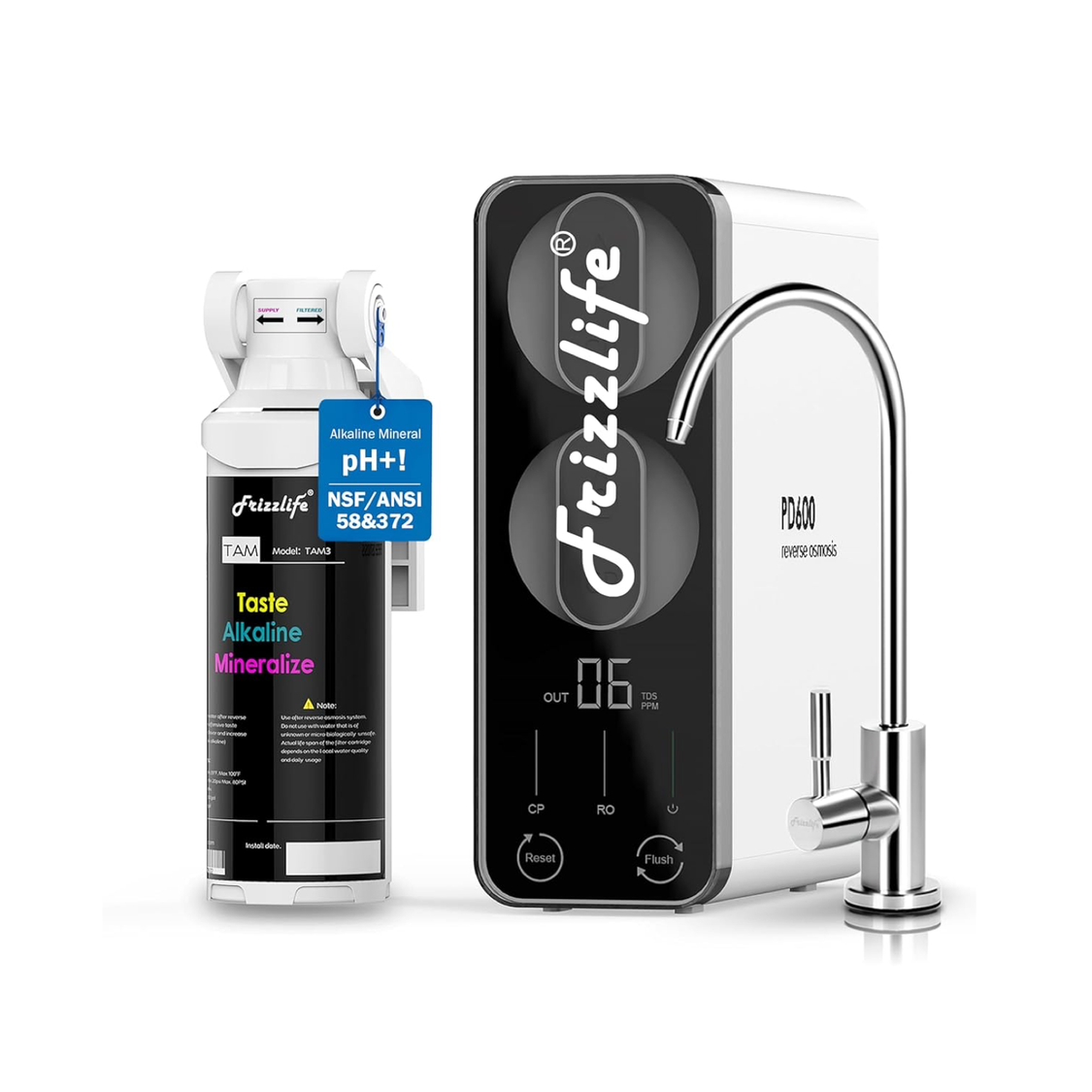
Frizzlife PD600-TAM3
Review the current product specifications, installation requirements, filter details, and model-level treatment information before choosing your system.
View PD600-TAM3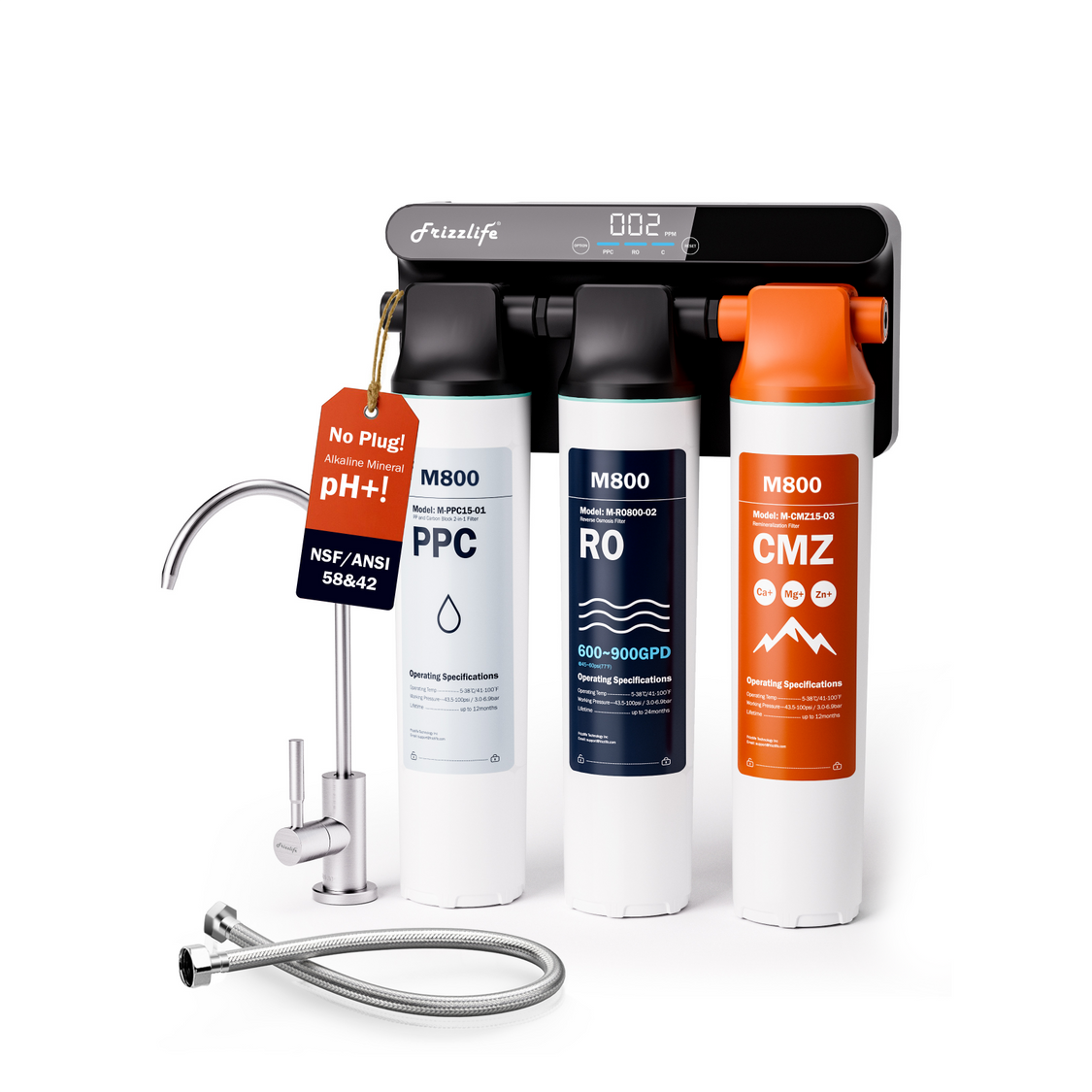
Frizzlife M800
Compare the M800's current specifications, installation needs, filter configuration, and documented product information with your household requirements.
View M800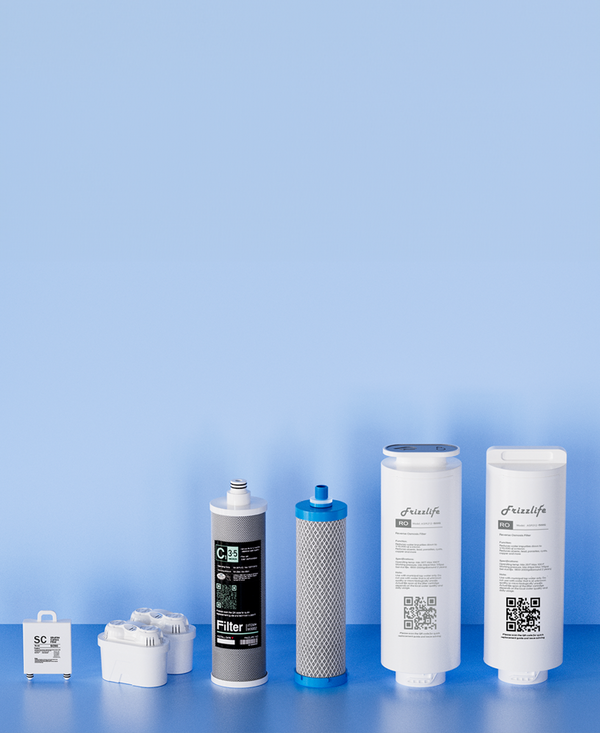
Replacement Filters
Find replacement filters for Frizzlife systems and confirm compatibility with your exact model before ordering.
Find Replacement FiltersFrequently asked questions about tankless reverse osmosis technology
Do tankless RO systems work during a power outage?
Most tankless RO systems rely on an electric booster pump and controls, so they generally will not operate normally during a power outage. Because there is no pressurized storage tank, there may also be no meaningful reserve available to dispense. Check the exact model documentation because system designs can vary.
Can a tankless RO system work with low or variable water pressure?
Only if the incoming supply remains within the model’s approved operating conditions. A booster pump supports pressure across the RO membrane, but it does not guarantee operation with every low-pressure or unstable supply. Pressure outside the specified range may cause slow flow, cycling, alerts, or shutdown.
Does tankless reverse osmosis eliminate wastewater?
No. Reverse osmosis produces a treated stream and a concentrate stream. The concentrate carries rejected material toward the drain. Water efficiency varies by model and test conditions, so review the definition and supporting conditions behind any advertised ratio.
Are all tankless RO systems certified under NSF/ANSI 58?
No. NSF/ANSI 58 is relevant to reverse osmosis drinking-water treatment systems, but certification must be verified for the exact model. “Tested,” “meets NSF standards,” and “certified to NSF/ANSI 58” do not necessarily mean the same thing.
Tankless RO systems work by combining the standard reverse osmosis process with on-demand sensing, pump-assisted pressure, and real-time water production. That design can save cabinet space and avoid dependence on a stored reserve, but it also introduces electricity, pressure, flow, and installation considerations. The better choice is the system whose documented requirements and delivery method fit your kitchen—not simply the one with or without a tank.
References
https://www.epa.gov/system/files/documents/2024-11/ws-products-ro-systems-mini-report.pdf
https://wqa.org/wp-content/uploads/2024/06/GettingSmartSystems.pdf