


Who this is for / who should avoid it
Decision Snapshot (rule of thumb: should/should not)
-
Your water test shows inorganic arsenic at or near 10 parts per billion (ppb) or higher, or you have a private well and want a dependable way to reduce long-term exposure.
-
You drink and cook with the water daily (not just “sometimes”).
-
You can commit to retesting and to replacing cartridges/media on schedule.
-
You haven’t tested your water and don’t know your arsenic level or whether it’s arsenic III or arsenic V.
-
You won’t track filter life or retest after installation.
-
You need high volume at multiple fixtures but are only looking at small countertop or pitcher-style filters.
-
You need treated water at many taps (or for appliances), or you have a specific reason to reduce arsenic beyond drinking/cooking water, and you’re prepared for higher cost and ongoing media maintenance.
You should prioritize this if you have arsenic in well water (or a private well) and you drink/cook with it daily
Avoid this route if you can’t test your water or you won’t track results over time
-
Is it arsenic III, arsenic V, or both?
-
How far above the limit is it?
-
Do you also have high iron, manganese, sulfate, or high TDS that may reduce arsenic capacity?
Is this overkill if your arsenic levels are under 10 parts per billion (EPA limit)?
-
They want an extra margin for safety.
-
Levels can change seasonally.
-
They’re pregnant, preparing infant formula, or have other risk factors.
Core trade-offs that actually affect the decision
Arsenic III vs arsenic V: which systems actually remove arsenic 3 and 5 reliably
-
Arsenic V (As(V)) is often easier to remove with several treatment methods.
-
Arsenic III (As(III)) is harder to remove and may slip through media that performs well on As(V).
-
Many adsorptive media systems (common in cartridges) perform better on As(V) than As(III).
-
Some systems rely on an oxidation step that converts As(III) to As(V) first, then filters it.
-
Reverse osmosis often performs well across both forms when designed and tested for arsenic, but performance still depends on membrane condition, pressure, and water chemistry.
Point-of-use vs whole house arsenic: what “protection” you’re really buying (drinking/cooking vs every tap)
-
Point-of-use (POU) at the kitchen sink: protects drinking and cooking water. Lower cost. Easier maintenance. Faster to install. Typically the best “first decision” for many homes.
-
Point-of-entry (POE) / whole-house: treats all the water entering the home. Higher cost. More maintenance. Makes sense when you need treated water across many fixtures or have other treatment goals tied in.
Arsenic Filter Comparison (RO vs Gravity vs Media)
| System Type | Best For | Arsenic Removal Performance | Key Limitation | Recommendation |
|---|---|---|---|---|
| Reverse Osmosis (RO) | Drinking + cooking water | High (both As III & V when tested) | Wastewater + space | Best overall choice |
| Gravity Filter | Rentals / no plumbing | Medium (depends on media) | Slow flow rate | Good backup option |
| Ion Exchange / Adsorptive Media | Whole-house engineered systems | Medium–High | Water chemistry sensitive | Best for specialized setups |
For most households comparing arsenic filter options, reverse osmosis systems remain the most balanced solution for performance, consistency, and long-term reliability.
Reverse osmosis vs gravity vs ion exchange: the real trade between removal performance, speed, and practicality
-
Strengths: high removal for many contaminants (often including arsenic, fluoride, lead, etc.), consistent output when maintained.
-
Weak points: needs pressure, creates wastewater, under-sink space constraints, can reduce minerals (taste change).
-
Strengths: great for rentals, off-grid setups, and “no-drill” households; simple mechanics; can be very durable.
-
Weak points: flow rate can be slow; arsenic claims vary by cartridge; performance depends heavily on using the correct media and replacing it on time.
-
Strengths: can be very effective for certain arsenic forms and water chemistries; often used in whole-house arsenic water treatment system designs.
-
Weak points: water chemistry matters a lot; competing ions can reduce capacity; may require pre-treatment (sediment, iron removal, chlorination/oxidation).
If you’re trying to decide quickly, RO systems tend to be the most reliable option for arsenic removal at the kitchen tap, especially when certified for arsenic reduction.
For a full comparison of arsenic filtration solutions, see our curated options:
Arsenic Filter Collection →What happens if your water has high TDS or competing ions (reduced arsenic capacity and faster media exhaustion)
-
High TDS (total dissolved solids): increases load on RO membranes and can reduce efficiency.
-
Sulfate, phosphate, silica: can compete with arsenic for adsorption sites in certain media.
-
Iron and manganese: can foul cartridges and media beds, causing channeling or clogging.
-
Hardness (calcium/magnesium): can cause scaling in RO membranes unless managed.

Cost, budget, and practical constraints
Upfront price bands: pitcher vs gravity stainless systems vs under-sink RO system vs point of entry systems
-
Pitcher-style filters: low upfront cost, but only a few are actually built for arsenic reduction and capacity is limited.
-
Countertop gravity systems (stainless or plastic): moderate upfront cost; no plumbing; capacity depends on size and element choice.
-
Under-sink RO system (tank or tankless): moderate to higher upfront cost; best fit for a dedicated drinking water faucet.
-
Whole-house (point-of-entry) arsenic treatment system: highest upfront cost; often part of a multi-stage setup (sediment + oxidation + media + sometimes softening).
The cost people miss: replacement filters/media, annual spend, and how lifespan claims vary in real use
-
Higher arsenic concentration than assumed
-
Higher water use (more coffee, more cooking, filling pet bowls, ice maker lines)
-
High sediment clogging prefilters
-
Competing ions reducing arsenic media capacity
-
Low pressure reduces RO efficiency (more waste, more cycling)
Is best water filter for arsenic removal worth it if you’re on a sub-$300 start-up budget?
-
If you haven’t tested: spend part of that budget on a proper water test first. Otherwise you might buy a filter that’s great for chlorine and taste but does little for arsenic.
-
If you can’t install plumbing: a gravity system or countertop unit may be the only workable route, but you must verify it’s designed for arsenic (not just “general contaminants”).
-
If your arsenic is high: the cheapest option may become expensive fast if replacement elements exhaust quickly.
Cost-of-ownership table (year 1 vs years 2–5 by system type)
| System type | Typical use case | Year 1 (equipment + initial filters) | Years 2–5 (annual filters/media) | Cost surprises to watch |
| Pitcher (arsenic-capable) | Single person, low volume | Low | Low–Medium | Low capacity; may not handle higher ppb well; frequent cartridge swaps |
| Countertop gravity system | Rentals, off-grid, backup | Medium | Medium | Slow flow can push you to buy larger unit or extra elements; element life depends on chemistry |
| Under-sink RO (tank) | Most homes treating drinking/cooking | Medium–High | Medium | Pre-filter/membrane schedule; tank takes space; mineral loss affects taste |
| Under-sink RO (tankless) | Limited space, higher daily volume | High | Medium–High | More sensitive to pressure; filter sets can cost more |
| Whole-house arsenic media system | Treat all incoming water | High | Medium–High | Media exhaustion from competing ions; may need oxidation/pre-treatment; service visits |
| Whole-house multi-stage (sediment + oxidation + media) | Complex wells (iron + arsenic) | Very High | High | Maintenance stack-up; requires retesting and tuning |
Best Arsenic Water Filter Options (Recommended Systems)
Choosing the best water filter for arsenic removal depends on water test results, household size, and installation conditions. In most cases, reverse osmosis systems provide the most consistent reduction performance when properly maintained.
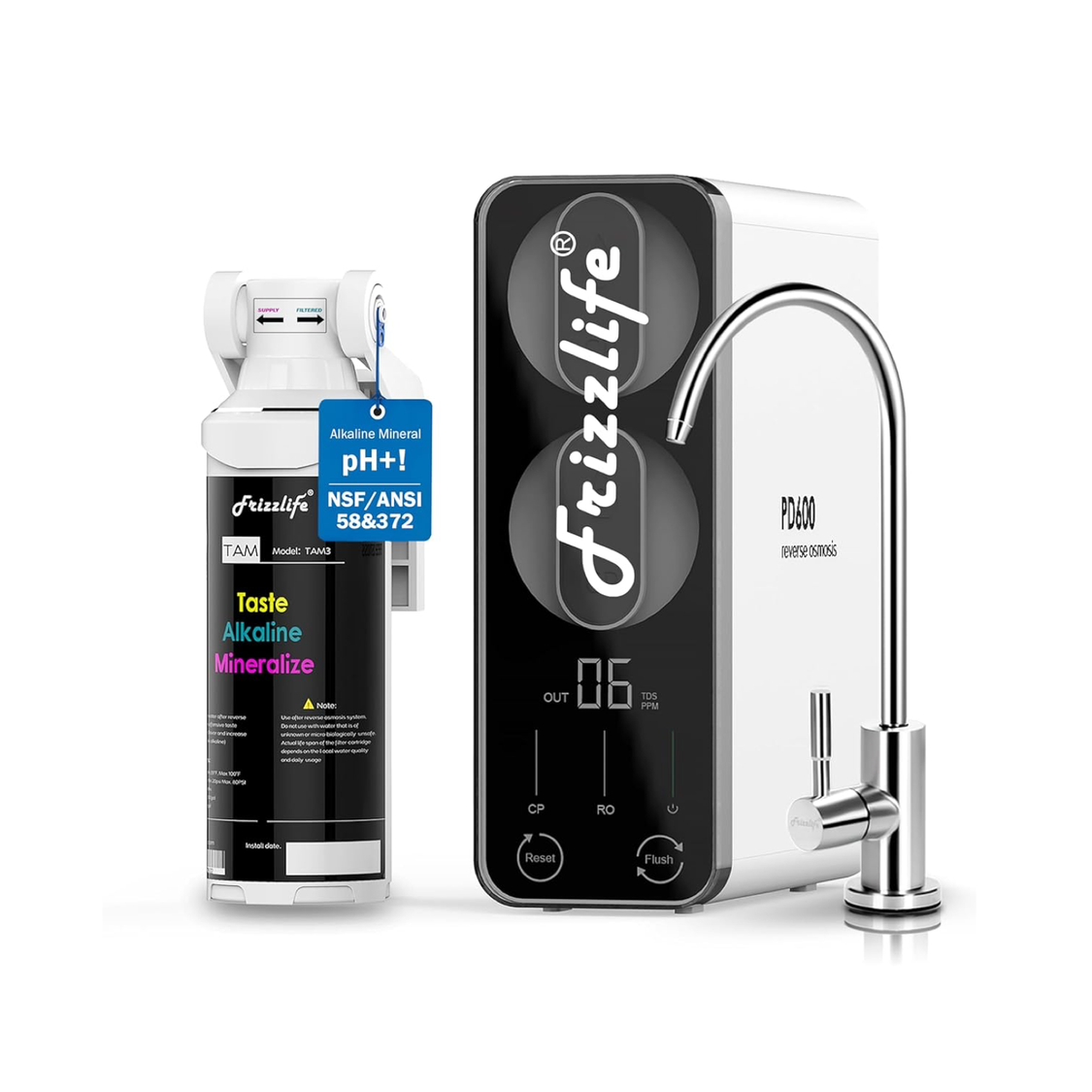
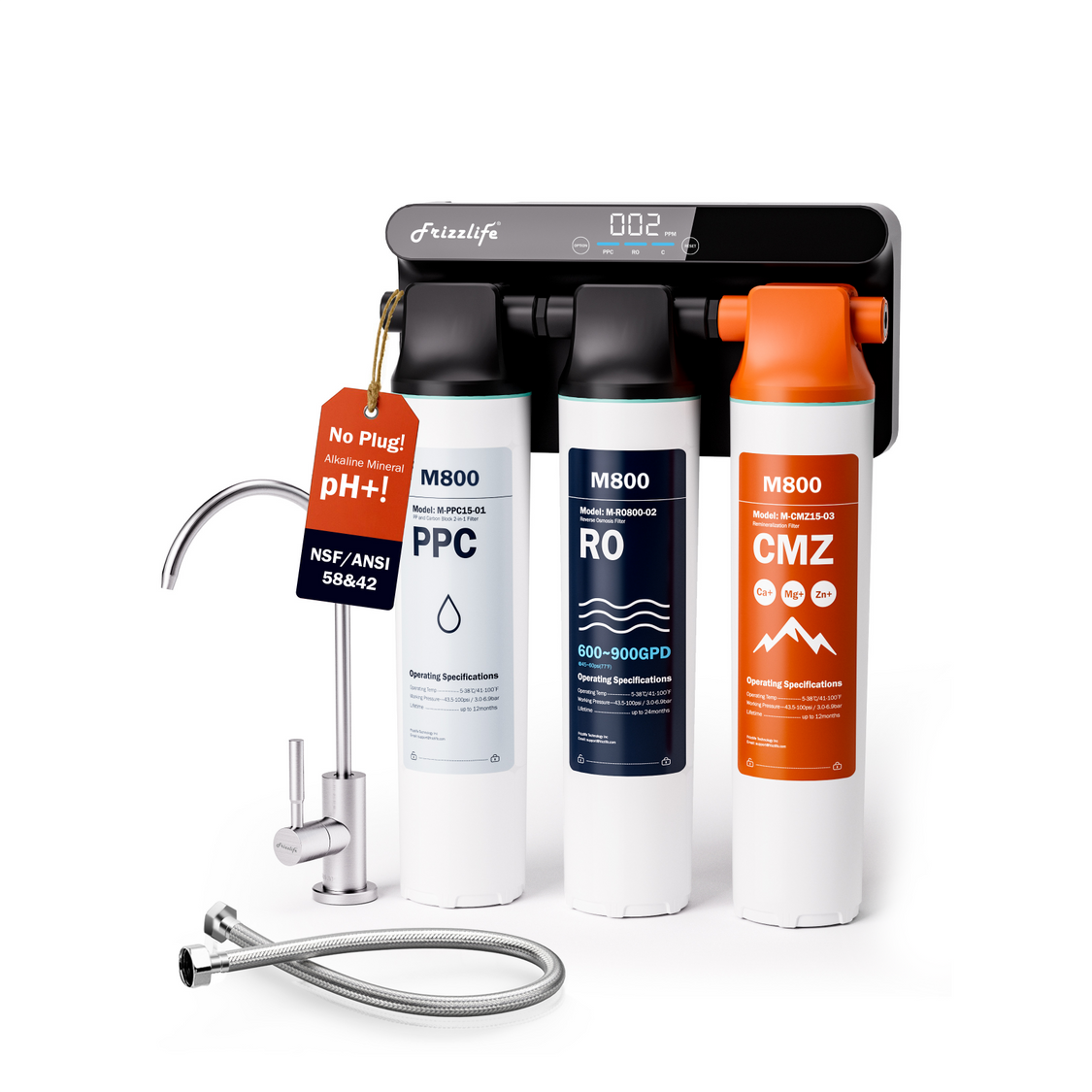
Recommended RO Systems for Drinking Water Safety
- Under-sink RO systems (best balance of performance and cost)
- Tankless RO systems (space-saving, higher output)
- Multi-stage RO systems (better for complex water conditions)
Fit, installation, or real-world usage realities
Under-sink RO fit: measuring cabinet space, tank clearance, and avoiding surprise incompatibility
-
Cabinet width/depth/height
-
Space around the drain trap and garbage disposal
-
Whether you can place a storage tank upright (if using a tank system)
-
Clearance to change cartridges without removing the whole unit
-
Dedicated RO faucet on the sink deck? (Do you have a free hole or do you need to drill?)
-
Feeding the refrigerator/ice maker? (You may need a line run and enough pressure.)
Rentals and no-drill constraints: countertop/“no-plumb” options vs permanent installs
-
Countertop units that connect temporarily to the faucet (if compatible)
-
Gravity filtration (fill from tap, no plumbing)
-
Pitchers (limited capacity)
Flow rate reality check: matching gallons of water per day to gravity GPH and RO production
-
Drinking + cooking for one adult is often 0.5 to 1.5 gallons/day.
-
A family of 4 can easily use 3 to 6 gallons/day just in the kitchen sink (more if you fill bottles, make ice, cook at home a lot).
-
Some gravity setups filter slowly enough that you’re constantly waiting or refilling.
-
RO systems produce water steadily, but tank size (or tankless production rate) decides whether you “run out” during busy times.
What happens if your water pressure is low (<40 PSI): slower output and worse RO waste water ratios
-
Slower production (you wait longer to fill a pot)
-
Lower rejection efficiency (worse contaminant reduction in some cases)
-
Higher wastewater ratio (more water down the drain per gallon produced)

Maintenance, risks, and long-term ownership
Daily friction: refill cycles, slow filtration wait times, and how that changes habits (and satisfaction)
-
With pitchers: the friction is constant refilling and small batches.
-
With gravity systems: friction is waiting for filtration and keeping the upper chamber filled.
-
With RO: the friction is usually low day-to-day, but spikes when filters need replacement or when you realize you’re producing less water than expected.
-
you host guests,
-
kids refill bottles all day,
-
or you cook a lot and need several gallons quickly.
Mineral loss and taste shifts: RO systems reducing calcium/magnesium and when remineralization matters
-
Will you actually drink it?
-
Will your household accept the taste?
-
Do you want a remineralization stage?
Health-risk management: when to retest arsenic concentration, and how to monitor over time
-
After installation: retest treated water to confirm reduction.
-
Ongoing: test at least once a year for arsenic (and more often if levels are high, if you change equipment, or if the water changes after storms, drought, or construction).
-
After maintenance events: test if you replaced a major component, changed media type, or disinfected the well.
Failure modes that create false confidence: expired cartridges, channeling, and relying on claims vs verified results
-
Expired cartridges that still pass water but no longer remove arsenic.
-
Channeling in media beds (water finds a path of least resistance and bypasses treatment).
-
Wrong match for arsenic form (system removes As(V) well but doesn’t address As(III) without oxidation).
-
Ignoring prefiltration needs (sediment/iron clogs or fouls the treatment stage).
-
Relying on marketing claims instead of certification and follow-up testing.

How to choose the best water filter for arsenic removal (by your exact conditions)
If you need maximum reduction for arsenic in drinking water: when RO for arsenic is the safer bet
-
You want a strong reduction at a single tap for drinking and cooking.
-
You also care about other contaminants often found with groundwater (like fluoride, uranium in some regions, nitrates in agricultural areas, or general high TDS).
-
You need consistent performance if you maintain it and have adequate pressure.
If you can’t install plumbing (or want off-grid durability): when gravity systems make sense—and when flow kills the deal
-
You can’t modify plumbing (rental, tiny home, temporary living).
-
You want a non-electric setup for emergencies.
-
You can handle a slower pace and manual refilling.
-
Your household needs several gallons of short windows (mornings, dinner time).
-
You underestimate how often you’ll refill.
-
You choose elements without confirmed arsenic performance.
If you want whole-home coverage: when a whole house arsenic system is justified (and when it’s not)
-
You need treated water at multiple fixtures daily (not just the kitchen).
-
You’re already building a treatment “train” for well water issues (sediment + iron + odor + arsenic).
-
You have a reason to reduce arsenic for appliances or other uses beyond drinking/cooking water.
-
Your primary concern is ingestion and a point-of-use system would cover it.
-
You want the simplest maintenance plan.
-
Your budget doesn’t allow for proper pre-treatment and retesting.
Decision checklist (water source + arsenic form + household size + pressure + space → recommended system)
| Your conditions | What tends to fit best | What tends to go wrong |
| Private well, arsenic near/above 10 ppb, family uses 3–6 gal/day for drinking/cooking | Under-sink RO (arsenic-certified), with proper prefiltration | Low pressure slows output; no space for tank; skipped filter changes |
| Private well, arsenic present, renter/no drilling allowed | Gravity system or no-plumb countertop unit designed for arsenic | Flow too slow; counter space issues; wrong cartridge for arsenic form |
| Arsenic III suspected/confirmed | RO or media system with oxidation step + verified arsenic III performance | Buying media that only targets arsenic V; no follow-up testing |
| Multiple water problems (iron/manganese + arsenic) | Whole-house multi-stage designed from water test | Fouled media; channeling; high maintenance without monitoring |
| Low water pressure (<40 PSI) | Gravity (if volume is manageable) or RO with pressure solution | RO wastes water and produces too slowly without addressing pressure |
| Small household, low daily treated volume | Pitcher/gravity/compact RO depending on test results | Underestimating replacement cost and capacity; inconsistent use |
Shortlists by scenario (so you can stop second-guessing)
Small apartment / limited space: what to buy when you can’t sacrifice cabinet room or counter space
-
If you can’t drill or plumb: pick a compact countertop or gravity option only if it’s verified for arsenic, and accept that you’ll be managing refills.
-
If you can install under-sink but space is tight: measure carefully and consider a compact system (often tankless) if your pressure supports it.
Families >4: avoiding underpowered RO and too-slow gravity filters (volume-first selection)
-
RO sized for higher daily demand (larger tank or higher production rate), with planned filter changes.
-
If gravity: a larger capacity unit and realistic expectations about refill habits.
-
Small pitchers (constant refills).
-
Slow gravity filtration that can’t keep up with school bottles, cooking, and guests.
“I only care about drinking and cooking”: best point-of-use path vs bottled water stopgaps
-
Treat one faucet well.
-
Retest that output.
-
Keep maintenance tight.
-
get a proper well water test,
-
confirm arsenic concentration and form,
-
and choose a system with verified performance.
When you also care about other contaminants (lead, fluoride, chlorine): choosing a filtration system without guessing priorities
-
chlorine/chloramine (more common in city tap water),
-
lead (often from plumbing, not the water source),
-
fluoride (often added in municipal supplies),
-
or other groundwater contaminants.
-
Carbon filters are great for chlorine and taste, but a basic carbon filter is not a reliable arsenic solution unless it’s specifically designed, tested, and certified for arsenic reduction.
-
RO often reduces a broad range of contaminants, which can simplify decisions when you have multiple concerns—at the cost of space, wastewater, and mineral changes.
Before You Buy
-
Get a real water test (private well or tap water), and confirm the amount of arsenic in ppb. Don’t buy based on suspicion alone.
-
Check whether arsenic III vs arsenic V matters for your choice, and pick a system verified to handle your situation (or plan for oxidation if needed).
-
Confirm certification or verified testing for arsenic reduction, not just “removes contaminants” language.
-
Measure space and installation constraints (under-sink clearance, tank height, available faucet hole, rental restrictions).
-
Estimate your daily treated-water volume (gallons per day for drinking/cooking), then match it to RO production or gravity flow.
-
Measure water pressure if considering RO; low pressure can mean slow output and more waste unless addressed.
-
Price the replacement filters/media for 2–5 years, not just the first purchase, and assume lifespan claims may shrink with high TDS or competing ions.
-
Plan your retesting schedule (after install and at least annually) so you don’t end up with silent filter failure.

FAQs
1. Is arsenic common in private well water?
2. Can I remove arsenic with a carbon filter?
3. What is the difference between Arsenic III and V?
4. Is RO the most effective way to remove arsenic?
5. How often should I test my well for arsenic?
6. What is the best water filter for arsenic removal?
The best water filter for arsenic removal is usually a certified reverse osmosis system installed at the point of use. It is commonly chosen because it can handle both arsenic III and arsenic V under typical residential conditions. Performance still depends on proper maintenance and matching the system to your water quality. In some cases, specialized arsenic media systems may also be suitable depending on test results.7. Does reverse osmosis remove arsenic completely?
8. Do I need a water test before choosing an arsenic filter?
9. Is a carbon filter enough for arsenic?
10. How often should arsenic filters be replaced?
References
Related Guides
Compare arsenic filter options and choose the right reverse osmosis system based on your water test and household needs.
Explore Arsenic Filter Collection