


If you’re searching for the best water filter for PFAS removal, the real question is not whether a product contains carbon or an RO membrane. You need to know whether the exact system has credible PFAS reduction evidence, fits your kitchen, and can maintain its performance over the amount of water your household actually uses.
PFAS can occur in both bottled water and tap water, but this guide focuses specifically on choosing a household filter. For more background on PFAS sources, bottled-water testing, health concerns, and current drinking-water rules, read our PFAS in Bottled Water: 2026 Safety and Testing Guide.
Below, we compare pitcher filters, faucet filters, under-sink carbon block systems, and reverse osmosis systems based on certification scope, contaminant coverage, installation, filter capacity, and maintenance. Households considering broader point-of-use treatment can also compare reverse osmosis water filter systems by installation type, flow rate, and daily water needs.
Who Should Use This PFAS Filter Buying Guide?
This guide is most useful if your water report or laboratory test shows PFAS, you use a private well without current PFAS data, or you live near a documented PFAS-impacted area. It is also useful if you are comparing carbon block and reverse osmosis systems but are unsure how certification, capacity, and maintenance affect the decision.
When current testing shows non-detect results with appropriate reporting limits, a PFAS-focused filter may not be the first treatment priority. In that situation, review the other contaminants actually found in your water before choosing a system.
Quick Decision Rule
Choose a product with a certification or product-specific performance report that explicitly includes PFAS reduction. NSF/ANSI 53 applies to many residential filtration devices, while NSF/ANSI 58 applies to reverse osmosis systems, but the standard number alone does not prove that every model has a PFAS reduction claim.
Then compare the tested PFAS compounds, rated capacity, installation requirements, replacement schedule, and other contaminants in your water. A filter is only a practical choice if you can use and maintain it consistently.
You should prioritize PFAS filtration if you’re on a private well water supply or a known PFAS-impacted area
-
Private well water: there’s no utility treatment and no routine PFAS reporting. If PFAS is there, it’s on you to test and treat.
-
Known PFAS-impacted areas: communities near airports (firefighting foam use), military facilities, certain industrial sites, landfills, or areas with documented PFAS contamination.
-
You have a water report that lists PFAS (even if it says “below advisory” or “monitoring only”). If it’s being reported, it’s worth taking seriously.
You should avoid “PFAS” filters that aren’t certified for PFAS reduction (NSF/ANSI 53 or 58)
-
which PFAS compounds were tested (PFOA/PFOS only vs a broader set),
-
the challenge concentration (test conditions),
-
how much water was treated before performance dropped,
-
whether the results were independently verified.
Is this overkill if your water test shows non-detect or very low PFAS levels?
Core Trade-Offs That Affect a PFAS Filter Decision
Verify the PFAS Claim, Not Just the Standard Number
Start with the exact contaminant claim rather than the technology name or logo on the packaging. A system may comply with NSF/ANSI 53 or NSF/ANSI 58 for one or more performance requirements without being certified for every PFAS compound.
Look for one of the following:
- A certification listing that explicitly includes a PFAS reduction claim
- A performance data sheet identifying the PFAS compounds tested
- A relevant third-party laboratory report showing incoming and treated concentrations
- A rated capacity or service cycle for the PFAS claim
- Clear replacement conditions and test limitations
“Tested” and “certified” are not interchangeable. Third-party certification normally includes ongoing product and manufacturing requirements, while a laboratory report applies to the product, samples, and conditions described in that specific report. Either type of evidence should be reviewed for its exact scope.
Carbon Block vs. Reverse Osmosis for PFAS
| Filter Type | When It May Fit | Main Advantages | Main Limitations |
|---|---|---|---|
| PFAS-rated pitcher | Renters or low-volume drinking-water use | No installation and low initial commitment | Small capacity, frequent refilling, and frequent cartridge changes |
| PFAS-rated faucet filter | Households wanting basic point-of-use treatment | Simple setup and no cabinet space required | Faucet compatibility and smaller cartridge capacity |
| Certified under-sink carbon block | PFAS-focused filtration at one kitchen tap | No RO reject-water stream and usually simpler maintenance | Performance depends heavily on carbon quantity, contact time, water chemistry, and timely replacement |
| Reverse osmosis | Households concerned about PFAS plus other dissolved contaminants | Broader treatment capability and multiple filtration stages | Requires more installation planning and model-specific maintenance |
| Ion exchange | Specialized PFAS treatment applications | Can be effective for selected PFAS when correctly designed | Residential availability, resin type, and claim scope vary |
Activated carbon, ion exchange, and reverse osmosis can all reduce PFAS, but no technology performs identically for every compound or water condition. Compare the exact claim, tested capacity, and maintenance requirements rather than assuming that every carbon or RO product has the same performance.
What a PFOA and PFOS Claim Does—and Does Not Cover
A PFOA and PFOS reduction claim confirms performance only for the substances and conditions listed in the certification or test report. It does not automatically prove equal reduction of every short-chain or long-chain PFAS compound.
When a water report lists several PFAS, compare those results with the product’s tested compounds. Do not treat a narrow PFOA/PFOS claim as a blanket claim for the entire PFAS family.
Why Filter Capacity and Replacement Timing Matter
PFAS cannot normally be detected by taste, smell, or appearance, so waiting for the water to taste different is not a useful replacement strategy. Carbon media and RO membranes have defined operating lives, and performance may decline when a cartridge reaches its rated capacity or is used outside the specified conditions.
Choose a replacement schedule you can realistically follow. Household water use, incoming water quality, filter capacity, and the presence of competing contaminants can all affect how long a cartridge performs as intended.
Which PFAS Water Filter Type Fits Your Home?
Choose a Pitcher or Faucet Filter When
A certified pitcher or faucet-mounted filter may fit a renter, a single user, or a household filtering a relatively small amount of drinking water. Check faucet compatibility, PFAS claim capacity, cartridge availability, and how often the filter must be replaced.
Choose an Under-Sink Carbon Block When
An under-sink carbon block can be a practical choice when PFAS reduction is the main treatment goal and you want steady flow without an RO drain connection. Confirm that the exact cartridge carries a PFAS reduction claim and that the rated capacity matches your expected drinking and cooking use.
Choose Reverse Osmosis When
Reverse osmosis may make more sense when your water concerns extend beyond PFAS to other dissolved contaminants covered by the specific system’s performance data. RO systems are available in tank, tankless, countertop, electric, and non-electric configurations, so installation and daily-use limitations differ by model.
Compare cabinet space, water pressure, electricity requirements, faucet installation, flow rate, reject-water ratio, remineralization, filter life, and product-specific contaminant testing before choosing a model.
Compare Reverse Osmosis Water Filter Systems →
PFAS Plus Lead, Arsenic, or Fluoride
When several contaminants are present, choose a system based on the complete water report rather than PFAS alone.
| Water Concern | What to Check |
|---|---|
| PFAS plus lead | Verify that the exact system has relevant claims for both PFAS and lead |
| PFAS plus arsenic | Check the arsenic species, test concentration, and product-specific arsenic claim |
| PFAS plus fluoride | Confirm that fluoride reduction is included in the system’s performance data |
| Multiple PFAS compounds | Compare the compounds in your water report with the product’s exact PFAS claim |
| Private well water | Test for additional well-related contaminants before selecting treatment |
A system that performs well for PFOA and PFOS should not automatically be assumed to reduce arsenic, fluoride, lead, or every other PFAS. Match the filter’s evidence to the contaminants actually found in your water.
Long-chain and short-chain PFAS: what “remove PFOA PFOS” does—and doesn’t—guarantee
-
Some filtration methods (especially carbon) may perform better on some PFAS than others, and performance can vary based on chain length and chemistry.
-
A claim that only lists PFOA/PFOS does not automatically mean strong reduction for other PFAS compounds in your water supply.
What happens if PFAS removal efficiency drops as the filter loads up over time?
-
You often can’t taste PFAS.
-
Carbon media can become saturated; after that, PFAS reduction can drop sharply.
-
Flow rate changes can be subtle, especially with under-sink carbon systems.

Which water filter for PFAS removal type matches your water and risk?
If your goal is PFAS-only reduction at the tap: carbon block under-sink vs faucet vs pitcher filters
-
Pros: lowest upfront cost, zero installation, easy for rentals.
-
Cons: small media volume, limited capacity, easy to fall behind on refills and filter changes, slow production.
-
PFAS note: some pitchers can reduce PFAS, but performance depends heavily on certification and replacement discipline.
-
Pros: simple installation, decent convenience, no counter space.
-
Cons: can reduce faucet usability, fit issues with pull-down sprayers or odd faucet shapes, smaller cartridges than under-sink.
-
PFAS note: look closely at certification and rated capacity; many faucet filters are built for chlorine taste, not long-term PFAS loading.
-
Pros: typically more carbon media, better contact time, better flow than pitchers, more consistent daily use.
-
Cons: needs cabinet space; install can be annoying in tight sinks; replacement costs can surprise people.
-
PFAS note: this is often the “sweet spot” for PFAS-only treatment when you want a balance of reliability and simplicity—if it’s certified for PFAS reduction.
If you want broad contaminant coverage too: when reverse osmosis makes sense (and when it doesn’t)
-
many dissolved solids,
-
some metals,
-
and other regulated contaminants depending on the setup.
-
you have limited under-sink space,
-
you don’t want a storage tank,
-
you’re sensitive to slower dispensing,
-
you’re on a septic system and want to minimize extra discharge,
-
or your water pressure is low (we’ll cover this in the fit section).
If you’re dealing with multiple water contaminants: PFAS + lead/arsenic/fluoride trade-offs by system type
-
PFAS + lead: carbon block systems that are certified for both can be a strong fit for point-of-use. Lead is often a plumbing issue, so filtering at the kitchen tap is common.
-
PFAS + arsenic: arsenic treatment can be more specific; some systems address it well, others don’t. Depending on arsenic type and level, RO is often considered because it can reduce many dissolved contaminants (with proper certification and setup).
-
PFAS + fluoride: if fluoride reduction is a priority, many simple carbon filters won’t target it effectively; RO is more often chosen for fluoride reduction.
Will a PFAS water filter still work if your total PFAS is high or you have multiple PFAS compounds?
-
Higher PFAS concentrations can use up filter capacity faster. A carbon filter that looks great on paper can become less effective sooner when PFAS loading is high. That means replacement intervals may need to be shorter than what “average use” suggests.
-
A mix of PFAS compounds can stress “single-claim” filters. If a filter is only verified for a narrow PFAS claim, it may not be the best match for water that shows multiple PFAS contaminants. This is where testing and reading the certification scope becomes more than paperwork—it’s how you avoid a false sense of security.
Compare Reverse Osmosis Options for PFAS-Focused Home Treatment
Reverse osmosis systems differ in flow rate, power requirements, remineralization, installation, maintenance, and contaminant testing. Review the exact product report or claim scope rather than assuming that every RO system has identical PFAS performance.
Start with the system type that fits your kitchen, household water use, installation preferences, and ongoing maintenance needs.
Compare Reverse Osmosis Systems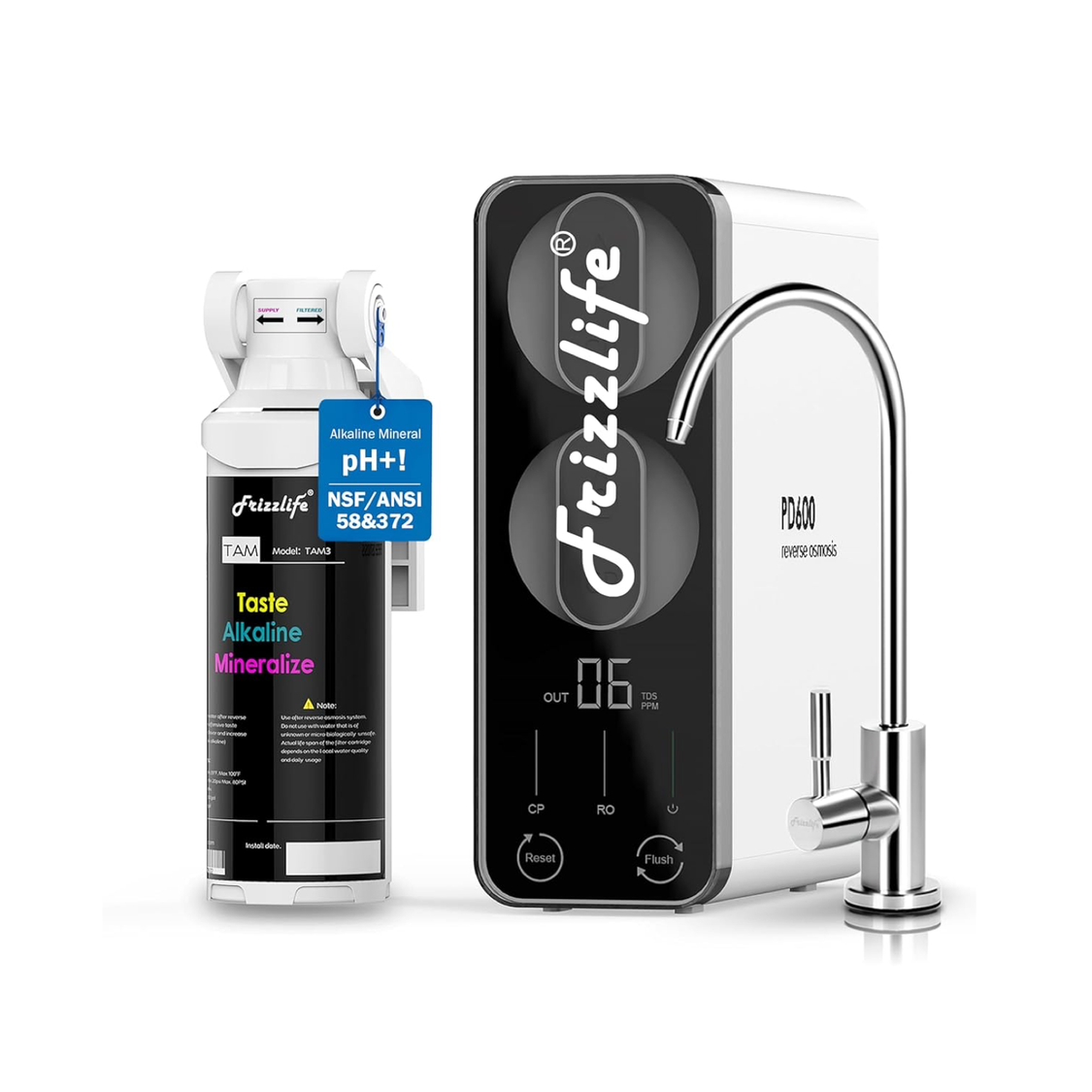
PD600-TAM3 Reverse Osmosis System
A 600 GPD tankless under-sink RO system with a 2:1 pure-to-drain ratio and a remineralization stage. Its product page lists SGS testing performed according to NSF/ANSI 42, 53, and 58 and includes PFAS in the test description.
- 600 GPD rated water production
- 2:1 pure-to-drain ratio
- Tankless under-sink design
- Remineralization stage for mineral-enhanced taste
- Review the report for tested PFAS and test conditions
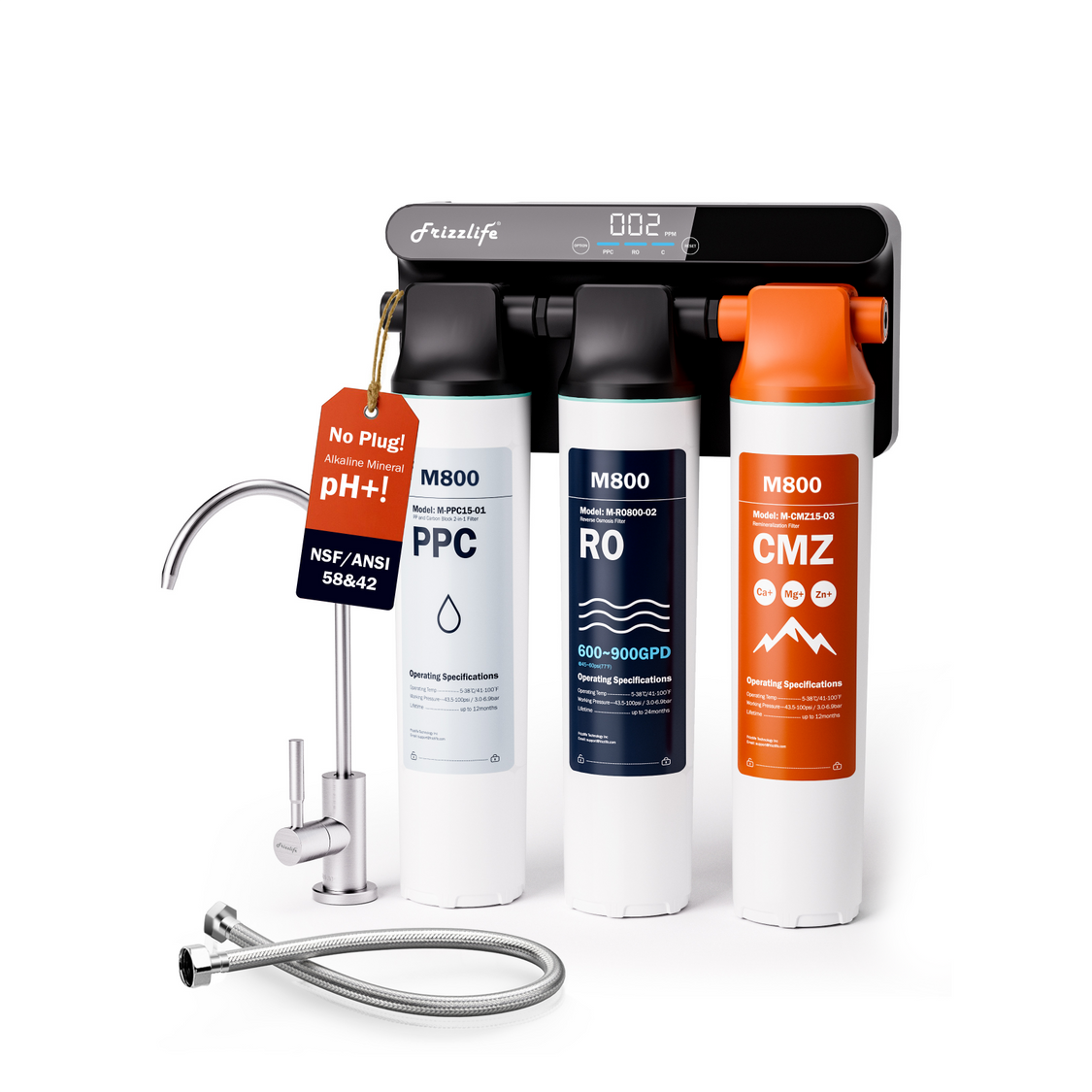
M800 Non-Electric Tankless RO System
A 900 GPD tankless reverse osmosis system designed to operate without electricity. Its product page describes an eight-stage filtration process and includes PFOA and PFOS among the listed reduction claims.
- 900 GPD rated water production
- No electricity required
- Tankless under-sink configuration
- Eight-stage filtration process
- Check the exact PFOA and PFOS claim scope
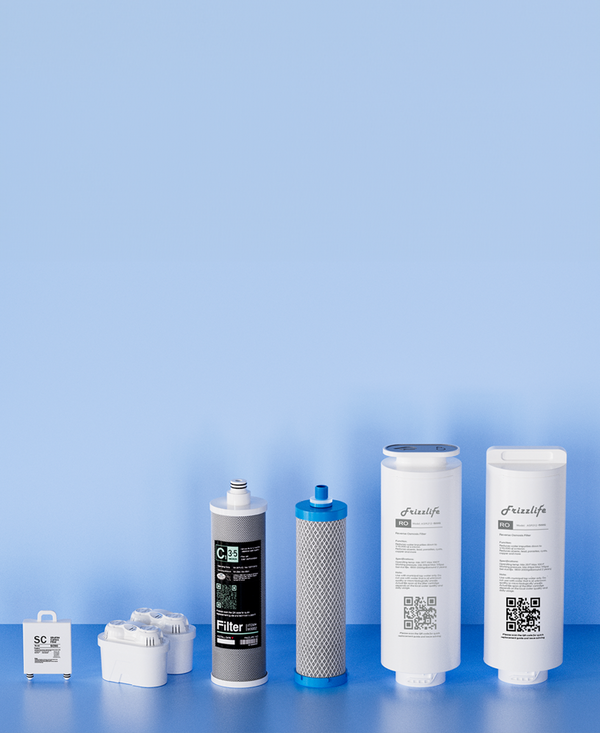
Find the Correct Replacement Filters
PFAS reduction performance depends on maintaining the system according to its tested or recommended conditions. Use model-specific replacement cartridges and membranes rather than waiting for a change in water taste or odor.
- Find filters by Frizzlife system model
- Replacement options for PD600-TAM3 and M800
- Check the cartridge type before ordering
- Follow the stated time or gallon limit
- Avoid unverified substitute cartridges
Product testing, certification scope, and contaminant claims vary by model. Review the current product specifications, complete performance report, tested PFAS compounds, installation requirements, and replacement schedule before choosing a system for a specific water concern.
PFAS Filter Cost: What to Budget Beyond the Purchase Price
Upfront price vs long-term replacement costs: what buyers underestimate
-
A “reasonable” system with expensive proprietary replacements.
-
A filter life estimate that assumes light use (one person) when you have a family.
-
Replacing multiple stages in an RO system instead of a single carbon cartridge.
Filter life and replacement timing: choosing based on your drinking water gallons (single vs family use)
-
Single adult: often ~1–2 gallons/day
-
Couple: ~2–4 gallons/day
-
Family with kids: often ~4–8 gallons/day
-
constant refilling,
-
frequent cartridge changes,
-
and a higher cost per gallon than you expected.
Is best water filter for pfas removal worth it if you’re only filtering drinking water (not whole-home)?
-
you actually use it for the water you drink (some people keep drinking from the fridge line or a bathroom tap), and
-
you keep up with replacements.
Visual: 5-year cost table (pitcher vs faucet vs under-sink carbon vs RO)
-
filtering drinking + cooking water at one kitchen point
-
typical household use (couple/small family)
-
replacing on schedule for PFAS reliability
Compare the annual replacement cost, not just the initial system price. Also check how many cartridges are required, whether each stage has a different replacement interval, and whether the correct filters are likely to remain available.
A lower-priced system is not necessarily less expensive over several years. A filter with very low capacity may require frequent replacements, while a more complex RO system may involve several cartridges and a membrane.
Installation and Fit: What to Check Before Buying
Before choosing an under-sink carbon or RO system, measure the usable cabinet space and identify the drain trap, disposal, shutoff valve, dishwasher hose, drawers, and trash pull-out. Leave enough access to replace cartridges without removing the entire system.
Renters should check whether the system requires drilling, a dedicated faucet, a drain connection, or permanent plumbing changes. Countertop and faucet-mounted options may be easier to remove, but faucet compatibility and counter space still need to be confirmed.
For an RO system, review the manufacturer’s required feed-water pressure rather than relying on a general rule. Some systems use a pump, some operate from line pressure, and some require electricity for monitoring or water production.
Wastewater performance also varies widely. Check the model’s stated pure-to-drain ratio and the conditions under which that ratio was measured.
Simple fit checklist + counter footprint guide for small kitchens/apartments
-
You have at least 4–6 inches of clear space around where the unit will sit (for cartridge changes).
-
You can reach the shutoff valve without removing everything from the cabinet.
-
There is a plan for the tubing so it won’t kink when you store items.
-
If there’s a dedicated faucet, you have a safe path to route it without hitting drawers or doors.
-
For RO: you have space for a tank (often the biggest item).
-
Pitcher: plan for roughly 6" × 12" footprint in the fridge (varies by shelf height).
-
Countertop (temporary faucet hookup): plan for roughly 8" × 14" of counter space plus clearance to access the diverter connection.
-
Faucet mount: no counter space, but it adds bulk at the faucet head.

Maintenance and Long-Term PFAS Performance
A PFAS filter only remains useful when it is operated and maintained according to its tested conditions. Water may still look and taste normal when a carbon cartridge or RO membrane is approaching the end of its recommended life.
Follow the stated replacement interval, but also review whether the interval is based on time, gallons, water quality, or filter-status monitoring. Higher water use or challenging incoming water may affect actual service life.
Before buying a system, confirm that replacement cartridges are easy to identify and purchase. Using an unverified substitute cartridge may change the system’s contaminant reduction performance.
Replacement cartridges and membranes vary by system model. Confirm the correct filter type and recommended replacement schedule before ordering.
Find the Correct Replacement FilterHow to Choose a PFAS Filter with Confidence
Step 1: Check Current Water Data
For municipal water, review your utility’s recent PFAS results, Consumer Confidence Report, state data, and applicable EPA monitoring information. For a private well or an area without current data, use an accredited laboratory that offers an appropriate PFAS panel.
Step 2: Match the Tested Compounds
Compare the PFAS listed in your water results with the substances included in the filter’s certification or test report. A PFOA/PFOS claim should not be treated as proof of equal performance for every PFAS compound.
Step 3: Compare Capacity and Household Use
Review the rated service capacity, expected daily water use, flow rate, and cartridge replacement schedule. Avoid choosing a very small filter for a household that uses a large volume of filtered water.
Step 4: Check Installation and Maintenance
Confirm cabinet space, faucet requirements, water pressure, drain connection, electricity needs, reject-water ratio, filter availability, and replacement cost.
Step 5: Verify Performance When Appropriate
When PFAS was detected at a meaningful concentration, follow-up testing can help confirm how the installed system performs with your source water and usage conditions.
Before You Buy
- Confirm whether your water comes from a municipal system or private well.
- Check whether recent PFAS data exists for your exact water source.
- Identify the PFAS compounds listed in the report.
- Look for a PFAS-specific claim under NSF/ANSI 53 or NSF/ANSI 58, or review relevant product-specific laboratory data.
- Do not assume that general NSF compliance confirms PFAS reduction.
- Compare the system’s rated capacity with your household’s drinking and cooking water use.
- Measure the installation area and check plumbing obstructions.
- Review feed-water pressure, electricity, drain, faucet, and installation requirements.
- Compare all cartridge and membrane replacement intervals.
- Confirm that model-specific replacement filters are readily available.
- Check whether the system covers any additional contaminants found in your water.
- Plan follow-up testing when the initial PFAS result or local conditions justify it.

FAQs
Does RO remove PFAS from drinking water?
Yes, reverse osmosis can substantially reduce many PFAS when the system is properly designed and maintained. The exact result depends on the PFAS compound, membrane, system configuration, incoming water, and filter condition. Look for a PFAS-specific NSF/ANSI 58 claim or relevant product-level performance data rather than relying only on the words “reverse osmosis.”
Are carbon filters effective against forever chemicals?
Yes, some activated carbon and carbon block filters can effectively reduce PFAS. Performance depends on the carbon type, quantity, contact time, flow rate, water chemistry, and cartridge capacity. Check for a PFAS-specific NSF/ANSI 53 claim because a basic chlorine taste-and-odor filter is not automatically a PFAS filter.
How do I test my tap water for PFAS?
Start with recent data from your water utility or state PFAS program. When local data is missing, outdated, or does not cover your private well, use an accredited laboratory that offers a PFAS water panel. Most home options are sampling kits that must be mailed to the laboratory rather than instant test strips.
What is the EPA limit for PFAS in 2026?
The federal maximum contaminant levels for PFOA and PFOS remain 4 parts per trillion each as of July 2026. EPA has proposed retaining those limits while potentially allowing qualifying public systems more time, until 2031, to comply. The agency has also proposed rescinding separate requirements for PFHxS, PFNA, HFPO-DA and the PFAS mixture Hazard Index, so readers should check current EPA updates because those 2026 changes are not yet final.
Is carbon block or reverse osmosis better for PFAS?
Neither option is automatically better for every household. A PFAS-rated carbon block may suit someone who mainly wants point-of-use PFAS treatment with simpler operation, while RO may suit water containing PFAS plus other dissolved contaminants covered by the specific system. Compare tested claims, capacity, installation, water use, and maintenance before deciding.
How often should a PFAS filter be replaced?
Replace it according to the product’s stated time or gallon limit. Actual service life can also be affected by household use, water quality, PFAS concentration, and other substances competing for filter capacity. Do not wait for a taste or odor change because PFAS breakthrough may not be noticeable.
References