


Water hardness can vary sharply from one US city to another. Some municipal systems deliver very hard water throughout much of their service area, while others provide soft or moderately hard water. Even within the same city, the number may change with seasonal source blending, neighborhood distribution zones or groundwater use.
This guide focuses specifically on official water-hardness examples from selected US cities, why no single national “hardest water” ranking applies to every household, and how to find the most relevant hardness number for your own address.
The city figures below are examples rather than permanent rankings. Always confirm the latest value through your water utility’s Consumer Confidence Report, water-quality summary or a test at your tap.
How to Read City Water-Hardness Data
Water hardness mainly reflects the amount of dissolved calcium and magnesium in water. City reports commonly express it as milligrams per liter of calcium carbonate or as grains per gallon.
The U.S. Geological Survey classification provides a consistent baseline for comparing reports from different utilities:
| USGS classification | Hardness as CaCO₃ | Approximate GPG |
|---|---|---|
| Soft | 0–60 mg/L | 0–3.5 |
| Moderately hard | 61–120 mg/L | 3.6–7.0 |
| Hard | 121–180 mg/L | 7.1–10.5 |
| Very hard | More than 180 mg/L | More than 10.5 |
These categories describe calcium-and-magnesium hardness. They do not determine whether the water is safe, identify individual contaminants or replace a complete water-quality report.
For a fuller explanation of limestone, groundwater contact time, temporary hardness and hardness testing, read What Causes Hard Water? 5 Main Causes, Hardness Levels & Testing.
Why There Is No Single Official Ranking of the Hardest-Water Cities
There is no single federal database that assigns every US city one permanent hardness value and ranks all cities from hardest to softest.
Utilities may report an annual average, a treatment-plant result, a distribution-system range or a value intended for water-softener settings. These numbers are not always directly comparable.
A city’s hardness may also change because of:
- seasonal source blending
- groundwater use during peak demand
- different treatment plants
- separate utility service areas
- neighborhood distribution zones
- private wells within the same metro area
For that reason, the most useful question is not simply, “Which city has the hardest water?” It is, “What hardness does my utility currently deliver to my address?”
Official Water-Hardness Examples From Selected US Cities
The following figures come from city utilities or current utility water-quality materials. They are examples, not a permanent national ranking. Check the source date and whether the value is an average or a range before comparing cities.
| City or utility area | Officially reported hardness | USGS interpretation | Important context |
|---|---|---|---|
| Las Vegas Valley, Nevada | About 280 ppm / 16 GPG | Very hard | Current utility guidance; groundwater blending may create local variation. |
| Phoenix, Arizona | 172–302 ppm / about 10–17.6 GPG | Hard to very hard | The official report provides a distribution-system range rather than one permanent citywide value. |
| Indianapolis, Indiana | 317 ppm / 19 GPG in 2025 | Very hard | Current utility data; historical documents may show a broader service-area range. |
| San Antonio, Texas | Typically 15–20 GPG | Very hard | Associated with naturally occurring calcium carbonate in aquifer water. |
| Kansas City, Missouri | About 100 mg/L / 5–6 GPG | Moderately hard | Substantially lower than the 250-plus ppm figures shown in some unsourced city rankings. |
| Nashville, Tennessee | 63.9–92.6 mg/L in the 2025 analysis | Moderately hard | The official report lists a range rather than one permanent value. |
| Denver, Colorado | Officially described as soft to moderately hard | Soft to moderately hard | Source water and seasonal operations affect the result. |
| New York City, New York | Citywide average about 1.8 GPG | Soft | Conditions can vary with source-water blending and location. |
What US State Has the Hardest Water?
There is no official nationwide ranking that assigns one hardness value to every state. States such as Texas, Arizona, Nevada and Indiana contain major service areas with very hard water, but hardness can still vary widely within each state.
Use state-level maps to understand broad geological patterns, then use the local utility report or a tap test for an actual treatment decision. A state average should not be used to size a water softener or determine whether point-of-use RO is appropriate.
City Water vs Private Wells: Why Homes in the Same Metro Can Differ
Municipal customers generally receive water from a defined utility system, which may use surface water, groundwater or a blend of both. The utility publishes an annual report, but the reported number may still represent a range across multiple plants or distribution zones.
Private wells can differ significantly over short distances because of well depth, aquifer geology and local mineral conditions. A city-level hardness value should not be applied automatically to a private well.
Well water may also contain iron, manganese, sulfur compounds or sediment in addition to hardness. Those conditions require separate testing and may change the treatment sequence.
For a detailed explanation of iron and softener limitations, read Can a Water Softener Remove Iron From Well Water?

How to Check the Water Hardness in Your City
Step 1: Identify Your Water Supplier
Confirm the utility name shown on your water bill. A metro area may contain multiple municipal systems and private water providers.
Step 2: Find the Latest Water-Quality Report
Search the utility website for:
- Consumer Confidence Report
- Annual Water Quality Report
- Water Quality Summary
- Treated Water Analysis
- Water Hardness FAQ
The EPA also provides a tool for finding local Consumer Confidence Reports.
Step 3: Search for the Correct Terms
Search the report for:
- hardness
- total hardness
- calcium carbonate
- CaCO₃
- calcium
- magnesium
- grains per gallon
Record whether the number is an average, range, maximum or treatment-plant result.
Step 4: Confirm the Units
Divide mg/L as CaCO₃ by approximately 17.1 to estimate grains per gallon. Do not convert a calcium-only result as though it were automatically total hardness unless the report identifies it that way.
Step 5: Test at the Tap When the Decision Matters
A test strip can provide a broad range. A drop titration kit generally gives a more useful hardness number for comparing a tap result with a utility report.
Private-well owners should consider broader laboratory testing when staining, odor, sediment, iron or manganese is also present.
What a City Hardness Number Means for Your Home
A city hardness value helps estimate the likelihood of scale, spotting and reduced soap performance, but it cannot predict the exact condition of every pipe or appliance.
Hard or very hard water is more likely to leave deposits on fixtures and heated surfaces. Actual impact depends on:
- water temperature
- household water use
- appliance design
- cleaning and maintenance
- plumbing age
- whether the utility value matches the water at your property
For detailed scale-control, membrane-life and treatment comparisons, read the complete reverse osmosis for hard water guide.
City Water-Hardness Questions People Search
Is Las Vegas Water Hard?
Yes. The Las Vegas Valley Water District currently lists water hardness at approximately 280 ppm, or 16 grains per gallon, which falls in the very hard category.
This value is useful for general expectations, but customers receiving a groundwater blend may still see local variation.
Does Phoenix Have Hard Water?
Yes. Phoenix’s 2025 water-quality report lists total hardness from 172 to 302 ppm, or approximately 10 to 17.6 grains per gallon.
That range spans hard to very hard water and shows why one fixed citywide number may not represent every address.
Does Indianapolis Have Hard Water?
Yes. Indianapolis utility data for 2025 lists hardness at 317 ppm, or 19 grains per gallon, placing it in the very hard category.
Does San Antonio Have Hard Water?
Yes. San Antonio Water System states that typical hardness is approximately 15 to 20 grains per gallon, which is classified as very hard.
The hardness is associated with naturally occurring calcium carbonate in aquifer water.
Does Kansas City Have Hard Water?
Kansas City Water reports an average hardness of about 100 mg/L, or 5 to 6 grains per gallon. Under the USGS scale, that is moderately hard—not the 250-plus ppm sometimes shown in unsourced online rankings.
Does Denver Have Hard Water?
Denver Water classifies its supply as soft to moderately hard. The exact hardness can vary with source water and seasonal operations.
Denver should not be grouped automatically with very hard desert systems such as Phoenix or Las Vegas.
Is Nashville Water Hard or Soft?
Nashville’s 2025 complete water-quality analysis lists hardness from 63.9 to 92.6 mg/L, placing the reported range in the moderately hard category.
Is New York City Water Hard or Soft?
New York City water is generally soft. NYC DEP currently lists a citywide average of about 1.8 grains per gallon.
Source-water blending and location can still create variation, so customers should use the latest NYC DEP information for their service area.
How Should Chicago Residents Check Water Hardness?
Chicago publishes annual water-quality reports and detailed chemical analyses. Residents should use the latest city analysis rather than relying on a fixed value copied from a national ranking.
Until a current official hardness result is confirmed for the relevant service area and reporting period, Chicago should not be described as one of the hardest-water cities.

What to Do After You Confirm Your Local Hardness
City hardness tells you the expected calcium-and-magnesium load, but it does not select the system for you.
| Main goal | Treatment direction | Important boundary |
|---|---|---|
| Reduce calcium and magnesium throughout the home | Whole-home ion-exchange softener | Requires hardness-based sizing and ongoing maintenance |
| Reduce scale behavior without removing hardness minerals | Model-appropriate scale conditioner | Does not necessarily produce chemically soft water |
| Reduce TDS in drinking and cooking water | Point-of-use reverse osmosis | Does not protect showers, water heaters or whole-home plumbing |
| Address iron, manganese or sediment in well water | Contaminant-specific pretreatment | Do not select treatment from hardness alone |
| Understand an elevated TDS reading | Review TDS data and source-water testing | TDS does not identify individual dissolved substances |
A whole-home scale problem and a kitchen drinking-water goal are separate decisions. Some households use a whole-home approach for hardness and point-of-use RO for drinking and cooking water.
Point-of-Use RO Options for Drinking Water
These point-of-use systems are intended for drinking and cooking water. In hard or very hard water areas, review the feed-water requirements and determine whether whole-home hardness treatment or other pretreatment is needed.
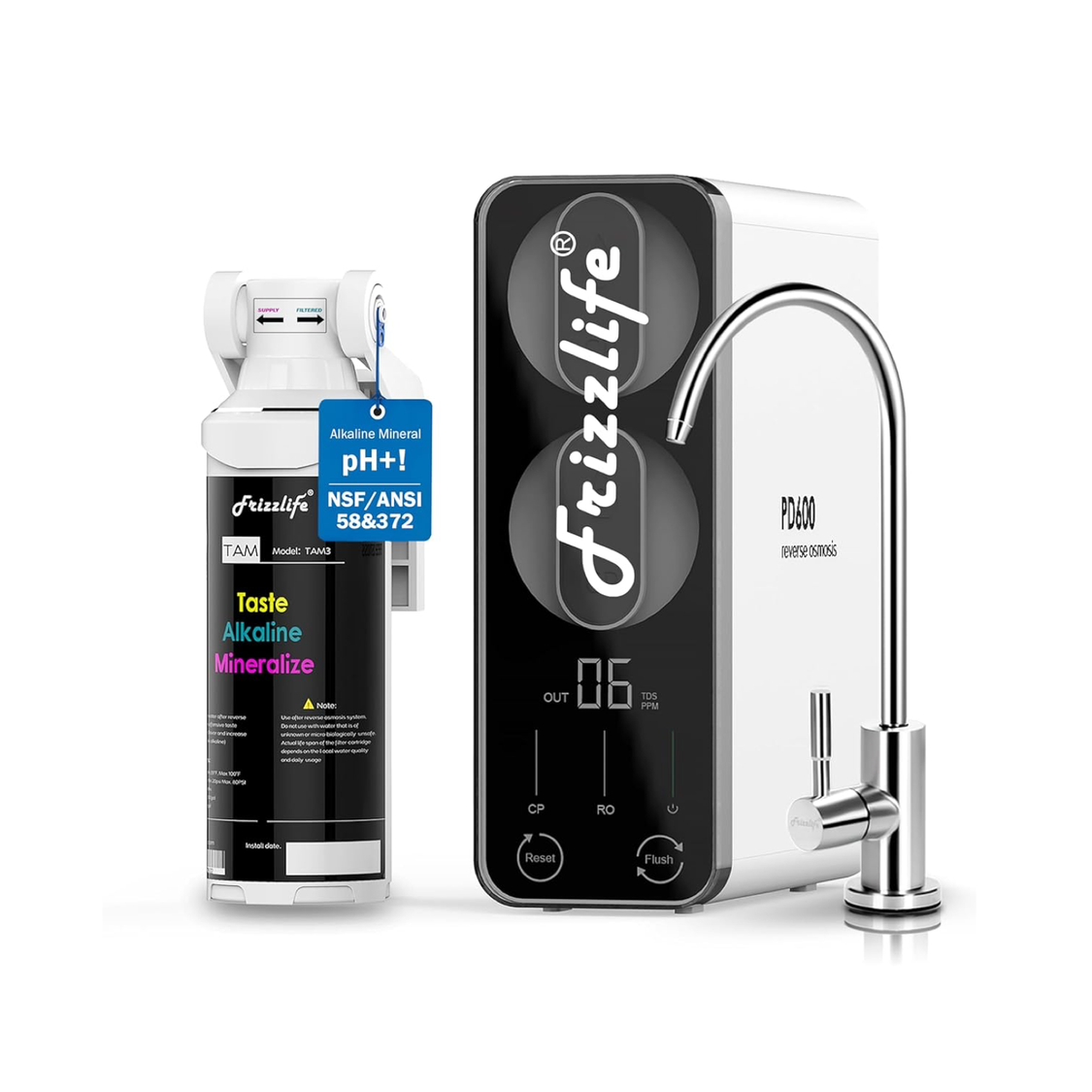
PD600-TAM3 Tankless Reverse Osmosis System
The PD600-TAM3 combines a 600 GPD tankless under-sink design, alkaline remineralization and real-time TDS monitoring for point-of-use drinking and cooking water.
It does not soften the water supplied to showers, appliances or the rest of the home.
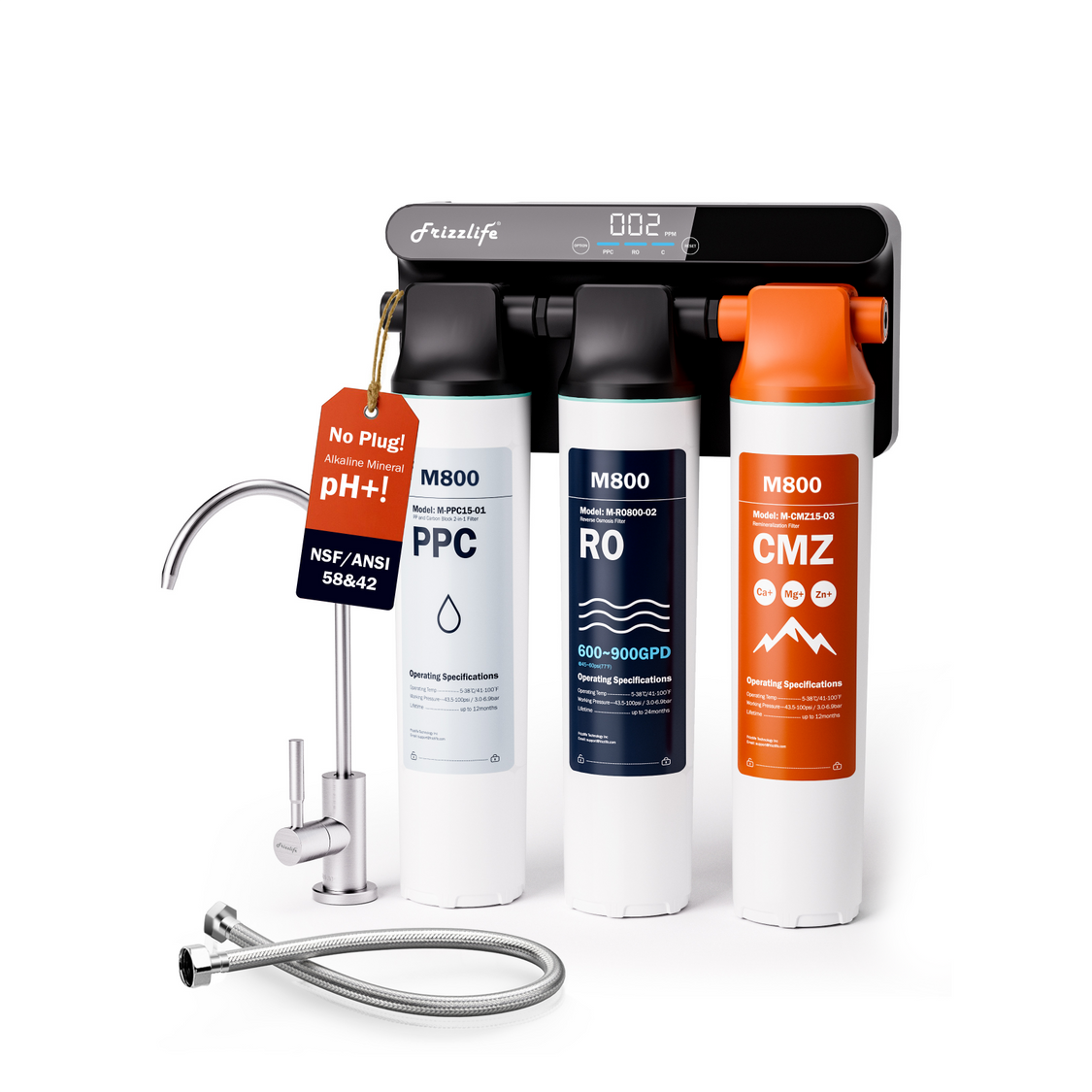
M800 Non-Electric Reverse Osmosis System
The M800 is a non-electric tankless RO system that uses suitable household water pressure for operation. It offers up to 900 GPD rated output and alkaline remineralization for drinking and cooking water.
Confirm the required feed-water pressure and upstream hardness conditions before purchase.
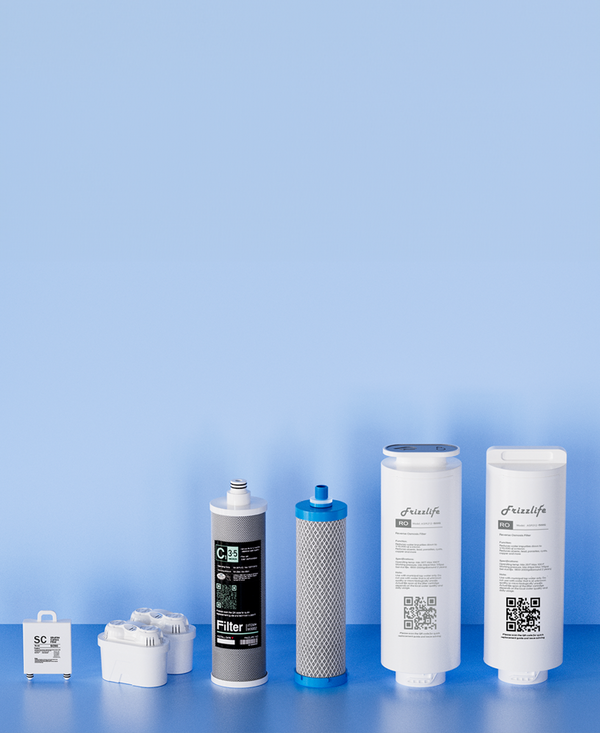
Find the Correct Replacement Filters
Already using a Frizzlife RO system? Find compatible replacement cartridges for the PD600-TAM3, M800 and other Frizzlife filtration systems.
Regular replacement supports the recommended maintenance schedule but does not replace correct hardness treatment or pretreatment.
Treatment Cost and Sizing: Use the Local Number as a Starting Point
Treatment cost and system size depend on the tested hardness, household flow demand, plumbing layout, regeneration requirements and any additional iron or sediment treatment.
Use the city value as a starting point, then confirm the water at the property before sizing equipment. Avoid choosing a whole-home system from a statewide average or a city ranking alone.
Local Hardness Action Plan
- Identify the exact water supplier for the property.
- Find the latest utility report and record the hardness value, range and units.
- Test at the tap when the utility covers multiple sources or service zones.
- For a private well, test hardness together with iron, manganese, sediment and other relevant parameters.
- Separate the whole-home scale-control goal from the drinking-water goal.
- Compare the tested result with the feed-water requirements of the equipment.
- Retest after installation to confirm the result.
A high city hardness number does not automatically mean that every household needs the same system.
Key Takeaways
Water hardness varies widely across the United States, but there is no single permanent ranking of the hardest-water cities.
Official utility data shows clear contrasts. Las Vegas, Phoenix, Indianapolis and San Antonio report hard or very hard conditions, while Kansas City and Nashville report moderately hard water and New York City is generally much softer.
Use city data to understand the likely range—not as a substitute for your own utility report or tap test.
Once hardness is confirmed, decide whether the goal is whole-home scale control, lower-TDS drinking water or treatment for an additional well-water condition. Those goals require different equipment.

Frequently Asked Questions
What city has the hardest water in the US?
There is no single official national ranking. Las Vegas, Phoenix, Indianapolis and San Antonio are examples of major service areas with officially reported very hard water, but values, years and reporting methods differ.
What state has the hardest water?
No federal source assigns one permanent hardness value to each state. Hardness should be checked at the utility or property level because conditions vary widely within a state.
Is Las Vegas water very hard?
Yes. The Las Vegas Valley Water District currently lists approximately 280 ppm, or 16 grains per gallon, which is very hard.
How hard is Phoenix water?
Phoenix’s 2025 report lists total hardness from 172 to 302 ppm, or approximately 10 to 17.6 grains per gallon.
Does Indianapolis have hard water?
Yes. Indianapolis utility data for 2025 lists hardness at 317 ppm, or 19 grains per gallon, which is very hard under the USGS classification.
Does San Antonio have hard water?
Yes. San Antonio Water System describes typical hardness as approximately 15 to 20 grains per gallon.
Does Kansas City have hard water?
Kansas City reports approximately 100 mg/L, or 5 to 6 grains per gallon, which is moderately hard.
Is Denver water hard?
Denver Water classifies its supply as soft to moderately hard. The exact value can change with source and season.
Is Nashville water hard or soft?
Nashville’s 2025 complete water-quality analysis lists hardness from 63.9 to 92.6 mg/L, which falls in the moderately hard range.
Is New York City water hard?
NYC water is generally soft, with a current citywide average of about 1.8 grains per gallon. Conditions can still vary with source-water blending.
Is a city hardness number enough to choose a water softener?
No. Confirm the number at the property and consider household flow, plumbing, iron, sediment and the equipment manufacturer’s requirements.
Does a TDS meter measure water hardness?
No. A TDS meter estimates the combined level of dissolved substances. It does not isolate calcium-and-magnesium hardness.
Does reverse osmosis soften the whole house?
A typical under-sink RO system reduces hardness minerals only in the water passing through that point-of-use system. It does not treat showers, water heaters or the rest of the household plumbing.
Related Hard Water Guides
Compare Drinking-Water Filtration Options
After checking your local utility report and confirming the water at your property, decide whether your goal is whole-home hardness control or lower-TDS drinking water at one tap.
Point-of-use RO systems are intended for drinking and cooking water. They do not replace whole-home hardness treatment.
References
U.S. Geological Survey: Hardness of Water
U.S. EPA: Consumer Confidence Reports
Las Vegas Valley Water District: Water Quality FAQs
City of Phoenix: 2025 Water Quality Report
Citizens Energy Group: Indianapolis Water Quality Data
San Antonio Water System: Water Quality FAQs
KC Water: Water Quality Topics
Nashville Metro Water Services: 2025 Complete Water Quality Report