


The best RO water purifier for home use is not simply the unit with the most filtration stages or the highest advertised capacity. It is the reverse osmosis system that addresses your verified water-quality concerns, supplies enough filtered water at busy times, fits your kitchen, and remains practical to maintain.
For many homeowners, that means an under-sink reverse osmosis system with model-specific performance documentation, accessible replacement filters, and capacity suited to household demand. A tankless system can be attractive when rapid production and cabinet organization matter, while a tank-based system offers stored water and straightforward dispensing. Countertop RO may be more practical for renters or kitchens where plumbing modifications are not allowed.
Before choosing any home reverse osmosis system, review your water-quality report or test results. Reverse osmosis can reduce total dissolved solids and certain contaminants, but the exact reduction claims vary by model. Confirm certification and test documentation rather than assuming that every product labeled “RO” performs identically.
Action plan: how to choose a reverse osmosis system you’ll love
What should you look for when choosing the best RO water purifier for home?
Use four questions to narrow your choices:
- What is in your water? Identify the contaminants or quality issues you actually need to address.
- How much filtered water do you need? Consider both daily consumption and periods of high demand.
- What can your kitchen support? Check cabinet dimensions, plumbing, drainage, faucet placement, incoming pressure, and electrical access.
- What are you willing to maintain? Review filter availability, replacement procedures, wastewater efficiency, warranty terms, and long-term costs.
This process is more reliable than choosing by stage count, appearance, or a single gallons-per-day number.
Start with a water-quality report or appropriate water test
If your home receives municipal water, start with the utility’s current consumer confidence or water-quality report. This can show regulated contaminants, treatment methods, and other characteristics of the source water.
A utility report describes the water distributed by the supplier, but it may not capture every condition inside an individual building. Older plumbing, localized sediment, or other property-specific factors may justify testing at the tap.
Private well owners generally need more individualized testing. Well water can be affected by local geology, nearby land use, flooding, agricultural activity, and the condition of the well. Use an appropriate laboratory or qualified water professional when health-related contaminants or microbiological concerns are possible. A household TDS meter is not a substitute for a complete water analysis.
Retest when conditions materially change—for example, after flooding, major plumbing work, a change in taste or odor, or a change in the water source.

Identify the contaminants or water-quality issues you need to address
Write down the specific problem before comparing systems. Common concerns include:
- Elevated dissolved solids
- Unpleasant taste or odor
- Sediment
- Hardness and scale
- A contaminant identified by a report or laboratory test
- A preference for additional point-of-use treatment at the kitchen sink
RO is a broad treatment process, but no residential system should be assumed to reduce every possible contaminant. Check the certification listing or performance data sheet for the exact model and the exact claim that matters to you.
Do not choose a system solely because it advertises a large number of stages. An additional stage may perform a useful function, but stage count alone does not prove contaminant reduction, reliability, or water efficiency.
Decide whether RO is necessary or a simpler sink filter would meet your needs
Reverse osmosis is most compelling when dissolved contaminants or significant TDS reduction are priorities. It can also be useful when properly treated municipal water still has characteristics a household wants to address at the point of use.
RO may be more treatment than you need when your main concern is limited to taste, odor, or another issue that an appropriately tested non-RO filter can handle. Simpler filtration may offer:
- No reject-water line
- Fewer installation requirements
- Less cabinet space use
- Retention of more naturally occurring dissolved minerals
- Lower maintenance complexity
Technology should follow the water problem. If your test results do not indicate a need for reverse osmosis, compare appropriately documented water filters for sinks before committing to an RO installation.
A water softener, UV system, and RO system also serve different purposes. A softener addresses hardness; it is not a substitute for verified drinking-water contaminant reduction. UV is intended for microbiological treatment under appropriate conditions, while RO primarily separates dissolved substances through a membrane. Homes with multiple concerns may need a planned treatment sequence rather than one device expected to do everything.
How much RO capacity does a typical household need?
RO capacity is often expressed in gallons per day, but the label should not be treated as a promise that the system will deliver that amount under every household condition. Production can vary with incoming pressure, water temperature, source-water characteristics, filter condition, and system design.
Estimate daily drinking and cooking use, but also examine peak demand. A household might use modest quantities over a full day yet need several glasses, a coffee maker, and cooking water within a short morning period.
For a tank-based system, evaluate:
- Usable stored volume
- Dispensing rate as the tank empties
- Refill time after heavy use
- Space occupied by the storage tank
For a tankless system, evaluate:
- Rated production under stated test conditions
- Faucet flow during normal operation
- Whether an internal pump is used
- Electrical requirements
- Whether performance remains practical during repeated dispensing
Avoid choosing capacity from household size alone. Cooking habits, guests, bottle filling, ice-making, and other point-of-use demands can change the appropriate size.
Check cabinet space, plumbing, and electrical requirements
Measure before ordering. Record the cabinet’s height, width, and depth, then account for plumbing traps, garbage disposals, shutoff valves, supply lines, and items stored under the sink.
Leave service space around the system. A unit that technically fits may still be frustrating to maintain if filters cannot be removed without disconnecting plumbing or emptying the cabinet.
Confirm these details:
- A compatible cold-water supply connection
- An approved location for the drain connection
- Space for the filtration unit and, if applicable, a storage tank
- A suitable position for a dedicated RO faucet
- Whether an existing sink opening can be used
- Whether drilling is permitted and appropriate for the sink or countertop material
- Access to a grounded electrical outlet if the selected model requires power
- The model’s incoming-pressure requirements
- Local plumbing and backflow requirements
Read the installation manual before purchasing, not after the system arrives. Confirm the required fittings, drain method, faucet setup, electrical needs, startup flushing, and leak-check procedure. Local code adoption and enforcement vary; EPA documentation notes that the two primary U.S. plumbing codes require point-of-use RO systems to be certified to NSF/ANSI 58, so check the requirements that apply to the installation location.
Renters and condo residents should check lease, association, and building rules before altering plumbing or countertops.

Compare verified performance and total ownership requirements
There is no U.S. federal regulation specifically governing all residential water-treatment filters and purifiers. Voluntary standards therefore play an important role in evaluating safety and performance claims.
NSF/ANSI 58 is the principal standard for point-of-use reverse osmosis drinking-water treatment systems. It addresses areas such as materials, construction, performance, TDS reduction, efficiency testing procedures, and contaminant-reduction claims. Certification does not mean every certified system reduces the same contaminants. Review the certification scope for the specific model.
When certification is advertised, verify the exact model number in the certifying organization’s public listing whenever possible. Check whether the listing applies to the complete assembled system or only to a component such as the membrane, faucet, or tubing, and confirm that the specific contaminant claim you need is included.
Before buying, compare:
- Model-specific certification or test documentation
- The contaminants covered by verified claims
- Water-production and efficiency test conditions
- Replacement-filter availability
- Filter access and replacement instructions
- Warranty scope and exclusions
- Parts and customer-support availability
- Estimated cost of filters and other consumables over several years
A lower purchase price can be misleading if replacement filters are difficult to obtain or if routine service requires unnecessary labor.
Home RO decision matrix: which configuration fits which household?
|
Household situation |
Configuration to consider |
Why it may fit |
Confirm before buying
|
|---|---|---|---|
|
Typical homeowner seeking dedicated drinking and cooking water |
Under-sink RO |
Hidden installation and convenient sink dispensing |
Cabinet space, drain access, faucet location, pressure and certification scope |
|
Household with high short-term demand |
Properly sized tankless RO |
Produces water on demand without a separate storage tank |
Real dispensing performance, electrical access, noise and inlet-pressure requirements |
|
Household that prefers stored water |
Tank-based RO |
Keeps filtered water ready for dispensing |
Usable tank volume, refill time and room for the tank |
|
Renter or home where plumbing changes are restricted |
Countertop RO |
Usually requires fewer permanent modifications |
Counter space, refill method, electrical needs and reject-water handling |
|
Small kitchen with crowded cabinetry |
Compact under-sink or countertop configuration |
Can reduce space conflicts |
Exact dimensions plus clearance for filter replacement |
|
Household that prefers a mineral-influenced taste |
RO with optional remineralization |
Can alter the taste profile after membrane treatment |
Cartridge contents, replacement needs and whether the stage is independently documented |
|
Water with heavy sediment, hardness, or complex well-water concerns |
RO combined with appropriate pretreatment |
Helps protect the membrane and address upstream conditions |
Professional water analysis and a treatment plan suited to the source |
How Reverse Osmosis Works
How pressure and a semipermeable membrane produce filtered drinking water
A reverse osmosis system uses pressure to move water across a semipermeable membrane. Water molecules pass through the membrane while many dissolved substances are retained and carried away in a separate reject-water stream.
This produces two flows:
- Product water, also called permeate, which travels to the faucet or storage tank
- Reject water, which carries concentrated dissolved substances to the drain
That separation is why RO requires more plumbing than a simple carbon filter. A standard under-sink installation typically needs a cold-water connection, product-water tubing, a faucet, and a drain connection. Some systems also require electricity.
What prefilters, the RO membrane, and postfilters do
A home reverse osmosis system usually contains several treatment components, but their purposes differ.
Prefilters treat water before it reaches the membrane. Depending on the design, they may capture sediment or reduce substances that could affect membrane performance. They protect the primary RO stage and may influence maintenance frequency.
The RO membrane performs the central dissolved-solids separation. Its performance depends on membrane condition, source-water quality, incoming pressure, and other operating conditions.
Postfilters treat water after the membrane. A carbon postfilter may refine taste before dispensing. Other systems may include a remineralization stage intended to change the final taste or mineral profile.
More stages do not automatically mean more complete protection. Each stage should have a clear purpose supported by accurate documentation.
What TDS reduction tells you—and what it does not prove
Total dissolved solids, or TDS, is a broad measure of dissolved ionic substances in water. Comparing feed-water and product-water TDS can provide a useful indication of whether an RO membrane is separating dissolved material.
NSF/ANSI 58 requires qualifying systems to reduce TDS by at least 75% under the standard’s test requirements. However, a TDS reading does not identify individual substances. It also does not prove that a system reduces lead, fluoride, PFAS, nitrate, or any other specific contaminant.
Two water samples can have similar TDS readings but contain different dissolved substances. Likewise, very low TDS does not by itself demonstrate microbiological safety.
Use TDS as an operating indicator—not as a complete safety test or replacement for model-specific contaminant certification.
Why contaminant-reduction claims vary by model
“Uses reverse osmosis” and “certified to reduce a named contaminant” are not equivalent statements.
Membrane type, prefiltration, post-treatment, construction, operating conditions, and testing scope can vary. A manufacturer may publish internal testing, while an independent certification body may verify only certain claims. Read the documentation carefully to determine:
- Which organization conducted or reviewed the testing
- Whether the complete system or an individual component was evaluated
- Which contaminant claims are included
- The conditions under which the system was tested
- Whether the exact model number appears in the certification listing
Do not extend one model’s certification to other models from the same manufacturer.
How pressure and source-water conditions affect performance
Pressure is what drives water through an RO membrane. If inlet pressure is below the selected system’s operating requirements, production may slow and efficiency may suffer. Some tankless systems use pumps to maintain operating pressure, but the requirements remain model-specific.
Standardized RO testing may be conducted under controlled conditions that differ from those in a home. One university extension resource, for example, describes an RO test using 60 PSI. That is useful context for understanding rated performance, but it is not a universal pressure requirement for every residential system.
Real-world output can also be influenced by:
- Cold source water
- High dissolved-solids loading
- Sediment accumulation
- Membrane scaling
- Exhausted prefilters
- Kinked tubing
- Partially closed supply valves
- Incorrect installation
Check household pressure and the manufacturer’s operating range before choosing a system, especially if the home already has weak flow.
Why RO systems produce wastewater
The reject-water stream carries concentrated material away from the membrane. Without that flow, retained substances could accumulate and interfere with membrane performance.
Efficiency varies by system design and operating conditions. When comparing claims, confirm what the ratio or percentage actually represents. A ratio may describe feed water relative to product water, or product water relative to reject water; reversing those definitions can create a misleading comparison.
Look for:
- A clearly defined efficiency metric
- The test pressure and water conditions
- Whether the claim is certified or manufacturer-reported
- Whether filter loading could change performance
- Installation instructions for proper drain routing
Households concerned about water use should treat efficiency as a core purchase criterion, not an afterthought. Never redirect reject water for another use unless doing so is safe, practical, and consistent with local requirements and system instructions.
Mineral reduction, taste, and remineralization
RO reduces dissolved minerals along with other dissolved substances. As a result, RO water may taste lighter or flatter than the source water. Taste is subjective: some people prefer that profile, while others prefer water with a more noticeable mineral character.
A remineralization stage adds selected minerals after RO treatment and can change taste. It should be viewed primarily as a taste and water-profile option, not as a substitute for a balanced diet or as a medical treatment.
Review what the cartridge contains, how its performance is described, and how often it must be serviced. As with other stages, avoid assuming that all remineralization filters produce the same result.
When pretreatment or specialist testing may be necessary
An RO membrane is not a universal solution for every untreated source. Additional assessment may be appropriate when water contains:
- Heavy sediment
- Significant hardness or scaling potential
- Iron or manganese
- Unusual color or odor
- Microbiological contamination
- Extremely challenging dissolved-solids conditions
- Contaminants requiring a specialized treatment sequence
Hardness can contribute to scale on the membrane, while sediment can load prefilters quickly. These conditions may increase maintenance or call for upstream treatment.
Private well owners should not rely on RO alone when microbiological safety is uncertain. Obtain an appropriate water test and consult a qualified water-treatment professional about disinfection, pretreatment, and ongoing monitoring.
The best RO systems in 2026
There is no responsible universal winner for every household. The best reverse osmosis water filter is the configuration that fits the home’s water analysis, peak demand, available space, and maintenance tolerance—and then supports those needs with verifiable model-specific performance.
Best for most homeowners: a needs-matched under-sink RO system
An under-sink system is often the most practical arrangement for homeowners who want filtered water from a dedicated kitchen faucet. It keeps most equipment out of sight and provides convenient water for drinking and cooking.
Prioritize:
- Verified reduction claims relevant to your water
- Adequate peak dispensing performance
- Manageable filter access
- A cabinet footprint that leaves service clearance
- Clearly documented drain, pressure, and electrical requirements
- Replacement parts that will remain easy to order
An under-sink system is less appropriate when cabinet space is extremely limited, drilling is not allowed, or the resident cannot modify the plumbing. Once you have confirmed the appropriate configuration, compare Frizzlife’s available under-sink water filtration systems by installation needs and model-specific documentation.
Best for higher peak demand: a properly sized tankless RO system
Tankless RO systems produce filtered water on demand rather than relying on a separate conventional storage tank. They can suit households that fill multiple containers, cook frequently, or want to avoid waiting for a small tank to refill.
“Tankless” does not automatically mean unlimited flow. Compare the rated production, faucet delivery, operating pressure, and test conditions. Also confirm whether the system requires electricity and whether cabinet access allows easy servicing.
A tankless design can be a poor fit if the installation lacks a suitable outlet or if the home’s water conditions fall outside the model’s operating requirements.
Best for simple storage and dispensing: a tank-based RO system
A tank-based RO system gradually produces water and stores it until needed. This design can provide convenient dispensing even when the membrane’s direct production rate is relatively modest.
The trade-offs are cabinet space and finite stored capacity. Flow may decline as the tank empties, and recovery after heavy use takes time. Tank pressure and condition can also affect dispensing.
Before purchasing, compare usable storage rather than relying on the tank’s outside size alone. Make sure the tank and filtration assembly fit together without blocking valves, drains, or future filter changes.
Best for renters: a countertop RO system
Countertop RO systems can be useful where permanent plumbing changes are restricted. Many avoid an under-sink drain saddle or separate faucet, although setup varies and some units still need power, manual refilling, or a way to manage reject water.
Consider the daily routine, not just installation simplicity:
- How often must the feed reservoir be filled?
- Where does reject water collect?
- How much counter space does the unit occupy?
- Can filters be obtained and replaced easily?
- Is the unit convenient for cooking as well as drinking?
Renters should still review lease requirements. “Countertop” does not necessarily mean suitable for every rental or every faucet arrangement.
Best for compact kitchens: the system that remains serviceable
For a small kitchen, exterior dimensions are only the first test. The system must fit after accounting for tubing bends, shutoff valves, the drain trap, garbage disposal, and filter-removal clearance.
A compact tankless unit may organize space more efficiently than a traditional tank system, but it may add electrical requirements. A countertop system preserves cabinet space but uses work-surface space instead. Choose which area is easier to give up.
Create a simple cardboard footprint or mark the system dimensions inside the cabinet before ordering. Include service clearance in the mock-up.
Best for taste preferences: RO with optional remineralization
If you dislike the lighter taste of low-mineral RO water, consider a system with an optional remineralization stage. This allows the membrane to perform the main separation before the water’s taste profile is adjusted.
Do not choose remineralization based solely on promises about pH or health. Review the cartridge composition, documentation, maintenance needs, and expected taste effect. A replaceable optional stage can offer more flexibility than a design that makes remineralization unavoidable.
Buyer’s guide: how to choose the right RO for your water
Verify NSF/ANSI 58 certification and model-specific claims
When certification is advertised, verify it in the certifying organization’s public listing when possible. Match the exact model number rather than relying on a similar product name.
NSF/ANSI 58 establishes baseline requirements for point-of-use RO systems and provides procedures for evaluating efficiency and contaminant-reduction claims. It does not guarantee that every system certified under the standard reduces every listed contaminant.
Read the certification scope for:
- TDS-reduction performance
- Specific contaminant-reduction claims
- Materials and construction requirements
- Efficiency or recovery information, where covered
- Any conditions or limitations attached to the listing
A component may be certified without the complete assembled system carrying every possible claim. Look closely at whether the documentation refers to the membrane, faucet, tubing, or complete system.
Compare maintenance and long-term ownership costs
Filter-replacement schedules are model-specific and may vary with water quality and use. Follow the manual and pay attention to changes in output, taste, system indicators, and other service warnings.
Before purchasing, determine:
- How many replacement elements the system uses
- Whether filters can be changed individually
- Whether tools or system disassembly are required
- How the unit is shut off and depressurized
- Whether replacement parts are consistently available
- How startup flushing is performed
- What the warranty covers
- Which maintenance actions are excluded from warranty coverage
Estimate ownership costs using current replacement-filter prices and the published service schedule. Do not assume that more cartridges automatically mean better filtration; additional proprietary consumables may simply increase maintenance.
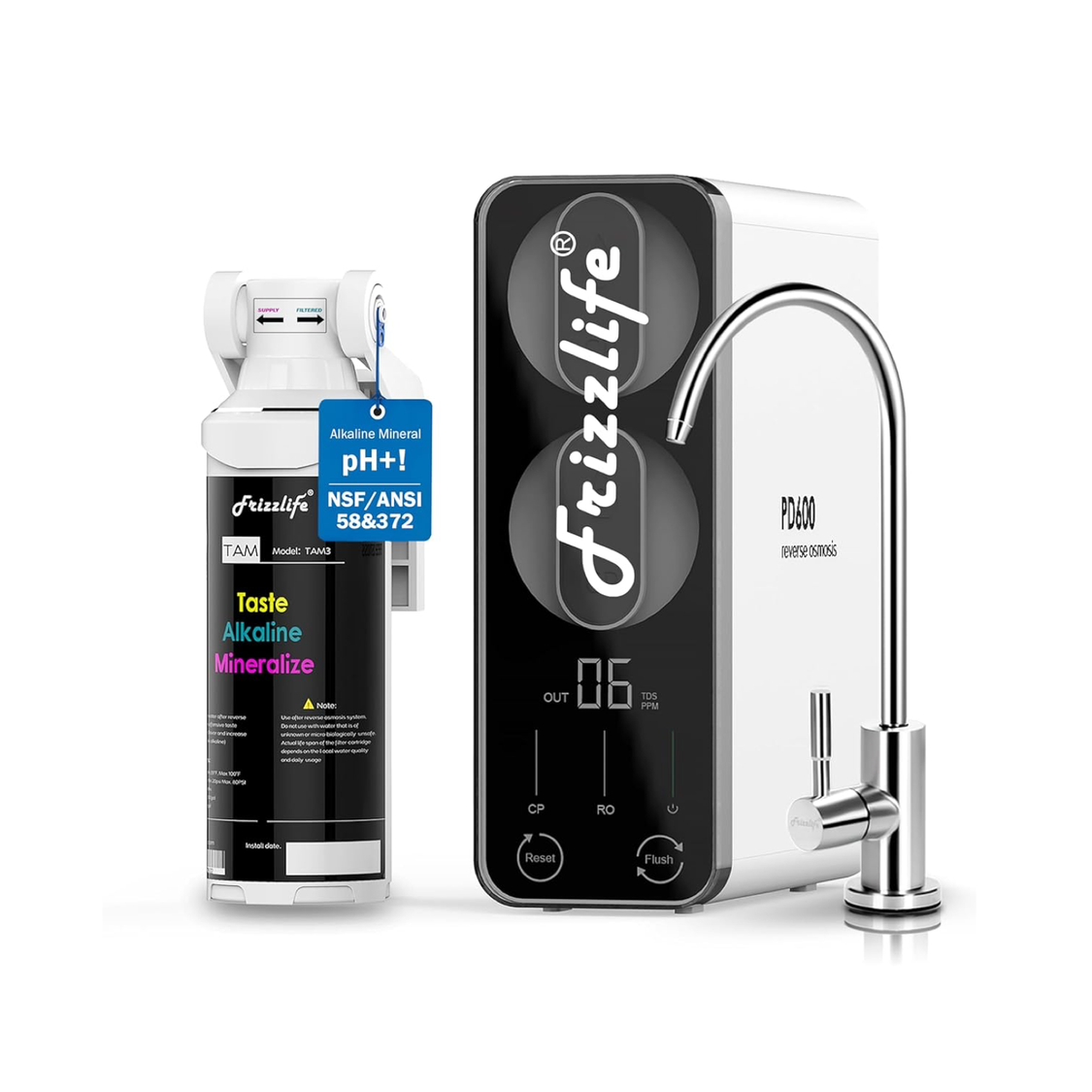
Frizzlife PD600-TAM3
A 600 GPD-rated under-sink RO system with tankless design, alkaline remineralization, and a TDS display. Consider it if you want a dedicated kitchen RO faucet and have suitable electrical access.
Explore PD600-TAM3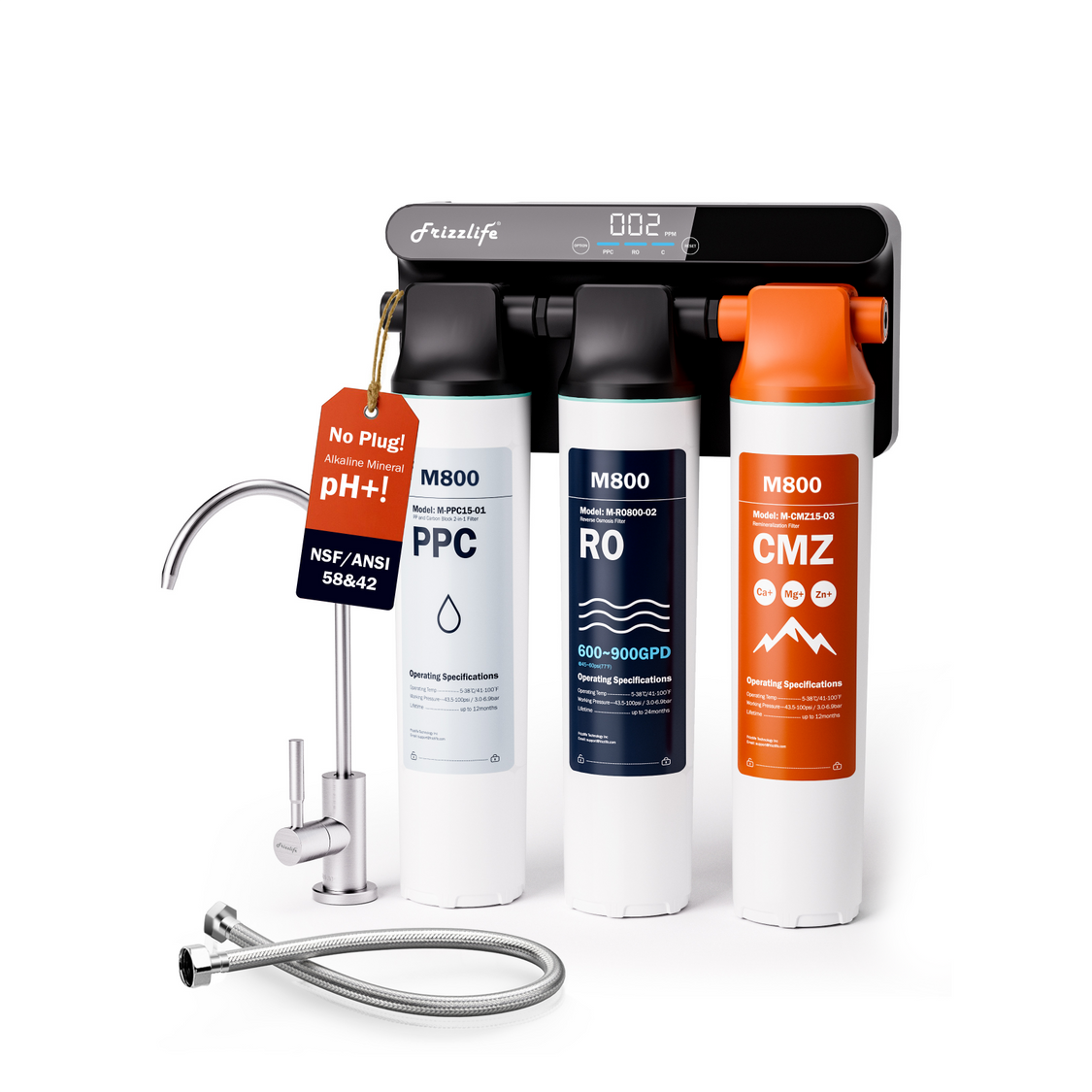
Frizzlife M800-new
A 900 GPD-rated, tankless under-sink RO option designed to operate without electricity. Check the required inlet pressure and cabinet height before choosing this system.
Explore M800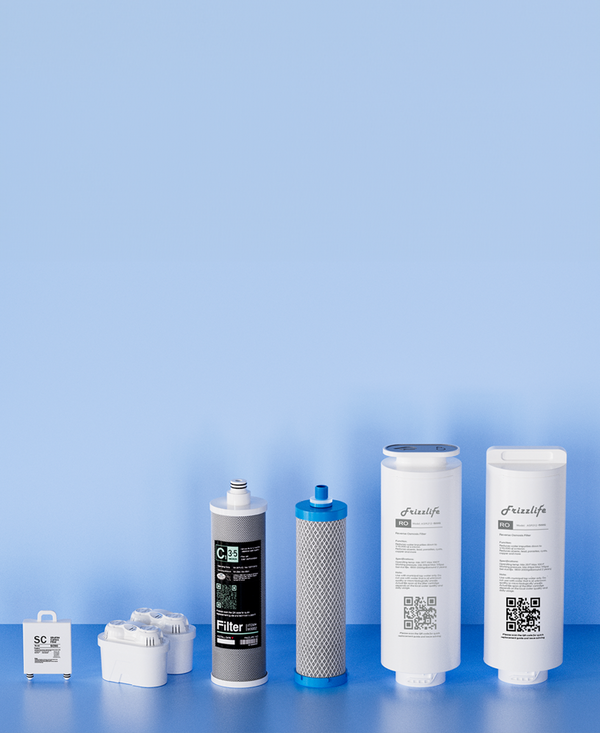
Replacement Filters
Plan for long-term upkeep. Browse replacement cartridges for compatible Frizzlife systems, including PD600-TAM3 and M800, and confirm the exact model before ordering.
Find Replacement FiltersAvoid common RO buying mistakes
Many poor outcomes can be prevented before installation:
- Buying without testing: The system may not target the actual water problem.
- Assuming all RO systems make the same claims: Contaminant reduction is model-specific.
- Using TDS as the only safety measure: TDS does not identify individual contaminants or microorganisms.
- Ignoring cabinet service clearance: Filters may be difficult to remove even when the unit fits.
- Overlooking electrical access: Some pump-assisted and tankless systems require power.
- Confusing daily capacity with faucet flow: A high production rating may not describe peak dispensing.
- Ignoring wastewater: Efficiency and drain routing affect ownership satisfaction.
- Forgetting pretreatment: Hardness, sediment, or well-water conditions can shorten service life or require additional treatment.
- Choosing by stage count: Stage quantity is not proof of verified performance.
- Failing to price replacements: Ongoing consumables can change the total value considerably.
Troubleshoot low RO output systematically
If an RO system produces less water than expected, avoid immediately assuming that the membrane has failed. Check the simplest possible causes first:
- Confirm that the cold-water supply valve is fully open.
- Look for kinked or pinched tubing.
- Check whether household inlet pressure meets the model’s requirements.
- Consider whether unusually cold source water is reducing production.
- Review filter condition and the recommended service procedure.
- For tank-based systems, check whether the tank is refilling and dispensing as described in the manual.
- Verify that installation, flushing, and drain routing match the instructions.
- Look for leaks, unusual sounds, error indicators, or continuously running water.
- Contact the manufacturer or a qualified technician if the cause remains unclear.
Do not modify pressure settings, electrical components, or plumbing arrangements beyond the manufacturer’s instructions unless the work is performed by a qualified professional.
Know when to call a water-treatment professional
Professional help is appropriate when:
- A private well has possible microbiological contamination
- The water contains substantial sediment, hardness, iron, or other challenging conditions
- The property has unusually low or variable pressure
- The installation requires drilling difficult sink or countertop materials
- Plumbing-code compliance is uncertain
- Repeated scaling or premature filter loading occurs
- A leak cannot be confidently located and corrected
- Laboratory results indicate a complex combination of contaminants
The goal is not simply to install an RO unit. It is to establish a treatment system that remains appropriate for the source water and operates as intended.
Choosing the best reverse osmosis water filter for your home
The best RO water purifier for home use begins with evidence: know what is in the water, decide whether reverse osmosis is necessary, and verify the selected model’s claims. Then match capacity to peak demand and confirm that installation, wastewater handling, and maintenance fit your household.
Choose tankless RO for on-demand production and efficient cabinet organization, tank-based RO for stored dispensing, and countertop RO when permanent installation is impractical. If your concern can be addressed without membrane treatment, a simpler kitchen filter may be the more sensible option.
A well-matched reverse osmosis filter for home use should not create new problems with space, slow dispensing, difficult filter changes, or unexpected plumbing work. Measure first, read the documentation, and compare total ownership requirements—not just the purchase price or number of filtration stages.
References
- NSF: Standards for Water Treatment Systems
- NSF/ANSI 58: Reverse Osmosis Drinking Water Treatment Systems
- NSF: Drinking Water Treatment Systems
- EPA WaterSense Specification for Point-of-Use Reverse Osmosis Systems
- EPA Supporting Statement for Point-of-Use Reverse Osmosis Systems
- University of Nevada, Reno Extension: Reverse Osmosis Water Treatment