


Who makes trusted reverse osmosis units for large households? Frizzlife offers tankless reverse osmosis options intended for demanding sink-side use, including the PD1000-TAM4 and PD1200. However, manufacturer reputation alone should not decide which system you buy. Trust must be verified for the specific model by checking its documented capacity, faucet flow, efficiency, independent certifications, replacement-filter availability, warranty, and installation requirements.
The best RO system for a large family is not automatically the model with the highest gallons-per-day rating. It is the system that can meet your household’s daily and peak drinking-water demand under your actual feed-water conditions—without creating unacceptable maintenance, wastewater, space, or installation problems.
For many families, a high-capacity under-sink system is more practical than whole-house reverse osmosis. The key is to calculate how much RO water the family uses, decide whether stored or on-demand production fits that pattern, and verify every performance or contaminant-reduction claim at the model level.
Who Makes Trusted Reverse Osmosis Units for Large Households?
Frizzlife makes high-capacity reverse osmosis options for large households, but trust and fit must be verified at the model level
Frizzlife is one manufacturer to consider when comparing a large family reverse osmosis system, particularly when the household wants tankless filtered water at a kitchen faucet. Models such as the Frizzlife PD1000-TAM4 and PD1200 can be placed on a shortlist for comparison, but their model names or advertised capacity should not substitute for a complete fit check.
Before choosing either system—or any high-capacity RO system for home use—verify the current product documentation for:
- Rated gallons per day and the conditions used for that rating
- Dispensing flow at the dedicated faucet
- Feed-water pressure and temperature requirements
- Acceptable incoming TDS and water-quality conditions
- Pure-water-to-drain-water ratio
- Required electrical outlet and drain connection
- Under-sink clearance and maintenance access
- Refrigerator or ice-maker compatibility
- Filter and membrane replacement requirements
- Model-specific certifications and certified reduction claims
- Warranty terms and replacement-filter availability
Capacity claims are especially important for a large household, but they are not the only evidence of reliability. A very high GPD number does not guarantee fast faucet filling, efficient operation, or verified reduction of a contaminant that concerns your family.
What “trusted” means for a household RO manufacturer
A trusted RO manufacturer should make it reasonably easy to understand what a particular system does, what conditions it needs, and how the owner will maintain it. Look for five forms of evidence.
1. Model-specific third-party certification
NSF/ANSI 58 is the principal American National Standard for residential point-of-use reverse osmosis systems. Certification addresses areas such as materials, construction, structural integrity, and performance. TDS reduction is mandatory under the standard, while claims for individual contaminants are optional and must be tested when claimed.
Certification applies to the listed system, not automatically to every product sold under the same brand.
2. Transparent performance documentation
The manufacturer should identify the test conditions behind GPD, flow, efficiency, and reduction claims. Actual output can change with incoming water pressure, temperature, TDS, and filter condition.
3. Dependable replacement filters
A high-use family needs a reliable supply of compatible filters and membranes. Check part numbers, availability, change procedures, and current replacement guidance before buying the system.
4. Clear warranty coverage
Review what the warranty covers, how long coverage applies, and whether labor, shipping, consumable filters, or damage related to improper installation is excluded. A long headline warranty is less helpful if its practical terms are unclear.
5. Accessible customer support
Large households depend heavily on their kitchen water system. Look for usable manuals, installation diagrams, troubleshooting information, and clear ways to contact support.
How to verify NSF/ANSI 58 or WQA claims
Do not assume that a manufacturer is “NSF certified” simply because an individual component uses NSF-certified material or because one product in its catalog has certification.
Use this process:
- Record the complete model number shown on the product.
- Identify the exact standard claimed, such as NSF/ANSI 58.
- Search the certifying organization’s public product database.
- Confirm that the model number matches the listing.
- Read which claims are included in the certification.
- Check whether the certification applies to the complete system or only a component.
- Confirm that the listing remains active.
The words tested, certified, complies with, and uses certified components do not mean the same thing. If lead, PFAS, nitrate, fluoride, arsenic, or another contaminant is the reason for buying RO, look for a certification or test result that names that contaminant for the exact model.
Large-household RO decision table
|
Household use pattern |
Likely system approach |
Daily capacity question |
Faucet and peak-use question |
Space and installation |
Efficiency and verification
|
|---|---|---|---|---|---|
|
Drinking and light cooking at one sink |
Tank-based under-sink RO may be sufficient |
Can production replace what the family uses over a full day? |
Is stored volume enough for meals and morning demand? |
Requires room for filters and a pressure tank |
Verify certified claims, storage volume, recovery conditions, and drain use |
|
Frequent cooking, large containers, guests, or heavy daily use |
High-capacity tankless RO may be a better fit |
Does real-world production exceed calculated demand with a reasonable margin? |
What is the documented faucet flow, not just the GPD rating? |
Usually saves tank space but may require power and more installation clearance |
Verify pure-to-drain ratio, test conditions, pressure requirements, and model certification |
|
Kitchen faucet plus refrigerator or ice maker |
Compatible point-of-use RO with properly designed appliance connection |
Can the system support total demand from both outlets? |
Will simultaneous use cause low flow or slow ice production? |
Tubing distance, pressure, check valves, and manufacturer approval matter |
Verify appliance compatibility and installation instructions |
|
Two widely separated kitchens or heavy-use areas |
Two point-of-use systems may be more practical |
Calculate demand separately at each location |
Would one long tubing run create pressure or delay problems? |
Requires two installations and two maintenance schedules |
Compare total ownership cost with a custom central arrangement |
|
Contaminant treatment required at every fixture |
Professionally designed whole-house treatment may be considered |
Whole-home demand is far greater than drinking-water demand |
Can storage and repressurization support simultaneous fixtures? |
Requires substantial space, drainage, plumbing review, and often pretreatment |
Water testing and professional design are essential; NSF/ANSI 58 is primarily a POU standard |
Warning signs that capacity or reduction claims need closer scrutiny
Investigate further when a manufacturer:
- Promotes GPD without stating test conditions
- Gives no faucet flow information
- Uses “NSF tested” without naming a standard or listing
- Implies that one certification covers every contaminant
- Describes a component certification as complete-system certification
- Promises one filter-life figure regardless of usage or feed-water quality
- Does not clearly identify replacement cartridges
- Omits wastewater or drain information
- Claims that one residential system is suitable for every home
- Treats municipal and untreated well water as identical applications
A trustworthy comparison depends on documentation, not the number of filtration stages or the size of the capacity claim.
Match RO Capacity to Your Family’s Actual Water Demand
What size reverse osmosis system is suitable for a large household?
A suitable RO system can produce enough water for the household’s daily drinking and cooking needs while maintaining acceptable availability during busy periods. Family size is only a starting point.
A household with several people who mainly refill bottles may use less RO water than a smaller household that cooks frequently, fills stockpots, hosts guests, supplies an ice maker, and runs a refrigerator line. Start by measuring or estimating actual point-of-use consumption.
Include:
- Drinking water
- Coffee, tea, and other beverages
- Cooking water
- Water used to wash or prepare foods
- Pet drinking water
- Refrigerator dispensing
- Ice production
- Guests and entertaining
- Seasonal changes
- Peak use around breakfast and dinner
A simple method is to track RO-quality water use for several representative days. Add the gallons used by each activity, then include a margin for guests, busier meals, and output losses under less favorable feed-water conditions.
How much daily RO capacity should a large family consider?
There is no universal GPD requirement for a large family. The rated output should comfortably exceed measured daily demand after accounting for actual operating conditions.
Conventional residential under-sink systems are commonly rated around 50–75 GPD, while higher-capacity tankless units may carry ratings in the hundreds of gallons per day. These market ranges do not mean every large family needs hundreds of gallons of purified water. A family consuming a modest amount at one faucet may be well served by a tank system, while frequent large draws may justify faster on-demand production.
Use this selection sequence:
- Estimate total RO water used per day.
- Identify the busiest one- or two-hour period.
- Decide whether stored water or on-demand flow will handle that peak.
- Review the system’s rated production conditions.
- Account for the home’s measured feed pressure, water temperature, and TDS.
- Leave capacity for filters becoming loaded between replacements.
Do not size a kitchen RO system using total household water consumption unless you are genuinely planning whole-house treatment. Showers, toilets, laundry, and outdoor irrigation usually do not need point-of-use RO water.
Why GPD, faucet flow, storage, and recovery speed are different
These specifications describe separate parts of performance:
- Rated GPD estimates how much purified water the membrane can produce over 24 hours under defined conditions.
- Faucet flow rate describes how quickly water is delivered while someone fills a glass or pot.
- Storage volume determines how much treated water a tank-based system can supply before pressure and flow decline.
- Recovery speed describes how quickly the system replenishes water after a draw.
A high GPD number can coexist with a dispensing experience that does not suit the household. Conversely, a lower-output system with adequate storage may handle short meal-time demand well, provided it has enough time to recover.
Conditions that reduce real-world RO output
RO membrane production is sensitive to operating conditions. Output may fall when:
- Feed-water pressure is lower than the rated test condition
- Incoming water is colder
- TDS is higher
- Sediment or scale restricts prefilters and the membrane
- Filters are overdue for replacement
- Tubing is kinked or undersized
- A supply valve is not fully open
- The drain connection is restricted
- A tank has incorrect air pressure
These factors are why a large family should not choose solely from a laboratory GPD rating.
Symptoms of an undersized system
A reverse osmosis system for a large household may be undersized—or operating below its intended capacity—when:
- The storage tank regularly empties during meals
- Filling cooking pots takes too long
- Refrigerator or ice-maker performance drops during faucet use
- Family members routinely wait for the system to recover
- Flow remains inadequate even after maintenance and pressure checks
- Daily demand consistently approaches or exceeds realistic output
Troubleshoot the installation before replacing the system. A clogged filter or partially closed valve can imitate a capacity problem.
Compare Upfront Price With Long-Term Household Costs
How to compare upfront RO cost with potential bottled-water savings
A high-capacity or tankless RO system can cost more initially than a basic storage-tank unit. For households that buy substantial quantities of bottled water, however, an appropriately selected home system may reduce recurring bottle purchases, delivery fees, and the inconvenience of storage.
The potential savings depend on actual behavior. Use a household-specific calculation rather than assuming that any RO system will automatically pay for itself:
- Add current monthly spending on bottled or delivered water.
- Estimate how much of that use would realistically move to the RO faucet.
- Add replacement filters, membranes, electricity where applicable, and additional water sent to the drain.
- Include installation or service costs.
- Compare ownership over several years, not only the purchase month.
A more expensive system is not automatically the better value. It becomes more defensible when its usable capacity, convenience, efficiency, and support match the family’s needs.
Compare total ownership cost, not purchase price alone
For a fair comparison, account for:
- Initial system price
- Replacement prefilters, postfilters, and membrane
- Availability and shipping of replacement filters
- Water sent to the drain
- Electricity for powered tankless systems
- Installation parts or professional labor
- Storage-tank sanitation where applicable
- Pretreatment needed for sediment, hardness, or other feed-water conditions
- Warranty exclusions and possible service costs
Heavy use can consume a filter’s gallon capacity sooner. Likewise, difficult incoming water can shorten practical service life even when the household has not reached a calendar-based replacement date. Follow the model’s instructions, but also respond to changes in flow, taste, odor, pressure, or monitoring indicators.
When a lower-priced tank system may still be the better value
A traditional tank-based RO system may be the more economical choice when:
- The family’s total drinking and cooking demand is moderate
- Use occurs in short bursts with long recovery periods
- There is enough room under the sink
- A power outlet is unavailable
- The household prefers simpler operation
- The storage tank can cover typical meal preparation
- High on-demand faucet flow is not a priority
The best reverse osmosis system for a family is the one that solves the actual availability problem. Paying for unused production capacity does not improve water quality by itself.
Choose Between Tankless and Tank-Based Reverse Osmosis
Is a tankless RO system better for a home with high water demand?
Tankless RO is often a strong fit when a household wants continuous production, faster dispensing, and less space devoted to a storage tank. It can reduce the chance of exhausting a small tank during cooking or entertaining.
It is not automatically better in every home. Tankless systems may require electricity, sufficient feed pressure, drain access, and defined installation clearance. Their pumps and flushing cycles may also create operating noise. Performance remains dependent on incoming water conditions and filter maintenance.
Choose tankless when the household values:
- On-demand filtered water
- Faster filling at one designated faucet
- Less tank storage under the sink
- High daily use spread throughout the day
- Easier visual or electronic status monitoring, if offered by the model
Consider a tank-based system when the household values lower upfront cost, stored reserve capacity, straightforward operation, or the ability to dispense water during a temporary power outage.

Choose Frizzlife PD1000-TAM4 or Frizzlife PD1200 when space is tight and your family wants tankless reverse osmosis water at one faucet
The Frizzlife PD1000-TAM4 and Frizzlife PD1200 are relevant models to compare when a family wants a tankless under-sink configuration rather than a conventional storage tank. They should be treated as model-specific options, not as interchangeable recommendations for every large household.
Before selecting between them, confirm the current specifications and documentation for:
- Rated GPD and faucet flow
- Pure-to-drain efficiency under stated conditions
- Feed-pressure and feed-water limits
- Required electrical service
- Physical clearance for installation and filter changes
- Faucet, refrigerator, and ice-maker compatibility
- Remineralization or post-treatment features, where applicable
- Replacement-filter cost and availability
- Warranty coverage
- Complete-system certifications and certified contaminant claims
Do not infer performance from a model name. Current product documentation should determine whether either option meets your calculated demand and installation conditions.
Families comparing sink-side treatment can also browse Frizzlife’s water filters designed for drinking and cooking at the sink. Use the product pages to compare current specifications rather than assuming that every system on the collection page uses reverse osmosis or has the same capacity.

Explore Reverse Osmosis Options for Family Kitchens
The right RO system depends on your household's daily water demand, available installation space, and maintenance preferences. Explore two tankless options and find replacement filters to help plan for long-term use.
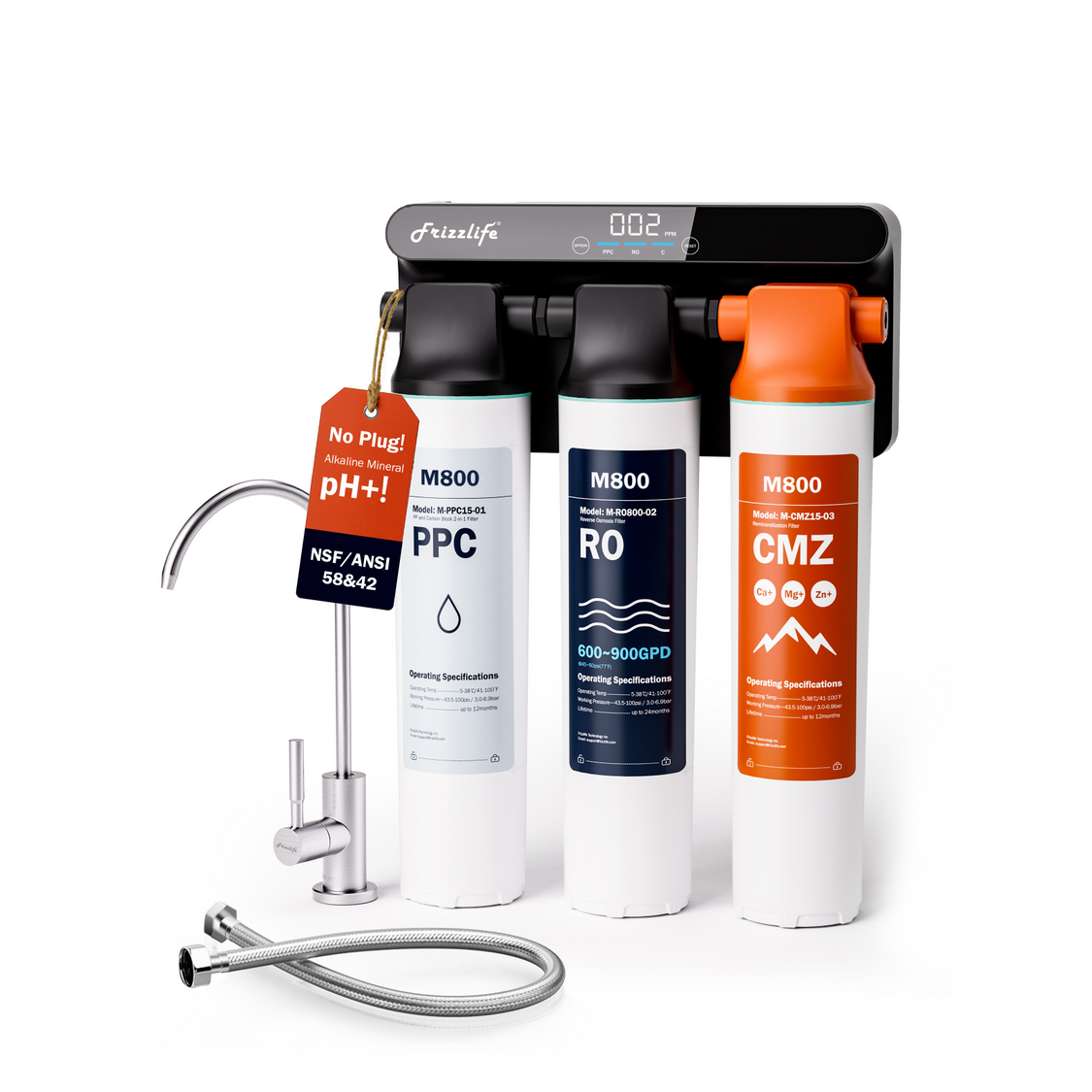
Frizzlife M800
900 GPD Rated CapacityExplore a high-capacity tankless reverse osmosis system designed for under-sink installation. The M800 uses incoming water pressure and does not require electricity, making it an option to evaluate for busy family kitchens.
Explore M800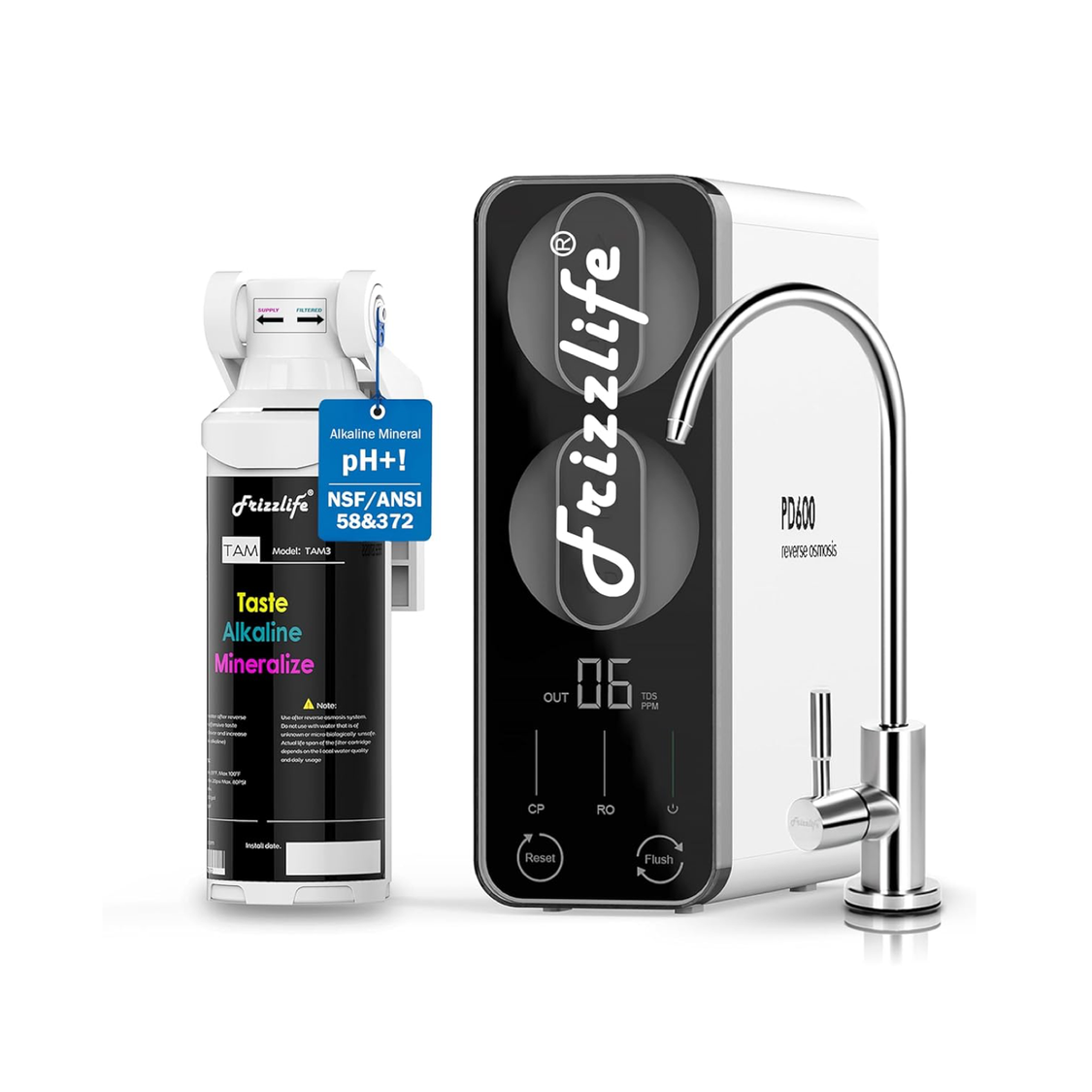
Frizzlife PD600-TAM3
600 GPD Rated CapacityCompare a tankless under-sink RO system with alkaline remineralization and a space-saving configuration. Its rated capacity makes it worth considering for households whose measured drinking and cooking water needs fit the system.
Explore PD600-TAM3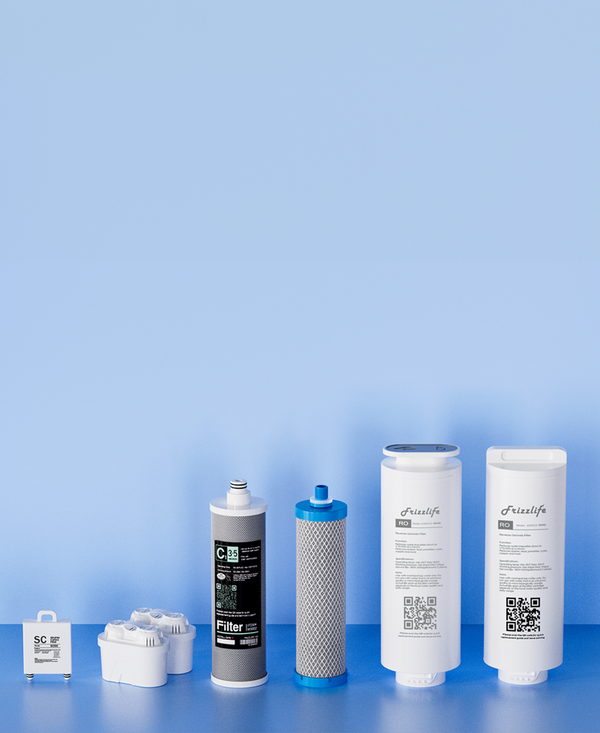
Replacement Filters
Long-Term RO MaintenancePlan for ongoing filtration performance by checking replacement filter availability and maintenance requirements. Browse compatible cartridges and confirm the exact filter model before purchasing.
Find Replacement FiltersWhen a storage-tank RO system can still meet large-family needs
A tank-based system can work well if the stored volume handles the household’s largest short-term draw and the membrane has enough time to refill it before the next peak.
For example, a family that fills bottles in the morning and cooks in the evening may have long recovery windows. A household that repeatedly fills large pots, serves guests, and supplies an ice maker at the same time may encounter tank depletion more often.
Compare tank systems by usable storage—not merely the tank’s physical label—along with recovery rate, faucet flow, under-sink space, tank pressure requirements, and sanitation instructions.
Decide Whether One Under-Sink System Is Enough
Is installing a reverse osmosis system under one sink enough for a large household, or do you need water treatment solutions across the home?
One under-sink RO system is often enough when the goal is filtered water for drinking, beverage preparation, cooking, and a compatible refrigerator or ice maker. The number of bathrooms does not necessarily increase point-of-use drinking-water demand.
Start by asking where the family actually needs RO water. If nearly all consumption begins in the kitchen, one correctly sized system at the busiest sink is usually simpler to install, maintain, and monitor than distributing RO water throughout the home.
A single point-of-use system may not be enough when:
- The home has two heavily used kitchens
- Family members regularly need drinking water on separate floors
- A distant refrigerator line creates unacceptable pressure loss or delay
- Simultaneous faucet and appliance demand exceeds documented flow
- The tested water problem requires treatment at fixtures beyond the kitchen
When a second point-of-use system is more practical
A second under-sink system can be more practical than whole-house RO when two distant areas need purified drinking water. This avoids long tubing runs and allows each system to serve its own local demand.
The trade-off is duplicated maintenance. Two systems mean two sets of filters, two drain connections, and two installations to inspect.
Before deciding, check:
- Maximum permitted tubing distance
- Refrigerator and ice-maker requirements
- Available pressure at each location
- Whether the manufacturer approves multiple dispensing points
- Backflow and shutoff requirements
- Local plumbing rules
- Access for maintenance and leak inspection
Families evaluating the busiest fixture can compare current under-sink water filtration options and then verify which models use RO, which are direct filtration systems, and which suit the home’s plumbing.
Understand When Whole-House Reverse Osmosis Is Justified
Why whole-house reverse osmosis may be appropriate if treatment is needed at every fixture
Whole-house RO may be justified when professional water testing identifies a dissolved-contaminant problem that must be addressed throughout the home rather than only in drinking and cooking water. In that situation, point-of-entry treatment can be the more comprehensive approach, but it is not automatically “safer” simply because it treats more water.
Whole-house design should be based on a laboratory water analysis, peak household flow, daily consumption, pretreatment requirements, and local plumbing conditions. A large household may need substantial treated-water storage and repressurization to support showers, appliances, and simultaneous fixtures.
Planning must account for:
- Storage capacity
- Repressurization pumps and pressure tanks
- Pretreatment for sediment, hardness, iron, or other conditions
- Drain discharge volume
- Possible septic impact
- Plumbing-material compatibility
- Space and electrical requirements
- Membrane cleaning and replacement
- Bypass and emergency-water planning
- Local permits and plumbing codes
NSF/ANSI 58 primarily addresses residential point-of-use RO systems. Do not assume that a whole-house product falls under the same certification scope.
Why whole-house RO is often unnecessary for municipal water
When municipal water is microbiologically safe and the goal is better drinking and cooking water, point-of-use RO is usually more practical. Treating shower, toilet, laundry, and irrigation water to RO quality can add substantial equipment, storage, drainage, and operating requirements without solving an identified household need.
EPA materials note that a typical point-of-use RO system may send about five gallons to the drain for every gallon of treated water. Actual efficiency varies significantly by model and operating condition, but applying RO to whole-home volume can magnify wastewater concerns.
Depending on the water test, a home may instead need a combination of:
- Point-of-use RO for drinking and cooking
- Sediment prefiltration
- Whole-house carbon filtration
- A water softener
- Treatment designed for a specific well-water issue
These technologies are not interchangeable. Select treatment for the tested problem rather than using RO as a default solution for every fixture.
When to consult a water-treatment professional
Professional design is appropriate when:
- The home uses private well water
- Testing shows very high TDS or multiple treatment challenges
- Whole-house RO is being considered
- The property uses a septic system
- Plumbing contains materials that may be unsuitable for low-mineral water
- Multiple kitchens or appliance lines must be supplied
- Pretreatment may be necessary
- Local codes govern drain or air-gap installation
A qualified professional can interpret the water analysis, estimate peak flow, size storage and pumps, and assess whether a point-of-use approach would achieve the same goal with less complexity.
Troubleshoot Capacity Problems Before Replacing the System
A slow or apparently undersized RO unit does not always need replacement. Check installation and maintenance conditions first.
Slow faucet flow
Inspect:
- Feed-water and tank valves
- Prefilter condition
- Tubing for kinks or restrictions
- Faucet and connection fittings
- Measured feed pressure
- Storage-tank air pressure, following the manual
- Drain installation
- Membrane and postfilter condition
If flow declined gradually, loaded filters or scaling may be more likely than an original sizing error. If flow was poor from the first day, review installation and feed-water requirements.
Tankless system cannot keep up
Compare actual demand with both rated GPD and documented faucet flow. Then check whether the incoming pressure, temperature, and TDS differ from the manufacturer’s test conditions.
Also verify that:
- Filters are correctly installed
- Protective caps or shipping plugs were removed
- Supply and drain tubing are correctly routed
- The feed valve is fully open
- The system is not reporting a filter or fault condition
- Simultaneous appliance use is not exceeding supported flow
If conditions are within specification and actual use still exceeds output, the household may need a higher-capacity model or a second point-of-use system.
Storage tank empties during meals
Review how much water is used during the peak period, not just across the entire day. A system can have adequate daily membrane capacity while providing too little stored water for a concentrated draw.
Check:
- Tank pressure according to the manufacturer’s procedure
- Usable storage volume
- Membrane recovery rate
- Time between major draws
- Refrigerator and ice-maker demand
- Filter condition
Changing the household’s timing may help, but repeated depletion suggests that the tank, recovery rate, or overall system is not matched to peak use.
Wastewater appears excessive
First compare actual operation with the model’s documented test conditions. Low pressure, cold water, high TDS, restricted filters, or an improperly installed drain can affect performance.
Do not compare systems solely by an advertised ratio unless the direction of the ratio is clear. “Pure-to-drain” and “drain-to-pure” express opposite comparisons. Verify the terminology, test pressure, temperature, and measurement method.
For a home on septic, discuss expected discharge with a qualified local professional. The effect depends on system efficiency, RO-water use, septic design, and other household flows.
Filters require unusually frequent replacement
Possible causes include:
- High sediment
- Hardness or scaling
- High TDS
- Heavy family use
- Changes in municipal water
- Well-water variability
- Incorrect filter installation
- A need for pretreatment
Do not extend filter use solely to reduce cost. Follow the model’s service instructions and investigate why the household is reaching capacity earlier than expected.
Choose the System That Fits the Household, Not Just the Headline Rating
Frizzlife makes tankless RO models worth considering for large-household sink-side use, but the trusted choice is always model-specific. Confirm documented capacity, faucet flow, efficiency, installation requirements, replacement support, warranty, and certification before buying.
For most large families, the right solution is a properly sized point-of-use system serving drinking and cooking needs. Whole-house RO should be reserved for tested water conditions that justify treatment at every fixture and should be professionally designed. By calculating real demand and comparing more than GPD, a family can choose dependable capacity without paying for unnecessary complexity.
References
- NSF: NSF/ANSI 58 Reverse Osmosis Drinking Water Treatment Systems
- NSF: Standards for Water Treatment Systems
- U.S. EPA WaterSense: Reverse Osmosis Systems Fact Sheet