


Sink water is often safe to drink when it comes from a regulated public water system, but the answer is not the same for every home. Water quality can be affected by the original source, local treatment, public distribution pipes, household plumbing, private wells, and temporary events such as flooding or a drinking-water advisory.
Instead of judging water only by how it looks or tastes, start with your local water-quality report and any current utility notices. Testing may also be appropriate if you use a private well, live in a property with older plumbing, or notice a sudden change in color, taste, odor, or sediment.
A water filter can help with specific concerns, but only when the selected system is designed and tested for the substance you want to reduce. No single filter is the correct solution for every water problem.
Already considering point-of-use filtration? Compare systems by filtration technology, faucet configuration, installation requirements, and model-specific reduction claims.
Compare Under-Sink Water FiltersWhat Determines Whether Sink Water Is Safe?
Sink water, also called tap water or faucet water, usually comes from a public water system or a private well. Whether it is appropriate for drinking depends on more than the treatment plant.
1. The Water Source and Treatment
Public water may come from rivers, lakes, reservoirs, or groundwater. Community water systems treat and monitor this water according to applicable drinking-water requirements.
Private wells are managed by the property owner and do not receive the same routine federal oversight as public water systems. Well owners are responsible for arranging appropriate testing and maintenance.
2. Distribution and Service Lines
Water may travel through miles of public infrastructure before reaching a building. Pipe damage, maintenance work, pressure loss, flooding, or a local contamination event can temporarily affect water quality.
3. Household Plumbing and Fixtures
Water quality can also change after it enters the property. Older service lines, pipes, solder, fittings, faucets, and water heaters may contribute metals, sediment, corrosion products, or other problems.
This is why two homes served by the same utility can still have different water at the kitchen faucet. The most reliable approach is to combine the local water report with information about the building’s plumbing and, when necessary, properly collected laboratory testing.

What Might Be in Your Tap Water?
The contents of tap water vary by source, local treatment, surrounding land use, distribution infrastructure, and household plumbing.
Some substances are intentionally used during treatment, while others occur naturally or enter the water later.
| Category | Examples | Possible Source |
|---|---|---|
| Treatment disinfectants | Chlorine, chloramine | Used by some public water systems to control harmful microorganisms |
| Naturally occurring minerals | Calcium, magnesium, iron | Rock, soil, and groundwater |
| Plumbing-related metals | Lead, copper, iron | Service lines, pipes, solder, fixtures, or corrosion |
| Source-water chemicals | Nitrate, arsenic, pesticides, PFAS | Natural deposits, agriculture, industry, runoff, or other local sources |
| Microorganisms | Bacteria, viruses, parasites | Untreated water, private wells, flooding, pipe damage, or treatment failure |
| Particles | Sediment, rust, pipe scale | Water mains, household plumbing, construction, or maintenance work |
A general list cannot tell you which substances are present in your home or at what concentration. Use your local water report or targeted testing to identify what is relevant to your water.
How to Check Whether Your Sink Water Is Safe
You do not need to rely on guesswork. Use the following steps to understand the water coming from your kitchen faucet.
Step 1: Read Your Local Water-Quality Report
If your home receives public water in the United States, look for the utility’s Consumer Confidence Report, also called an annual drinking-water quality report.
The report normally explains:
- Where the water comes from
- Which regulated substances were detected
- Whether any applicable standards were exceeded
- What the utility did in response to a violation
- How to contact the water supplier for more information
Also check for current boil-water notices, do-not-drink notices, maintenance alerts, flooding notices, or reports of a pressure loss.
Step 2: Inspect the Water and Plumbing
Changes in color, taste, odor, or flow may show that further investigation is needed, but they cannot confirm that the water is safe.
Check for:
- Persistent discoloration
- Sediment that settles in a glass
- Blue-green, orange, or brown staining
- A sudden metallic or chemical taste
- An unusual sulfur-like odor
- Corroded fixtures or older plumbing
- Recent pipe repairs, flooding, or pressure loss
Lead is especially important because it cannot be reliably detected by sight, taste, or smell.
Step 3: Use Home Test Kits as Screening Tools
At-home strips and test kits may provide a basic indication of pH, hardness, chlorine, nitrate, or certain other parameters. Their capabilities and accuracy vary, so they should not be treated as a complete drinking-water safety assessment.
Step 4: Use a Certified Laboratory When Accuracy Matters
Consider a state-certified drinking-water laboratory when:
- You suspect lead or another health-related contaminant
- A home test produces an unexpected result
- The water remains discolored or unusual
- You use a private well
- The property has older or questionable plumbing
- A pregnant person, infant, or young child may be exposed
- The utility or health department recommends testing
Ask the laboratory which sample bottle, collection method, standing-water period, and shipping conditions are required before collecting the sample.

Common Warning Signs and What They May Mean
A visible or noticeable change does not always mean the water is dangerous, but sudden or persistent changes should not be ignored.
| What You Notice | Possible Explanation | Recommended Next Step |
|---|---|---|
| Cloudiness that clears after standing | Air released from pressurized water | Observe whether it clears; contact the utility if it persists |
| Sediment settling at the bottom | Rust, pipe scale, sand, or other particles | Check utility notices and consider testing |
| Metallic taste | Iron, copper, corrosion, or household plumbing | Do not use taste to diagnose lead; arrange targeted testing |
| Strong chlorine-like smell | Residual disinfectant or a temporary treatment change | Review the local report or contact the utility |
| Brown or orange staining | Iron, rust, or pipe sediment | Inspect the plumbing and test if the problem continues |
| Blue-green staining | Possible copper corrosion | Contact the utility, plumber, or certified laboratory |
| Rotten-egg odor | A water heater, plumbing, or well-related issue | Determine whether it affects hot water, cold water, or both |
| Sudden change after flooding or pressure loss | Possible infrastructure or source-water problem | Follow local utility or health department instructions |
Taste, smell, and appearance are useful warning signs, but some important contaminants may be present without producing any noticeable change.
When Should You Stop Using the Water and Ask for Help?
Do not rely on a household filter as the first response to an official boil-water, do-not-drink, or do-not-use advisory.
Follow the exact instructions provided by the water utility, local government, or health department.
Contact the utility, health department, or a qualified laboratory when:
- A formal drinking-water advisory has been issued
- The water changes suddenly after flooding, construction, or pressure loss
- The water remains discolored
- Several neighbors report the same problem
- A laboratory result identifies a concerning contaminant level
- You suspect a lead service line or older plumbing
- Private well water has not been tested recently
- Someone becomes ill and contaminated water may be involved
A point-of-use filter should be selected only after you understand the problem and confirm that the model is designed and tested for the relevant substance.
Is Bottled Water Automatically Safer Than Sink Water?
Bottled water is not automatically safer than tap water. In the United States, public drinking water is regulated by the EPA, while bottled water is regulated as a packaged food product by the FDA.
The right choice depends on the circumstances. Unopened bottled water may be useful during an official advisory or when a safe water source is temporarily unavailable.
For normal daily use, review the local water report and identify any household plumbing concerns before assuming that bottled water is necessary. A properly selected point-of-use filter may be a practical long-term option for a specific taste or contaminant concern, but the filter must match the problem and be maintained correctly.

When Can a Water Filter Help with Sink Water?
A water filter can help when you have identified a specific concern and selected a treatment method designed for it. Buying the most advanced-looking system is not a substitute for checking the local report or testing the water.
Carbon and Direct-Connect Filters
Activated-carbon and compound filters are commonly selected to improve chlorine taste, odor, and other aesthetic qualities. Some models also have tested or certified claims for specific health-related contaminants.
Check the exact certification report rather than assuming that every carbon filter reduces lead, PFAS, nitrate, or other substances.
Ultrafiltration
Ultrafiltration uses a fine membrane for physical filtration. It is different from reverse osmosis and is generally not selected for substantial TDS reduction.
Reverse Osmosis
Reverse osmosis is commonly considered when reducing TDS and selected dissolved substances is a priority. RO systems may require a dedicated faucet, drain connection, electrical power, and additional maintenance.
Performance still varies by model. Confirm the specific substances for which the system has been tested or certified.
Pitcher and Countertop Systems
Portable systems may be appropriate for renters, lower daily water use, or homes where plumbing modifications are not practical. Their filtration capabilities, capacity, and replacement requirements vary considerably.
Whole-House and Microbiological Treatment
Whole-house equipment treats water where it enters the property and is intended for different problems than a kitchen drinking-water filter. Private wells with microbiological risks may require disinfection or another treatment selected with professional guidance.
The key question is not “Which filter is best?” It is “Which system has verified performance for the problem found in my water?”
| Filter Approach | Main Use | What to Verify |
|---|---|---|
| Pitcher | Low-volume taste improvement or portable use | Certified claims, capacity, and replacement frequency |
| Direct-connect under sink | Continuous access through the existing faucet | Plumbing compatibility, flow, and certified reduction claims |
| Dedicated-faucet under sink | A separate filtered-water outlet | Faucet opening, drilling, and cabinet clearance |
| Ultrafiltration | Fine physical filtration | Membrane rating, tested claims, and TDS limitations |
| Reverse osmosis | TDS and selected dissolved-substance reduction | Tested claims, drain, power, faucet, and wastewater ratio |
| Whole-house treatment | Property-wide treatment for an identified water problem | Water test, required flow, and treatment objective |

Already know which water concern you want to address? Compare direct-connect, dedicated-faucet, ultrafiltration, and reverse osmosis systems by installation type and model-specific reduction claims.
Explore Under-Sink Water FiltersTwo Point-of-Use Options for Different Water Concerns
MK99 is a compact direct-connect option for the existing faucet, while PD600-TAM3 is a tankless reverse osmosis system for households prioritizing TDS reduction.

A compact two-stage, 0.5-micron system that connects to the existing kitchen faucet and requires no electricity.
View MK99 →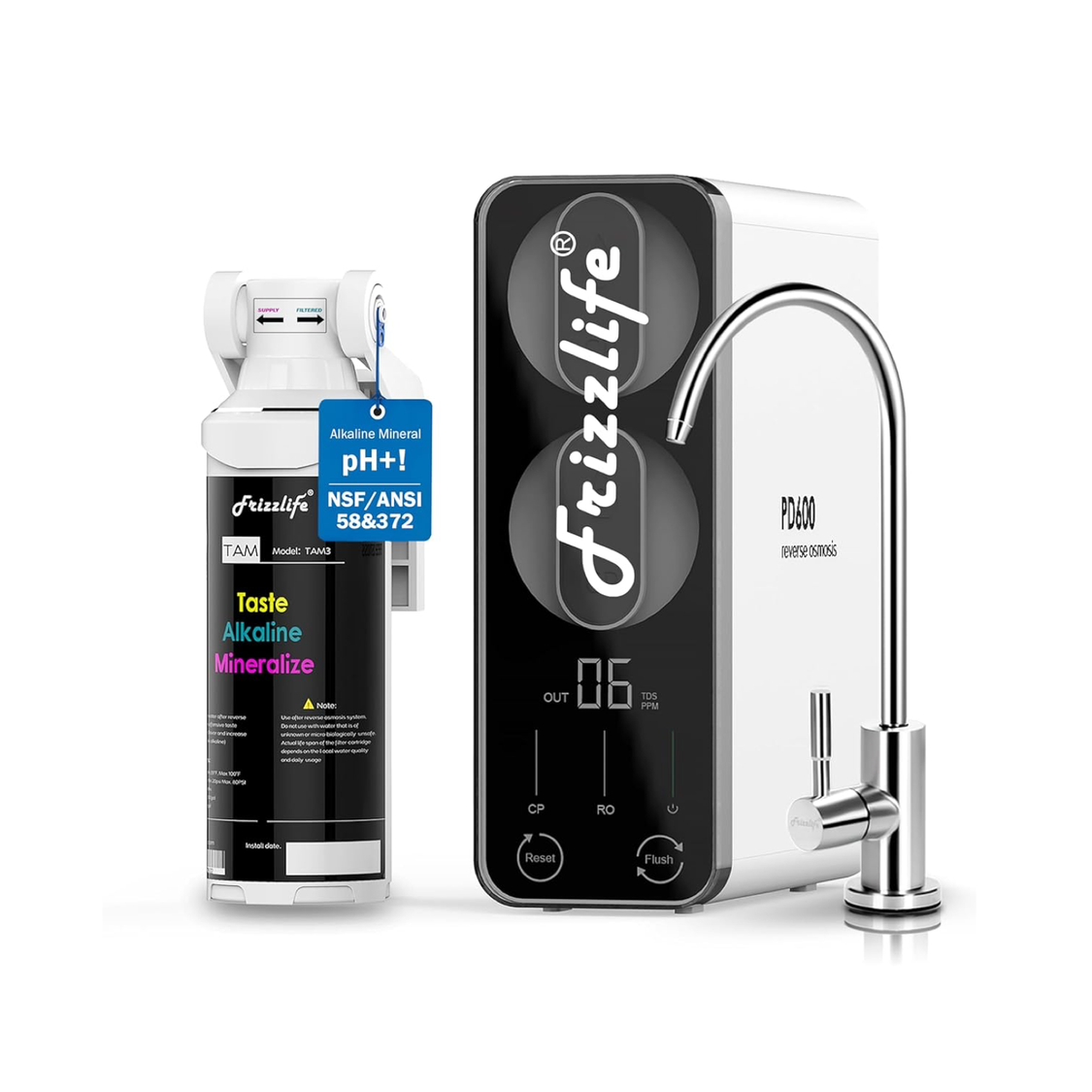
A 600 GPD tankless RO system with alkaline remineralization and real-time outlet TDS monitoring.
View PD600-TAM3 →Faucet and Sink Maintenance That Supports Water Quality
The water supply is not the only part of the system that requires attention. Faucet aerators, supply hoses, water heaters, and filter cartridges should also be inspected and maintained.
Clean the Faucet Aerator
The aerator can collect sediment or pipe scale. Remove and clean it according to the faucet manufacturer’s instructions, especially after plumbing work or when the flow becomes uneven.
Inspect Supply Hoses and Fittings
Check below the sink for corrosion, moisture, stressed tubing, or slow leaks. Replace damaged plumbing components rather than relying on a water filter to solve a plumbing problem.
Maintain Water Filters Properly
Install the correct cartridge, flush it as directed, use the specified water temperature, and replace it according to the manufacturer’s instructions.
Flush After Long Periods of Non-Use
If a faucet or property has not been used for an extended period, follow utility or public-health guidance about flushing before using the water for drinking or cooking.
Why Does My Sink Water Look, Smell, or Taste Strange?
Cloudy or Milky Water
Cloudiness that clears after the water stands may be caused by small air bubbles. If it does not clear, leaves sediment, or appears suddenly throughout the building, contact the water utility.
Metallic Taste
A metallic taste may be associated with iron, copper, corrosion, or household plumbing. It cannot confirm or rule out lead because lead has no reliable taste, smell, or visible appearance.
Chlorine-Like Smell
A chlorine-like smell may be related to disinfectant used by the water supplier. Check the annual report or contact the utility if the smell becomes unusually strong or changes suddenly.
Sulfur or Rotten-Egg Odor
Determine whether the smell occurs in hot water, cold water, or both. A hot-water-only issue may involve the water heater, while a problem affecting all water may require well, plumbing, or utility investigation.
Brown, Orange, or Black Particles
Particles may come from rust, pipe scale, a water heater, filter media, or utility work. If the problem persists, identify the source before continuing to use the affected fixture for drinking.
Sudden Change After a Pressure Loss or Flood
Check for an active advisory and follow instructions from the utility or health department. Do not assume that boiling or a household filter will address every possible chemical or microbiological problem.
Public Water vs. Private Well: What Changes?
Public Water
Review the annual water-quality report and sign up for utility alerts. The report describes the water source, detected regulated contaminants, applicable violations, and actions taken by the supplier.
Remember that the report reflects the public water system. It may not identify a problem caused by the service line, apartment building, or plumbing inside your home.
Private Well Water
Private wells are not routinely regulated, treated, or monitored like public water systems. Well owners should arrange regular testing for locally relevant microorganisms and chemicals.
Additional testing may be appropriate after:
- Flooding
- Repairs to the well
- A change in taste, color, or odor
- Land disturbance near the well
- Suspected nearby contamination
- A pregnant person or child beginning to use the water
Ask the local health department or a certified laboratory which substances should be included based on local conditions.
What to Do Before Buying a Water Filter
- Read the most recent local water-quality report.
- Check for active utility or public-health advisories.
- Identify whether the concern may come from household plumbing.
- Use a certified laboratory when an accurate contaminant result is needed.
- Choose a filter with verified performance for that specific substance.
- Confirm the installation, flow, capacity, and maintenance requirements.
- Replace cartridges and maintain the system exactly as directed.
- Continue following official advisories even after installing a filter.
For suspected lead, use cold water for drinking and cooking, follow local flushing guidance, and look for a point-of-use filter with the appropriate independent certification for lead and particulate reduction.
Conclusion: Is Your Sink Water Safe to Drink?
Sink water may be appropriate for drinking, but the answer depends on the local water supply, current advisories, household plumbing, and any recent changes in the water.
Start with the annual water-quality report. If the home uses a private well, has older plumbing, or shows persistent changes in color, taste, or odor, arrange appropriate testing rather than relying only on appearance.
A water filter can improve taste or reduce specific substances, but it should be selected after the concern has been identified. Check the model’s exact tested or certified claims, use the correct cartridge, and follow all installation and maintenance instructions.
For households ready to compare point-of-use systems, visit the Frizzlife Under-Sink Water Filter Collection.

Frequently Asked Questions
1. What Is Sink Water Called?
Sink water is commonly called tap water or faucet water. It may come from a public water system or a private well before traveling through the building’s plumbing to the kitchen faucet.
2. Is It Safe to Drink Tap Water from the Sink?
It may be safe when the public water system meets applicable requirements and there is no problem in the service line or household plumbing. Check the local water report, current advisories, and any unusual changes in the water.
3. How Can I Tell If Sink Water Is Unsafe?
Appearance, taste, and smell can identify some warning signs but cannot confirm overall safety. Important contaminants such as lead may be present without any noticeable change. Laboratory testing is the reliable way to measure a specific substance.
4. Is Sink Water the Same as Bottled Water?
No. Tap water and bottled water may come from different sources and are regulated through different systems. Bottled water is not automatically safer than tap water.
5. Should I Test My Water Before Buying a Filter?
Testing is appropriate when you suspect a health-related contaminant, use a private well, have older plumbing, or notice a persistent change. For a taste or odor concern already documented by the utility, a model with appropriate verified claims may be selected directly.
6. Can a Water Filter Make Any Sink Water Safe?
No. Filters have different capabilities, and no household system addresses every chemical and microorganism. During an official advisory, follow the instructions from the utility or health department.
7. What Type of Filter Should I Use?
Match the filter to the identified concern. Carbon filters are commonly used for chlorine taste and odor, while reverse osmosis is generally considered when TDS or selected dissolved substances are a priority. Always verify the individual model’s tested or certified reduction claims.