


Choosing between a 3-way kitchen faucet and a separate reverse osmosis faucet comes down to sink layout, installation preferences, compatibility, and repair priorities.
A 3-way faucet for a reverse osmosis system delivers hot tap water, cold tap water, and RO water through one fixture. A properly designed model keeps the filtered-water route separate from the regular hot and cold pathways. A separate RO faucet uses a smaller, independent fixture connected only to the filtration system.
A 3-way model is often the better fit when you want a cleaner sink area or do not want to drill another countertop hole. A separate RO faucet may be preferable when an accessory hole is already available or when you want the kitchen faucet and filtered-water outlet to remain independently replaceable.
Neither configuration is automatically better in every kitchen. The right choice depends on whether the faucet has the correct filtered-water inlet, whether its connections match your under-sink system, and how much you value integrated design versus simpler component replacement.
What Is a 3-Way Filtered Water Faucet?
A 3-way filtered water faucet—also called a tri-flow or triple-flow faucet—is a primary kitchen fixture designed to dispense three water supplies:
-
Hot tap water
-
Cold tap water
-
Filtered or reverse osmosis water
The hot and cold supplies usually operate like those in a conventional kitchen faucet. A separate lever, knob, or control activates the filtered-water line.
“Three-way” describes the three water supplies, not three filtration stages. The faucet itself generally does not perform reverse osmosis. It serves as the dispensing point for an under-sink RO system or another compatible water filtration system.
This design differs from a faucet-mounted filter. A faucet-mounted unit treats water at the existing spout, while a 3-way water filter faucet receives treated water from a separate system installed under the sink.
What Is a 3-Way Faucet for a Reverse Osmosis System?
A 3-way faucet for an RO system replaces the regular kitchen faucet while adding a dedicated connection for purified water. The RO outlet tube connects to the faucet’s filtered-water inlet rather than to the ordinary hot or cold supply.
Inside a properly designed faucet, the filtered water follows its own route to the outlet. This allows one fixture to perform two distinct jobs:
-
Supply regular hot and cold water for washing, rinsing, and general kitchen use.
-
Dispense RO water for drinking and cooking.
Installing this type of faucet usually means that a second, smaller RO faucet is unnecessary. It can therefore be useful in kitchens with no open accessory hole or in installations where the homeowner does not want to drill into the sink or countertop.
However, the phrase “3-way faucet” alone does not guarantee RO compatibility. Confirm that the model is intended for drinking-water filtration and has a dedicated filtered-water inlet and internal waterway.
How Hot, Cold, and Filtered Water Travel Through Separate Pathways
A conventional kitchen faucet receives hot and cold water, combines them in a mixing valve, and sends the mixed water through the spout. A 3-way kitchen faucet adds another inlet and internal pathway for filtered water.
The typical routing is:
-
Hot supply: Connects to the home’s hot-water plumbing.
-
Cold supply: Connects to the home’s cold-water plumbing.
-
Filtered supply: Connects to the outlet of the under-sink filter or RO system.
The regular faucet handle controls hot and cold water. A second control opens only the filtered-water channel.
The exact internal construction varies. Some models use separate tubes all the way through the spout, while others use different outlet or aerator arrangements. Some manufacturers also make model-specific claims about the materials that contact filtered water. Those features should be confirmed in the product documentation rather than assumed for every 3-way faucet.
Why a Standard Kitchen Faucet Is Not Automatically RO-Compatible
A standard kitchen faucet normally has only hot and cold inlets. Connecting an RO outlet directly into one of these mixed-water supplies can create several problems:
-
It does not provide a dedicated filtered-water control.
-
Purified and untreated water may not remain properly separated.
-
The faucet may demand more flow than the RO system is designed to deliver.
-
Connection sizes may not match standard RO tubing.
-
Materials and components may not be evaluated for the intended filtered-water application.
An RO system should also be fed from the cold-water supply according to its installation instructions. Hot water is not a substitute for the specified cold-water feed.
If you want RO water from the primary kitchen fixture, use a filtered water kitchen faucet designed with a separate inlet and waterway. Otherwise, install a dedicated drinking-water faucet.
Will a 3-Way Faucet Mix RO Water With Regular Tap Water?
A properly designed and correctly installed 3-way RO faucet should keep filtered water separate from the hot and cold tap-water pathways. The RO system’s outlet connects only to the dedicated filtered inlet, and the filtered control opens only that channel.
That does not mean every faucet advertised as “three-way” has identical construction. Before purchase, verify:
-
There are separate hot, cold, and filtered-water connections.
-
The filtered inlet feeds a dedicated internal pathway.
-
The installation manual identifies the faucet as compatible with the intended filtration setup.
-
The filtered line is not meant to connect to the hot/cold mixing valve.
Incorrect plumbing can defeat the intended separation. For example, the RO outlet should not be joined to a regular mixed-water supply simply to make a standard faucet act like a 3-way model.
If preventing contact between filtered water and particular faucet materials is important to you, review the product’s waterway diagram and material specifications. Claims such as “no metal contact” are model-specific and are not universal features of all 3-way faucets.
Can a 3-Way Faucet Work With an Existing Under-Sink Filtration System?
Yes, a 3-way faucet can often work with an existing under-sink filtration system if the system has a dedicated treated-water outlet and the connections are compatible. This may include reverse osmosis systems and some non-RO under-sink filters.
Compatibility depends on more than whether the system produces filtered water. Check:
-
The outside diameter of the filter’s outlet tubing
-
The faucet’s filtered-water connector size
-
The connection type and thread standard
-
Any required reducer, union, or adapter
-
The system’s operating instructions
-
The faucet manufacturer’s permitted pressure and temperature ranges
-
Whether the faucet is intended for the type of drinking-water system being used
Quarter-inch tubing is common on residential RO outlets, while some faucet filtered-water inlets use a different size, such as a 3/8-inch connection. This does not necessarily make the products incompatible, but it may require a manufacturer-approved adapter.
Do not assume that an adapter included with one faucet will fit every under-sink system. Compare the actual tubing and connector specifications before beginning installation.
Installing a 3-Way Kitchen Faucet With RO

Installing a 3-way kitchen faucet with RO involves replacing the main faucet and connecting three supply paths. The general sequence is:
-
Shut off the hot and cold water supplies.
-
Relieve pressure and remove the existing kitchen faucet.
-
Confirm that the sink or countertop hole fits the new faucet’s mounting hardware.
-
Mount the 3-way faucet and secure it from below.
-
Connect the hot and cold supply hoses to the correct shutoff valves.
-
Connect the RO system’s treated-water outlet to the dedicated filtered-water inlet.
-
Inspect tubing for kinks, tight bends, or incomplete push-fit connections.
-
Restore the water supply and check every connection for leaks.
-
Flush the faucet and filtration system as directed by their manufacturers.
-
Test the tap-water and filtered-water controls separately.
This is a general overview, not a replacement for the manuals. Faucet mounting arrangements, sealing methods, connector styles, flushing procedures, and local plumbing requirements vary.
The RO system’s feed, filtration stages, storage tank if present, and drain connection remain separate parts of the installation. Changing the dispensing faucet does not eliminate those system requirements.
Check the Filtered-Water Inlet, Tubing Size, and Required Adapters

Connection mismatches are among the most common obstacles when adding a 3-way faucet to an existing RO system. Inspect both products before removing the original faucet.
Record the following:
-
RO outlet tubing outside diameter
-
Faucet filtered-inlet size
-
Whether the connection is push-fit, threaded, compression, or another type
-
Adapter sizes listed in the faucet instructions
-
Whether inserts, ferrules, locking clips, or O-rings are required
Do not identify a tube only by appearance. Tubing with different outside diameters can look similar under a dark sink cabinet.
If a reducer is required, use a fitting intended for potable-water plumbing and the tubing material involved. Avoid stacking multiple improvised adapters when one correct fitting is available. Every additional joint introduces another potential leak point.
The filtered line should run directly from the under-sink system’s treated-water outlet to the faucet’s filtered inlet. Keep the route as short and smooth as practical without stretching the tube.
Confirm Sink Clearance, Mounting-Hole Fit, and Handle Operation
A 3-way faucet replaces a heavily used kitchen fixture, so physical fit matters as much as plumbing compatibility.
Check these points before purchase:
-
Mounting-hole fit: Compare the required hole diameter and countertop thickness with the faucet specifications.
-
Under-sink clearance: Confirm there is room for the mounting nut, hoses, RO tubing, storage tank, filter cartridges, and drain plumbing.
-
Above-sink clearance: Make sure the faucet will not hit a window ledge, shelf, backsplash, or cabinet.
-
Spout reach: The water stream should land in a practical area of the sink rather than too close to the back wall or front edge.
-
Handle movement: Test whether the main and filtered-water controls can operate without contacting the backsplash.
-
Accessory holes: Determine what will happen to an existing sprayer, soap dispenser, or covered sink opening.
-
Spout rotation: Consider nearby walls and multi-basin sink placement.
A separate RO faucet has a smaller footprint but needs its own mounting location. If the sink already has a free accessory hole, installing it may be easier than replacing the main kitchen faucet. If no hole is available, a 3-way model can avoid adding another opening.
Troubleshooting Leaks, Low RO Flow, and Incorrect Connections
After installation, test the regular and filtered sides independently. If a problem appears, isolate the affected pathway before changing multiple components.
If a connection leaks:
-
Shut off the water.
-
Confirm that the tube was cut squarely.
-
Check that it is inserted to the required depth.
-
Inspect the O-ring, ferrule, washer, or seal for damage.
-
Verify that the fitting matches the tubing diameter.
-
Avoid overtightening parts not designed for excessive torque.
If RO flow is lower than expected:
-
Confirm that the RO tank valve, if present, is open.
-
Look for pinched or sharply bent tubing.
-
Check whether a small adapter is restricting the line.
-
Verify that the filter cartridges are installed and maintained correctly.
-
Allow a tank-based RO system time to refill.
-
Compare the result with the system’s documented flow expectations.
RO water normally flows differently from regular hot or cold tap water. The filtered side may be limited by membrane production, storage-tank pressure, tubing diameter, filter condition, and the faucet’s internal channel. A slower stream does not automatically indicate a defective faucet, but a sudden or severe reduction warrants troubleshooting.
If water comes from the wrong control:
-
Recheck the hot, cold, and filtered labels.
-
Confirm that the RO outlet is connected only to the filtered inlet.
-
Do not rely solely on hose position or color if the manual identifies the lines differently.
-
Correct any crossed connections before normal use.
If filtered water has an unusual initial taste or odor:
-
Follow the required flushing procedure.
-
Check for stagnant water in new tubing.
-
Confirm that all wetted fittings are intended for drinking-water use.
-
If the issue continues, troubleshoot the filtration system and faucet separately.
Comparison Snapshot: 3-Way Faucet vs. Separate Drinking Water Faucet
Both configurations can provide a dedicated outlet for RO water. The main difference is whether that outlet is integrated into the primary kitchen faucet or mounted as a second fixture.
A 3-way faucet consolidates controls and can reduce visual clutter. A separate drinking-water faucet keeps the filtration outlet independent and may be easier to add or replace when a suitable countertop hole already exists.
Practical Decision-Support Table: Installation, Drilling, Compatibility, Repairs, and Sink Space
|
Decision factor |
3-way kitchen faucet |
Separate RO faucet |
|---|---|---|
|
Main configuration |
One fixture for hot, cold, and filtered water |
Main kitchen faucet plus an RO-only faucet |
|
Countertop hole |
Usually replaces the existing main faucet without adding another hole |
Requires an open accessory hole or a new hole |
|
Internal routing |
Must include a dedicated filtered-water inlet and pathway |
RO water travels through an independent fixture |
|
Installation scope |
Requires replacement of the main kitchen faucet |
Main faucet can usually remain in place |
|
RO connection |
May require an adapter between the RO tube and filtered inlet |
Often designed around common RO tubing, but specifications still vary |
|
Sink appearance |
Cleaner, consolidated look |
Adds another visible fixture |
|
Control arrangement |
Regular handle plus a separate filtered-water control |
Separate faucet control makes RO water visually distinct |
|
Repairs |
A problem with the integrated fixture may affect the primary faucet setup |
RO faucet and main faucet can be serviced or replaced independently |
|
Future replacement |
Replacement must preserve hot, cold, and filtered functionality |
Either faucet can be changed without necessarily replacing the other |
|
Best fit |
No spare hole, minimalist sink area, planned faucet replacement |
Open accessory hole, functional main faucet, preference for independent components |
Is a 3-Way Faucet Better Than Installing a Separate RO Faucet?
A 3-way faucet is better when avoiding an extra hole and maintaining a streamlined sink area are the main priorities. It can also be a practical choice when the primary kitchen faucet already needs replacement.
A separate RO faucet is better when installation simplicity and independent replacement matter more. If a suitable accessory opening is already present, there may be little reason to replace a functional main faucet.
The decision is less about filtration quality than fixture design. The RO system performs the treatment. The faucet must deliver the treated water through a compatible, dedicated path without undermining the intended plumbing arrangement.
Explore Reverse Osmosis Options
Choosing the faucet is only part of the setup. Explore Frizzlife RO systems and replacement filters for different under-sink filtration needs.
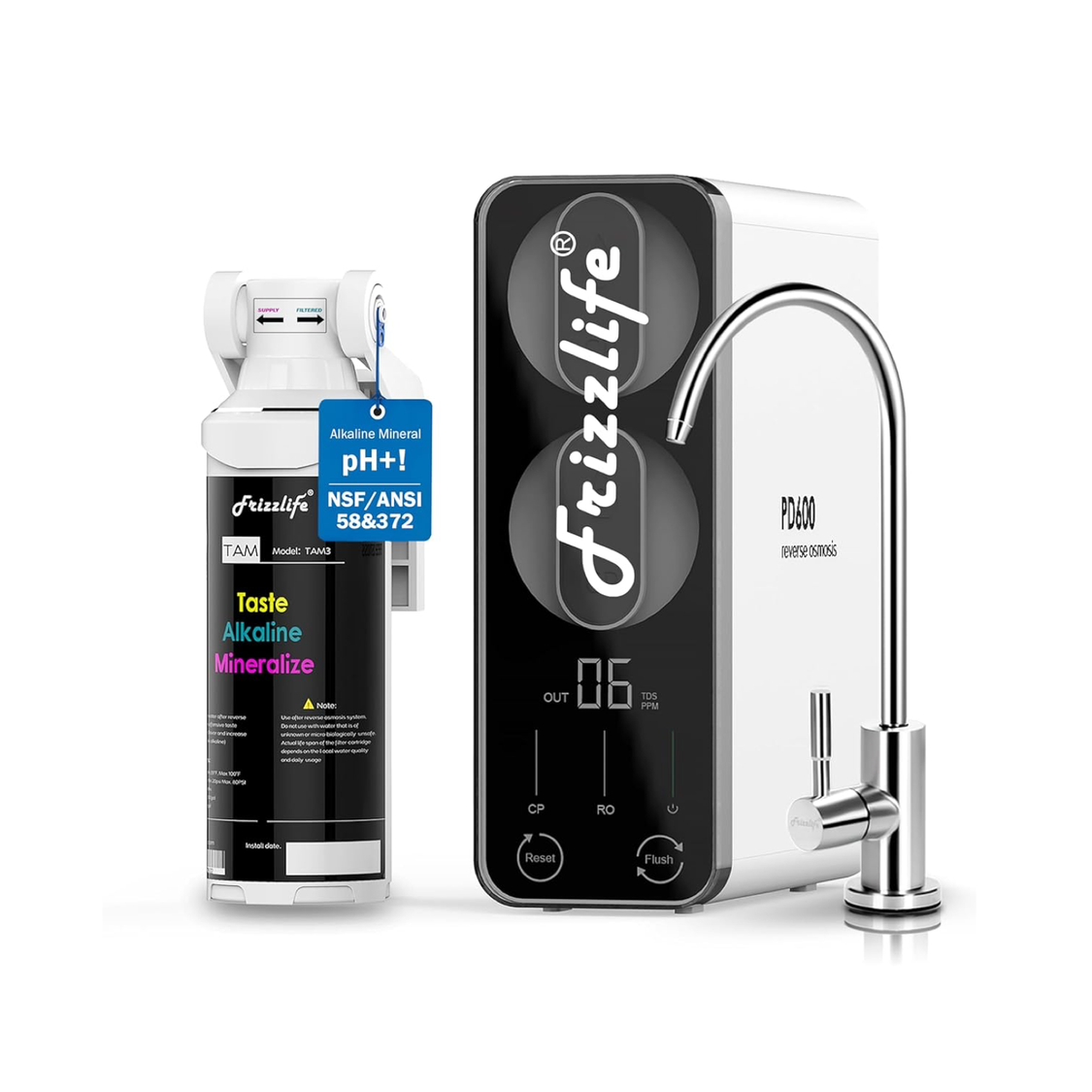
Frizzlife PD600-TAM3
Explore the PD600-TAM3 for an under-sink reverse osmosis setup designed for everyday drinking-water filtration.
View PD600-TAM3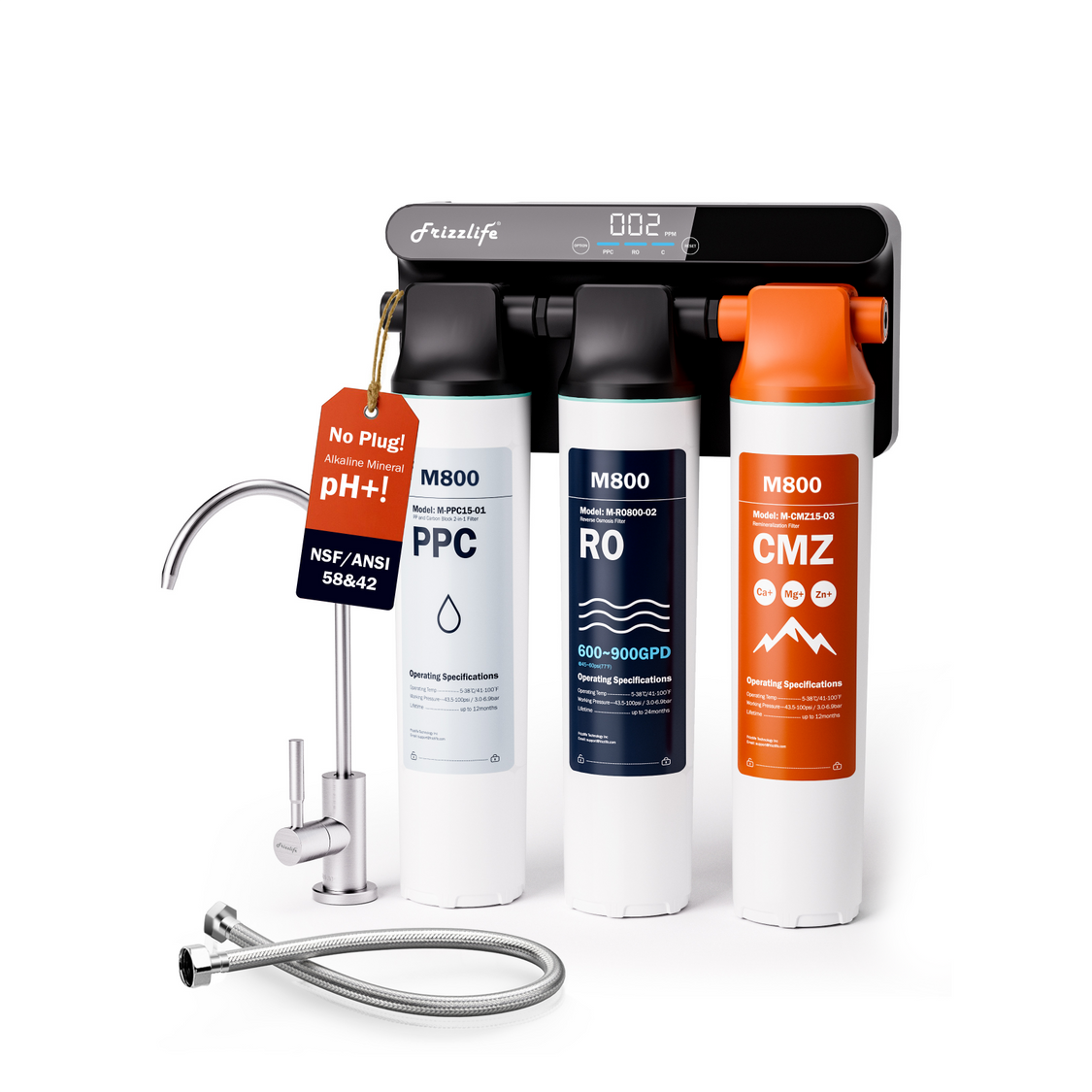
Frizzlife M800
Compare the M800 if you are planning a dedicated under-sink RO installation and want another system option to consider.
View M800
Frizzlife Replacement Filters
Already own a Frizzlife system? Find compatible replacement filters and maintenance options for your model.
Find Replacement FiltersWhen a 3-Way Kitchen Faucet Is the Better Fit
Consider a 3-way faucet when:
-
There is no free accessory hole.
-
You do not want to drill into the sink or countertop.
-
You prefer one integrated fixture.
-
The existing kitchen faucet is due for replacement.
-
Countertop space is limited.
-
You want filtered water available from the main sink position.
-
You have confirmed the faucet’s inlet and tubing compatibility.
A 3-way model can be especially attractive during a remodel because the faucet and filtration layout can be planned together. It may also make sense when an existing soap dispenser or sprayer opening must remain available for its current purpose.
The integrated appearance should not override technical fit. A faucet that needs several uncertain adapters or lacks clear documentation may be less practical than a straightforward separate faucet.
When a Separate RO Faucet Is the Better Fit
A dedicated drinking-water faucet may be the stronger choice when:
-
The sink already has a spare accessory hole.
-
You want to keep the current kitchen faucet.
-
The RO system includes a clearly compatible faucet.
-
You prefer independent repairs and replacement.
-
You want a visibly distinct outlet used only for drinking and cooking water.
-
A compatible 3-way model does not fit the sink or backsplash.
-
You are renting and cannot make a major fixture change without permission.
A separate faucet also keeps the primary hot/cold fixture mechanically independent from the RO outlet. If either faucet develops a problem, the other may remain usable while repairs are arranged.
Countertop Holes, Sink Layout, and Visual Clutter
A separate RO faucet does not always require drilling. Many sinks and countertops already have an opening for a side sprayer, soap dispenser, or optional accessory. A covered opening may also be available.
If there is no suitable opening, drilling requirements depend on the faucet and countertop material. Hole dimensions are model-specific. Stone, composite, stainless steel, and porcelain surfaces require different tools and precautions, so professional drilling may be appropriate.
A 3-way faucet generally uses the existing main faucet position. That avoids an additional hole, but it still requires confirmation that the mounting opening, deck thickness, under-sink hardware, and control clearance are suitable.
Think about everyday use as well. A second faucet adds another component to clean around, but it also creates a clearly recognizable filtered-water station. A single integrated fixture looks simpler, yet household members must understand which control activates filtered water.
RO Water Flow Expectations in Each Faucet Setup
The choice between a 3-way faucet and a separate RO faucet does not, by itself, determine the system’s production capacity. Flow at the outlet depends on several interacting factors:
-
Incoming water pressure
-
RO system design
-
Storage-tank pressure and fill level, if a tank is used
-
Filter and membrane condition
-
Tubing diameter and length
-
Number and type of fittings
-
Faucet waterway design
Regular hot and cold water generally flows more strongly because it is supplied directly by household plumbing through larger lines. RO water travels through treatment components and commonly uses smaller tubing.
As a result, the filtered control on a 3-way faucet should not be expected to match the main tap’s washing flow. The same is true for many separate RO faucets. If strong filtered-water delivery is important, compare the documented requirements and performance of the entire system rather than judging by faucet style alone.
Repair and Replacement Tradeoffs
A separate RO faucet is a relatively isolated component. If its valve, spout, or connector fails, it can often be replaced without removing the main kitchen faucet. Likewise, replacing the main faucet does not necessarily disturb the RO fixture.
A 3-way faucet combines these functions. This reduces the number of visible fixtures but increases reliance on one faucet body. A malfunction on the tap-water or filtered-water side may require model-specific parts or replacement of the integrated fixture.
Before choosing either design, consider:
-
Availability of replacement seals, cartridges, and adapters
-
Clarity of the installation manual
-
Access to connections under the sink
-
Whether the filtered pathway can be serviced separately
-
How easily the faucet could be replaced in the future
-
Whether changing the faucet could affect system warranty terms
Routine filter and membrane maintenance remains part of the under-sink system. Switching faucet styles does not change the system’s prescribed replacement or flushing schedule.
Drinking-Water Material Standards and Model-Specific Claims to Verify
Standards for the RO system and standards for the faucet serve different purposes.
NSF/ANSI 58 addresses reverse osmosis drinking-water treatment systems, including relevant material, construction, and performance requirements. Certification of an RO system under this standard does not automatically mean every third-party faucet attached to it carries the same certification.
NSF/ANSI 61 concerns drinking-water system components and the contaminants or impurities that may be imparted to drinking water by those components. It does not verify that a faucet performs reverse osmosis or reduces specific contaminants.
When evaluating claims, distinguish carefully among these terms:
-
Certified: A certification organization has evaluated the identified product within a stated scope.
-
Tested: Testing may have been performed, but the test method, laboratory, model, and scope should be identified.
-
Meets a standard: This may be a manufacturer statement unless third-party certification is documented.
-
Lead-free or drinking-water-safe: These descriptions do not establish filtration performance.
Verify claims for the exact faucet and RO system model. Do not assume that certification of one component applies to the entire installation.
Reference
https://www.epa.gov/watersense/point-use-reverse-osmosis-systems