


You’re choosing between a budget tank RO with remineralization, a sleek tankless RO, plain RO, and a simpler carbon under-sink filter—and they are not interchangeable. The right pick depends on whether you are fighting PFAS, lead, fluoride, high TDS, flat taste, low cabinet space, or long-term filter costs. Remineralization can make RO water more pleasant, but it can also add cost, hardness, and maintenance you may not need.
Choose Your RO Path
Comparison Snapshot
Choose an under sink RO system with remineralization when you want broad contaminant reduction and better daily taste. This is often a balanced option for homeowners concerned about PFAS, lead, fluoride, high TDS, or “flat” RO water.
For most buyers, start with verified RO performance when contaminant reduction matters most. Choose remineralization for better taste, then decide between tank and tankless designs based on space, flow needs, and long-term ownership costs.
Choose plain RO if purity matters more than mouthfeel. It gives you lower TDS, but the water may taste thin, especially in coffee or tea.
Choose carbon-only filtration if your water report is clean and your main complaint is chlorine taste or odor. Avoid carbon-only filters if your concerns include fluoride, lead, nitrates, arsenic, high TDS, or PFAS and forever chemicals.
Choose tankless RO with remineralization only if cabinet space, faster flow, and filter-life displays matter enough to accept higher cost, electronics, and brand-specific cartridges.
| Option | Choose it when | Avoid it when |
| Tank RO with remineralization | You want strong filtration, better taste, and lower upfront cost | Cabinet space is tight or slow faucet flow will annoy you |
| Tankless RO with remineralization | You want compact size, faster flow, and smart monitoring | You dislike electronics, proprietary filters, or higher annual cost |
| Plain RO | You want lowest TDS and do not mind flat taste | Taste, coffee, tea, or drinking comfort matters |
| Carbon-only under-sink filter | Chlorine taste is the main issue and water tests are clean | Dissolved contaminants are the reason you are buying |
Use a side-by-side under-sink RO comparison table before buying, especially to compare contaminant data, filter cost, cabinet fit, and remineralization stages.

Best for Contaminant Risk
If the reason you are shopping is a health-related contaminant concern, choose based on verified reduction data rather than filtration type alone. For PFAS, lead, fluoride, nitrates, arsenic, chromium-6, or other specific concerns, look for model-specific certification or contaminant testing that shows which reductions have been verified under defined test conditions.
When homeowners ask about contaminants such as PFAS, lead, or fluoride, the important point is that the RO membrane is the primary filtration stage responsible for reducing many dissolved substances. Actual reduction performance depends on the specific membrane, system design, water conditions, and verified testing.
Remineralization does not make the system remove more fluoride, PFAS, lead, nitrates, or arsenic. It usually sits after the RO membrane and improves taste or raises pH. So if contaminant reduction is your main goal, do not pay extra for “alkaline” language while ignoring the membrane rating, test data, or certification.
For health-driven buying, vague claims are a red flag. “Removes contaminants” is not enough if you care about PFAS, chromium-6, fluoride, nitrates, or lead. Look for third-party testing or certification information where available, and check whether it applies to the specific model and the contaminant claims you care about.
Carbon-only filters can help improve chlorine taste, odor, and certain organic compounds. However, many carbon-only systems are not designed to address dissolved contaminants that require other treatment approaches.
They may look simpler, cheaper, and less wasteful, but their reduction capabilities depend on the filter design and tested claims. Many carbon-only systems are not intended to provide the same type of dissolved contaminant reduction associated with RO.
Best for Taste Seekers
Plain RO water often tastes flat because the membrane strips out most dissolved minerals. That can be a win on a TDS meter, but a loss in a glass. If you drink a lot of water, make coffee, brew tea, or cook with filtered water, remineralization often changes the daily experience enough to justify the extra cartridge.
This is where many buyers regret choosing plain RO. They compare systems by contaminant reduction only, install the cheaper non-mineral unit, then realize the water tastes thin. Some add a remineralization cartridge later, which means more tubing, more parts, and more trial and error than buying the right configuration from the start.
Choose plain RO if you like very low-TDS water or prefer to get minerals from food instead of water. That is a valid choice. But do not choose it just to save a small amount if you already dislike bland bottled waters or filtered water with no mineral feel.
A remineralization or alkaline mineral stage is best viewed as a taste upgrade, not a medical feature.
Do You Really Need a Remineralized RO System?
Remineralized RO may be more system than you need if your municipal water is already low-TDS, independently tested, and your only complaint is chlorine smell. In that case, a carbon under-sink filter is simpler, cheaper, keeps natural minerals, wastes no water, and usually has fewer maintenance points.
RO is not overkill when you have old plumbing, lead risk, PFAS concern, high TDS, hard water at the drinking tap, or unknown water quality. It is also reasonable if your local water report leaves you unsure about nitrates, arsenic, or industrial contaminants.
Hard water can change which RO setup makes sense. An under-sink RO system with remineralization may improve the taste of filtered drinking water and reduce dissolved solids at the treated faucet, but it does not replace whole-home water softening. In homes with high hardness levels, additional treatment or pretreatment may be considered because mineral buildup can affect system performance depending on the membrane and operating conditions.
RO vs Carbon Filters: Which Under Sink Filter Is Better?
Contaminant Coverage Gaps
The core difference in reverse osmosis vs carbon filter for under sink drinking water is not “better vs worse.” It is dissolved contaminant reduction vs simpler taste polishing.
RO is often considered for concerns involving dissolved solids and certain regulated contaminants in drinking water, including fluoride, lead, nitrates, arsenic, or chromium-6. However, reduction performance depends on the specific system, membrane, source water conditions, and available testing data.
Carbon-only claims for lead or PFAS should be treated carefully. Accept those claims only when the exact contaminant, reduction level, and testing method are clearly documented through certification or named laboratory testing.
A mismatch happens when a buyer chooses a filtration method that does not address their specific water concern. If your concern involves issues such as elevated TDS, lead exposure risk, PFAS-related concerns, agricultural contaminants, or fluoride reduction, compare the filter’s tested capabilities carefully. A carbon-only system may improve taste while not addressing every contaminant concern a homeowner wants to evaluate.

RO has its own gaps. What contaminants does reverse osmosis not remove well by itself? RO membranes are designed primarily for reducing many dissolved substances, but overall performance depends on the complete system design. Additional stages, such as carbon filtration, may be needed for concerns involving certain gases, VOCs, chlorine, or other treatment goals.
This is why a good under-sink RO is usually a system, not just a membrane: sediment pre-filter, carbon pre-filter, RO membrane, post-carbon, and sometimes remineralization.
Certification and testing matter more than stage count. Look for systems tested under recognized reverse osmosis certification standards, since performance claims are more meaningful when they are backed by contaminant-specific testing. A seven-stage system with vague claims is less useful than a simpler system with clear reduction data. If the decision is health-driven, require contaminant-specific proof.
| Decision factor | RO system | Carbon-only filter |
| Fluoride | Usually the better choice | Usually not the right choice |
| Lead | Strong choice when tested/certified | Some can reduce lead, but verify carefully |
| PFAS | Often stronger, but check test data | Some carbon filters help; performance varies |
| TDS | Reduces TDS | Does not meaningfully reduce TDS |
| Chlorine taste | Good when carbon stages are included | Very good |
| Wastewater | Yes | No |
| Minerals retained | Mostly removed, then optionally added back | Mostly retained |
TDS and Hard Water
If high TDS is part of the problem, carbon-only filtration is not the right comparison. Carbon can make water taste cleaner without lowering dissolved solids much.
RO systems are commonly used when reducing dissolved solids at the drinking faucet is a primary goal. Actual TDS reduction depends on the specific system, membrane condition, and feed-water characteristics.
For hard water, remineralized RO can sound confusing because RO removes minerals and then adds some back. The difference is control. Hard feed water may contain high calcium, magnesium, and other dissolved solids. RO reduces that load. A remineralization stage may add selected minerals depending on the media used, which can influence taste and water chemistry.
Do not assume remineralization “fixes” hard water in the house. It only affects the filtered drinking line. Your shower, dishwasher, washing machine, and most plumbing still see the original hard water unless you install broader treatment.
If feed-water hardness is high, the real comparison is RO alone vs RO protected by pre-treatment. A membrane fighting hard water can scale faster, produce less water, and create low pressure at the faucet. If you already have a softener, RO often performs better and lasts longer.
Wastewater and Mineral Loss
RO wastes some water because it separates cleaner product water from reject water. That is the trade-off for broad dissolved contaminant reduction. If you cannot accept any wastewater, carbon-only wins on simplicity and conservation.
But do not treat wastewater as the only cost. If your water has lead, PFAS, fluoride, or high nitrates, avoiding wastewater may mean accepting weaker contaminant reduction. That can be the wrong saving.
RO also removes beneficial minerals along with unwanted substances. Remineralization adds some minerals back, but not necessarily the same balance as the source water. If your goal is exact natural mineral retention, carbon is a better fit. If your goal is lower contaminant load with better taste than plain RO, remineralized RO is the better fit.
Certification Decision Rules
If the purchase is health-driven, compare proof before features. NSF/ANSI 58 is one recognized standard that buyers may consider when evaluating certified RO system performance, where applicable. NSF/ANSI 372 matters for lead-free materials. PFAS, lead, fluoride, and nitrate claims should be backed by certification or clear lab reports.
Avoid systems that sell the number of stages as the main proof. “Alkaline,” “healthy,” and “multi-stage” do not tell you what the system reduces.
| Proof point | Why it matters |
| NSF/ANSI 58 | RO performance claims |
| NSF/ANSI 372 | Lead-free material compliance |
| PFAS data | Needed if forever chemicals are a concern |
| Lead data | Needed with old plumbing or service-line risk |
| Fluoride data | Needed if fluoride reduction is a buying reason |
| Published lab reports | Helps verify real contaminant claims |
Remineralization Trade-Offs That Matter
Flat Taste Problem
The question is not only “does RO water need minerals added back?” It is “will you enjoy drinking it every day if you do not?” Plain RO can measure impressively low on a TDS meter, but some users notice a lighter mouthfeel because fewer minerals remain in the water.
Choose remineralization when you already know you prefer spring water, mineral water, or bottled water with a rounder taste. It can change the feeling of drinking water and may be preferred by users who want a different taste profile for beverages such as coffee or tea.
Remineralization is mainly a taste and use-preference choice, not a requirement for safe drinking water, hydration, or getting essential minerals. For many homes, this comfort factor is the difference between using the system daily and going back to bottled water.

Choose plain RO when lowest TDS matters more than taste. Some people want the cleanest possible base water for special diets, aquariums, humidifiers, or mixing minerals manually. In those cases, a remineralization stage can be a downside because it raises TDS after filtration.
The regret point is predictable: buyers skip remineralization to save money, then add it later because the water tastes bland. If taste is already one of your complaints, do not treat remineralization as a luxury add-on.
pH and Mineral Gain
How does remineralization work in a reverse osmosis system? After water passes through the RO membrane, it flows through mineral media such as calcite or calcium/magnesium blends. As water passes through the media, certain minerals may dissolve into the water. Depending on the cartridge design and source water conditions, this can influence taste and may affect pH levels.
If your goal is how to increase pH after reverse osmosis filtration, moderate remineralization is usually the cleaner choice than chasing extreme alkaline claims. It can bring very low-mineral RO water closer to a pleasant drinking profile without turning it into hard water. A higher post-RO TDS level or pH number does not automatically mean better water quality.
Higher mineral levels may not match every user’s preference, especially for applications where lower mineral content is desired or where appliance manufacturers specify water-quality requirements.
Consider the mineral content added by a remineralization cartridge if the filtered line is used with appliances that have specific water-quality requirements. Espresso machines, kettles, steam ovens, and humidifiers can build scale faster when mineral levels rise. For those uses, plain RO or a lightly remineralized line may be better than a high-pH cartridge.
Alkaline Filter Claims
Reverse osmosis alkaline filter vs remineralization filter is often a marketing problem. A remineralization filter usually adds small amounts of minerals and may raise pH. An “alkaline” filter may focus more on a pH number than on meaningful mineral content.
Choose a cartridge that discloses what it adds, such as calcium or magnesium media, expected pH range, and before-and-after TDS changes. That gives you a real basis for comparison.
Avoid buying based only on “alkaline water” language. If the brand does not publish mineral composition, expected pH range, or test results, you are paying for a label, not a clear water profile.
Is RO Remineralization Worth It?
Remineralization is worth it when RO output TDS is very low, the water tastes flat, or you want a more bottled-water-like profile at the sink. It is also worth considering if you are replacing bottled water and want the filtered water to feel satisfying enough that your family will actually drink it.
It may not be worth it when your source water is low-risk, plain RO tastes fine to you, or you want fewer cartridges and lower annual cost.
| Buyer type | Need minerals added back? |
| Taste-sensitive drinker | Yes |
| Coffee or tea drinker | Usually yes |
| Maximum-purity buyer | Maybe no |
| Appliance-focused buyer | Use caution |
| Medical mineral restriction | Ask a clinician |
Tankless Versus Tank Systems
Space and Cabinet Fit
Tankless vs tank under sink reverse osmosis system decisions usually turn on cabinet space first.
Tankless systems fit better in apartments, condos, and crowded sink bases because there is no storage tank. They look cleaner, take less floor space, and often leave more room for trash bins or cleaning supplies.
These space advantages only make sense if you accept the trade-offs that often come with tankless designs. Many models rely on proprietary cartridges, electronic controls, pumps, and manufacturer-specific support. Before choosing tankless, consider future filter availability, replacement costs, and whether you are comfortable depending on the brand for long-term service.、
Tank-based RO is better when budget and serviceability matter more than footprint. The storage tank, filter rack, tubing, and drain saddle take space, but the parts are often simpler and easier to replace. For homeowners who have a normal sink base and do not mind a busy cabinet, the lower purchase price can be worth the clutter.
Avoid tank-based systems if you cannot fit the tank, filters, tubing, and drain connection without crushing hoses or blocking disposal plumbing. A cramped install can create leaks, kinks, and service frustration.
Flow and Pressure Limits
Tankless RO usually wins for on-demand flow. It is better for bottle filling, cooking water, and households that use filtered water often. Many tankless models use pumps to push water through the membrane quickly.
Tank systems can feel slower at the faucet, but stored water is useful. If the tank is full, you can draw water without waiting for the membrane to produce it in real time. The downside is that flow can drop as the tank empties.
Under sink reverse osmosis system low water pressure causes include low feed pressure, clogged sediment or carbon filters, a fouled membrane, kinked tubing, an under-pressurized tank, or a failing pump in powered systems. For tank systems, incorrect tank pressure is a common issue. For tankless systems, incoming pressure and pump performance matter more.
Choose a booster-pump or permeate-pump setup if your water pressure is below the model’s requirement. Avoid high-GPD tankless systems if your home has frequent pressure drops or well-pump cycling that has not been fixed.
Wastewater Ratio Reality
Tankless systems often have better recovery ratios than older tank systems, but compare tested ratios, not only marketing numbers. A claimed low waste ratio may depend on ideal pressure, temperature, and feed-water quality.
Choose high-efficiency tankless RO when water cost, water conservation, or high daily use matters. The savings can add up if your household fills bottles, cooks with filtered water, and uses a fridge line.
Avoid paying a large premium for efficiency if your household uses little drinking water. A cheaper tank system may cost less over five years even if it wastes more water.
Backup Stored Water
Tank systems are better if you want stored filtered water during brief pressure interruptions or short power issues. The tank can still supply some water even when the membrane is not producing quickly.
Tankless systems are better if you want fresher on-demand water and less stagnant storage. They also avoid tank pressure problems and free up cabinet space.
The trade-off is simple: tanks take space and can lose pressure; tankless systems may depend on electricity, sensors, pumps, and proprietary cartridges.
Under Sink RO System Cost and Long-Term Ownership
Upfront Price Gap
Budget tank RO with remineralization is usually the value pick when you want strong basic filtration at a lower initial price. You accept the tank, slower flow, and more visible tubing because the purchase cost is easier to justify.
Premium tankless RO is better when cabinet space, fast flow, smart displays, and lower waste are worth paying for. It looks like the cleaner solution at first, but the higher price only makes sense if you benefit from those features every day.
Carbon-only under-sink filters are the cheapest and simplest, but only when they match the problem. If you need dissolved contaminant reduction, the low price can become a false saving.
| System type | Typical upfront range | Best fit |
| Entry tank RO | $180–$300 | Budget filtration, enough cabinet space |
| Premium tank RO | $300–$500 | Better parts, possible pump, still serviceable |
| Tankless RO | $400–$900+ | Space savings, higher flow, smart features |
| Carbon-only under-sink | $80–$250 | Chlorine taste and simple filtration |
Filter Replacement Cost
How often to replace filters in an under sink RO system depends on water use and source water quality. Sediment and carbon filters are often changed every 6–12 months. RO membranes often last around 2–3 years. Remineralization cartridges commonly last 6–12 months.
Choose standard canister systems when low-cost, widely available replacement filters matter. They may be messier to change, but long-term ownership is usually easier to control.
Choose quick-change cartridges when convenience matters more than price. They are cleaner and faster, but they can lock you into one filter design.
Hidden Cost Risks
The full ownership cost includes replacement filters, remineralization cartridges, membrane replacement, water waste, leak detectors, possible booster pump, fittings, and installation supplies. Tankless systems may also add electricity use and higher cartridge prices.
Avoid tankless systems if proprietary filter pricing or uncertain long-term filter supply would bother you. Buyers often focus on the clean cabinet look and forget that cartridges may cost much more over time.
| Cost item over 5 years | Tank RO with remineralization | Tankless RO with remineralization | Carbon-only |
| Initial unit | Lower | Higher | Lowest |
| Annual filters | Low to medium | Medium to high | Low to medium |
| Membrane | Every few years | Cartridge-based schedule varies | None |
| Remineralization | Extra cartridge | Built-in or extra cartridge | None |
| Water waste | Higher on older designs | Often lower | None |
| Repair risk | More fittings, simpler parts | Electronics and sensors | Low |
Use a product comparison table that shows estimated annual filter costs before choosing.
Explore Under-Sink RO Options
Compare two remineralizing tankless RO systems and explore replacement filters when long-term maintenance and filter availability are part of your buying decision.
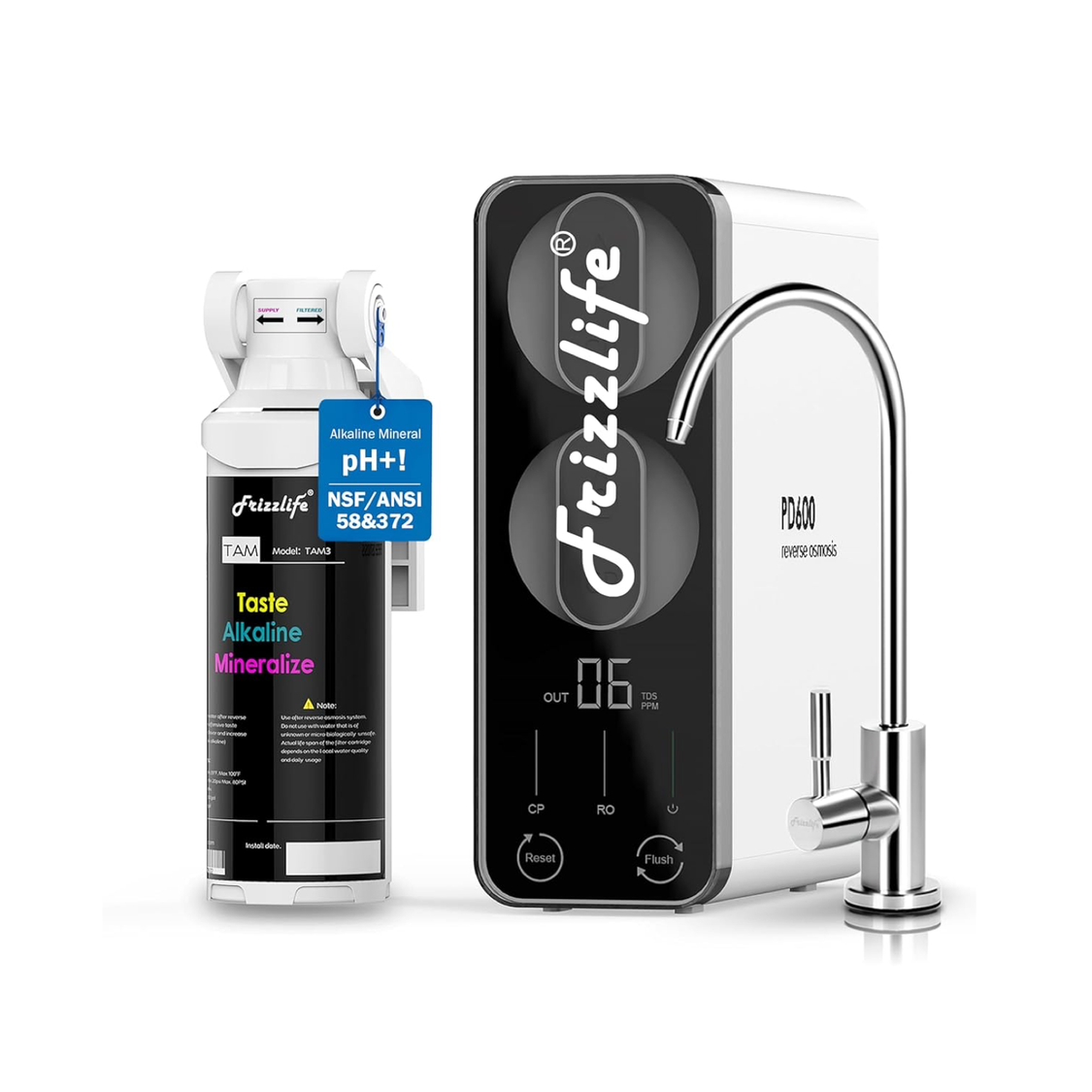
Balanced Tankless Option
Frizzlife PD600-TAM3
A compact tankless RO system that combines reverse osmosis filtration with alkaline remineralization for users who want filtered water with a smoother taste.
- 600 GPD tankless RO design
- Alkaline remineralization stage
- Real-time TDS and filter status display
- Designed to save under-sink space
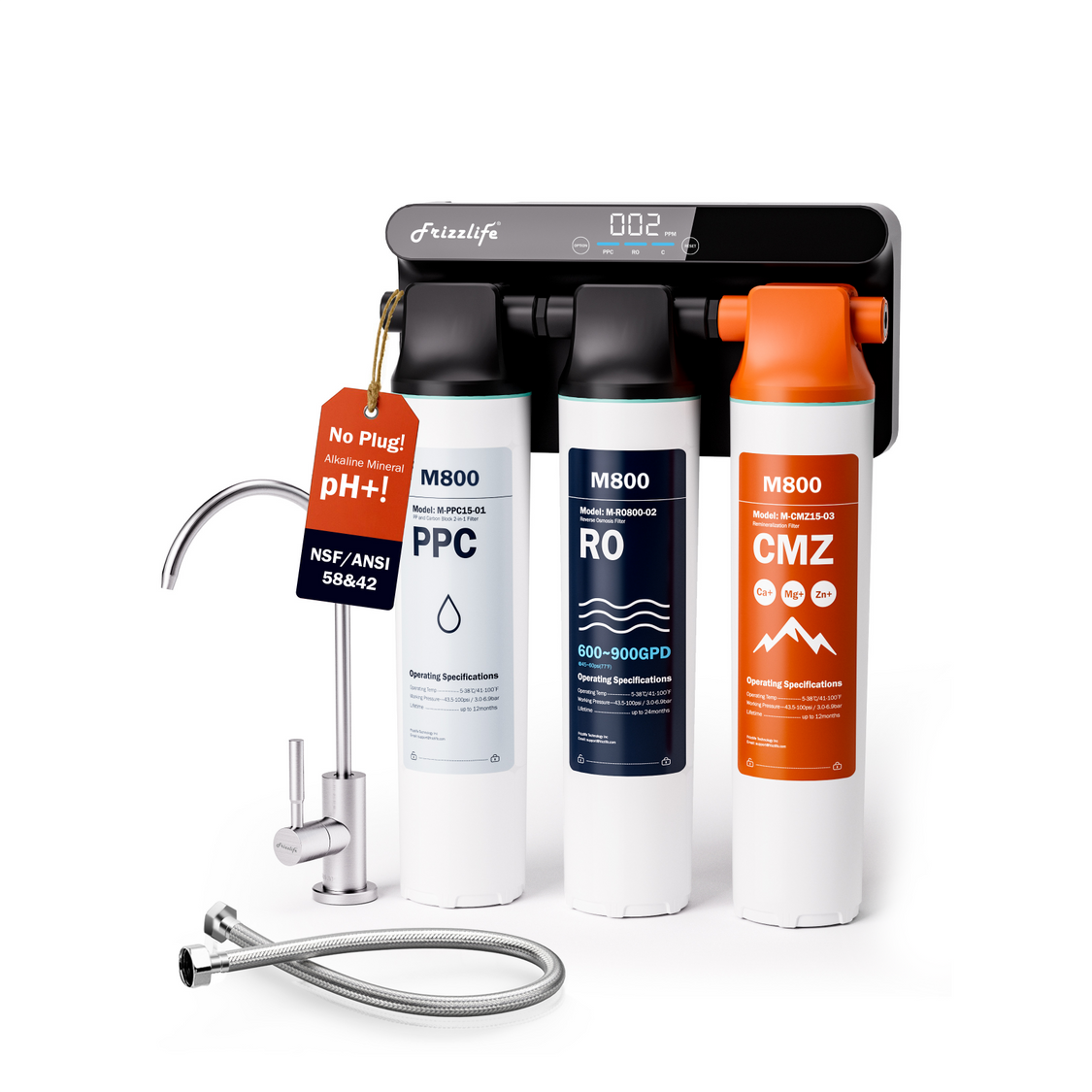
High-Flow Non-Electric Option
Frizzlife M800
A high-output tankless RO system designed to operate without a traditional electrical connection while adding minerals back after reverse osmosis filtration.
- Up to 900 GPD output
- Non-electric tankless design
- Remineralization after RO filtration
- Designed for higher daily water demand
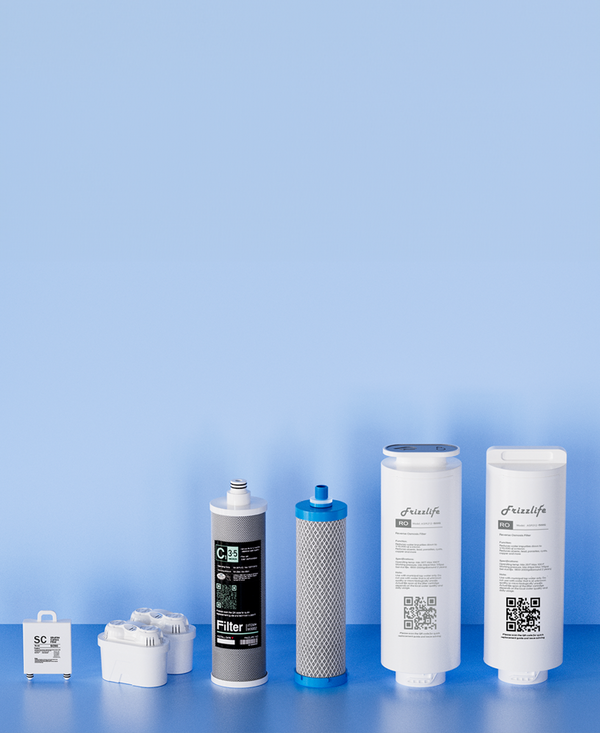
Long-Term Maintenance
Replacement Filters
Check compatible replacement cartridges before buying so you can compare filter availability, replacement schedules, and ongoing ownership needs.
- Find filters by Frizzlife system
- Replacement options for PD and M series
- Plan routine filter maintenance
- Compare compatible cartridges in one place
Five-Year Value Math
Tank systems usually win five-year cost comparisons when cabinet space is available because the upfront price, replacement options, and serviceability are often easier to control. Tankless systems need enough value from space savings, faster flow, high daily use, or water-efficiency improvements to offset higher cartridge costs, electronics, and possible repair risks. Buyers should compare total ownership rather than purchase price alone.
Installation and Daily Fit
Installation Requirements Checklist
Under sink RO system installation requirements should eliminate bad fits before you buy:
- Cold-water feed adapter
- Drain saddle connection
- Dedicated faucet hole or countertop drilling plan
- Enough cabinet space
- Proper feed-water pressure
- Room to change filters
- Safe routing for tubing
- Optional outlet for powered tankless systems
Choose DIY-friendly systems when documentation, standard fittings, and simple tubing matter. Choose professional installation when drilling stone countertops, adding a fridge line, dealing with low pressure, or working in a cramped cabinet.
Low Pressure Causes
Tankless systems may underperform if incoming pressure is too low. Tank systems may have weak flow if the storage tank pressure is wrong, the membrane is clogged, or filters are overdue.
Choose a booster-pump or permeate-pump system when pressure is consistently below the model’s requirement. Do not buy a high-output tankless unit and expect it to fix a weak water supply by itself.
If low pressure is already a problem at the sink, solve that before choosing a high-GPD system.
Fridge Line Use
Choose higher-flow RO or a tank system with enough storage if you plan to feed a refrigerator, ice maker, or more than one drinking point. A fridge line increases demand and makes slow production more noticeable.
Avoid low-output systems if you expect fast ice production, large pot filling, and drinking faucet use at the same time.
| Setup | Better fit |
| Faucet only, 1–2 people | Tank RO or compact tankless |
| Faucet plus fridge | Higher-flow tankless or larger tank capacity |
| Faucet, fridge, heavy cooking | High-flow RO with pressure support |
| Ice maker priority | Check pressure, tank capacity, and flow before buying |
Small Kitchen Fit
Tankless RO can also work well in smaller kitchens where every inch of cabinet space matters. Measure the available area before buying, because a compact design still needs room for tubing, connections, and filter changes. It also makes filter changes easier if the unit slides out or mounts cleanly.
Tank RO is better when space is available and you want lower cost, fewer electronics, and easier generic-part replacement.
| Fit factor | Tank RO | Tankless RO |
| Tank footprint | Large | None |
| Filter-change clearance | Needs side/front room | Usually front access |
| Drain connection | Required | Required |
| Outlet needed | Usually no | Often yes |
| Cabinet clutter | Higher | Lower |
Maintenance Risks and Regret
Constant Draining Causes
“Why is my under sink RO system draining constantly?” is more than a troubleshooting question. It is a regret warning.
In tank systems, constant draining can come from a failed auto shutoff valve, low tank pressure, clogged membrane, incorrect drain setup, or check-valve failure. These parts are usually fixable, but the system has more mechanical pieces and tubing.
Tankless systems can also drain or cycle strangely, but the cause may involve sensors, pumps, solenoids, or control boards. That can be harder to diagnose without brand support.
Choose systems with clear troubleshooting guides, accessible parts, and responsive support. Avoid complex systems if you do not want to depend on electronics or specialized service.
Leak and Clog Risks
Standard multi-stage systems have more tubing and fittings. That means more possible leak points, but also easier part replacement. If a fitting fails, you can often replace that part without replacing the whole unit.
Compact cartridge systems reduce exposed fittings and make filter changes cleaner. The trade-off is lock-in. If the cartridge design changes or prices rise, you have fewer options.
A leak detector or automatic shutoff accessory is worth considering for any under-sink system, especially in cabinets with wood floors, disposal vibration, or cramped tubing.
Proprietary Filter Lock-In
Choose standard housings when long-term serviceability and low-cost filters matter most. This is the practical path for homeowners who want to own the system for many years without worrying about cartridge availability.
Choose proprietary quick-change filters when clean replacement and convenience matter more than price. That can be a fair trade if you hate messy filter changes and value a sealed cartridge.
Regret risk is highest for buyers who choose smart tankless systems for looks but later dislike app dependence, electronics, short warranties, or expensive annual cartridges.
Long-Term Regret
Tankless regret usually comes from proprietary filters, electronics, warranty limits, and uncertainty about future cartridge availability. Owners may still like the space savings and fast flow, but worry about repair after the warranty period.
Tank-system regret usually comes from slow flow, cabinet clutter, tank pressure issues, and visible tubing. These problems are less glamorous but often easier to fix.
Remineralization regret goes two ways. Some buyers skip it and dislike flat water. Others choose higher-mineral cartridges without considering whether the resulting water profile matches their taste preferences or appliance requirements. The safer middle is moderate, disclosed remineralization.
How to Choose the Best Under Sink RO System With Remineralization?
- If your concern is PFAS, lead, fluoride, nitrates, arsenic, or high TDS, eliminate carbon-only.
- If your only complaint is chlorine taste and your water report is clean, eliminate RO.
- If cabinet space is tight, eliminate tank RO unless you measure first.
- If proprietary filters bother you, eliminate many smart tankless systems.
- If flat water will annoy you, eliminate plain RO.
- If you use espresso machines or kettles heavily, avoid aggressive mineral cartridges.
- If feed pressure is low, avoid high-output RO without pump support.
- If five-year cost matters, compare replacement filters before purchase.
FAQs
Does reverse osmosis with remineralization remove fluoride from water?
An RO membrane is the filtration stage typically responsible for reducing fluoride, but the actual reduction level depends on the specific system, membrane performance, and test data. The remineralization stage comes after filtration and is mainly used to adjust taste, pH, and mouthfeel. If fluoride reduction is a top reason for buying, compare membrane performance, NSF/ANSI 58 certification, and fluoride test data. Do not rely on “alkaline” or “mineral” claims as proof of fluoride reduction.
Why not choose a carbon filter instead of RO?
Choose carbon-only when chlorine taste, odor, and simple filtration are the main issues. Do not choose carbon-only when the buying reason is dissolved contaminants such as fluoride, nitrates, arsenic, high TDS, or broad PFAS concern. Carbon can be useful, but RO is the stronger choice when multiple contaminant classes matter.
Does RO water need minerals added back?
Not always. Plain RO is fine if you like low-TDS water and get minerals from food. Remineralization is worth it when the water tastes flat, thin, or unpleasant. It is mainly a taste and comfort choice, not a requirement for everyone. If you have medical mineral restrictions, ask a clinician.
Is tankless RO better than a tank system?
Tankless is better when cabinet space, faster flow, and smart monitoring matter. A tank system is better when lower upfront cost, standard parts, and easier long-term service matter. Tankless can become the wrong choice if proprietary cartridges, electronics, or higher annual filter cost will bother you later.
Why is my under sink RO system draining constantly?
Common causes include a failed auto shutoff valve, low tank pressure, clogged membrane, bad check valve, or incorrect drain setup. Tank systems usually have more mechanical causes. Tankless systems may involve sensors, pumps, or solenoids. If easy repair matters, compare parts access and troubleshooting support before buying.
References