


-
Activated carbon is commonly used to reduce chlorine-related taste and odor.
-
Some carbon filters may reduce specific VOCs, lead, chloramine, PFAS, or disinfection by-products, but only when the exact product has a relevant performance claim.
-
Carbon alone generally does not meaningfully lower hardness minerals, salts, nitrate, or TDS.
-
Activated carbon is not a substitute for water disinfection.
-
Testing and product-specific documentation should determine whether carbon alone is sufficient.
What Is an Activated Carbon Water Filter?
-
Water filter pitchers
-
Faucet-mounted filters
-
Refrigerator filters
-
Countertop systems
-
Under-sink carbon block systems
-
Whole-house granular activated carbon tanks
-
Pre-filters and post-filters inside multi-stage RO systems
-
Your municipal water meets drinking-water requirements but has an unwanted chlorine taste or odor.
-
You want a pitcher, faucet, or under-sink format without a complex treatment process.
-
The exact filter has a verified claim for the substance you want to reduce.
-
You understand and can follow the required replacement schedule.
When an Activated Carbon Filter Alone May Not Be Enough
-
Bacteria, viruses, or other microbial contamination
-
High nitrate, significant arsenic, high salinity, or dissolved salts
-
Hardness caused by calcium and magnesium
-
A need for meaningful TDS reduction
-
A contaminant for which the exact carbon filter has no verified claim

How Activated Carbon Filters Water
-
Carbon source and treatment
-
Granule and pore structure
-
Amount of carbon, water flow rate, and contact time
-
Starting contaminant concentration and competing organic matter
-
Water temperature, pH, filter age, and remaining capacity
Types of Activated Carbon Filters
Granular Activated Carbon
-
Advantages: It can support relatively high flow and can be used in larger carbon beds.
-
Limitations: Poor water distribution may create channels that reduce effective contact.
Carbon Block Filters
-
Advantages: Controlled contact and potentially stronger product-specific reduction performance.
-
Limitations: It may restrict flow or clog when source water contains significant sediment.
Carbon Designed for Specific Claims
Some carbon products are modified or combined with additional media to support claims such as chloramine, lead, or other contaminant reduction. Do not assume that every GAC cartridge or carbon block provides these capabilities.
Charcoal Sticks

What Does Activated Carbon Remove from Water?
| Water Concern | General Role of Activated Carbon | What to Verify |
|---|---|---|
| Chlorine taste and odor | A common use of activated carbon | NSF/ANSI 42 chlorine, taste, or odor claim |
| Chloramine | Some products may reduce it | A specific chloramine claim for the exact model |
| VOCs | Certain carbon filters may reduce specific VOCs | NSF/ANSI 53 or contaminant-specific test data |
| Lead | Possible only in filters designed for the claim | Exact lead-reduction listing for the product |
| PFAS | GAC may reduce certain PFAS under suitable conditions | Exact PFAS tested, capacity, flow, and breakthrough data |
| Disinfection by-products | Some filters may reduce specific compounds | Exact compound and product-level claim |
| Fluoride | Standard carbon is generally not the primary treatment | Additional media or another technology may be required |
| Hardness | Carbon does not generally soften water | Consider ion exchange or another hardness treatment |
| Nitrate and salts | Carbon alone is generally not designed for meaningful reduction | Consider reverse osmosis when appropriate |
| TDS | Carbon usually does not produce major TDS reduction | Compare RO if lowering dissolved solids is the goal |
| Bacteria and viruses | Activated carbon is not a disinfection method | Use treatment designed for microbial control |
Chlorine, Taste, and Odor
Chlorine-related taste and odor are among the most common reasons people use activated carbon. The exact reduction capacity and lifespan still depend on the cartridge design and operating conditions.
Lead and Other Health-Related Claims
Do not assume that carbon naturally removes lead simply because a filter uses a carbon block. Lead reduction must be supported by a claim for the exact product and model.
PFAS
Granular activated carbon can be an important PFAS treatment option, particularly for some longer-chain PFAS. Performance varies by PFAS type, carbon material, bed depth, flow rate, water chemistry, organic matter, and replacement timing.
Shorter-chain PFAS may pass through the carbon bed sooner. Therefore, “activated carbon removes PFAS” is too broad unless the exact PFAS, test conditions, capacity, and product are identified.
Where Activated Carbon Is Weaker
-
It does not generally remove meaningful amounts of calcium and magnesium that cause hardness.
-
It is generally weak on nitrate, most dissolved salts, and meaningful TDS reduction.
-
It does not reliably disinfect water or kill bacteria and viruses.
How to Check Activated Carbon Filter Certifications
NSF/ANSI 42
This standard covers aesthetic or non-health-related effects. Depending on the product’s listed claims, examples may include chlorine, taste, odor, chloramine, or particulate reduction.
NSF/ANSI 53
This standard covers specific health-related reduction claims. Depending on the exact product listing, claims may include lead, VOCs, cysts, chromium, or other substances.
NSF/ANSI 401
This standard covers specific emerging compounds and incidental contaminants. Do not automatically describe NSF/ANSI 401 as a universal PFAS certification. Check the exact substances listed for the product.
Independent Laboratory Reports
When a product uses independent test data rather than a certification listing, confirm the exact product model, laboratory, test method, starting and ending concentrations, flow rate, tested capacity, and replacement or breakthrough point.
A logo or broad phrase such as “tested to NSF standards” is not the same as an active third-party certification for a specific claim. For more detail, read the NSF-certified water filter guide.

Activated Carbon vs. Reverse Osmosis: Which One Fits Your Water?
| Comparison | Activated Carbon | Reverse Osmosis |
|---|---|---|
| Main treatment process | Adsorption onto carbon surfaces | Water passes through a semipermeable membrane |
| Chlorine taste and odor | Common application | Usually addressed by carbon pretreatment stages |
| Hardness minerals | Generally not removed | May reduce calcium and magnesium |
| Salts and TDS | Usually little meaningful reduction | Designed to reduce many dissolved ions |
| Nitrate | Generally weak | May reduce nitrate depending on the system |
| Lead and PFAS | Only with product-specific claims | May reduce certain substances; verify the exact system |
| Microbial control | Not a disinfection method | Complete-system hygiene and maintenance still matter |
| Wastewater | Usually none during normal filtration | Produces concentrate or drain water |
| Installation | Pitcher, faucet, under-sink, or whole-house | Commonly under-sink or countertop |
Choose activated carbon when your verified goal is mainly chlorine-related taste, odor, or another carbon-compatible claim. Consider reverse osmosis when testing identifies dissolved salts, nitrate, fluoride, hardness minerals, TDS, or multiple treatment goals that carbon alone does not match.
Common Activated Carbon Filter Formats
Pitcher Filters
Because cartridges are small, capacity and replacement frequency should be checked carefully.
Countertop and Faucet-Mounted Filters
They can be practical for renters, but should not be assumed to provide the same treatment as a larger carbon block or RO system.
Under-Sink Carbon Block Systems
Choose the system according to verified claims rather than assuming that every under-sink carbon filter reduces lead, PFAS, chloramine, or another health-related substance.
Whole-House Activated Carbon Filters
Removing disinfectant residual throughout household plumbing can affect microbial control, so system design and maintenance should be reviewed carefully. A whole-house carbon tank is not automatically a complete solution for hardness, microbial contamination, nitrate, or dissolved salts.
Shower Filters
Gravity Systems with Carbon
Slow flow alone does not prove broad contaminant reduction.

Filter Bottles and Portable Systems
Do not use a taste-only bottle filter for untreated surface water or microbial risk unless it includes an appropriate microbial barrier and supporting performance claims.
Carbon Sources and Environmental Considerations
-
Coconut shells
-
Coal-based carbon
-
Wood, bamboo, or other plant-based materials
How to Choose the Right Activated Carbon Filter
Step 1: Identify Your Water Source
-
Regulated municipal supply
-
Private well
-
Collected rainwater or another temporary source
Step 2: Identify the Actual Treatment Goal
-
Chlorine taste or odor
-
Chloramine
-
Lead, specific VOCs, or PFAS
-
Hardness, nitrate, salinity, or high TDS
-
Microbial contamination
Do not choose a filter only because the water tastes unusual. Harmful substances may have no taste or odor, while harmless substances may create noticeable taste or smell.
Step 3: Match the Goal to a Verified Claim
-
For chlorine taste and odor, look for a relevant NSF/ANSI 42 claim.
-
For lead, VOCs, or another health-related concern, verify the corresponding product-specific claim.
-
For PFAS, review the exact compounds tested, total capacity, flow rate, and breakthrough information.
-
For salts, nitrate, hardness minerals, or meaningful TDS reduction, compare RO or another appropriate technology.
Step 4: Choose the Right Format
-
Available counter or cabinet space
-
Whether plumbing changes are allowed
-
Daily water use and required flow rate
-
Cartridge capacity, replacement access, and ongoing cost
Step 5: Review Maintenance Requirements
-
Flushing instructions
-
Rated filter capacity and replacement interval
-
Maximum flow rate and pressure requirements
-
Storage instructions and restart procedures after non-use

When Activated Carbon Alone Does Not Match Your Goals
If testing shows that you need broader reduction of dissolved substances, compare complete RO systems by filtration stages, output, installation requirements, maintenance, and model-specific contaminant claims.
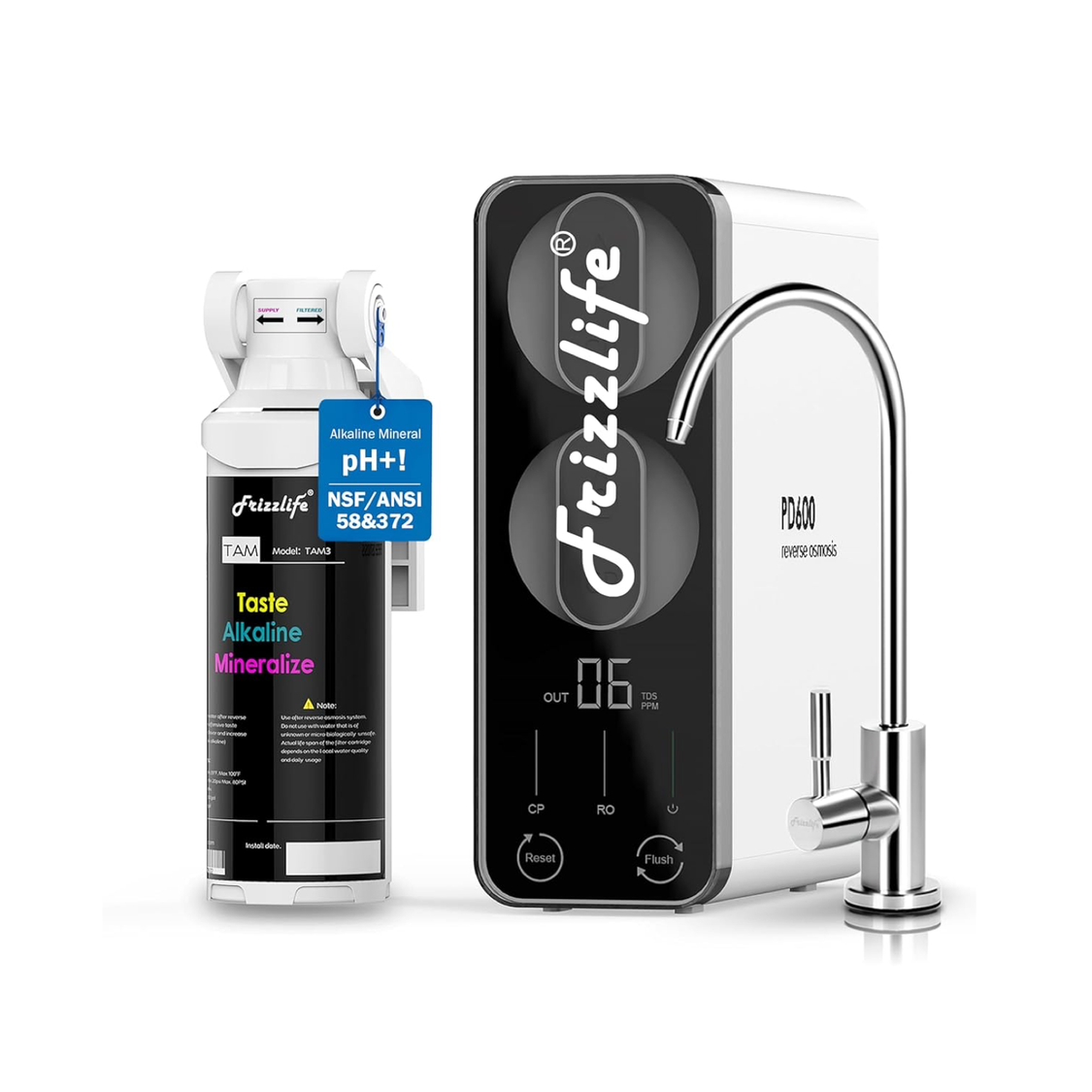
PD600-TAM3 Reverse Osmosis System
A compact tankless under-sink RO option with alkaline remineralization and real-time TDS monitoring. Consider it when your treatment goals extend beyond chlorine-related taste and odor.
View PD600-TAM3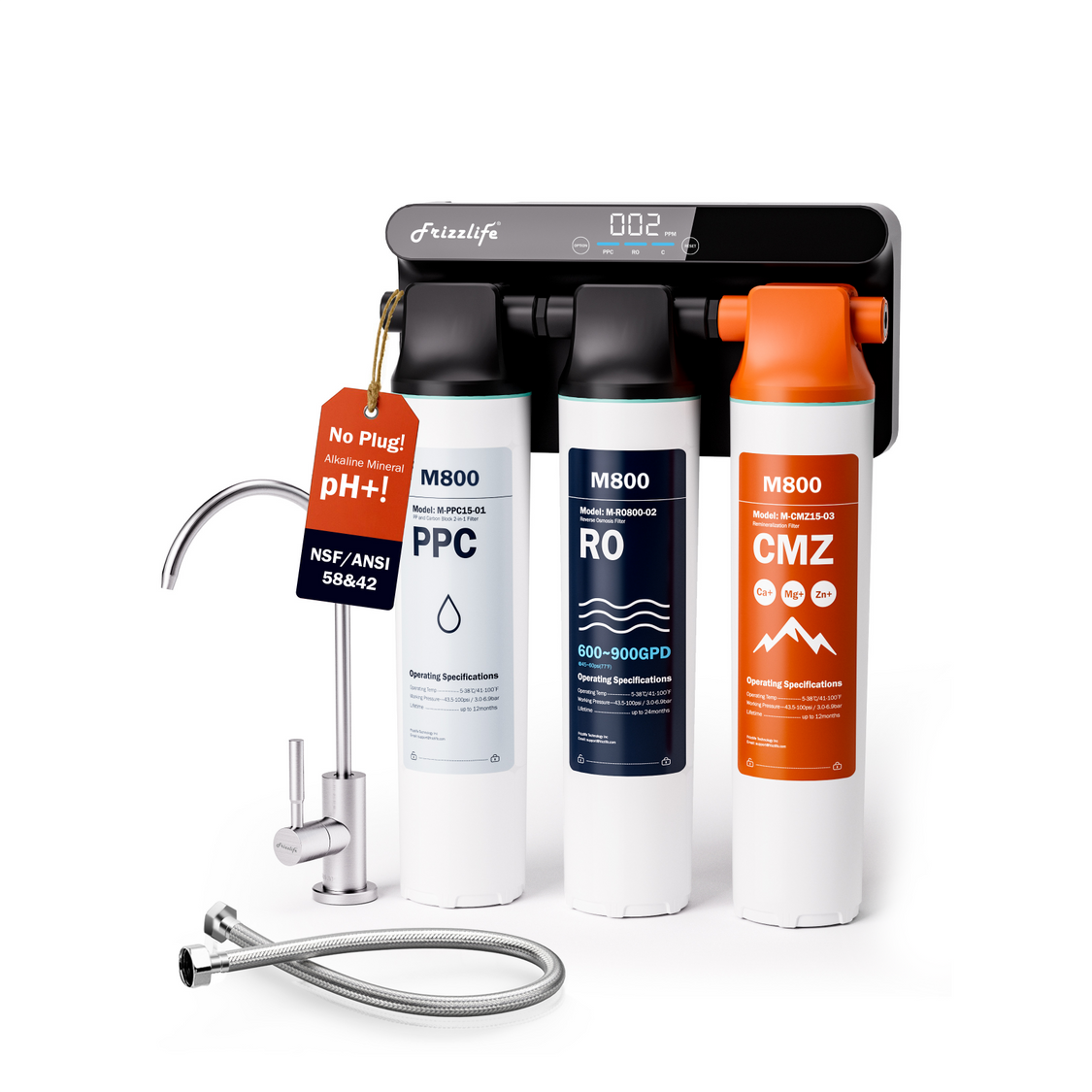
M800 Non-Electric RO System
A non-electric tankless under-sink RO option with alkaline remineralization. Consider it when you want broader RO treatment without relying on an electric pump.
View M800Review each product page for current installation requirements, filtration claims, certifications, output, maintenance, and filter replacement information. Do not assume that every RO system has the same contaminant-reduction performance.
Installation, Maintenance, and Troubleshooting
Follow the Product Instructions
-
Flush new cartridges according to the manufacturer’s instructions.
-
Confirm faucet compatibility, flow requirements, cartridge orientation, and leak checks.
-
Use a qualified installer when plumbing work is outside your experience.
Replace Filters by Capacity and Condition
-
Water usage and starting contaminant concentration
-
Sediment load, flow rate, and water chemistry
-
Cartridge size, product capacity, and periods of non-use
Replace the cartridge according to the manufacturer’s rated capacity or schedule, whichever limit is reached first.
Common Problems and Quick Fixes
-
Low flow: Check for sediment, low pressure, an air pocket, incorrect installation, or an exhausted cartridge.
-
Black specks: Loose carbon fines can occur with a new cartridge. Flush according to the product instructions.
-
Odor after storage: Follow the manufacturer’s restart, sanitizing, or replacement instructions.

Testing Water Before and After Carbon Filtration
Start with Available Water Information
-
Review the current Consumer Confidence Report for municipal water.
-
Remember that building plumbing may affect water after it leaves the utility system.
-
Use qualified laboratory testing for private wells and after flooding or major repairs.
What Home Tests Can Help With
-
Free and total chlorine
-
Hardness, pH, iron, or nitrate screening
When to Use a Laboratory
-
Lead
-
PFAS, arsenic, uranium, VOCs, or pesticides
-
Microbial contamination or other health-related substances
Do not rely on a general multipurpose strip to confirm that a filter removes PFAS, lead, uranium, or another complex contaminant.
Compare the Correct Samples
- Collect an untreated sample.
- Collect a filtered sample under normal operating conditions.
- Follow the laboratory’s sampling instructions.
- Use the same test method for both samples.
- Record cartridge age and approximate water usage.
- Compare the results with the filter’s documented performance claim.

Is Activated Carbon-Filtered Water Safe to Drink Every Day?
-
The source water is appropriate for the filter.
-
The exact product is designed for drinking water and matches the treatment goal.
-
Installation, flushing, and replacement instructions are followed.
Do not state that filtered water is automatically safer than unfiltered water in every situation. A taste-and-odor filter may not address a health-related contaminant, and an old or poorly maintained cartridge may no longer perform as intended.
Drinking water that has passed through an activated carbon cartridge is different from consuming loose activated charcoal powder. This article does not recommend ingesting loose charcoal.
Environmental Considerations
-
Follow the manufacturer’s disposal guidance.
-
Compare cartridge capacity rather than assuming that the smallest filter creates the least waste.
-
Do not reuse spent drinking-water carbon in food gardens when it may have adsorbed metals or other contaminants.

How to Read Activated Carbon Test Results
-
Exact product model and contaminant
-
Starting and final concentrations
-
Flow rate and total water volume
-
Water temperature, pH, and test standard
-
Laboratory identity and cartridge condition
-
Whether the result represents a new filter or end-of-life testing
Be cautious when a page lists high removal percentages without identifying the exact product and test conditions. A result from one gravity filter, carbon block, or whole-house tank cannot automatically be applied to every activated carbon product.
User reviews can describe taste, odor, installation, leaks, and flow. They cannot verify invisible contaminant reduction without appropriate testing.
Is an Activated Carbon Water Filter Right for You?
-
Identify your water source.
-
Review the local water report or obtain appropriate testing.
-
Define the exact treatment goal.
-
Match the goal to a product-specific claim.
-
Compare capacity, flow, installation, maintenance, and ongoing cost.
-
Consider reverse osmosis when broader dissolved-contaminant reduction is needed.
Frequently Asked Questions About Charcoal Water Filters
1. Are charcoal water filters good for you?
2. What do charcoal water filters remove?
3. What are the disadvantages of charcoal water filters?
-
They do not remove every contaminant.
-
Standard carbon does not meaningfully lower hardness, salts, nitrate, or TDS.
-
They are not a reliable disinfection method.
-
Cartridges require replacement, and poorly maintained filters may allow microbial growth.
4. Is it safe to drink activated carbon-filtered water every day?
5. How long does activated carbon take to filter water?
6. Does activated carbon remove PFAS?
Granular activated carbon can reduce certain PFAS under suitable conditions, especially some longer-chain compounds. Performance varies by PFAS type, carbon type, contact time, flow rate, water chemistry, and filter age. Check the exact compounds tested and the product’s rated capacity.
7. Does activated carbon lower TDS?
Standard activated carbon usually does not produce a major reduction in TDS because most dissolved salts and minerals pass through the carbon media. If lowering TDS is one of your goals, compare reverse osmosis systems and verify the exact model’s performance.
8. Is activated carbon better than reverse osmosis?
Neither method is universally better. Activated carbon may be enough for chlorine-related taste and odor or another verified carbon-compatible claim. Reverse osmosis may be more appropriate for broader reduction of dissolved salts, nitrate, fluoride, hardness minerals, or TDS.
References
- U.S. Environmental Protection Agency. PFAS and Drinking Water
- U.S. Centers for Disease Control and Prevention. About Choosing Home Water Filters
- NSF. NSF/ANSI 42, 53 and 401 Filtration Standards
- World Health Organization. Drinking-Water Fact Sheet