


Perchlorate in tap water is not a routine concern for every household, but it can be significant near military facilities, aerospace and defense operations, fireworks manufacturing, and other areas with a history of perchlorate use or disposal. It may also occur naturally in some regions.
If testing confirms contamination, a perchlorate water filter must be chosen carefully. Reverse osmosis can substantially reduce perchlorate because the membrane rejects dissolved ions as water passes through the system. However, the answer to “Does RO remove perchlorate?” is not a universal percentage that applies to every device.
Membrane design, water pressure, feed-water chemistry, maintenance, and certification all affect the result. Homeowners should therefore begin with water testing and verify a model-specific perchlorate reduction claim before relying on any filter.
Key Takeaway: RO Can Reduce Perchlorate, but Performance Is System-Specific
A properly designed and maintained reverse osmosis system can reduce perchlorate in drinking water. EPA materials identify point-of-use RO as an effective household treatment option, while technical studies have reported perchlorate reductions ranging from more than 80% to approximately 98% under different conditions. Some high-pressure systems have achieved even greater rejection, but those results may not represent a typical residential unit.
That distinction matters. A laboratory result, municipal pilot study, or result from one certified device cannot be applied automatically to every under-sink RO system.
Why certification and water testing matter more than stage count
The number of filtration stages does not, by itself, establish perchlorate performance. Sediment and carbon prefilters can protect an RO membrane, but the membrane is the central treatment component for dissolved perchlorate.
A system with numerous stages but no perchlorate-specific data may be less useful for this problem than a simpler system with an appropriate membrane and a verified reduction claim.
What Is Perchlorate, and How Does It Get Into Drinking Water?
Perchlorate is an anion with the chemical formula ClO₄⁻. It can be present in water as part of salts such as ammonium, potassium, or sodium perchlorate.
Perchlorate compounds are associated with rocket propellants, explosives, fireworks, flares, and certain industrial processes. Releases during manufacturing, use, storage, or disposal can contaminate soil. Because perchlorate is highly soluble in water, it may migrate from soil into groundwater and, eventually, public water supplies or private wells.
Low levels may also occur naturally. As a result, finding perchlorate does not always prove that a nearby industrial source caused the contamination.
How perchlorate reaches private wells and tap water
Potential pathways include:
-
Industrial discharge or improper waste disposal
-
Leaks or releases at military and aerospace facilities
-
Fireworks manufacturing or repeated fireworks activity
-
Explosives production, storage, or testing
-
Contaminated soil leaching into groundwater
-
Movement of a groundwater plume into a well field
-
Naturally occurring deposits in certain dry regions
-
Use of affected groundwater by a public water system

Perchlorate in tap water is location-dependent. A household near a known source may have no detectable perchlorate, while a more distant well could be affected by groundwater movement. Testing is the only reliable way to establish the concentration at a particular property.
Which households are more likely to face contamination?
Testing deserves consideration when a home:
-
Uses a private well near a military, aerospace, defense, or explosives site
-
Is located near a documented perchlorate cleanup area
-
Receives local notices about groundwater contamination
-
Is served by a utility that has reported perchlorate detections
-
Is in an area where state or local agencies recommend monitoring
-
Has a well downgradient from a suspected industrial source
A nearby facility is a reason to investigate, not proof that the home’s water is contaminated.
Why perchlorate raises thyroid and developmental concerns
Perchlorate can competitively inhibit iodide uptake by the thyroid gland. The thyroid needs iodide to produce thyroid hormones, which help regulate metabolism and support normal growth and neurological development.
The biological effect depends on dose, exposure duration, iodine status, and individual sensitivity. Health authorities generally focus on reduced iodide uptake as the earliest effect. Evidence about clinical thyroid disease at low environmental concentrations is more complex, so risk should not be overstated.
People who may warrant additional caution include:
-
Pregnant or breastfeeding individuals
-
Fetuses and infants
-
Young children
-
People with low iodine intake
-
People with certain thyroid conditions
Anyone with a medical or thyroid-related concern should consult a qualified healthcare professional. A water filter is not a substitute for medical evaluation.
Perchlorate Levels, Regulations, and Water Testing
Perchlorate regulation in the United States has changed over time, and older online resources may not reflect the latest federal activity.
According to EPA’s January 2026 proposal, the agency proposed a maximum contaminant level goal, or MCLG, of 0.02 mg/L, equal to 20 µg/L or 20 ppb. EPA also co-proposed possible enforceable maximum contaminant levels of 20, 40, or 80 µg/L.
These were proposed values rather than a final nationwide enforceable limit at the time of the proposal. An MCLG is a non-enforceable public-health goal, while a finalized maximum contaminant level would be an enforceable standard for covered public water systems.
EPA’s perchlorate reference dose is 0.0007 mg per kilogram of body weight per day. This corresponds to a drinking water equivalent level of 24.5 ppb. The reference dose and drinking water equivalent level are risk-assessment benchmarks, not enforceable drinking water standards.
State standards and advisory values
Some states established their own limits before a federal rule was finalized:
|
Jurisdiction or organization |
Perchlorate value |
Status |
|
California |
6 µg/L |
State maximum contaminant level |
|
Massachusetts |
2 µg/L |
State maximum contaminant level |
|
EPA, January 2026 proposal |
20 µg/L MCLG |
Proposed non-enforceable health goal |
|
EPA, January 2026 proposal |
20, 40, or 80 µg/L |
Co-proposed options for an enforceable MCL |
|
EPA drinking water equivalent level |
24.5 µg/L |
Risk-assessment value, not an MCL |
|
Environmental Working Group (EWG) |
1 µg/L ideal; no more than 2 µg/L |
Non-government recommendation, not an enforceable standard |
State rules apply within the relevant state. Other jurisdictions may use notification levels, screening values, cleanup standards, or local advisories rather than an MCL.
Because regulations evolve, homeowners should verify current information with their state drinking water program, local health department, or water utility instead of relying only on a national summary.
How to check a Consumer Confidence Report
Customers of a community public water system usually receive an annual Consumer Confidence Report, or water quality report. Search the report for “perchlorate” and note:
-
Whether the contaminant was tested
-
Whether it was detected
-
The highest result or reported range
-
The unit used, usually µg/L or ppb
-
The date and location of sampling
-
Any applicable state standard or advisory
Perchlorate may not appear in every report. Absence from the document does not necessarily mean the concentration is zero; it may mean the system was not required to report it during that period. Contact the utility and ask whether perchlorate has been tested at the source, in finished water, or within the distribution system.
Testing private well or tap water
Private well owners are responsible for their own water testing. If perchlorate is suspected, use a laboratory certified or approved by the appropriate state agency for the specific analysis.

Before collecting a sample:
-
Ask the laboratory whether it is approved to test drinking water for perchlorate.
-
Request its sampling container and instructions.
-
Confirm where to sample—before treatment, after treatment, or both.
-
Follow preservation, storage, and delivery requirements exactly.
-
Ask how results will be reported and what detection limit the method provides.
A first sample should normally establish the untreated concentration. If a perchlorate drinking water filter is installed, test the treated water separately to confirm performance. Where contamination is persistent, periodic retesting can identify changes in source water or declining treatment performance.
Does Reverse Osmosis Remove Perchlorate?
Yes. Reverse osmosis can remove or reduce perchlorate, but actual results depend on the system and operating conditions.
RO uses pressure to push water through a semipermeable membrane. Water molecules pass to the treated side, while many dissolved ions—including perchlorate—are rejected and remain in the concentrate stream.
Unlike a chemical treatment that selectively destroys perchlorate, household RO separates it from part of the incoming water. The treated stream is used for drinking, while the concentrated reject stream typically goes to a drain.

What technical evidence says about reverse osmosis perchlorate removal
EPA technical materials and water-treatment research recognize RO as a viable perchlorate treatment technology. Reported findings include:
-
Pilot and bench studies showing more than 80% removal under some conditions
-
Results approaching approximately 98% under other conditions
-
An industry example reducing 100 µg/L to below 6 µg/L
-
Approximately 97% reduction in a cited NSF/ANSI 58 test scenario, from a 130 µg/L challenge concentration to 4 µg/L
-
About 99.9% removal in some high-pressure research systems
These figures illustrate what RO technology can achieve; they are not a universal promise for residential equipment. High-pressure industrial or utility systems may operate above 150 psi and under carefully controlled conditions that differ substantially from household water pressure.
The most meaningful number is not the highest percentage in a study. It is the final perchlorate concentration produced by a specific system under conditions similar to those in the home.
For example, even the same percentage reduction produces different treated-water results:
-
A 90% reduction from 10 µg/L leaves approximately 1 µg/L.
-
A 90% reduction from 100 µg/L leaves approximately 10 µg/L.
That is why both the starting level and the target treated-water level matter.
Factors that affect RO perchlorate reduction
Feed-water concentration and chemistry
The starting perchlorate concentration directly affects the final result. Other dissolved salts and ions can also influence membrane behavior, osmotic pressure, scaling, and overall system recovery.
A complete water analysis may be appropriate when a private well has hardness, iron, manganese, sediment, high total dissolved solids, nitrate, or other contaminants in addition to perchlorate.
Membrane type and condition
Different membranes have different rejection characteristics. Performance can decline when a membrane becomes:
-
Fouled by sediment or organic matter
-
Scaled by hardness minerals
-
Chemically damaged
-
Improperly installed
-
Aged beyond its useful condition
-
Exposed to water outside the system’s design range
A membrane that once performed well may not continue doing so without appropriate pretreatment and replacement.
Water pressure and temperature
RO depends on pressure. Insufficient feed pressure can reduce treated-water production and may affect rejection performance. Water temperature also changes membrane output. Published results obtained under controlled pressure and temperature should not be assumed to apply under different household conditions.
Recovery rate and system design
Recovery describes how much feed water becomes treated water. Changes in recovery affect ion concentration near the membrane and in the reject stream. System configuration, flow controls, membrane area, and storage or tankless design can all influence performance.
Pretreatment and maintenance
Sediment and carbon prefilters do not necessarily remove perchlorate themselves, but they can protect the RO membrane from particles and chemicals that could shorten its service life. Pretreatment cannot compensate for an unsuitable or damaged membrane, however.
Follow the manufacturer’s maintenance schedule and investigate changes such as:
-
A major drop in flow
-
Unusual taste or odor
-
Unexpected changes in total dissolved solids
-
Leaks or pressure problems
-
A treated-water perchlorate result above the expected level
A TDS reading can help indicate general membrane behavior, but it does not directly measure perchlorate. Only contaminant-specific laboratory testing can confirm the perchlorate concentration.
What Water Filters Reduce Perchlorate?
The main recognized treatment options are reverse osmosis, anion exchange, and certain large-scale biological processes. Nanofiltration and distillation may also have a role, depending on the application.
Reverse osmosis for drinking and cooking water
Point-of-use RO is often a practical choice when the main goal is to reduce ingestion through drinking, food preparation, beverages, and infant formula. It can also reduce many other dissolved contaminants, although the exact claims depend on the individual system.
An under-sink unit treats a limited volume at one faucet. That is usually less complex than producing RO water for every fixture in a home.
Anion exchange for perchlorate-specific treatment
Anion exchange uses a resin that attracts negatively charged ions such as perchlorate. Perchlorate-selective resins can be effective, and technical sources report that ion exchange has been used to reduce levels to 4 µg/L or lower.
Performance depends on:
-
Resin type and selectivity
-
Competing anions in the water
-
Influent concentration
-
Bed size and flow rate
-
Breakthrough monitoring
-
Resin replacement or regeneration practices
Ion exchange is widely used in groundwater and municipal treatment. Residential applications require proper design because exhausted resin can stop providing the intended reduction, and spent media or regenerant may require appropriate handling.
Can activated carbon remove perchlorate?
Standard activated carbon should not be assumed to remove perchlorate reliably.
Carbon is commonly used for chlorine, tastes, odors, and certain organic chemicals. Perchlorate is a highly soluble inorganic anion, so ordinary carbon pitchers and basic carbon cartridges are not generally the primary treatment technologies identified for it.
Specialized or modified media may be marketed for perchlorate, but any claim should be supported by independent testing or certification for that specific cartridge. The presence of activated carbon in a multistage system does not establish a perchlorate reduction claim.
Other treatment methods
-
Distillation: Evaporates water and condenses the vapor, leaving many dissolved salts behind. It may be suitable for producing relatively small amounts of drinking water but uses energy and requires cleaning.
-
Nanofiltration: Can reject perchlorate to varying degrees, although its performance may differ from RO according to the membrane and water chemistry.
-
Biological treatment: Uses microorganisms to reduce perchlorate to chloride and oxygen. It is primarily a municipal, industrial, or groundwater-remediation technology rather than a typical household filter.
-
Hybrid systems: Utilities and industrial facilities may combine membrane, ion exchange, or biological processes to meet site-specific treatment goals.
RO vs. ion exchange and other perchlorate treatment methods
|
Treatment method |
Documented capability |
Typical application |
Multi-contaminant treatment |
Main practical considerations |
|
Reverse osmosis |
Substantial perchlorate reduction when properly designed and operated |
Under-sink, point-of-use, and some utility or point-of-entry systems |
Reduces many dissolved ions rather than targeting only perchlorate |
Produces reject water; membrane performance depends on pressure, condition, and pretreatment |
|
Anion exchange |
Strong capability with an appropriate resin; can be designed specifically for perchlorate |
Municipal, groundwater, point-of-entry, and specialized residential treatment |
Depends on resin selectivity and competing ions |
Requires breakthrough control and resin replacement or regeneration |
|
Standard activated carbon |
Should not be assumed to provide reliable perchlorate reduction |
Pitchers, faucet filters, and pretreatment |
Useful for chlorine and selected organic contaminants |
Perchlorate claims require specific evidence; ordinary carbon is not enough |
|
Distillation |
Can separate many dissolved inorganic contaminants |
Small-volume household production |
Broad treatment of many nonvolatile dissolved substances |
Energy use, slow production, and cleaning requirements |
|
Nanofiltration |
Variable perchlorate rejection |
Primarily specialized or larger systems |
Reduces selected ions and larger dissolved substances |
Results are membrane- and chemistry-dependent |
|
Biological treatment |
Can convert perchlorate to chloride and oxygen |
Municipal, industrial, and remediation projects |
Usually engineered for specific water-treatment goals |
Operational complexity makes it uncommon in homes |
Choosing a Perchlorate Drinking Water Filter for Your Home
Start with a confirmed laboratory result, not a general concern about local water quality. Once the starting concentration is known, define the treated-water target using current state or local guidance.
Under-sink RO versus whole-house treatment
A point-of-use system treats water at one drinking-water faucet. A point-of-entry system treats water as it enters the home.

For perchlorate, ingestion through drinking water is generally the central household concern. Point-of-use RO can therefore be a practical fit for:
-
Drinking water
-
Cooking
-
Coffee and other beverages
-
Washing produce when water will be consumed
-
Preparing infant formula
Whole-house RO may be considered when there are multiple contaminants, exceptionally difficult source-water conditions, or a need for treated water throughout the property. It is a more complex application because it may require storage, repressurization, pretreatment, corrosion management, and a plan for a larger reject-water volume.
High perchlorate levels or complex private-well chemistry may justify professionally designed ion exchange, RO, or combined treatment.
How to verify an NSF/ANSI 58 perchlorate claim
NSF/ANSI 58 is the main standard associated with residential reverse osmosis systems. However, certification to the standard does not automatically mean that every optional contaminant-reduction claim has been tested.
Look for a certification listing or performance data sheet that explicitly names perchlorate reduction. Verify:
-
The exact model number
-
The named contaminant claim
-
The challenge concentration
-
The maximum or average treated-water concentration
-
The stated reduction percentage
-
Test pressure and other operating conditions
-
Required replacement components
-
Any limitations in the certification listing
A cited test scenario for perchlorate under NSF/ANSI 58 used a challenge concentration of 130 µg/L and a treated-water level of 4 µg/L, equivalent to about 97% reduction. That test framework demonstrates why the challenge and final concentrations matter. It does not mean every system carrying an NSF/ANSI 58 certification has the same perchlorate claim.
Questions to ask before purchasing
Use the following checklist when evaluating any perchlorate water filter:
-
Is perchlorate explicitly listed?
General statements about reducing dissolved solids are not the same as a verified perchlorate claim. -
Who tested or certified the system?
Distinguish independent certification from a manufacturer’s own statement. -
Does the documentation match the exact model?
Results for one membrane or model should not be applied to another. -
What concentration was used in testing?
Compare the challenge level with the concentration found in your water. -
What final level did the device produce?
A percentage without a treated-water concentration provides incomplete information. -
What pressure and water conditions were used?
Make sure your home can provide suitable operating conditions. -
What maintenance is required?
Confirm how filters and membranes are monitored and when replacement is recommended. -
Is post-installation testing advised?
For confirmed contamination, the safest approach is to verify the result at the tap.
After defining these requirements, homeowners can review Frizzlife reverse osmosis system options. Check the exact product documentation and certification listing rather than assuming that every RO model carries a perchlorate-specific claim.
Explore Reverse Osmosis System Options
If laboratory testing confirms perchlorate in your water, compare the exact system specifications, membrane information, operating requirements, and available performance documentation before choosing a reverse osmosis system.
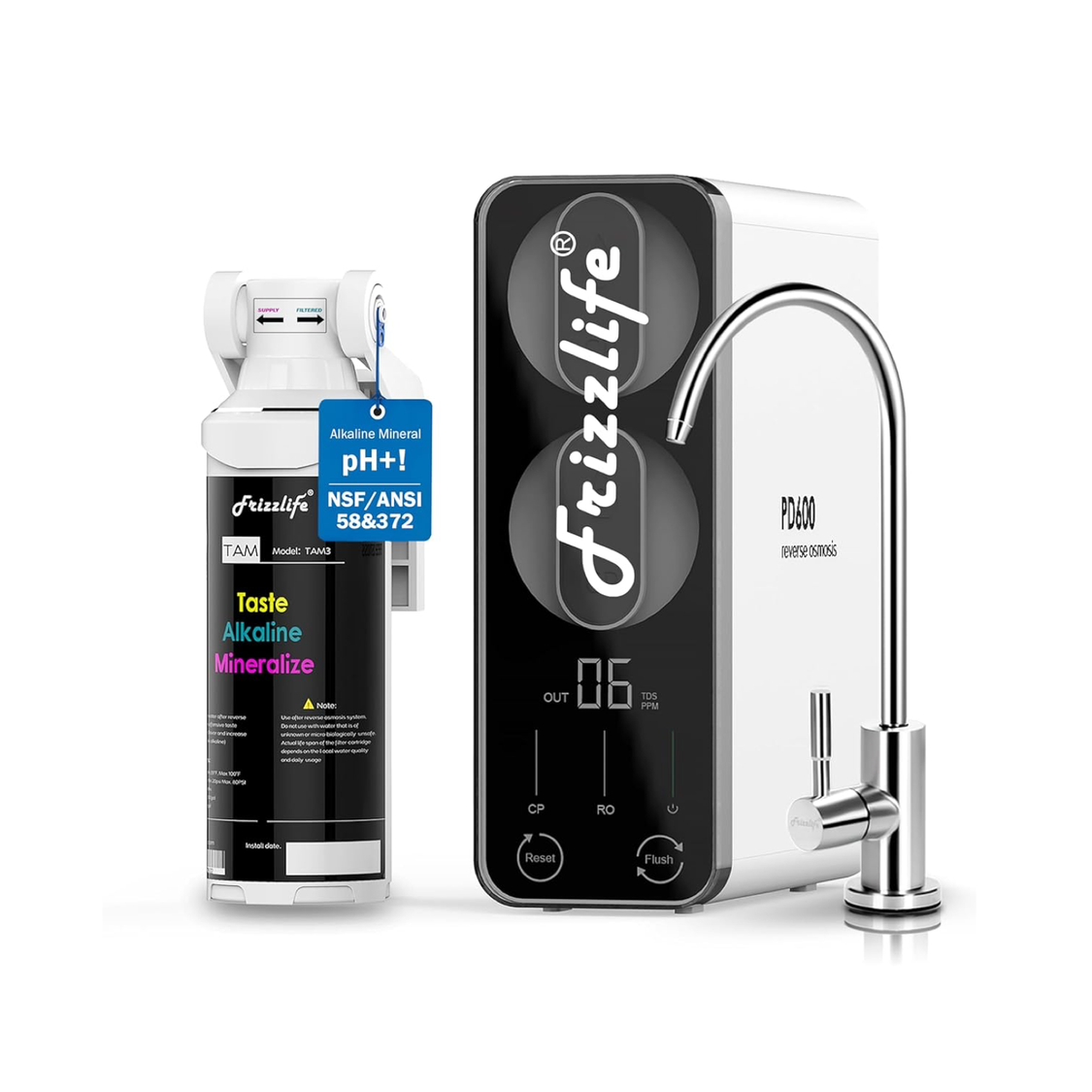
Frizzlife PD600-TAM3
Review the PD600-TAM3 specifications, membrane configuration, operating requirements, and available product documentation to determine whether it fits your water-treatment needs.
View PD600-TAM3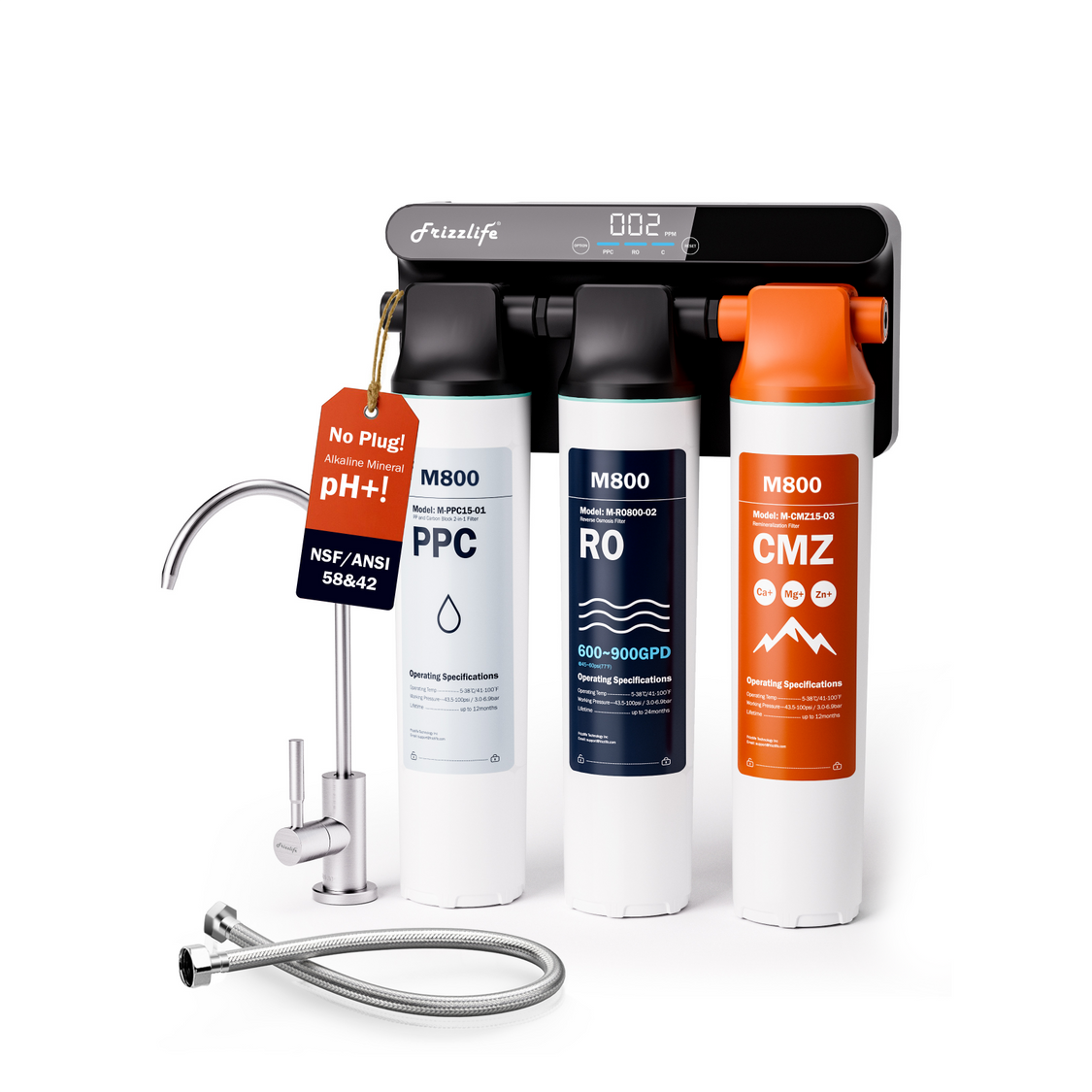
Frizzlife M800
Compare the M800 system specifications and available performance documentation with your tested source-water conditions and required treated-water target.
View M800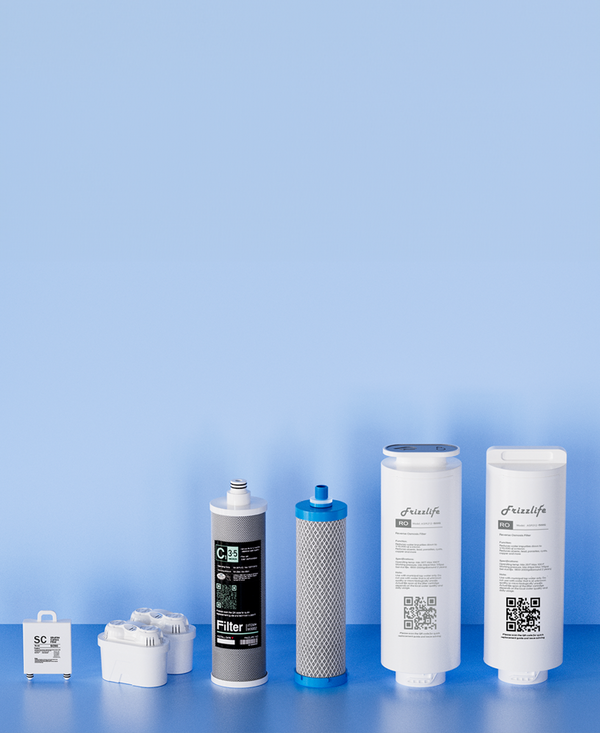
Replacement Filters
Regular filter and membrane replacement is part of maintaining an RO system. Find the correct replacement components for your specific Frizzlife model.
Find Replacement FiltersLimits and Practical Considerations of RO Perchlorate Removal
RO can be highly useful, but it does not destroy perchlorate. It separates it into the reject-water stream.
Reject water and disposal
The concentrate from an RO system contains the rejected perchlorate along with other dissolved ions. Most residential systems discharge this water to a household drain, where it enters a public sewer or septic system.
For ordinary point-of-use equipment, the volume is much smaller than that produced by a municipal installation. Even so, private well owners using septic systems should consider local plumbing, environmental, and wastewater requirements—especially when contamination is severe or a large point-of-entry system is proposed.
Utility and industrial systems face more substantial brine-management challenges because of their larger concentrate volumes.
Mineral reduction, taste, and pH
RO does not target only perchlorate. It reduces a broad range of dissolved ions, including minerals that influence taste and water chemistry.
Some people prefer remineralization for flavor. In whole-house applications, low-mineral water may also require professional evaluation for corrosion control and compatibility with plumbing. Remineralization is a water-quality preference or design consideration; it is not the step responsible for perchlorate reduction.
What RO pretreatment can and cannot do
Sediment filtration can reduce particles that might foul a membrane. Carbon pretreatment can reduce chlorine where necessary to protect certain membrane materials. Other pretreatment may be required for hardness, iron, manganese, or other source-water conditions.
Pretreatment helps preserve membrane operation, but it does not prove perchlorate reduction. The membrane and overall system must still have suitable performance data.
Why boiling does not remove perchlorate
Boiling is not a treatment for perchlorate. It removes water as vapor while dissolved salts remain behind, potentially increasing their concentration in the water left in the pot.
This differs from distillation, which captures and condenses the vapor in a separate clean container. If perchlorate is confirmed, use appropriately treated water rather than relying on boiling.
What to Do If Perchlorate Is Found in Your Water
A laboratory detection should lead to a structured response rather than an immediate purchase based only on filter marketing.
-
Confirm the result.
Review the sampling method, units, detection limit, and laboratory certification. Consider a second sample if the result is unexpected. -
Compare it with current guidance.
Check state standards, local advisories, and any applicable public-water requirements. Regulatory values can change. -
Contact the appropriate authority.
Public-water customers can ask their utility about source testing and treatment. Private well owners can contact a local health department, state drinking water program, or qualified water-treatment professional. -
Identify the water uses that require treatment.
Prioritize verified treated water for drinking, cooking, beverages, and infant formula. Sensitive household members may warrant additional caution based on medical advice. -
Select treatment for the measured concentration.
Point-of-use RO may be suitable for ingestion-related exposure. High levels, whole-house goals, or complex water chemistry may call for professionally designed RO, anion exchange, or a combined approach. -
Install and maintain the system correctly.
Follow the exact model’s instructions. Do not extend replacement intervals without evidence that performance remains adequate. -
Test the treated water.
Collect a sample from the drinking-water faucet after installation and appropriate flushing. Confirm that the final perchlorate concentration meets the chosen target. -
Continue monitoring when the source remains contaminated.
Changes in groundwater, source blending, membrane condition, or system operation can affect long-term performance.
The Bottom Line
Reverse osmosis can substantially reduce perchlorate in drinking water, and point-of-use RO is recognized as a practical household treatment approach. But “RO” alone is not a performance guarantee.
The right process is to test the untreated water, determine the necessary final concentration, verify a model-specific perchlorate claim, maintain the system as directed, and retest the treated water. Standard carbon pitchers and stage-count claims should not replace contaminant-specific evidence. For high concentrations or complicated well water, seek professional treatment design and guidance from the appropriate local authority.
References
https://www.epa.gov/sdwa/perchlorate-drinking-water