

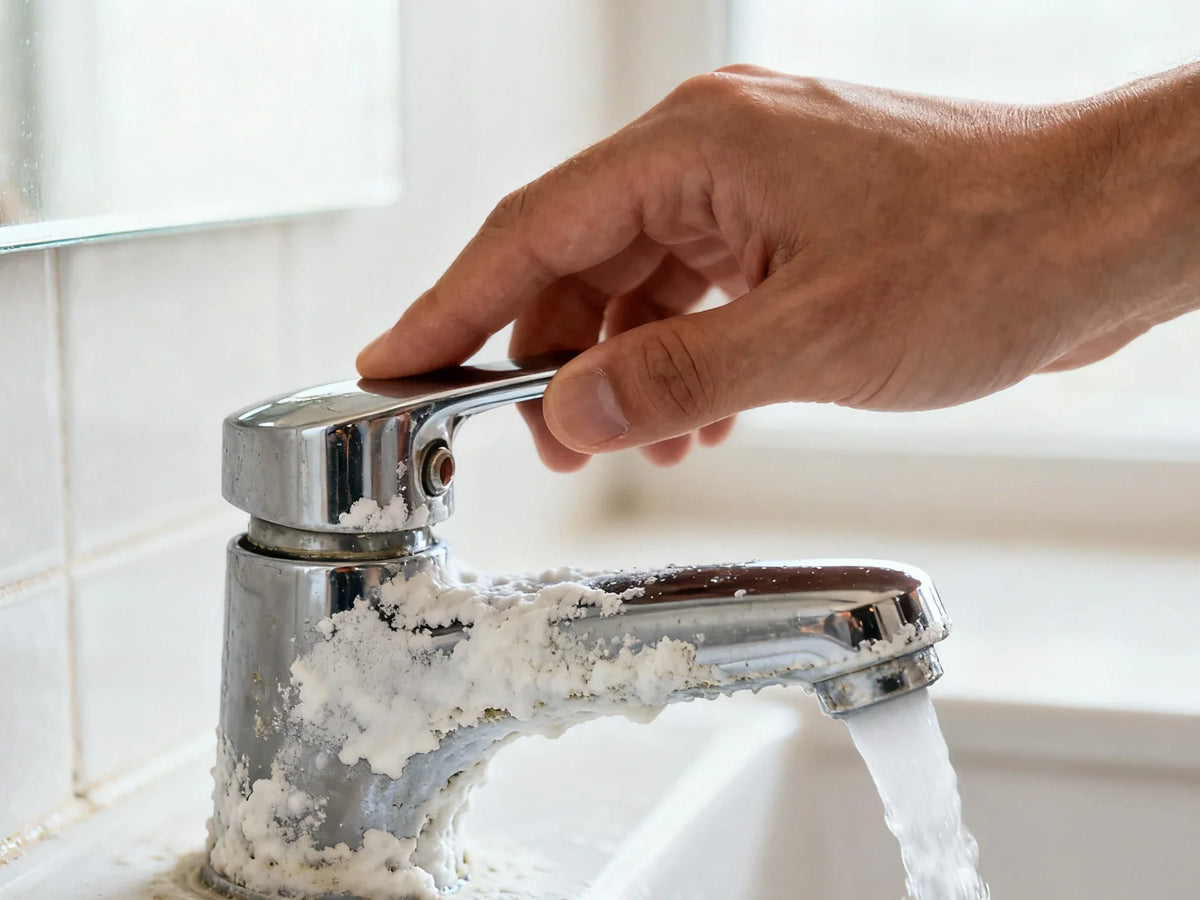
Is limescale harmful? Limescale is the hard, chalky calcium carbonate that forms from hard water, quietly wrecking efficiency in homes and industries. It coats heating elements, clogs pipes, and pushes energy and maintenance costs higher. Want quick wins? Remove limescale you can see with citric acid or a commercial descaler, and prevent limescale at the source with a salt-based water softener or a reverse osmosis (RO) water filter at key taps and appliances. This guide explains what limescale is, where it forms, how to dissolve limescale, and the best ways to remove and prevent it. You’ll also see ROI examples, step-by-step methods, easy tests, and safety tips that protect your plumbing system and appliances.
Limescale 101: What It Is and Why It Matters
If you’ve noticed white, chalky deposits on your taps, kettles, or shower glass, you’re seeing the effects of limescale—a common problem in homes and industrial systems that affects performance, energy use, and appliance lifespan.
The chemistry of limescale (calcium carbonate from hard water)
- What is lime scale? Limescale is calcium carbonate deposits that form when hard water (water with high calcium and magnesium) is heated or evaporates, according to the USGS.
- When you heat water (kettles, water heaters, boilers) or when water dries on surfaces (taps, shower glass), the dissolved calcium and magnesium become limescale deposits.
- You’ll spot chalky deposits on kettle elements, shower heads, faucet aerators, and inside pipework. In some areas, limescale builds layers in pipework faster because water is hard most of the year.
Where limescale forms: home vs. industrial systems
- Home: kettles, hot water heaters, dishwashers, faucets, toilet bowls and rims, shower doors, tiles, plumbing fixtures, aerators, and washing machines.
- Industry: boilers, heat exchangers, cooling towers, and long piping networks. Scale builds faster due to higher temperatures, large flows, and constant cycles.
- Impact on systems: limescale build up reduces heat transfer, restricts water flow, adds backpressure, and accelerates wear on pumps, valves, and seals.
Why it matters: performance, energy, and lifespan impacts
- Energy waste: Even a thin scale layer insulates heating surfaces. Water heaters and boilers can use well over 10–20% more energy with boiler scaling and internal deposits, based on recommendations from the U.S. Department of Energy (DOE).
- Shorter life: Appliances in hard-water areas may fail in 3–5 years instead of 8–10 if you never treat hard water deposits.
- Hidden costs: Unplanned shutdowns, emergency lime scale removal, repeated acid cleaning, and early replacements drive up bills at home and in facilities.
The Real Cost of Limescale: Data, Energy, and ROI
Limescale isn’t just an eyesore—it affects your energy bills, appliance lifespan, and overall maintenance costs. Understanding the numbers helps you make smarter choices for your home or facility.
By the numbers: market size and production trends
- Scale-control is big business. The limescale preventer and treatment market is projected in the billions of dollars, driven by residential and industrial need.
- Lime industry scale: The U.S. produces tens of millions of tons of quicklime and hydrated lime yearly, while global production is many times higher. This reflects the size of water treatment and process needs.
- Why it matters to you: Bigger markets mean more product options and better technology for anti-scale and scale inhibitor methods.
Note: Lime production stats show the scale of treatment markets and are useful context, but your decision comes down to energy, lifespan, and maintenance costs in your home or facility.
Household economics: what limescale does to your bills
- Energy penalty: A scaled water heater or kettle heats slower. Many homes see >20% energy overhead in heaters, and kettles can lose up to ~30% efficiency if never descaled.
- Appliance wear: Heating elements, valves, and pumps fail 2–3x more often in high water hardness without prevention.
- Payback: A water softener often pays for itself in 2–4 years through lower energy, fewer repairs, and longer appliance life. RO filters at the kitchen tap protect coffee makers, ice makers, and reduce film in kettles.
Industrial impact: case-based savings
- Boilers: Case reports show 10–12% higher energy use and major maintenance spend before installing softening and proper treatment.
- Cooling towers: Cooling tower scaling can boost energy use by up to 15%, and repeated strong-acid cleans are costly.
- ROI: Facilities that combine softening, best-practice chemistry, RO for critical points, and planned maintenance see fast returns from fewer cleans, less downtime, and better heat transfer.
Spotting and Diagnosing Limescale (With Simple Tests)
Before you can remove or prevent limescale, it’s important to identify where it forms and how severe it is. Recognizing the signs early can save energy, reduce appliance wear, and protect your plumbing system.
Visible Signs Across Equipment
Limescale can show up in both home appliances and larger water systems. Knowing what to look for helps you act before deposits become serious.
At home:
- White or gray stains on taps, shower glass, and faucets
- Sluggish water flow caused by clogged aerators or showerheads
- Noisy kettles, longer boil times, or cloudy glassware
- Stiff laundry after washing
- Persistent toilet rings that keep coming back
In systems:
- Rising differential pressure across heat exchangers
- Higher approach temperatures and reduced water throughput
- More frequent descaling or alarms indicating scale buildup
These signs usually point to water containing calcium and magnesium carbonates, which create the chalky deposits known as limescale. Left untreated, this buildup can reduce efficiency in hot water appliances, restrict flow in your plumbing system, and increase energy bills.
Do-It-Yourself Hard Water Checks
Even without professional equipment, you can test your water and spot potential limescale problems early.
Soap Test:
- Rub soap on wet hands or a sponge.
- If the soap doesn’t lather well or leaves a film on sinks or tubs, your water is likely hard. Hard water is a common cause of limescale buildup.

Test Strips or Drops:
- Measure water hardness using gpg (grains per gallon) or mg/L (ppm).
- This gives you a quantifiable idea of how likely your water is to form limescale.
Keep a Simple Log:
- Track your water hardness, visible scale, and appliance performance monthly.
- Some regions have seasonal variations, so logging helps identify patterns and predict when removing limescale buildup will be needed.
Tools to plan maintenance
- Risk quiz: Match your region, symptoms, and hardness test to a plan that fits your home.
- Timeline generator: See how often to clean or descale kettles, dishwashers, and water heaters based on hardness and usage.
- Savings calculator: Estimate energy and replacement savings from a softener and RO vs. doing nothing.
How to Remove Limescale: Methods Compared (Home and Pro)
Removing limescale effectively requires knowing which method works best for the situation—whether it’s a small home appliance or a large industrial system. The right approach protects your plumbing system and keeps your hot water appliances running efficiently.
DIY acids (vinegar, citric acid): when they work best
- Great for cleaning lime deposits with vinegar or citric acid on kettles, taps, shower heads, tiles, and glass.
- How to dissolve limescale: Soak parts in a 1:1 water–vinegar mix or add 1–2 tbsp citric acid per liter of warm water. Wait 30–60 minutes, scrub gently, rinse. Repeat for stubborn limescale.
- Limits: DIY acids remove limescale you can reach but do not prevent limescale buildup. Avoid long contact on natural stone and some metals. Always spot-test.

Commercial descalers: faster, targeted removal
- Pros: Formulated to dissolve thick scale quickly and often safer on specific surfaces when you follow the label.
- Uses: Heavy kettle scale, toilet bowls, glass, tiles, and some heat exchangers (if rated for that use).
- Safety: Ventilate, wear gloves and eye protection, and never mix acids with bleach.
Professional descaling and system flushes
- Needed for: Boilers, closed-loop systems, and severe limescale build up.
- Steps: Acid circulation, neutralization, passivation (protective layer), and proper waste handling.
- Timing: Tie into planned maintenance to reduce downtime and track improved water pressure, temperatures, and energy use after service.
Limescale Prevention and Removal: What Actually Works Long-Term
Preventing limescale is more effective than constantly removing it. The right combination of water treatment, appliances, and maintenance keeps your plumbing system and hot water appliances running efficiently for years.
Salt-based water softeners (ion exchange): strongest prevention
- What they do: Swap calcium and magnesium for sodium or potassium. That stops calcium carbonate scale from forming downstream.
- Best for: Whole-house or whole-facility protection. High success in prevent limescale in your home and reduce limescale on fixtures.
- Considerations: Uses salt and regeneration water. Check local rules and set to efficient modes.
Reverse osmosis (RO) filters: point-of-use and selective whole-home
- How they help: RO removes dissolved minerals that cause limescale, cutting scale at taps and appliances.
- Where to use: Kitchen drinking water taps, icemakers, espresso and coffee gear, and sensitive appliances.
- Setup tips: In very hard water, add pre-filtration and sometimes a softener to protect the RO membrane. RO greatly reduces limescale in your home at the treated outlet, and it can improve taste compared with tap water in hard-water areas.

Salt-free conditioners, electronic/magnetic devices: mixed evidence
- Template-assisted crystallization (TAC): Helps minerals stay in suspension so they are less sticky. Results vary with water chemistry and flow.
- Electronic/magnetic units: Many users see mixed outcomes. They may reduce spotting but often do not equal ion exchange for full prevention.
- Use case: Where softeners aren’t allowed or wanted. Track results by surface checks and hardness testing.
Routine maintenance: small habits that prevent big problems
- Flush water heaters yearly in hard-water regions to remove sediment and loose scale.
- Descale kettles monthly; run dishwasher and washing machine cleaning cycles every 1–3 months.
- Clean aerators and shower heads quarterly. Replace worn seals and cartridges.
- Squeegee shower glass after each use to slow mineral deposits.
Limescale Removal and Prevention Methods: Quick Comparison
| Method | Best For | Speed of Results | Prevents Future Scale? | Surface/Material Notes | Ongoing Cost | Notes |
| Vinegar or lemon juice (DIY) | Light, visible deposits | Moderate | No | Avoid natural stone; spot-test metals | Low | Great for home to remove buildup you can see |
| Citric acid (DIY) | Light to moderate deposits | Moderate–fast | No | Gentler smell; good on kettles, taps, glass | Low | Often the easiest “how to get rid of limescale” start |
| Commercial descaler | Thick deposits | Fast | No | Check label for plumbing fixtures and surfaces | Low–Medium | Strong results; follow safety rules |
| Salt-based softener | Whole-house/facility | N/A (prevention) | Yes | N/A | Medium | Strongest long-term anti-scale prevention |
| Reverse osmosis (RO) | Drinking taps, appliances | N/A (prevention) | Yes (at outlet) | Requires pre-filtration | Low–Medium | Protects coffee gear, icemakers; reduces limescale stains |
| TAC/conditioners | Where softeners not feasible | N/A (mitigation) | Mixed | N/A | Low–Medium | May reduce adhesion; test results locally |
| Electronic/magnetic | Spot treatment/experiments | N/A (mitigation) | Mixed | N/A | Low–Medium | Verify with before/after checks |
Step-by-Step: Safely Removing Limescale on Common Surfaces
Removing limescale effectively requires careful handling and the right techniques for each surface. Follow these steps to protect your plumbing system and hot water appliances while restoring performance and appearance.
Kettles and coffee equipment
Kettles:
- Fill with 1:1 water–vinegar or add 1–2 tbsp citric acid per liter.
- Heat or soak 30–60 minutes.
- Scrub gently; rinse well.
- Boil a full pot of fresh water and discard to clear taste.
Coffee/espresso machines:
- Follow the manual’s descaling program.
- Avoid damage to aluminum parts. Use approved concentrations.
- For taste and scale control, use RO water at the coffee station and, if needed, a small remineralization cartridge for flavor consistency.
Faucets, showerheads, glass, and tiles
- Removable parts: Soak in warm citric acid solution. Brush gently, rinse.
- Fixed taps/showerheads: Fill a bag with vinegar or citric solution; tie around the tap or shower head; soak 30–60 minutes; brush; rinse.
- Glass and tiles: Spray, let it sit, wipe with a non-scratch pad.
- Do not use acids on natural stone such as marble or limestone. Use pH-neutral stone cleaners.

Water heaters, boilers, and heat exchangers
Home water heater:
- Power off, isolate, drain, and flush to remove sediment and flakes.
- For heavy limescale buildup, hire a pro for a chemical flush.
Industrial systems:
- Professional chemical circulation, neutralization, and passivation are standard.
- Manage waste and permits properly.
After cleaning: Track energy use, temperature delta, and pressure to confirm gains.
Social Proof and Case Studies: What Real Users and Sites Show
Real-world experiences help illustrate the impact of limescale on home and industrial systems. Understanding these examples can guide your decisions for prevention and removal.
Household appliances: measurable efficiency gains
- In hard water areas, kettles and heating elements can lose up to ~30% efficiency when clogged with mineral deposits.
- Many real-world tests show >80% less visible scale on sinks, faucets, and kettles fed with soft water compared with untreated tap water.
Commercial: hospital and cooling tower outcomes
- Boiler case studies show 10–12% higher energy use and large annual maintenance costs before softening.
- Cooling tower scaling can raise energy use by up to 15%, with frequent acid cleans. Optimized treatment and soft water cut chemical use and reduce downtime.
Reddit & community experiences
- Homeowners often describe aerator clogs every 6 months in hard water regions. After installing a water softener, many report clear shower glass and fewer spots.
- Reviews for electronic or magnetic descalers are mixed, while strong consensus supports ion exchange softeners for prevent limescale buildup.
Environment, Safety, and Compliance
Proper limescale removal and prevention should balance effectiveness with safety and environmental responsibility. Follow best practices to protect your plumbing system and the environment.
Chemical footprint and wastewater considerations
- Frequent use of strong acids increases safety risks and adds wastewater concerns.
- Citric or lactic acid are milder choices for limescale removal. Follow local guidance for disposal.
Balancing softening benefits with sustainability
- Water softeners use salt and regeneration water. Choose efficient models and settings that fit your water quality and usage.
- Where rules limit softeners, try TAC conditioners and RO at key taps. RO can cut plastic bottle use and improve taste.
- Set a simple maintenance schedule to keep systems efficient with minimal chemicals.
Safer handling and surface protection
- Always ventilate. Wear gloves and eye protection when handling acids.
- Never mix acids with bleach.
- Avoid acids on natural stone. Use pH-neutral cleaners and test a small area first.
- Keep descalers and acids away from children and pets.

Tools, Maps, and Next Steps
To tackle limescale effectively, you need to know your water hardness and monitor scale buildup. Many tools and maps are available online for you to check and plan your maintenance.
Water hardness map and test starter kit
- Check your region’s water hardness using official maps and local utility data.
- Buy a simple test strip kit or a drop kit.
- Tip: Test monthly for a few months. Note any seasonal changes or after your water supplier changes sources.
Limescale cost and savings calculator
Inputs: hardness (gpg/ppm), heater type and age, energy rates, number of occupants, visible scale level.
Outputs: estimated energy waste, expected lifespan gain from softening, and simple payback time.
Scenarios:
- “DIY only” (descale surfaces, flush heater yearly)
- “Softener only”
- “Softener + RO”
- “Conditioner + RO” (where softeners are restricted)
Example (illustrative only):
- Hardness: 18 gpg; Gas water heater; 4 people; heavy scale
- Expected energy penalty: 15–25% without treatment
- Softener + annual flush: payback in ~2–3 years through lower gas use and fewer repairs
When to call a professional
- Persistent heater noise, long heat-up times, or a sudden energy spike
- Severe scaling in boilers or heat exchangers
- Before buying a softener or RO, get sizing advice and check local rules
- For closed systems or any job that needs chemical circulation and passivation
Quick Wins and Action Plan
Start reducing limescale in your home today with simple, practical steps. These actions improve water flow, protect your plumbing system, and save energy.
Today:
- Tackle visible limescale stains with vinegar or citric acid.
- Clean aerators and shower heads; restore water flow and water pressure.
This month:
- Test water hardness.
- Set a maintenance reminder for kettles, dishwashers, washing machines.
This season:
- Flush your water heater.
- If hardness is high, install a salt-based water softener. Add RO at the kitchen sink.
Ongoing:
- Watch for new deposits.
- Adjust softener settings for efficiency.
- Keep a small log of hardness, energy use, and any limescale build you see.
Sample Maintenance Calendar (Hard-Water Home)
Every month:
- Descale kettle and coffee maker
- Quick check of taps, showerheads, and glass
Every 1–3 months:
- Run dishwasher and washer cleaning cycles
- Inspect and clean aerators
Every 6 months:
- Check softener salt level and settings; replenish as needed
- Inspect RO pre-filters; replace on schedule
Every 12 months:
- Flush water heater
- Review hardness logs and energy bills; fine-tune your plan
Summary: Remove and Prevent Limescale the Smart Way
- Get rid of limescale you can see with DIY acids or a commercial descaler.
- Prevent limescale buildup with a salt-based water softener for whole-home protection and RO at key taps and appliances.
- Keep simple routines: flush heaters, clean aerators, and descale on a schedule.
- Track water hardness, inspect surfaces, and watch energy use.
- The payoff: better water flow, lower energy bills, longer-lasting appliances, and fewer plumbing headaches.
FAQs
1. How do you get rid of limescale?
Getting rid of limescale doesn’t have to be complicated. Start small with DIY acids like vinegar, lemon juice, or citric acid. Simply soak the affected area, wait 30–60 minutes, scrub gently, and rinse. For stubborn limescale buildup in kettles, taps, or showerheads, repeat the process until the chalky deposits disappear.
If you’re dealing with heavy deposits on tiles, toilet bowls, or inside hot water appliances, a commercial descaler can speed up the process—just follow the product instructions carefully.
For water heaters, boilers, or complex plumbing systems, professional descaling is often the safest and most effective option. To prevent limescale in your home over time, install a salt-based water softener for whole-house protection or a reverse osmosis (RO) filter at key taps and appliances. This stops calcium and magnesium from forming new scale.
2. Is limescale in water harmful?
Good news: limescale in water isn’t toxic. It’s mainly made of calcium and magnesium carbonates, which are safe for most people to drink. The real problem isn’t health—it’s mechanical. Limescale can clog pipes, reduce water flow, decrease energy efficiency, and even change the taste or appearance of water.
If you prefer low-mineral drinking water, especially for coffee, tea, or baby formula, using an RO water filter at your kitchen tap is a smart choice. It not only improves taste but also helps prevent scale buildup in hot water appliances like kettles and espresso machines.
3. Does white vinegar dissolve limescale?
Yes! White vinegar is great for dissolving calcium carbonate deposits. You can either soak small parts like faucet aerators or spray surfaces like tiles and glass. Let it sit for a while, scrub gently, and rinse thoroughly.
Tips:
- Avoid using vinegar on natural stone such as marble or limestone, as it can etch the surface.
- Never mix vinegar with bleach or chlorine-based products, as this can create harmful fumes.
- For stubborn deposits, consider using a citric acid solution as a gentler alternative that’s safe on metals and glass.
4. What removes 100% limescale?
On surfaces you can reach—like taps, showerheads, kettles, or tiles—repeated acid treatments combined with gentle scrubbing can remove almost all visible limescale without damaging the surface.
Inside pipes, boilers, or industrial hot water systems, full removal usually requires a professional flush. Professionals can circulate acids, neutralize them, and ensure your plumbing system is protected from corrosion.
Pro tip: Prevention is always easier than removal. Use a salt-based water softener for whole-house protection and RO filters at key points. Over time, this approach is the only true way to avoid new limescale buildup and protect your hot water appliances.