

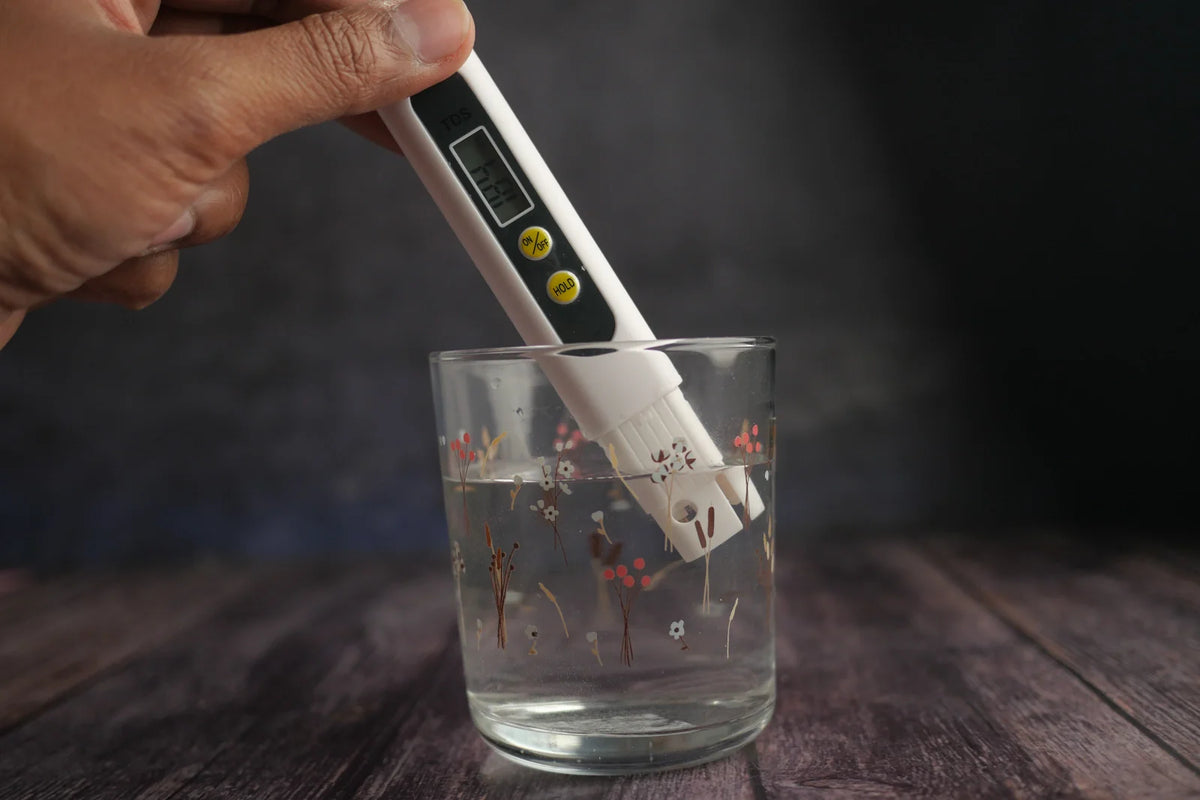
A handheld TDS meter estimates total dissolved solids (TDS in water) through electrical conductivity (EC), providing an indirect measure of the dissolved solids present in your drinking water, which can help you assess drinking water quality with a TDS meter. This method allows people to quickly assess the quality of water present in your drinking water, whether it's from the tap, a water filter system, or an RO water filtration system, helping you understand any issues like water contamination. However, while a TDS meter or a water testing device is useful for estimating how much dissolved, electrically active material is present in the water, it cannot directly tell you what that material is, such as contaminants, or whether the water is safe to drink. To accurately determine the safety and purity of your water, it is important to consider comprehensive water testing kits and resources like the EPA's drinking water regulations and the World Health Organization's water quality guidelines, which address specific contaminants and water safety standards.
What people usually think this means when they use a TDS meter to test water quality
Most people use a TDS meter to determine water quality because they want a quick answer: "Is my water good?" The meter gives an estimate of the dissolved solids in your water, but it doesn’t indicate whether the water systems in place, such as a water filter, have removed harmful contaminants that could make your water safer. Since the TDS meter presents a single number, it’s natural to treat the reading as an assessment of overall water quality.
If you're concerned about water contaminants, it might be time to explore a high-quality under-sink water filter that can target specific pollutants that a TDS meter can’t detect.
Understanding Snapshot: when the ppm intuition works—and when it fails
What people usually believe:
-
Higher ppm = dirtier, more contaminated, less safe.
-
Lower ppm = purer, cleaner, safer.
-
The TDS tester appears to offer a broad assessment of the water’s quality, but it can’t give a complete answer to the question: "What does a TDS meter tell you about your water's safety and purity?" What’s in your water is often more complex than what the meter reflects, and water safety depends on a broader range of factors beyond conductivity, as outlined in the EPA and WHO guidelines.
What’s more accurate:
-
A TDS meter is mainly a conductivity meter that estimates dissolved, charged stuff (ions), giving you an idea of what is present in your drinking water but not detailing the specific contaminants.
-
While it can give you a general sense of water quality, it can't tell you exactly which ions are present, and it misses many important risks that don’t conduct well, such as microbial contamination or chemicals like PFAS.
When intuition works (usually):
-
Comparing the same water source over time (today vs last month).
-
Spotting big changes (a sudden jump can mean something changed).
-
Noticing mineral-heavy water that causes scale or taste changes.
When intuition fails:
-
Judging safety (many dangerous contaminants don’t raise TDS much).
-
Comparing different water types (same ppm can mean totally different chemistry).
-
Assuming “0 ppm” means “no contaminants” (it often just means “very low conductivity”).
“Higher number = worse water quality” (and why that feels true)
This shortcut feels true because it’s often true for things you can notice. Water with more dissolved ions often:
-
tastes “harder” or more mineral,
-
leaves scale on kettles and shower heads,
-
behaves differently with soap.
So when someone sees 350 ppm from the kitchen tap and 25 ppm from a filtered line, it feels like the meter is showing “dirty vs clean.”
The key missing detail is that the meter does not label the dissolved material as 'good' or 'bad.' For instance, a high TDS level might indicate the presence of beneficial minerals like calcium and magnesium (which contribute to hard water), but it could also signal contaminants that require specific filtration systems to remove. A higher number can come from calcium and magnesium (common minerals). It can also come from sodium, chloride, sulfate, or other ions. Those can be harmless at some levels, annoying at others, and risky in certain situations. The number alone doesn’t tell you which story you’re in.
Real-life example: Two homes can both read 400 ppm on their TDS meters. One home has mostly calcium and bicarbonate (causing hard water and scale buildup), while the other has more sodium and chloride (resulting in a salty taste). A higher TDS number doesn’t automatically mean worse water quality—it’s important to understand what is dissolved in the water. For example, high TDS levels in your water could come from minerals like calcium or magnesium, but also from harmful substances like sodium or nitrate, which require different water filtration methods. Is high TDS water safe to drink? Water with high TDS is not automatically unsafe. It depends on the specific ions present, and whether the water contains harmful contaminants that are not detected by the TDS meter.
“Lower number = purer / safer water” (and where that shortcut comes from)
“Lower must be safer” comes from a true idea: removing dissolved ions usually lowers conductivity, and many purification steps reduce conductivity.
But low TDS is not the same thing as “no risk.” Water can have:
-
very low dissolved ions (low TDS),
-
and still contain harmful substances such as lead or bacteria that a TDS meter can't detect. This highlights why relying solely on TDS for water safety can be misleading, even if you have a water filtration system in place.
Also, “low” can mean different things in different contexts:
-
For appliances (less scale), law is often helpful.
-
For taste, extremely low mineral content can taste “flat” to some people.
-
For health and safety, low TDS is not a pass/fail test.
Real-life example: Distilled water reads very low, but that doesn’t tell you whether the container is clean, or whether a separate chemical (that doesn’t conduct much) is present.
“A TDS meter tells me what’s in my drinking water” (the implied promise)
The implied promise is: “This number is basically a full water test.” That’s the biggest mental model error.
A TDS meter can’t tell you:
-
which ions are present,
-
whether the dissolved material is mostly minerals or something else,
-
whether microbes are present,
-
whether non-ionic chemicals are present,
-
whether any specific contaminant is above its safe limit.
It tells you something real, just narrower than people assume: how conductive your water is, converted into an estimated TDS level. This TDS meter reading does not fully account for all contaminants that might be present in your water, such as those that don’t affect conductivity.
Takeaway: A TDS meter is a useful indicator of dissolved ionic content, but it is not a complete measure of safety or ‘what’s in the water,’ as it doesn’t assess contaminants not detected by conductivity.

Where that understanding breaks down
The biggest problems happen when someone uses a TDS meter as a safety verdict, or as proof that filtration removed “contaminants.”
Can a TDS Meter Accurately Determine Water Safety?
Is high TDS water safe to drink? Not directly, as TDS also includes various dissolved solids that might not necessarily be harmful but can still impact the water’s taste and safety.. A TDS meter can give you a general idea of how much dissolved material is in the water, but it won’t tell you whether that material is harmful. For a complete assessment, water isn’t necessarily safe just because its TDS level is low. Many harmful contaminants, such as lead or microbial pathogens, may be present in water even with low TDS readings. As noted by the EPA, safe drinking water standards must account for a wide variety of pollutants and contaminants that a TDS meter cannot detect.
Safety depends on specific risks, and many of those do not show up well in a conductivity-based reading. A TDS meter might notice a big change in dissolved ions, which can be a clue that something changed in the water source or treatment. But it can’t tell you “safe” in the way a targeted contaminant test can.
This is why simple ppm thresholds get misused. People quote “good under X ppm” or “bad over Y ppm.” Those ranges may track taste or scaling risk in many places, but they do not reliably track health risk. A water supply can have moderate TDS and still have a specific contaminant problem. Another supply can have high TDS mainly from benign minerals.
Real-life example: If a city switches disinfectants or adjusts corrosion control, your water’s safety profile can change without a dramatic TDS change. Or the TDS can change while safety stays the same.
A TDS meter measures conductivity, not everything dissolved
This is the key technical boundary.
Inside the meter, two electrodes measure how easily electricity passes through water. Dissolved ions (charged particles) carry that current. The meter measures electrical conductivity (or “EC”) and then applies a conversion factor to display “TDS” in ppm.
So what does the number really represent?
-
It is an estimate of dissolved ionic concentration, not a direct weighing of dissolved residue.
-
It depends on which ions are present because different ions conduct differently.
-
It depends on temperature because conductivity rises as water warms.
If your water has lots of dissolved material that does not form ions (or forms weakly), the reading can stay low even when there is “stuff” in the water.
Real-life example: A solution with mostly sodium chloride will conduct strongly and read higher than a solution with the same mass of a weakly ionizing substance.
What a TDS meter won’t see: non-conductive contaminants and biological risks
Certain contaminants, such as lead, can be present at levels far exceeding legal limits without significantly altering TDS readings. Many non-conductive or biologically harmful substances, like bacteria or microplastics, do not increase conductivity and are therefore undetectable by a TDS meter. A TDS meter is “silent” on many common concerns because they don’t reliably increase conductivity:
-
Microbes: bacteria, viruses, parasites.
-
Many organics: many pesticides, solvents, fuel-related compounds.
-
PFAS (often discussed as “forever chemicals”).
-
Microplastics (not dissolved ions).
-
Some dissolved gases and many taste/odor compounds.
Even some metals can be present at harmful levels and still not move the TDS number much, because legal limits for metals are often extremely low compared to the amount needed to noticeably change conductivity. In practice, a metal might need to be many times above its limit before it meaningfully affects a simple TDS reading.
Real-life example: Water can read “nice and low” after a treatment step, and still be unsafe due to microbial contamination from a storage tank or plumbing issue. The TDS meter has no way to detect that.
Why “high TDS reading indicates contamination” can be wrong (beneficial minerals vs harmful ions)
“High TDS” can mean mineral-rich groundwater (often calcium, magnesium, bicarbonate), salty intrusion (sodium, chloride), fertilizer-related ions (nitrate), or industrial and natural sources of sulfate, fluoride, etc. The TDS meter will show a high TDS level, but it won’t tell you whether these dissolved solids are beneficial or harmful.
The meter cannot separate these. So “high” is not automatically “contaminated.” It might be:
-
mostly beneficial minerals (nutritionally minor, but can affect taste and scaling),
-
mostly nuisance ions (taste, corrosion, staining),
-
or a mix that includes ions of health concern.
This is where people get trapped: they treat the TDS number as a moral label (“clean vs dirty”) instead of a composition clue (“more ions are present, but which ones?”).
Real-life example: A well can have high TDS due to hard water minerals like calcium and magnesium and still be microbiologically safe. However, a low-TDS source could contain harmful contaminants such as nitrates or pesticides that a TDS meter doesn’t detect.
Visual: boundary diagram—“TDS applies here” vs “TDS is silent here”
| What a TDS Meter Can "Hear" (Usually) | What a TDS Meter Is Mostly "Silent" On |
| Dissolved ions that carry charge: | Not reliably conductive or not ions: |
| - Calcium, magnesium (hardness) | - Bacteria / viruses / parasites |
| - Sodium, potassium | - Many pesticides, solvents, PFAS |
| - Chloride, sulfate, bicarbonate | - Microplastics |
| - Nitrate (as an ion) | - Many taste/odor organics |
| - Some toxins at harmful-but-low levels |
Takeaway: A TDS meter can flag “more or fewer ions,” but it cannot confirm safety or detect many important contaminant categories.

Key distinctions or conditions people miss
Even when people understand “it measures dissolved solids,” they often miss the hidden assumptions inside that statement.
“TDS” (a residue idea) vs “TDS meter reading” (a conductivity estimate)
True “total dissolved solids” can be measured by evaporating water and weighing what’s left (a residue method). That’s closer to the literal meaning of TDS.
A handheld TDS meter does something different:
-
Measures conductivity.
-
Converts conductivity to “TDS” using a factor (because people like ppm).
So the meter’s ppm is not a direct mass measurement. It’s a model output.
This matters most when:
-
you compare readings across different water types (different ionic mixes),
-
you compare different meters (different conversion factors),
-
you assume the ppm equals “mg/L of everything dissolved.”
Real-life example: Two waters can have the same true residue but different conductivity, because one has ions that carry current well and the other has more weakly conducting dissolved material.
Can a TDS Meter Reveal What’s Really in Your Water?
It can hint, but it cannot determine.
A TDS reading answers: “How conductive is this water?” That can suggest:
-
mineral-rich water (often higher),
-
highly purified water (often lower),
-
a change in the source or treatment (a jump or drop).
But it cannot tell you:
-
whether the ions are mostly calcium vs sodium,
-
whether nitrate is high,
-
whether lead is present,
-
whether the issue is microbial.
If you want to know “what’s in the water,” you need either:
-
a lab test, or
-
targeted field tests for specific parameters (like nitrate, hardness, chlorine, etc.).
Real-life example: If your TDS rises from 180 to 320 ppm, the correct next thought is not “unsafe.” It’s “something changed—what ions increased, and why?”
TDS vs water hardness: overlapping signals, different meanings (scale, soap, taste)
People often mix up TDS with hardness because both relate to minerals and both can affect taste and scaling.
-
Hardness is mainly about calcium and magnesium (the ions that form scale and reduce soap lather).
-
TDS includes hardness ions plus many other dissolved ions.
So:
-
You can have high TDS and low hardness (for example, lots of sodium and chloride).
-
You can have high hardness with moderate TDS (hardness minerals dominate, but not much else is present).
-
A water softener can lower hardness but not necessarily lower TDS (more on that later).
Real-life example: If your shower glass spots got worse but your TDS didn’t change much, hardness may have changed slightly, or your cleaning/evaporation conditions changed. TDS won’t always track the problem you see.
TDS meter accuracy: conversion factors, temperature effects, calibration limits
A common surprise: two meters dipped into the same cup show different ppm.
That can happen for several reasons:
-
Conversion factor differences: Many meters use a factor (often around 0.5–0.7) to convert conductivity to “TDS.” Different default factors produce different ppm for the same conductivity.
-
Temperature: Conductivity changes with temperature. Some meters compensate; some do it imperfectly; some not at all. If one sample is colder, it may read lower.
-
Calibration and drift: Electrodes age and get dirty. Small residues on the probe can change readings.
-
Water composition: Even with perfect conductivity measurement, ppm is still an estimate. If your water’s ionic mix doesn’t match the meter’s assumed model, the “TDS” number is less faithful.
How to think about accuracy: a TDS meter is often better for tracking relative changes (up/down) than for determining exact composition, especially when you want to assess the dissolved solids in your water over time.
Real-life example: If your RO water reads 18 ppm one day and 25 ppm the next, that difference may be real, or it may be temperature and meter variability. Trends matter more than single points.
Takeaway: Treat the ppm as a conductivity-based estimate, not a precise inventory of dissolved material.
Real-world situations that change outcomes
Even if you read the meter correctly, the same number can mean different things depending on the water source and treatment.
Why TDS Meter Readings Can Differ Across Water Sources?
Because “TDS” is a bucket that mixes many different ions. Different sources fill the bucket with different stuff.
What changes the meaning of a reading:
-
geology (limestone vs granite regions),
-
salt intrusion near coasts,
-
fertilizers and runoff,
-
water treatment choices,
-
plumbing materials and corrosion control,
-
seasonal changes in source blending.
So the meter is not lying. It’s just answering a narrower question than people want it to answer.
Real-life example: A lake-sourced city supply and a deep-well supply can both read 250 ppm, but have very different hardness, alkalinity, and corrosion behavior.
Tap water vs well water vs bottled: the same ppm can imply very different composition
Here’s the trap: people compare numbers across types and assume the same meaning.
-
Tap water: TDS often reflects treatment plus the mineral profile of the source. It might be stable, or it might shift if the utility blends sources.
-
Well water: TDS can be higher because groundwater dissolves minerals over time. High TDS here often means hardness, but it could also mean specific ions (like nitrate) depending on land use.
-
Bottled water: Some bottled waters are mineralized on purpose, so a higher TDS can simply mean “more minerals,” not “worse.”
So “300 ppm” is not one story. It’s many possible stories.
Real-life example: Someone switches from tap (220 ppm) to a mineral water (350 ppm) and assumes the bottled water is “dirtier.” But it may just be more mineral content.
RO water tds level: why reverse osmosis often reads low, and when “not zero” isn’t failure
Reverse osmosis (RO) filtration systems often reduce dissolved solids significantly, so RO water TDS level usually reads much lower than the feed water. But not zero is normal; a small reading still reflects the presence of certain ions that the RO system can’t fully remove.
Reasons RO water may not read 0 ppm:
-
RO membranes don’t remove 100% of ions.
-
A storage tank can pick up small amounts of dissolved material.
-
Some systems add minerals after treatment (remineralization).
-
CO₂ from air dissolves into water and can shift conductivity slightly (especially in very low-TDS water).
-
Meter limitations: at very low conductivity, small errors become a bigger percentage.
So the right model is: RO tends to lower dissolved ions a lot, but a small reading does not automatically mean “membrane failure.”
Real-life example: If your tap is 300 ppm and RO is 20 ppm, that indicates strong ion reduction. If RO drifts from 20 to 40 ppm, that’s a change worth noticing, but not instant proof of unsafe water.
Water softeners and “higher TDS”: when treatment changes ions without making water “dirtier”
Water filtration systems such as water softeners can replace calcium and magnesium (which contribute to hard water) with sodium, leading to a higher TDS level without necessarily making the water "dirtier." This doesn’t always mean the water is unsafe—it just means the ion composition has changed. A water softener often replaces calcium and magnesium (responsible for hard water) with sodium (or sometimes potassium), which reduces scale buildup and improves soap lathering. However, this can result in a higher TDS reading, even though the water may actually be 'softer' and more pleasant to use. That can:
-
reduce scale,
-
improve soap lather,
-
change taste.
But it can also leave TDS similar or even slightly higher, because you still have dissolved ions—just a different set.
This confuses people because they expect “treatment” to always push TDS down. Softening is not mainly designed to reduce total ions; it’s designed to change which ions are present.
Real-life example: After softening, your TDS may remain the same or even slightly higher (e.g., 350 ppm), but the water becomes less likely to form scale. Water softeners don't always lower TDS; they change the composition of ions in the water.
Visual: if–then flow for interpreting a tds reading (taste/scale clues vs safety unknowns)
| Situation | Likely Cause | Next Step |
| If your TDS reading changes suddenly (up or down) | - Did the source change? - Did treatment change? - Plumbing work? - Seasonal shift? | Identify which ions/risks (hardness test, nitrate test, utility report, lab test). |
| If your TDS is high and you see scale/soap problems | Hardness minerals are a big part of it (but not guaranteed). | Test hardness specifically. |
| If your TDS is high and water tastes salty/bitter | Sodium/chloride/sulfate mix. | Check utility report or lab ion panel. |
| If your TDS is low | Expect: less mineral taste, less scale. | But safety is still unknown. Use appropriate contaminant tests for your risks (microbes, metals, nitrate, etc.). |
Takeaway: The meaning of a TDS number depends on water source and treatment; use it as a clue, not a universal grade.

What this understanding implies for later decisions
Once you stop treating the meter as a “safety detector,” it becomes more useful, not less. What’s in your water is much more complex than what a TDS meter can indicate. A low TDS reading doesn’t guarantee purity, as many non-conductive contaminants may still be present. For complete water safety, it is important to use additional testing methods, including specialized tests for metals, microbes, and other pollutants, as described in the EPA’s water safety guidelines.
What a TDS meter is genuinely useful for: trends, baselines, and sudden changes (not verdicts)
A good use of a TDS meter is pattern tracking:
-
Establish a baseline for your usual water (tap, filtered, RO).
-
Watch for sudden shifts that suggest a change in source water, treatment, or equipment performance.
-
Compare “before vs after” in the same setup to see whether dissolved ions changed a lot.
What it should not be used for:
-
declaring “safe/unsafe,”
-
proving that all contaminants are removed,
-
assuming low ppm means “no lead,” “no microbes,” or “no chemicals.”
Real-life example: If your tap has been 180–210 ppm for a year and suddenly becomes 350 ppm for a week, that’s useful information. It’s a prompt to ask, “What changed?” not a conclusion that the water is now unsafe.
What “low tds vs pure water” implies: purity claims, remineralization, and taste expectations
People say “low TDS equals pure water,” but “pure” depends on what you mean.
-
Low TDS usually means low dissolved ions.
-
Purity could mean low ions, low microbes, low organics, low metals, and more.
So low TDS supports a narrow kind of purity (ionic). It does not guarantee broad purity.
Taste is another piece. Very low mineral water can taste flat. Some people prefer that; others prefer some mineral content. That’s not a safety issue by itself, but it explains why two “clean” waters can taste different.
Real-life example: Two waters both test safe by proper standards. One reads 30 ppm and tastes flat; the other reads 180 ppm and tastes “crisp.” The TDS meter mostly describes minerals, not overall cleanliness.
How to avoid relying on a TDS meter as a water test for contaminants in your water
A simple rule helps: TDS is not a contaminant panel.
To avoid false confidence:
-
Use the TDS meter for what it measures (ionic changes).
-
Use targeted testing for what it cannot measure (metals, microbes, many chemicals).
What targeted testing looks like depends on context:
-
Private well: periodic lab tests for microbes and key chemicals are common because there is no utility doing it for you.
-
Municipal tap: use the utility’s published water quality report as a starting point, but remember it describes the system, not always your exact plumbing.
-
After plumbing work or in older buildings: metals testing can be more relevant, because plumbing can be a source.
Real-life example: If you’re worried about lead, a low TDS reading cannot reassure you. Lead risk is about corrosion and plumbing materials, and it can be present at levels that don’t move TDS much.
Turning a ppm number into the right next question: “Which solids?” “Which risks?” “Which context?”
A TDS reading becomes useful when it triggers better questions:
-
Which solids? Is it hardness minerals, sodium salts, or something else? (This is where hardness tests or an ion panel helps.)
-
Which risks? Are you worried about microbes, metals, nitrate, or specific chemicals? A TDS meter can’t choose for you.
-
Which context? Tap vs well, RO vs softened, seasonal changes, and your building’s plumbing all change what the number means.
When you ask those three questions, the TDS meter stops being a judge and becomes what it really is: a quick trend tool.
Takeaway: Use TDS readings to ask better follow-up questions, not to make final claims about safety or “purity.”
Common Misconceptions (mini recap)
-
“A TDS meter tells me if water is safe.” → It mainly reflects conductivity from ions; safety needs targeted tests.
-
“High TDS means contamination.” → It can be mostly normal minerals; you need to know which ions.
-
“Low TDS means pure.” → It often means low minerals, but many hazards don’t raise TDS.
-
“The ppm is an exact total of dissolved solids.” → It’s an estimate based on conductivity and a conversion factor.
-
“Two meters should match exactly.” → Different factors, temperature, and calibration can cause differences.

FAQs
1. Can high TDS water be safe to drink?
Yes, high TDS can be safe to drink, as it primarily indicates more dissolved ions. These ions may be harmless minerals like calcium and magnesium, which affect taste and scaling. However, high TDS can also include undesirable ions like sodium or nitrate, so the safety depends on the specific ions present.
2. Is low TDS water the same as distilled or "pure" water?
Not always. Low TDS often means fewer dissolved ions, which is common in distilled water, but "pure" water encompasses more than just low mineral content. It also involves the absence of harmful microbes and chemicals. Low TDS doesn’t guarantee complete purity.
3. Why does my RO water have a TDS reading that isn't zero?
Reverse osmosis (RO) typically reduces most ions but doesn’t remove them entirely, leading to small TDS readings. Other factors, like CO₂ from air or minor contaminants from the storage tank, may cause slight conductivity. A small non-zero reading is normal and doesn’t necessarily indicate a problem.
4. How accurate is a TDS meter in ppm?
TDS meters estimate dissolved solids based on conductivity, and their accuracy varies due to factors like calibration, ion composition, and temperature. This means two meters might give different readings for the same water, so it’s often better to track trends over exact numbers.
5. Can a TDS meter detect lead, bacteria, or pesticides?
No, TDS meters are not designed to detect lead, bacteria, or pesticides. These substances don’t significantly affect conductivity. For concerns about these risks, specific tests are needed, as TDS meters primarily measure ionic content, not contaminants that don’t conduct electricity.
References