


Filtered tap water can be used as a starting water source for some fish tanks, but “filtered” does not automatically mean aquarium-ready. The water may still contain chlorine or chloramine, and its pH, hardness, temperature, and mineral content may not match the needs of your fish.
Before adding household water to an aquarium, identify how your utility disinfects the water, review what the household filter actually reduces, and prepare the water for the specific fish, plants, or other aquatic animals in the tank.
A drinking-water filter and an aquarium filter also perform different jobs. A household filter treats the incoming water source, while the aquarium filter circulates water inside the tank, captures debris, and supports the biological processes that manage fish waste.
This guide answers the practical questions aquarium owners commonly ask:
- Can filtered tap water go directly into a fish tank?
- What is the difference between chlorine and chloramine?
- Does a faucet filter replace aquarium water conditioner?
- Can reverse-osmosis water be used for freshwater or saltwater fish?
- Which water parameters should be checked before a water change?
Looking for a Filter for Everyday Drinking Water?
Aquarium water requires species-specific conditioning and testing. For normal drinking and cooking needs, compare point-of-use filters designed for compatible kitchen faucets.
Compare Faucet Water FiltersWhy Untreated Tap Water Can Be a Problem for Fish
Public tap water is treated to make it suitable for people to drink, but that does not mean it can always be added directly to an aquarium. Water utilities commonly use chlorine or chloramine to control germs in the distribution system. Fish and other aquatic animals absorb substances from the surrounding water through their gills and body surfaces, making them more sensitive to these disinfectants than people.
Tap water can also differ in pH, hardness, alkalinity, temperature, and dissolved mineral content. These differences matter because fish species are adapted to different water conditions. A sudden change may be stressful even when the water looks clear and is considered suitable for human consumption.
Untreated tap water is therefore not automatically bad for an aquarium. In many homes, it can be a practical source water after disinfectants have been properly neutralized and the important parameters have been checked.
The correct preparation depends on:
- whether the utility uses chlorine or chloramine;
- whether the aquarium is freshwater, saltwater, or brackish;
- the species being kept;
- the tank’s existing temperature and water chemistry;
- the verified performance of any household water filter;
- the amount of water being replaced.
Chlorine vs Chloramine: Why the Difference Matters
Chlorine and chloramine are both used to disinfect public drinking water, but they do not behave the same way when aquarium water is prepared.
Free Chlorine
Free chlorine may gradually dissipate when water is left uncovered, although the time required varies. Simply allowing water to sit is not the most controlled method because the starting concentration, temperature, container size, and water movement can all affect the result.
An aquarium conditioner labeled for chlorine provides a more predictable preparation method when used according to its instructions.
Chloramine
Chloramine is more persistent than free chlorine. It does not reliably disappear after water sits overnight, and boiling is not an appropriate general aquarium-treatment method.
Water containing chloramine normally requires an aquarium conditioner specifically labeled for chloramine or another treatment method verified for that purpose. Do not assume that a normal household faucet, pitcher, or refrigerator filter removes chloramine.
Important: Some chloramine treatments neutralize the chlorine portion while leaving ammonia that must then be managed by the aquarium’s established biological filter. Follow the conditioner instructions and monitor ammonia when appropriate.
How to Check Which Disinfectant Your Utility Uses
- Review the utility’s annual water-quality report.
- Search the utility website for chlorine or chloramine.
- Contact the utility if the information is unclear.
- Ask whether its disinfectant changes seasonally.
Household Water Filters and Aquarium Filters Do Different Jobs
The phrase “fish tank filter” can refer to two very different types of filtration. Confusing them can lead to incorrect water preparation and poor aquarium maintenance.
Household Drinking-Water Filters
A household filter treats water before it enters the aquarium. Depending on the exact model, it may reduce sediment, free-chlorine taste and odor, selected metals, dissolved solids, or other substances listed in the product specifications.
Performance must be checked by model. A filter that reduces free chlorine does not necessarily reduce chloramine, ammonia, nitrate, hardness, alkalinity, or total dissolved solids.
Aquarium Filters
An aquarium filter works on water already circulating inside the tank. It may provide three types of filtration:
- Mechanical filtration: captures suspended debris, uneaten food, and other particles.
- Biological filtration: provides surfaces for microorganisms involved in converting ammonia to nitrite and then nitrate.
- Chemical filtration: uses media such as activated carbon for selected substances.
Preparing filtered source water does not remove the need for an established aquarium filter. Likewise, an aquarium filter does not make untreated chlorinated or chloraminated tap water safe the moment it enters the tank.

Can Faucet-Filtered Water Go Directly Into a Fish Tank?
Not necessarily. Whether faucet-filtered water is suitable depends on what the filter is designed and verified to reduce.
A faucet filter may help with normal drinking-water concerns such as free-chlorine taste, odor, or sediment. It should not automatically be assumed to:
- remove chloramine;
- neutralize ammonia;
- remove every heavy metal;
- lower hardness or alkalinity;
- stabilize aquarium pH;
- provide minerals required by a particular fish species;
- replace an aquarium water conditioner;
- replace the tank’s biological filtration.
Before using faucet-filtered water:
- Check whether the utility uses chlorine or chloramine.
- Review the exact reduction claims for the filter model.
- Treat any remaining disinfectant with a suitable aquarium conditioner.
- Match the replacement water temperature to the tank.
- Test the relevant parameters before making a large water change.
Faucet-filtered water may be a useful starting point, but aquarium readiness depends on the final prepared water—not simply on whether the water passed through a filter.
Tap Water, Faucet-Filtered Water, and RO Water Compared
| Water source | What it may offer | What still needs attention |
|---|---|---|
| Untreated tap water | Convenient and may contain minerals suitable for some local freshwater setups. | Chlorine or chloramine must be addressed. Check temperature, pH, hardness, and alkalinity. |
| Faucet-filtered water | May reduce sediment, taste, odor, or other substances listed for the exact filter. | Do not assume chloramine, ammonia, hardness, alkalinity, or TDS has been addressed. |
| Reverse-osmosis water | Provides a lower-mineral starting point by reducing many dissolved substances. | May require controlled remineralization, mixing, buffering, or marine salt before use. |
| Bottled water | May be useful during temporary problems with the household water supply. | Spring, purified, distilled, and RO water have different mineral profiles and are not interchangeable. |
| Aquarium-conditioned water | Tap or filtered water prepared for a specific aquarium. | Must still match the species requirements for temperature, pH, hardness, alkalinity, and salinity. |
No single source is best for every aquarium. Some freshwater fish can do well in properly conditioned local tap water. Other setups may require mixed, remineralized, softened, or reverse-osmosis water. Marine aquariums require an appropriate salt mix and controlled salinity rather than untreated freshwater alone.
Base the choice on the fish species and measured water conditions, not only on tank size or the advertised output capacity of a household filtration system.
Can You Use Reverse-Osmosis Water in a Fish Tank?
Reverse-osmosis water can be useful in some freshwater and marine aquarium setups because it provides a lower-mineral starting point. However, pure or very low-mineral RO water should not automatically be added directly to every tank.
Removing dissolved substances also lowers hardness, alkalinity, and buffering capacity. Depending on the fish and aquarium setup, RO water may need to be:
- mixed with properly prepared tap water;
- remineralized with a controlled aquarium product;
- combined with an appropriate marine salt mix;
- adjusted and tested for pH, hardness, alkalinity, conductivity, or salinity.
The target conditions should be based on the species being kept. A drinking-water remineralization cartridge should not be treated as proof that the final water contains the correct calcium, magnesium, alkalinity, or pH for an aquarium unless aquarium-specific information is provided.
Stability matters as much as any individual test result. Sudden changes in temperature, pH, hardness, or dissolved mineral content may stress fish even when the replacement water is otherwise clean.

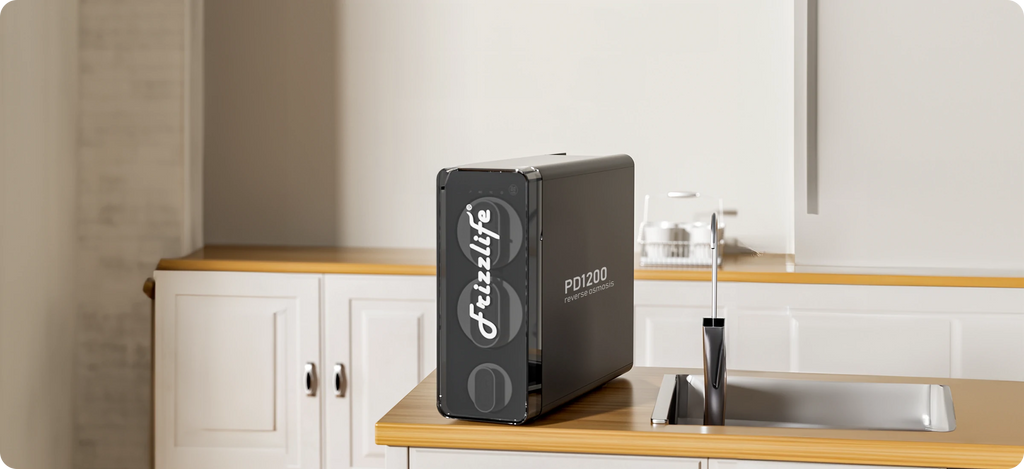
A household RO system can produce source water for further aquarium preparation, but its flow rate, daily production capacity, TDS display, or drinking-water remineralization stage does not by itself confirm that the water is ready for fish.

High-capacity household systems may be useful when a home needs larger amounts of drinking or preparation water. Aquarium suitability still depends on controlled conditioning, mineral adjustment, testing, and the requirements of the species.
Do not choose a household water system only because the aquarium is large. Calculate the normal water-change volume and preparation schedule, then select source-water equipment that can produce enough water while still allowing time for conditioning, mixing, temperature adjustment, and testing.
Need Point-of-Use Filtration for Drinking and Cooking?
Aquarium conditioning is a separate process. For normal household tap-water improvement, compare faucet compatibility, verified filtration claims, flow, and replacement requirements.
Explore Faucet Water FiltersHow to Prepare Tap or Filtered Water for a Fish Tank
Use a repeatable preparation process rather than adding household water directly to the aquarium.
1. Identify the Water Source
Determine whether you are using untreated tap water, faucet-filtered water, reverse-osmosis water, private-well water, or bottled water. Each source has different preparation needs.
2. Check for Chlorine or Chloramine
Review the utility report and the household filter specifications. If either disinfectant may remain, use an aquarium conditioner labeled for the specific disinfectant and follow the dosage instructions.
3. Test the Important Parameters
The relevant tests depend on the aquarium, but commonly include:
- temperature;
- pH;
- general hardness and carbonate hardness for freshwater systems;
- alkalinity or buffering capacity;
- salinity for marine or brackish systems;
- ammonia;
- nitrite;
- nitrate.
4. Match the Replacement Water to the Tank
Avoid sudden changes in temperature or chemistry. Prepare and test replacement water before adding it, especially when using RO water, changing water sources, or modifying the mineral content.
5. Add the Water Gradually
Avoid pouring untreated water directly onto fish. Add prepared water in a controlled way and follow a water-change routine appropriate for the tank size and species.
6. Keep the Aquarium Filter Running
Source-water preparation does not replace mechanical or biological filtration. Maintain the aquarium filter according to its instructions. Avoid cleaning all biological media at the same time or rinsing it in untreated chlorinated water.
7. Test Again After the Water Change
Watch for unusual fish behavior and check the parameters most relevant to the system, especially after changing the source water, conditioner, salt mix, or remineralization method.
Does Tank Size Affect Water Preparation?
Tank size affects how much replacement water must be prepared and how quickly a mistake may change the aquarium’s chemistry. In a small aquarium, an incorrect conditioner dose or a sudden pH and temperature change may affect a larger portion of the total water volume.
However, tank size alone does not determine which household drinking-water system is appropriate. A larger aquarium does not automatically require a higher-output RO model.
Consider:
- the normal water-change volume;
- the frequency of water changes;
- storage space for prepared water;
- whether the setup is freshwater, saltwater, or brackish;
- the target pH, hardness, alkalinity, conductivity, or salinity;
- whether remineralization or salt mixing is required;
- how long the replacement water needs for preparation and temperature adjustment.
Choose source-water equipment based on the volume and chemistry of prepared water required—not simply the aquarium’s total capacity.
Common Mistakes When Using Filtered Water for an Aquarium
Assuming “Filtered” Means Dechlorinated
A household filter may reduce free chlorine but not chloramine. Always review the exact product claim and use an appropriate aquarium conditioner when necessary.
Confusing a Household Filter With an Aquarium Filter
A drinking-water filter treats incoming water. It does not replace the circulation, mechanical filtration, or biological filtration required inside the tank.
Adding Pure RO Water Without Checking Minerals
Very low-mineral water may need controlled remineralization, mixing, buffering, or a marine salt mix before use.
Matching Water Only by Appearance
Clear water may still contain disinfectants or have unsuitable temperature, pH, hardness, alkalinity, ammonia, or nitrite levels.
Changing the Water Source Too Quickly
Switching from tap water to RO water—or from one mineral profile to another—can create abrupt changes in aquarium chemistry. Test the new water and make transitions carefully.
Assuming All Fish Need the Same Water
Water suitable for one freshwater species may not suit another, and freshwater prepared for a community tank will not automatically suit marine or brackish animals.
Final Takeaways: Prepare the Water, Not Just the Filter
Filtered water can be a useful starting source for a fish tank, but it is not automatically ready to use. The correct process depends on what remains in the water and what the aquarium inhabitants require.
Before adding tap or filtered water:
- identify whether the utility uses chlorine or chloramine;
- verify what the household filter actually reduces;
- use an appropriate aquarium conditioner when needed;
- match the temperature and relevant water chemistry;
- maintain the aquarium’s mechanical and biological filtration;
- monitor ammonia, nitrite, nitrate, and other species-specific parameters.
Faucet-filtered water, conditioned tap water, and reverse-osmosis water can each have a role. The most suitable option is the one that has been properly prepared and tested for the specific aquarium—not simply water labeled “filtered.”
FAQs
1. Can I Put Filtered Tap Water Directly Into a Fish Tank?
Not automatically. Check whether chlorine or chloramine remains, whether the filter changes hardness or mineral content, and whether the temperature and pH match the aquarium. An aquarium conditioner may still be required.
2. Does a Faucet Water Filter Remove Chlorine for Fish?
Some faucet filters reduce free chlorine, but performance varies by model. Do not assume the filter also removes chloramine. Review the exact reduction claims and use an aquarium conditioner when required.
3. Can I Leave Tap Water Out Overnight Before Adding It to an Aquarium?
Letting water stand may reduce some free chlorine, but it does not reliably remove chloramine. Because utilities may use chloramine or change disinfectants, an aquarium conditioner labeled for the relevant disinfectant provides a more controlled approach.
4. Can I Use RO Water for Freshwater Fish?
Sometimes, but very low-mineral RO water may need to be mixed or remineralized. The correct hardness, alkalinity, pH, and mineral content depend on the fish species. Test the prepared water before use.
5. Is Aquarium Filtration the Same as Drinking-Water Filtration?
No. Drinking-water filtration treats water before it enters the tank. Aquarium filtration circulates tank water, captures debris, and supports biological processes that manage ammonia and nitrite.
6. Does Filtered Water Prevent Algae?
Not by itself. Algae growth can be influenced by light, nutrients, feeding, maintenance, plants, and source-water chemistry. A household filter may change some source-water components, but it is not a complete algae-control solution.
7. Can Bottled Water Be Used in a Fish Tank?
It depends on the type and mineral profile. Spring water, purified water, distilled water, and RO water can have very different hardness and buffering capacity. Check the label and test the water rather than assuming all bottled water is suitable.
8. Do I Still Need an Aquarium Filter if I Use Filtered Water?
Yes. Prepared source water does not remove waste produced after fish enter the tank. An established aquarium filter is still needed for circulation, debris control, and biological filtration.
Related Guides
Compare Faucet Filters for Everyday Drinking Water
Faucet water filters are intended for household drinking and cooking needs—not as a replacement for aquarium conditioning, testing, or biological filtration.
View Faucet Water Filters