Arsenic in drinking water cannot be detected by taste, smell, or appearance, which makes it a hidden risk for many households using private wells or groundwater sources. Even when water looks clean and tastes normal, arsenic levels may still exceed safe limits, which is why testing is the only reliable way to confirm exposure.
If you are trying to understand how arsenic affects your water safety and what filtration options actually work, start with decision guide and direct system selection:
Worried you might “taste” arsenic in your water or food? You’re not alone. Many people search for the taste or smell of arsenic as a warning sign. Here’s the key point up front: you cannot detect arsenic by taste, smell, or sight at levels that matter for health. Water can be crystal clear, taste normal, and still contain arsenic at levels that raise the risk of cancer and other diseases. Only certified testing can tell you if arsenic is present.
Does arsenic have a taste? Does arsenic taste like almonds? All questions will be answered in this guide. It gives the quick answer and essential numbers first, then explains why arsenic taste is not a useful signal, what symptoms look like in real poisoning, how to test well water or tap water, how to reduce exposure with the right water treatment, and which myths to stop believing. If your water tastes fine, it can still contain arsenic—so learn what to test, what results mean, and which treatments work.
Arsenic taste: quick answer and key facts
Direct answer: arsenic is tasteless and odorless in water
Arsenic in drinking water has no reliable taste or odor. You cannot tell if your water contains arsenic by drinking it, smelling it, or looking at it (
WHO, 2022). Even at low levels of arsenic that increase long‑term health risks, there is no sensory warning. The takeaway is simple: rely on testing, not taste.
Numbers that matter for drinking water
Below are the most important numbers to keep in mind when you think about arsenic in drinking water and safety. These values guide public health actions, water treatment choices, and what your results mean for your home.
| Item |
Number |
Notes |
| EPA drinking water standard (MCL) |
10 micrograms per liter (µg/L) = 10 parts per billion (ppb) |
Applies to public water systems in the U.S. |
| Some states’ benchmark (e.g., NJ, NH) |
5 µg/L (5 ppb) |
Stricter standard or guidance in some states |
| WHO guideline |
10 µg/L (10 ppb) |
Global guideline value |
| Sensory detection by people |
No reliable threshold |
Arsenic is effectively tasteless/odorless at environmental levels |
| Bangladesh exposure |
Tens of millions affected |
Detection requires testing; water often tastes normal |
Health effects can occur from long‑term exposure at low ppb levels (
NIEHS, 2025). There is no taste or smell to warn you.
What is arsenic? Types, sources, and exposure pathways
Arsenic is a naturally occurring mineral found in rocks and soil. Weathering and natural sources can release it into groundwater, and human activities like mining, smelting, and past pesticide use can add to the problem. People are exposed mainly by ingestion of water and food.
Inorganic vs organic arsenic: why it matters
Arsenic comes in different forms of arsenic, called species. This matters because some forms are much more toxic than others.
- In water, inorganic arsenic is the main concern. It appears mainly as two forms: arsenite (As(III)) and arsenate (As(V)). These are the forms linked to increased risk of cancer, diabetes, and cardiovascular disease in long‑term exposure (American Cancer Society, 2023). Arsenate (As(V)) is a negatively charged oxyanion in many waters, while arsenite (As(III)) is often uncharged and harder to remove.
- In many foods, especially seafood, arsenic can be present in organic forms (such as arsenobetaine) that are less toxic. But rice and some juices may contain inorganic arsenic, which is more concerning.
Common sources: water, food, and industry
Most concern for arsenic exposure comes from:
- Drinking water from private wells in areas with arsenic‑rich geology. Unlike the public water supply, private wells are not regulated by the EPA, so owners should have water tested.
- Certain foods, like rice and rice‑based foods, because rice grown in flooded fields can take up arsenic from soil and water. Some shellfish and juices can contribute small amounts too.
- Industrial or legacy contamination from pesticide production and use, wood preservative sites, and smelting. These can leach into groundwater and affect local drinking water source areas.
Global and local hotspots
Arsenic is found around the world. Some hotspots include parts of Bangladesh, India, and Latin America. In the U.S., elevated arsenic in groundwater is common in parts of the West and Northeast. Even within a single county, one well can be clean while a neighbor’s has high levels of arsenic. This patchy pattern is why well water test schedules matter.
Why you can’t taste arsenic at real‑world levels
Many contaminants warn us with a bad taste or odor. Chlorine, for example, can smell like a swimming pool. Iron can add a metallic taste or stain sinks. Arsenic is different. At typical levels of arsenic in drinking water, there is no smell of arsenic, no change in color, and no characteristic flavor.
Chemistry basics: speciation and solubility
In oxygen‑rich water, arsenic often appears as arsenate (As(V)). In low‑oxygen (reducing) groundwater, arsenite (As(III)) may dominate. Both are soluble at drinking water pH. They do not make water change color, and they do not add a reliable taste or odor—even when arsenic levels exceed health standards.
People sometimes ask, “What color is arsenic?” Elemental arsenic is a gray metallic solid, but that’s not what’s in your tap. In water, arsenic exists as dissolved ions or molecules, so the water remains clear. That’s why arsenic is usually called an “invisible” contaminant.
Sensory thresholds vs hazardous concentrations
Our senses are poor tools for detecting trace contaminants. Risk from arsenic begins in the ppb range, also written as micrograms per liter. At those low levels, there is no taste or odor. Even at higher levels, any odd taste in water usually comes from other minerals, not arsenic itself.
| Concentration in water |
Human taste/smell? |
Health context |
| 0–10 ppb |
No |
Meets the U.S. drinking water standard for public systems (EPA). Some experts aim even lower when feasible. |
| 10–50 ppb |
No |
Above the EPA MCL; linked to increased long‑term health risks. |
| >50 ppb |
No reliable taste |
Still often no sensory change. Any off‑tastes are more likely from iron, manganese, or sulfur, not arsenic. |
The key idea: hazardous concentrations are far below human sensory thresholds. So you can’t taste your way to safety.
What to Do If You Suspect Arsenic in Your Water
Since arsenic cannot be detected by taste or smell, the next step is always testing and choosing a verified treatment system based on results. Reverse osmosis systems are commonly used for point-of-use arsenic reduction in drinking water applications.
Compare Arsenic Filter Options →
Recommended RO Systems
Compare Reverse Osmosis Systems for Drinking Water Safety
Reverse osmosis systems are commonly used for arsenic-related water concerns because they provide consistent multi-contaminant reduction when properly maintained and matched to household water conditions.
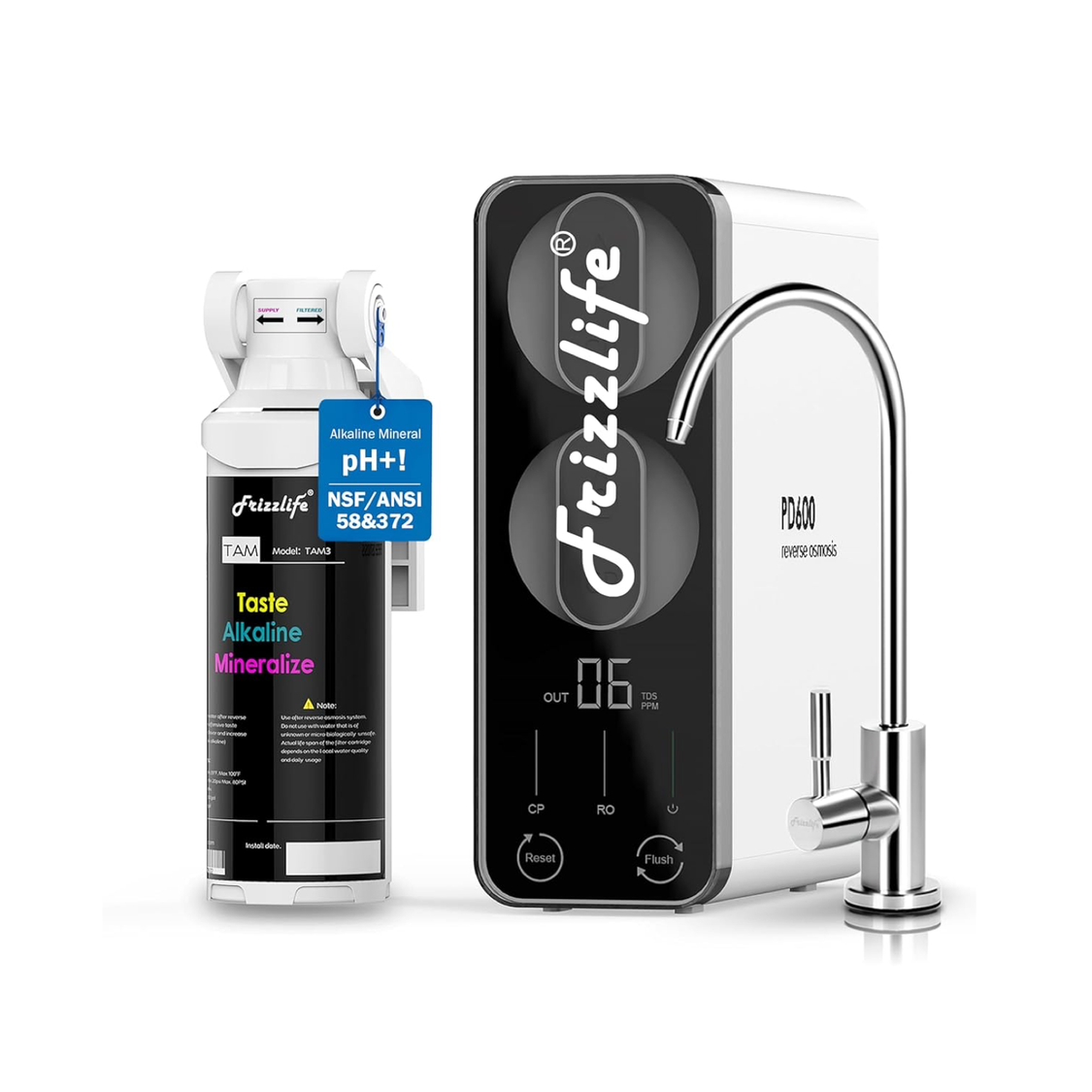
PD600 RO System
A balanced under-sink reverse osmosis system designed for everyday drinking and cooking water, suitable for households seeking reliable baseline filtration performance.
View PD600 Details →
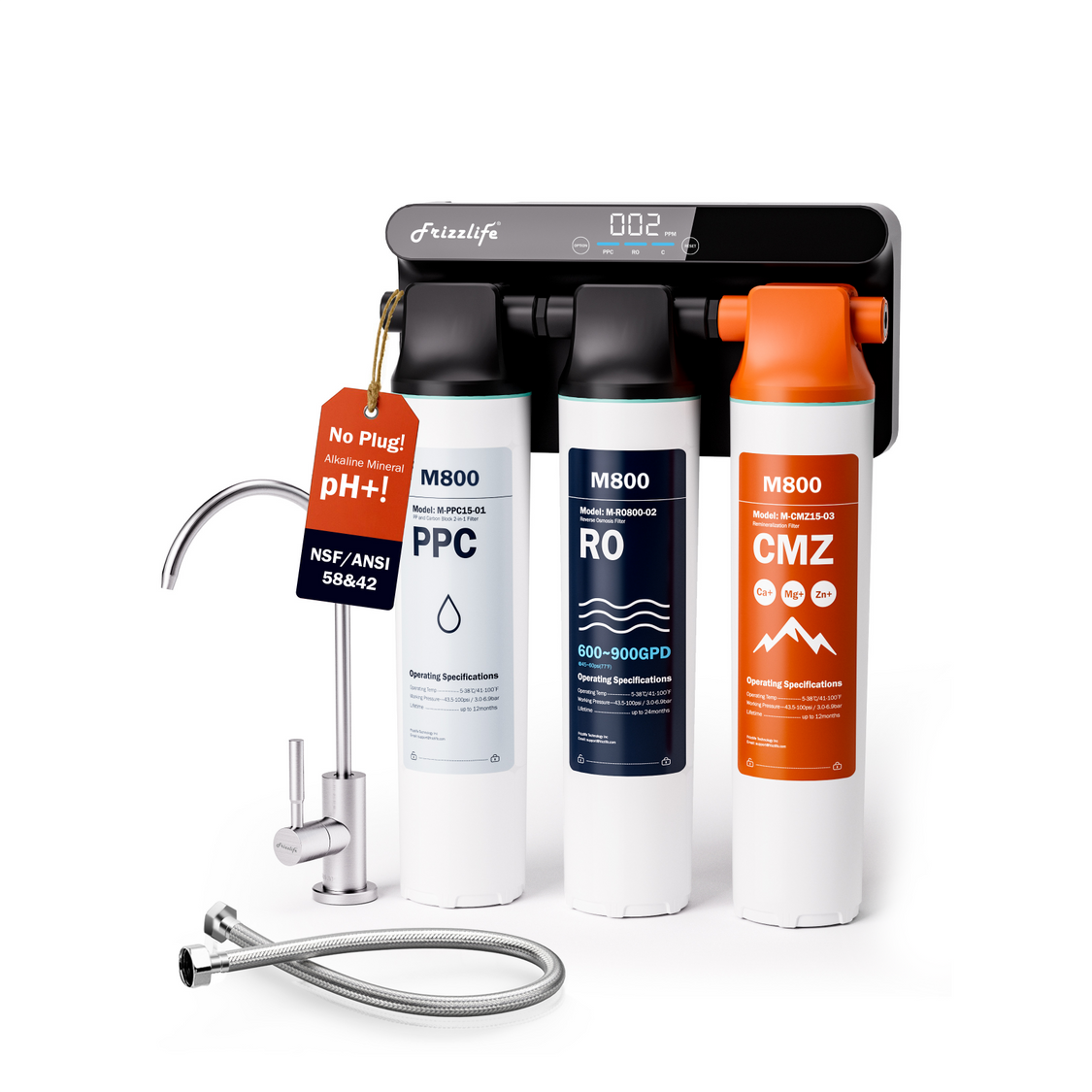
M800 RO System
Higher-capacity reverse osmosis system designed for households with greater daily water usage and more frequent demand for filtered drinking water.
View M800 Details →
Tip: The most suitable reverse osmosis system depends on your household water usage, installation space, and long-term maintenance expectations rather than model alone.
Arsenic poisoning symptoms: metallic taste, garlic breath, and more
Symptoms depend on dose and duration. Short, high‑dose exposure looks very different from long‑term, low‑dose exposure. Most people worried about their tap are in the second group: chronic, low‑level exposure with no taste or odor.
Acute exposure: what clinicians watch for
Severe arsenic poisoning is rare, but it can happen during industrial accidents or with intentional poisoning. Health workers look for sudden, intense symptoms such as nausea, vomiting, watery diarrhea, abdominal pain, headache, drowsiness, confusion, and, in severe cases, shock. There can be a metallic or garlic‑like taste, garlic breath, hypersalivation, and throat or mouth irritation. These signs appear fast—often within hours.
If you ever see these symptoms after a known high‑risk exposure, seek emergency care.
Chronic exposure: subtle but serious
Long‑term exposure to low levels of arsenic can be silent for years. It does not change the taste of your water, but it can raise risks over time. Documented health effects include skin changes (dark spots or thickening called hyperkeratosis), numbness or tingling in hands and feet (neuropathy), and higher risks of skin cancer, bladder and lung cancer, cardiovascular disease, diabetes, and effects on the immune and endocrine systems. These problems happen slowly, which is why routine testing and treatment matter even when water tastes fine.
Dose context: when sensory signs appear
The metallic taste or garlic breath reported in textbooks relate to very high doses—far above typical environmental arsenic at levels found in drinking water supplies. At the everyday ppb range found in some wells, there is usually no symptom you can feel or taste. That’s why prevention depends on testing, not on your senses.
Suggested visual & tool
- Visual: A “symptom timeline” from minutes (acute) to months/years (chronic), showing how signs differ by dose.
- Table: Acute vs chronic signs and typical contexts.
| Exposure type |
Typical context |
Signs and timing |
Sensory notes |
| Acute, high dose |
Accidents, intentional poisoning |
Minutes to hours: vomiting, diarrhea, abdominal pain, shock |
Metallic/garlic taste or breath may occur but is not a reliable signal |
| Chronic, low dose |
Contaminated well water or food |
Months to years: skin changes, neuropathy; increased risks of cancer and cardiovascular disease |
No taste, no smell |
How to detect arsenic: water tests, food checks, and biomonitoring
Because you cannot sense arsenic at harmful levels, detection means testing. The right method depends on your source (private well vs public drinking water) and your goal (screening vs confirmatory lab work).
Lab methods that work
For water, certified laboratories use instrumental methods that can measure arsenic down to very low levels:
- ICP‑MS (Inductively Coupled Plasma Mass Spectrometry)
- Hydride‑generation Atomic Absorption (HG‑AAS)
- EPA drinking water methods that target arsenic down to ppb
These methods can also speciate arsenic in some cases (identify two forms As(III) and As(V)), which helps with treatment. If you own a private well, a certified lab report is the gold standard.
At‑home options: pros and cons
At‑home screening kits and strips can provide a quick check. They are useful as a first look, but they are not as accurate, and results can be hard to interpret. If a screening test suggests arsenic—or if you live in a higher‑risk area—follow up with a certified lab. Always follow sampling instructions to avoid contamination, and do not flush the tap before collecting unless the lab advises it.
Interpreting results and action levels
- At or below 10 ppb: Meets the EPA standard for public systems. Many households still aim to reduce arsenic as low as possible, especially for pregnant people and children.
- Between 5 and 10 ppb: Above some state benchmarks. Consider treatment to lower exposure.
- Above 10 ppb: Act now. Choose proven treatment and use safe water for drinking and cooking until treatment is verified.
Remember, 1 µg/L equals 1 ppb. Some reports use ppm (parts per million); 0.010 ppm is the same as 10 ppb.
Reducing exposure: filtration, treatment, and practical steps
Once you know your levels, you can pick a treatment that fits your home. The right water treatment depends on the arsenic form and how you use the water (whole‑house vs drinking/cooking taps).
Effective treatments for arsenic in water
-
Reverse osmosis (RO): A point‑of‑use membrane that can remove both As(V) and, to a degree, As(III). RO also reduces fluoride and many other contaminants. For best results with arsenic compounds, pre‑oxidize As(III) to As(V) so the membrane and adsorbents work better.
- Distillation: A countertop process that boils water and condenses steam, leaving arsenic behind. It’s slow but effective for drinking and cooking water.
- Activated alumina and iron‑based media: Adsorptive filters at the tap or whole‑house that are very effective for As(V). They work less well for As(III), so oxidation first is helpful.
- Anion exchange: Can remove As(V) because arsenate is negatively charged. Pre‑oxidation of As(III) is again key.
What about carbon filters? Standard carbon improves taste and odor (like chlorine) and can help with some organics, but it does not reliably remove arsenic. It’s great for taste issues, not for arsenic control.
Does boiling help? No. Boiling does not remove arsenic, and it can increase the concentration because water evaporates while arsenic stays behind. If you’re wondering “how long to boil water to remove arsenic?” the answer is: there’s no boiling time that will do it. Boiling is useful to kill bacteria and viruses, not to remove metals or metalloids like arsenic.
If you’re waiting for treatment or lab results, use bottled water for drinking, infant formula, and food preparation, or use a known safe tap.
Household checklist
Use this quick plan to stay on top of arsenic and other contaminants:
- Test your private well water for arsenic when you move in or drill a new well, then at least once a year.
- If you are on a public water supply, read your Consumer Confidence Report each year; test your tap if you have special concerns or use untreated private sources.
- If results are above 5–10 ppb, install a proven treatment at the kitchen tap (RO, distiller, or certified adsorption). Consider whole‑house if you want protection for showers and laundry as well.
- Retest after installing treatment to confirm it works, and retest at least annually. Replace filters and media on schedule.
- Use safe water for drinking and cooking for babies and pregnant people while you fix the problem.
Private wells vs municipal water
- Private wells: The homeowner is responsible for testing and treatment. There is no routine EPA monitoring. Your county or state health department can guide you on local risks and certified labs.
- Municipal water: The Environmental Protection Agency sets the arsenic standard for public systems. Utilities test and report results. If your city meets the EPA standard but you still want lower levels of arsenic in drinking water at your tap, a POU RO unit is a practical step.
Myths vs facts about arsenic taste and safety
Myths spread fast, especially when people are scared. These quick checks can help you separate fact from fiction.
“If water tastes fine, it’s safe”—false
Taste and smell can guide you for some issues (like chlorine or sulfur), but not for arsenic. Arsenic could be present at harmful levels with no change in taste, color, or odor. Organoleptic tests (taste, smell, appearance) are not safety tests.
“Bitter almond smell means arsenic”—it’s cyanide
The “almond” clue belongs to cyanide, not arsenic. Even then, not everyone can smell cyanide. Arsenic has no dependable smell in water.
“Boiling removes arsenic”—it does not
Boiling water kills bacteria and viruses, but it leaves arsenic behind and can make the concentration higher. Use RO, distillation, or adsorptive media instead. If you ask “does boiling water remove arsenic?” the accurate, short answer is no.
Real‑world cases: lessons from communities and social media
Harmful arsenic exposure often feels “invisible” because there are no early sensory clues. That can make it hard to act before health risks grow. Real‑world stories show why testing matters.
Bangladesh well crisis: invisible risk at scale
In Bangladesh, millions of people rely on tube wells drilled into arsenic‑rich aquifers. The water looks and tastes normal, yet testing shows high levels of arsenic in many wells. Public health teams organized widespread well screening and marked safe wells to guide families. This large‑scale effort underscores the central truth: detection requires testing, not taste.
U.S. private well stories
Across the U.S., many homeowners share a similar message: “Our water looked and tasted fine, but the lab found arsenic above 10 ppb.” Often, neighbors have very different results even a short distance apart. After installing a RO system or adsorptive media and re‑testing, families see arsenic drop to safer levels. These stories remind us to test for arsenic when you move or sink a new well, not just when water tastes odd.
Video and forum demos: what people learned
Online demos show side‑by‑side tests on clear tap water that quietly contains arsenic above guidelines. Viewers often say, “I had no idea; it tastes normal.” That surprise is a teaching moment: for invisible risks, only data guides action.
FAQs
1. What does arsenic do to the mouth?
At low levels of exposure to arsenic in your drinking water, you won’t notice any mouth changes. When much arsenic is ingested—such as during acute exposure—arsenic may cause mouth irritation, metallic or garlic-like breath odor, and hypersalivation. These effects happen only at dangerous doses of this natural arsenic substance, not from normal food and water. Arsenic can cause severe stomach pain, vomiting, and other systemic symptoms, so seek medical help fast.
2. Can you smell arsenic in water?
People often ask what does arsenic smell like, but the answer is simple: it doesn’t. Arsenic found in water is odorless and tasteless at the levels that matter for safe drinking water. You cannot detect water with arsenic by smell, sight, or taste. Even when exposure to arsenic increases cancer risk, it gives no warning signs. Testing and certified filter water systems are the only way to detect and remove this contaminant.
3. Can activated carbon remove arsenic?
Activated carbon filters improve taste and odor but do not reliably remove arsenic in your drinking water. Arsenic is a dissolved mineral substance, and much arsenic can remain after basic filtration. To make new drinking water safe, use reverse osmosis, distillation, or adsorptive media designed for arsenic removal. These methods effectively reduce exposure to arsenic found in food and water. Remember, carbon filters alone are not protection against this cancer-causing element.
4. Should I test food for arsenic at home?
Testing food at home for arsenic is not practical. Arsenic found naturally in soil and water can enter rice and juices, but reliable detection requires lab testing. Focus on water with arsenic first—test your well or tap regularly. Exposure to arsenic from food and water can increase long-term health risks, so eat a varied diet and use safe drinking water treated by a certified filter water system. This approach keeps daily intake of this toxic substance low.
5. Is bottled water always low in arsenic?
Not always. Many bottled water brands meet safe drinking water standards, but levels of natural arsenic vary. Check the company’s water quality report if you are worried about exposure to arsenic. Some bottled water may come from wells where arsenic can cause severe health effects if untreated. If you want to reduce risk, filter water at home using a system certified for arsenic removal. That ensures your new drinking water stays clean and below limits.
6. How often should I test a private well?
If you rely on a private well, test at least once a year for arsenic and other contaminants. Natural arsenic in groundwater can change over time, especially after floods or repairs. Exposure to arsenic often comes from these hidden sources of arsenic in food and water. Even clear, normal-tasting water with arsenic may exceed safe levels. Regular lab testing ensures your filter water system continues to make safe drinking water and limits cancer-causing risks.
7. Can you taste arsenic in water?
No, arsenic cannot be tasted in drinking water even at levels that may exceed safety guidelines. This is because it is fully dissolved and does not activate taste or smell receptors. Sensory perception is not sensitive enough to detect arsenic at ppb levels. As a result, water may taste completely normal even when arsenic is present.
8. Does arsenic change water taste?
No, arsenic does not change the taste, smell, or appearance of water. It remains chemically dissolved in forms that do not affect sensory characteristics. Any unusual taste in water is usually caused by other substances such as iron or sulfur. Therefore, taste differences should not be used to judge arsenic presence.
9. Why can’t humans detect arsenic by senses?
Humans cannot detect arsenic because it exists in dissolved ionic forms at extremely low concentrations. These levels are far below human sensory detection thresholds for taste and smell. Even when present at elevated levels, arsenic does not create noticeable sensory signals. This makes it effectively “invisible” to human senses.
10. Is taste a reliable way to detect water safety?
Taste is not a reliable indicator of water safety for arsenic or other dissolved contaminants. Many harmful substances do not affect flavor, odor, or appearance at risky concentrations. Relying on taste can therefore create a false sense of safety. Only water testing can accurately confirm arsenic presence.
References
Related Guides
Compare verified arsenic filtration systems and choose the right reverse osmosis solution based on your water test results and household needs.
Explore Arsenic Filter Collection