


The best faucet water filter is not necessarily the model with the longest list of contaminant claims. It is the filter that fits your kitchen faucet, is independently certified for the contaminants you care about, provides acceptable flow, and has a replacement schedule your household can maintain.
A kitchen faucet water filter can be a practical choice for renters, smaller households, and anyone who wants filtered drinking water without permanent plumbing changes. However, faucet-mounted systems do not fit every tap, soften hard water, or make microbiologically unsafe water safe. Their performance also varies substantially by model and cartridge.
This 2026 guide explains how faucet filters work, what certifications mean, how to avoid compatibility problems, and when a pitcher, countertop unit, or under-sink system is the more suitable choice.
Best Faucet Water Filter: Kitchen Buyer’s Guide
Instead of ranking individual products without model-specific testing, the most useful approach is to rank faucet-filter configurations by household need. Certification, compatibility, water conditions, and expected usage matter more than a generic “best overall” label.
Decision Snapshot: The Best Faucet Water Filter Depends on Your Water, Faucet, and Usage
For most buyers, the strongest choice is a faucet-mounted filter that:
- Fits the faucet without relying on an unstable connection.
- Has an accredited third-party certification for the desired reduction claim.
- Provides separate filtered and unfiltered modes.
- Has documented cartridge capacity and replacement instructions.
- Maintains usable flow under the home’s actual water conditions.
- Does not obstruct routine washing, cooking, or filling containers.
The best type depends on the problem you are trying to solve:
- For chlorine taste or odor: Look for an exact model certified for the applicable NSF/ANSI 42 claim.
- For lead concerns: Verify the exact model and cartridge for lead reduction under NSF/ANSI 53. Do not rely on a general statement about the brand or product family.
- For visible sediment or particulate concerns: Check for the applicable particulate-reduction claim, including the specified particulate class.
- For multiple contaminant concerns: Compare the certified listing and performance data sheet claim by claim. A broad marketing phrase such as “multi-stage filtration” does not confirm a specific reduction capability.
- For high daily water use: Consider whether a small faucet cartridge will create excessive replacement and flow compromises. An under-sink system may be more practical.
- For a pull-down or specialty faucet: A direct faucet mount is often unsuitable. A separate filtered-water faucet may be the better configuration.
No point-of-use filter certification is mandated across the board by the federal Safe Drinking Water Act. Certification is voluntary, which makes independent verification especially important when comparing products.
Faucet Water Filter Decision Table
|
Filter configuration |
Certification to verify |
Faucet fit |
Likely flow impact |
Maintenance |
Ideal use case |
|---|---|---|---|---|---|
|
Basic faucet-mounted carbon filter |
Exact NSF/ANSI 42 claims, if advertised |
Usually requires a compatible removable aerator and correct adapter |
Filtered mode may be slower than normal tap flow |
Replace and flush cartridges according to model instructions |
Municipal water users focused primarily on chlorine taste or odor |
|
Faucet-mounted filter with health-related claims |
Exact NSF/ANSI 53 claims for each named contaminant |
Same compatibility limits as other faucet mounts |
Depends on media, pressure, sediment and cartridge condition |
Timely replacement is essential to maintain claimed performance |
Households with a specific, verified contaminant concern such as lead |
|
Faucet filter with additional specialty claims |
Relevant certified listing, potentially including NSF/ANSI 401 claims |
Model- and faucet-dependent |
May be affected by cartridge design and water conditions |
Follow the stated capacity and operating conditions |
Buyers who have identified additional contaminants and verified corresponding claims |
|
Pitcher filter |
Exact certified contaminant claims |
Independent of faucet style |
Does not restrict faucet flow |
Refill pitcher and replace cartridge |
Renters, low-volume users and incompatible faucets |
|
Under-sink filter |
Exact claims for the complete system and cartridges |
Requires plumbing compatibility and installation space |
Does not add a bulky attachment to the faucet tip |
Periodic cartridge service under the sink |
Higher consumption, frequent cooking and households wanting a cleaner sink setup |
|
Dedicated filtered-water faucet system |
Exact system-level certified claims |
Requires sink or countertop mounting space |
Separate from the main faucet’s washing flow |
Service filters according to system instructions |
Pull-down faucets, high-use kitchens and households wanting a dedicated drinking-water line |
Compare ownership cost as well as the initial purchase price. To estimate annual cartridge cost, divide expected yearly filtered-water use by the cartridge’s rated capacity, round up to a whole cartridge, and multiply by the replacement-cartridge price. Treat the result as an estimate because sediment, water conditions, and time-based replacement limits may increase actual replacement frequency. Also confirm that the exact certified replacement cartridge is readily available.
How to Verify Certification and Model-Specific Contaminant Claims
A certification logo or general reference to an NSF standard does not automatically mean that a filter reduces every contaminant covered by that standard.
Use this verification process:
- Write down the complete model number. Include the cartridge number when it is listed separately.
- Identify the certification organization. The claim should name the accredited third party rather than use vague language such as “tested to industry standards.”
- Search the organization’s official product directory.
- Match the brand, model and cartridge configuration exactly.
- Read the specific reduction claims. Do not infer lead, chemical or microorganism reduction from a chlorine taste claim.
- Review operating conditions and capacity. Certification applies under defined testing conditions and for the specified cartridge life.
- Confirm that replacement cartridges carry the same applicable listing. A physically compatible cartridge is not automatically equivalent to the certified original configuration.
The distinction between the most common standards is important:
- NSF/ANSI 42 covers specified aesthetic effects such as chlorine taste and odor and can include particulate claims.
- NSF/ANSI 53 addresses specified contaminants with health effects, including lead when lead reduction is explicitly listed.
- NSF/ANSI 401 covers specified emerging-contaminant claims. Coverage remains claim- and model-specific.
Certification standards and benchmarks can also be revised. Check the current official listing instead of depending on an old review, package photo, or third-party summary.
Regret-Avoidance Checklist Before Choosing a Faucet Mounted Water Filter
Before ordering a water filter for a kitchen faucet, check the following:
- Does the faucet have a removable aerator?
- Is the faucet thread internal or external?
- Does the manufacturer supply the required adapter?
- Is the tap a pull-down, pull-out, handheld, sensor-operated, or specialty faucet?
- Will the filter housing reduce clearance for pots and dishes?
- What contaminant are you trying to reduce?
- Is that exact claim independently certified for the exact model?
- Is your water supplied by a regulated utility, private well, or another source?
- Is the home’s current water pressure already low?
- Does the water contain enough sediment to clog small cartridges quickly?
- How much filtered water does the household use each day?
- What is the documented cartridge capacity?
- Are replacement cartridges readily available?
- Can users switch between filtered water for drinking and unfiltered water for washing?
- Do the instructions restrict water temperature or operating conditions?
If the answers expose problems with fit, high usage, low flow, or source-water safety, a faucet-mounted design may not be the right solution. Buyers whose sink setup is compatible can compare the available Frizzlife faucet water filter options using the same model-specific criteria.
How Kitchen Faucet Water Filters Work
The Water Path Through a Faucet-Mounted Filter
A faucet filter connects to the end of a compatible tap, usually where the aerator was installed. Inside the unit, a diverter directs water along one of two paths.
In unfiltered mode, water bypasses the cartridge and exits much like ordinary tap water. In filtered mode, the diverter sends water through the cartridge before it reaches the glass, bottle, kettle, or cooking pot.
The cartridge may combine more than one treatment mechanism. Water first encounters screens or mechanical layers that trap particulates. It then passes through activated carbon or other media intended for specific claims. The filtered water leaves through a separate outlet or designated flow channel.
This treatment happens at the point of use. It does not filter water supplied to showers, dishwashers, washing machines, or other fixtures.
Activated Carbon, Mechanical Filtration, and Model-Dependent Specialty Media
Activated carbon is commonly used to address chlorine-related taste and odor. Its porous surface allows certain substances to attach through adsorption. That is different from straining: the target compounds adhere to the media rather than simply being caught because they are larger than a pore.
Mechanical filtration physically retains particles within a defined size range. The actual particulate capability depends on the filter’s design and certified claim. A screen that catches visible debris is not automatically certified for Class I particulate reduction.
Some cartridges include additional media intended for particular metals or chemical compounds. Their presence alone does not prove performance. Media quantity, cartridge construction, flow path and validated testing all affect the result.
Terms such as “advanced carbon,” “multi-stage” or “specialty media” describe design features, not certified outcomes. Always connect the claimed technology to an exact third-party listing.
Why Filter Media, Contact Time, and Water Conditions Affect Performance
A compact faucet cartridge has limited media volume. Water needs sufficient contact with that media for adsorption and other treatment mechanisms to occur. This is one reason filtered flow may be slower than the unrestricted faucet flow.
Water conditions also matter:
- Sediment can accumulate in mechanical layers and restrict flow.
- High household consumption can use cartridge capacity more quickly.
- Low incoming pressure can make filtered flow feel unusually slow.
- Water chemistry can influence how treatment media performs.
- Using a cartridge beyond its rated capacity may put certified performance outside the validated conditions.
Two households using the same model can therefore have different maintenance experiences. Published capacity is a comparison tool, but it should not be treated as a guarantee that every home will reach the same calendar date before replacement.
Filtered and Unfiltered Modes at the Kitchen Sink
A selectable bypass helps preserve cartridge life. Filtered mode can be reserved for drinking, beverages, rinsing produce and cooking, while unfiltered mode handles handwashing, cleaning and other tasks that do not require treated water.
Use the temperature and flushing instructions supplied with the exact filter. Unless a unit is expressly designed and validated for other conditions, avoid assuming that hot water can be sent through its cartridge. Temperature can affect filter materials and performance.
A bypass also protects sink usability. Running every gallon through a compact filter can cause unnecessary restriction and shorten the interval between cartridge changes.
What a Kitchen Faucet Water Filter Can and Cannot Reduce
Chlorine Taste, Odor, Particulates, Lead, and Other Model-Specific Claims
A kitchen faucet water filter may improve chlorine-related taste and odor, reduce specified particulates, or address certain health-related contaminants. It can do so only when its design and validated performance support those claims.
Do not assume all faucet filters reduce:
- Lead
- Volatile organic compounds
- Pesticides
- Pharmaceuticals
- PFAS compounds
- Bacteria, viruses or parasites
Each claim needs separate verification. Even within the same product family, different cartridges may have different listings.
NSF/ANSI 42, 53, and 401: What Buyers Should Verify
The standard number is only the beginning of the verification process.
For NSF/ANSI 42, identify whether the model is certified for chlorine taste and odor, a particular particulate class, or another specified aesthetic effect. For NSF/ANSI 53, identify the exact health-related contaminant listed. For NSF/ANSI 401, inspect the named emerging-contaminant claims rather than assuming comprehensive removal.
Also distinguish between these phrases:
- Certified by an accredited third party: The organization has evaluated the listed model for specified claims.
- Tested to a standard: Testing may have occurred, but this phrase does not necessarily establish current third-party certification.
- Meets a standard: This may be a manufacturer statement unless supported by an official listing.
- Uses certified components: Component certification does not automatically certify the assembled filter for contaminant reduction.
Do Faucet Filters Reduce Lead?
Some do. A faucet filter should be considered suitable for lead only if the exact model and cartridge are certified for lead reduction under NSF/ANSI 53.
The EPA advises consumers concerned about lead to look for products certified by an accredited third party for lead reduction under NSF/ANSI 53 and for Class I particulate reduction under NSF/ANSI 42. NSF reports that faucet-mounted filters certified for lead reduction are challenged during testing with water containing 150 parts per billion of lead, although test requirements and benchmarks should always be checked in their current versions.
Independent research also shows why correct operation matters. In one peer-reviewed evaluation of properly operated NSF/ANSI 53 lead-certified point-of-use filters, filtered samples met the study’s certification requirement, and none exceeded 2.5 parts per billion. That is a study-specific result—not proof that every faucet filter will perform identically in every home.
If lead is suspected, water testing and source investigation are important. A filter can reduce exposure at the selected faucet when appropriately certified and maintained, but it does not remove the source of lead from plumbing.
Limits: Hardness, Microorganisms, and Unverified Contaminant Claims
Most faucet-mounted carbon filters are not water softeners. They should not be expected to remove the calcium and magnesium responsible for hardness or prevent scale throughout the kitchen.
A conventional faucet filter also should not be assumed to disinfect water. During a boil-water advisory or when a private supply may be microbiologically unsafe, follow instructions from the relevant public health or water authority. Do not substitute an ordinary faucet filter for required boiling or an appropriately validated disinfection system.
Other limitations include:
- Treatment occurs only at one faucet.
- Cartridge performance is finite.
- High sediment can cause early clogging.
- A compact attachment can interfere with sink tasks.
- Unverified contaminant claims should not guide safety decisions.
- Filtration does not repair corroded plumbing or correct a contaminated source.
When Source-Water Testing Should Come Before Filter Selection
Testing should come first when the concern is more specific than unpleasant taste or odor. Examples include suspected lead from plumbing, contaminants in private well water, recurring discoloration, unusual chemical odors, nearby industrial activity, or a public water advisory.
Municipal customers can begin by reviewing their utility’s water quality report. However, a report for the distribution system may not reveal contamination introduced by a building’s plumbing. If the concern involves the home’s service line or fixtures, an appropriate tap-water test can provide more relevant information.
Once the contaminant is identified, match it to a certified reduction claim. Shopping in the opposite order—buying a filter first and hoping it addresses the problem—creates unnecessary risk and expense.
Kitchen Faucet Compatibility and Installation
Can You Install a Water Filter on a Kitchen Faucet?
Yes, if the faucet has a compatible removable aerator and can physically support the filter and adapter. Many standard fixed-spout faucets accept a direct-mounted unit, but compatibility must be confirmed before purchase.
Start by unscrewing the aerator. Determine whether the faucet has internal threads, with threads inside the spout, or external threads around the outside. Compare the dimensions and configuration with the filter manufacturer’s fit guide and included adapters.
Do not force a nearly matching adapter. Similar-looking thread patterns can still be incompatible.
Do Faucet Water Filters Fit Every Kitchen Faucet?
No. Faucet-mounted filters commonly have difficulty with:
- Pull-down sprayer heads
- Pull-out faucets
- Handheld or flexible spouts
- Sensor-operated fixtures
- Faucets without removable aerators
- Square, oval or unusually shaped outlets
- Specialty or recessed aerators
- Fixtures that cannot support the attachment’s size or weight
An improvised connection can leak, damage threads, or detach under pressure. If your primary faucet is incompatible, consider a pitcher, countertop system, under-sink system, or separate drinking-water faucet rather than forcing a faucet mount.
Standard Aerators, Thread Types, Adapters, and Pull-Down Faucet Limitations
A standard aerator screws into or over a threaded faucet outlet. After removing it, a filter may connect directly or through a supplied adapter. A washer or gasket creates the seal; thread tape should be used only when the product instructions call for it.
Pull-down faucet heads present a different challenge. Their outlets, internal hoses, docking mechanisms and sprayer controls generally are not designed to carry an external filter housing. Added weight can also make the head difficult to dock or handle.
For this sink type, an under-sink system connected to a dedicated filtered-water faucet often provides a cleaner arrangement while preserving the pull-down sprayer.
Basic Installation Steps for a Faucet Mounted Water Filter
Instructions vary, but the general process is:
- Turn off the faucet.
- Remove the existing aerator by hand or with a protected tool if the instructions permit.
- Clean debris from the faucet threads.
- Identify the correct direct connection or adapter.
- Place the specified washer or gasket correctly.
- Thread the adapter on by hand, keeping it straight.
- Attach the filter housing without overtightening.
- Insert the cartridge in the required orientation.
- Run water slowly and inspect every connection.
- Flush the cartridge for the manufacturer-specified period before drinking the water.
- Test both bypass and filtered modes.
Save the aerator and unused adapters. Renters may need to reinstall the original fixture later.

Troubleshooting Leaks, Cross-Threading, and Loose Adapters
If water leaks at the faucet connection, turn off the tap and remove the filter. Check whether the washer is missing, doubled, twisted or damaged. Confirm that the adapter is the correct one.
A connection that tightens at an angle is probably cross-threaded. Back it off immediately rather than applying more force. Clean the threads and restart by hand. Overtightening can deform a gasket or damage the faucet and adapter.
If the filter body rotates or sags, verify that every retaining ring and connector is seated as instructed. Persistent leaks, visible cracks or unstable connections indicate that installation should stop until the fit is corrected.
Faucet Filter Performance, Flow, and Maintenance
Why Faucet Filters Can Reduce Water Flow
Unfiltered faucet water follows a relatively open path. Filtered water must pass through screens and treatment media. That resistance can reduce flow, especially when incoming pressure is low or the cartridge has accumulated sediment.
A moderate difference between bypass and filtered mode can be normal. A sudden drop, uneven stream or near-trickle suggests a clogged cartridge, blocked inlet, improperly installed part, or pressure problem.
Troubleshooting Slow Flow and Premature Cartridge Clogging
Use a step-by-step approach:
- Compare filtered and bypass flow.
- Check other faucets to determine whether the home has a broader pressure issue.
- Confirm that the diverter is fully engaged.
- Inspect accessible inlet screens for debris, following the manual.
- Verify that the cartridge is installed in the correct direction.
- Review whether the cartridge has reached its rated capacity or replacement indicator.
- Consider recent utility work, pipe disturbance, discoloration or sediment.
- Replace the cartridge when required rather than attempting unapproved cleaning.
If new cartridges clog unusually quickly, investigate water conditions. Repeated early clogging is information about the source water or plumbing, not merely a maintenance inconvenience.

How Often Should a Faucet-Mounted Water Filter Be Replaced?
Replace it according to the exact manufacturer’s capacity, time limit or indicator—whichever applicable limit is reached first. There is no universal replacement interval for all faucet filters.
Actual timing depends on:
- Daily filtered-water consumption
- Sediment concentration
- Incoming water quality
- Cartridge design
- Whether the bypass is used for cleaning
- Operating conditions
- The model’s validated capacity
Record the installation date and, when practical, estimate household filtered-water use. Do not extend a cartridge’s service solely because the water still tastes acceptable. Taste is not a reliable indicator for contaminants such as lead.
Signs a Cartridge May Need Replacement
Common warning signs include:
- A significant decline in filtered flow
- A replacement indicator reaching its limit
- The rated capacity or time limit being reached
- Return of the original chlorine taste or odor
- Visible cartridge damage
- Failure to flush normally after installation
- Manufacturer instructions requiring replacement after specified events or conditions
Cloudiness immediately after a cartridge change may sometimes be related to trapped air or flushing, but follow the model’s instructions. Persistent discoloration, odor or unusual particles deserve further investigation.
Maintenance Practices That Help Preserve Sink Usability and Filter Life
Use unfiltered mode for dishwashing and general cleaning when appropriate. Keep the outlet clean without allowing cleaning products to enter the cartridge. Avoid striking the housing with pots or using it as a handle to move the faucet.
Other useful habits include:
- Flush every new cartridge as directed.
- Keep track of the installation date.
- Use only the approved replacement configuration.
- Check adapters and seals periodically for leaks.
- Follow all temperature and pressure limitations in the manual.
- Do not leave an exhausted cartridge in service.
- Investigate abnormal flow changes rather than compensating by opening the tap more aggressively.
Faucet Filter vs Pitcher, Countertop, and Under-Sink Systems
When a Faucet Filter Is the Best Tap Water Filter for the Job
A faucet filter is a strong choice when you have a compatible tap, moderate filtered-water demand, limited counter space and no desire for permanent installation. It provides on-demand water without waiting for a pitcher to refill.
It is less suitable when the attachment obstructs the sink, the faucet is incompatible, water pressure is already poor, or the household consumes enough water to make a small cartridge inconvenient.
Faucet Filter vs Pitcher Filter for Renters and Light Daily Use
Both options can suit renters because they generally avoid permanent changes.
A pitcher works with any faucet and does not reduce tap flow, but it occupies refrigerator or counter space and must be refilled. A faucet filter delivers water on demand but adds weight and bulk to the tap.
Certification remains model-specific for both formats. A pitcher is not inherently weaker or stronger than a faucet filter; compare the exact certified claims, capacity and upkeep.
Explore Faucet-Connected Countertop Water Filters
If a faucet-mounted filter isn't the right fit for your kitchen, a countertop water filter may be another practical solution. Frizzlife DS99 and TS99 connect to compatible kitchen faucets, provide filtered water on demand, and require no drilling. Compare their filtration configurations to find the setup that best fits your needs.
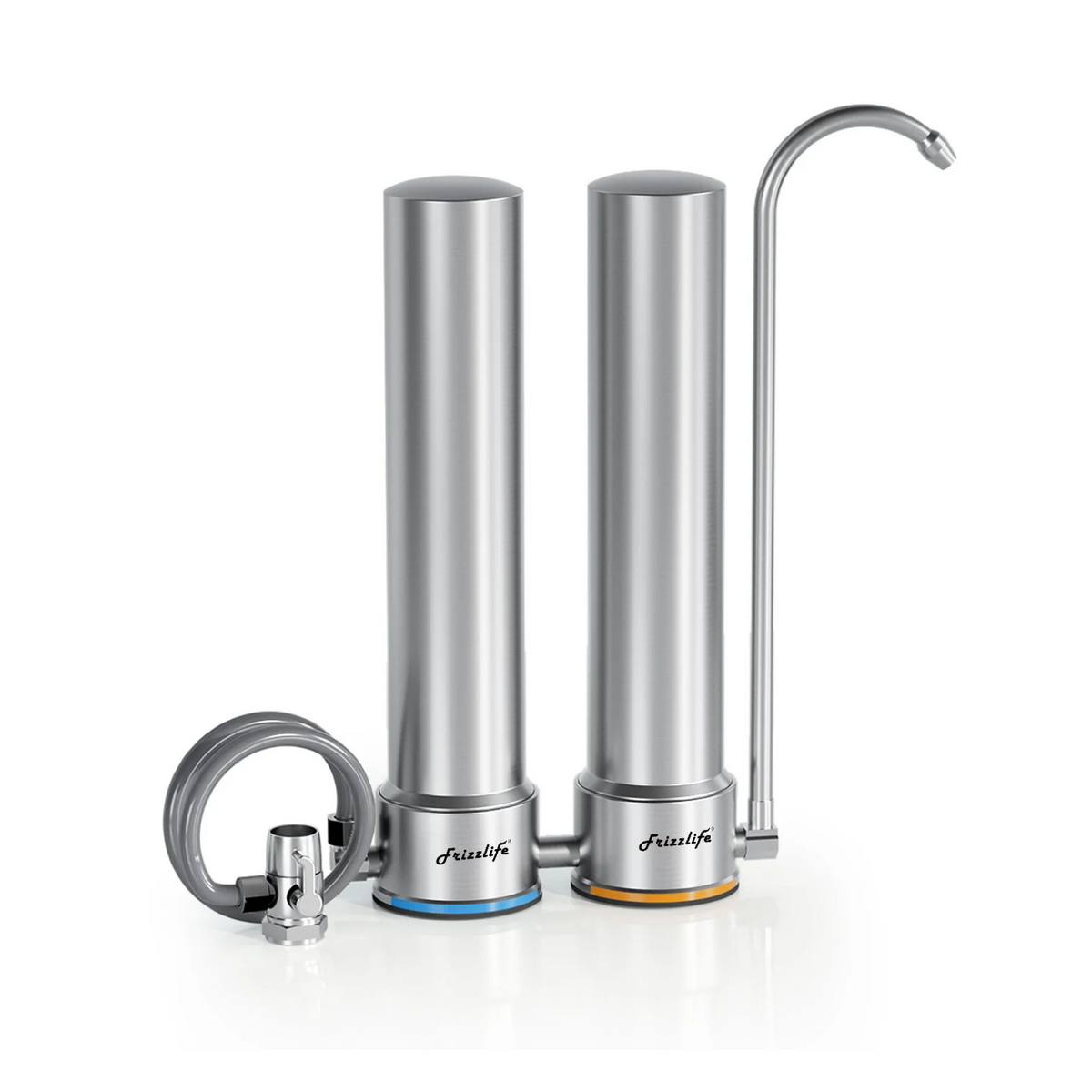
Frizzlife DS99
8-Stage FiltrationA dual-cartridge countertop water filtration system with a durable stainless steel housing. Designed for users who want a faucet-connected filtration option without drilling into the sink or countertop.
Dual-cartridge design
Up to 2 GPM at 60 psi
No electricity required
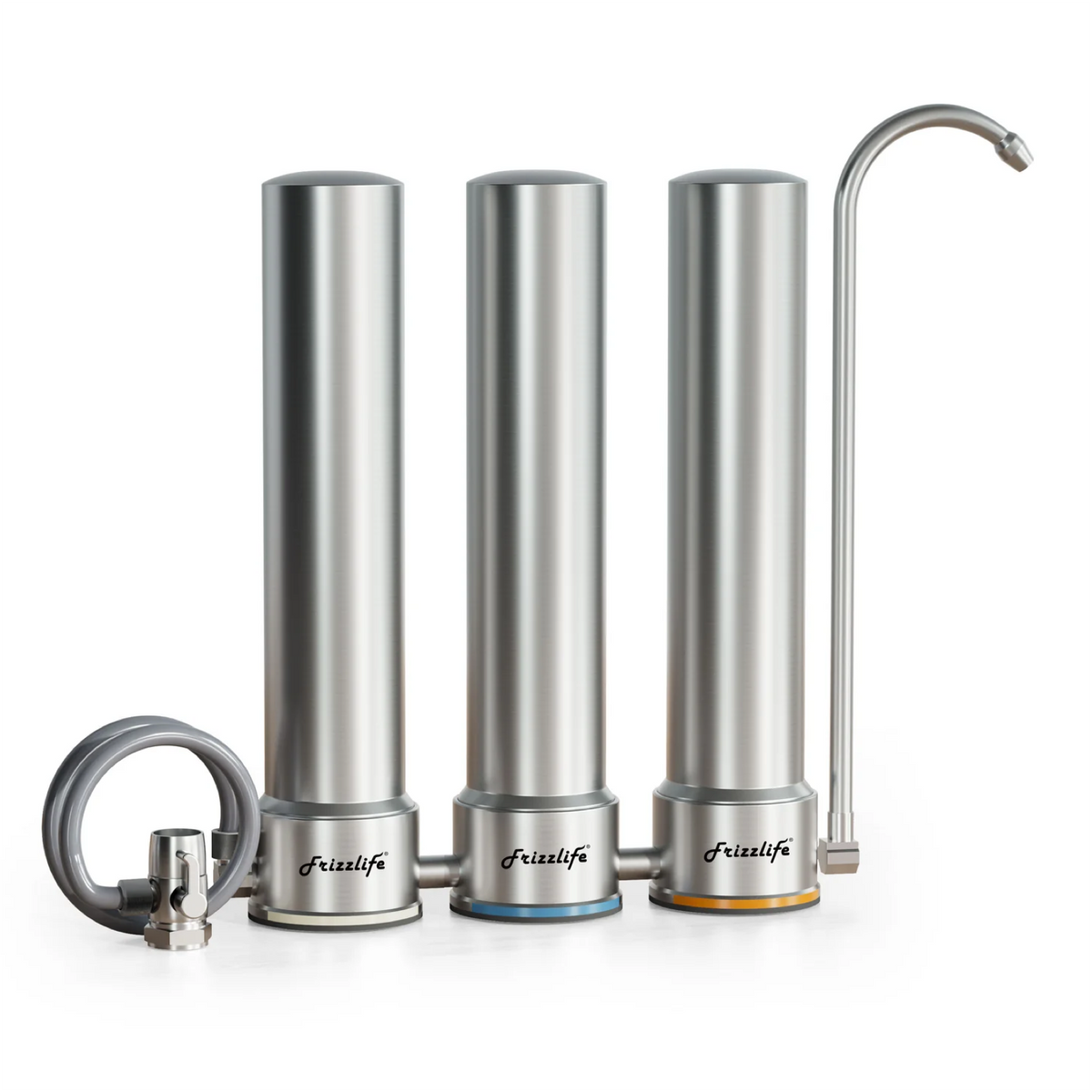
Frizzlife TS99
9-Stage FiltrationA three-cartridge countertop filtration system featuring an additional sediment prefiltration stage. Its stainless steel construction and faucet-connected design provide another option for kitchens where permanent plumbing changes are undesirable.
Three-cartridge design
Up to 2 GPM at 60 psi
No electricity required
Note: DS99 and TS99 are faucet-connected countertop systems, not faucet-mounted cartridge filters. Check faucet compatibility, cartridge replacement requirements, and model-specific certification details before purchasing. NSF/ANSI 372 addresses lead content in water-contact materials, not contaminant reduction performance.
When Is an Under-Sink Filter a Better Choice Than a Faucet Filter?
An under-sink filter is usually the better choice when:
- The household uses substantial amounts of filtered water.
- A faucet attachment would interfere with cooking or washing.
- The main faucet is a pull-down or incompatible design.
- More treatment capacity is preferred.
- The user wants equipment hidden inside the cabinet.
- The selected treatment process requires a configuration not available in a compact faucet mount.
- Cartridge changes at the faucet would be too frequent or disruptive.
Under-sink systems require cabinet space and a suitable plumbing connection. Some use the main cold-water faucet; others feed a separate fixture. Buyers considering the second arrangement can review Frizzlife’s drinking-water faucet configurations while checking mounting requirements and system compatibility.
When a Dedicated Filtered-Water Faucet Makes More Sense
A separate filtered-water faucet preserves the full flow and maneuverability of the main fixture. It can be a good match for a high-use kitchen or a sink with a pull-down sprayer.
The trade-off is installation. The sink or countertop needs a suitable mounting opening, and the filter system must be connected correctly below the sink. This is more involved than attaching a filter to a removable aerator, but it can create a less cluttered daily setup.
Who Should Skip a Faucet-Mounted Filter?
A faucet mount is probably the wrong choice for:
- Homes under a boil-water advisory unless authorities specifically approve the exact treatment method
- Untested private well water with possible microbial contamination
- Households expecting the filter to soften water
- Incompatible pull-down, sprayer or specialty faucets
- Kitchens with very low water pressure
- High-volume users unwilling to accept slower filtered flow
- Water with heavy sediment that rapidly blocks compact cartridges
- Anyone unable or unwilling to replace cartridges on schedule
Frequently Asked Questions About Faucet Water Filters
1. Do water faucet filters really work?
Yes, faucet filters can work for the specific claims for which the exact model has been properly tested and certified. Performance depends on correct installation, suitable water conditions and timely cartridge replacement. A chlorine-certified model should not be assumed to reduce lead, microorganisms or other unlisted contaminants.
Can a Faucet Water Filter Be Used During a Boil-Water Advisory?
Do not assume so. A conventional faucet filter is not a substitute for boiling or disinfection unless the responsible public health authority explicitly says the treatment is suitable. Follow the advisory’s instructions for drinking, cooking, ice and brushing teeth.
Can a Faucet Filter Soften Hard Water or Prevent Scale?
Most faucet-mounted filters do not soften water. Activated carbon filtration generally should not be expected to remove the calcium and magnesium that cause hardness. If scale is the main concern, test the water and evaluate a treatment system specifically designed for hardness.
Choosing the Right Filter Without Guesswork
The best faucet water filter is the one that matches a known water concern and a compatible sink—not the one with the broadest marketing language. Verify the exact certification listing, inspect the faucet before buying, account for flow and cartridge maintenance, and choose a different format when household volume or fixture design makes a faucet mount impractical.
References
- U.S. Environmental Protection Agency, Consumer Tool for Identifying Point-of-Use and Pitcher Filters Certified to Reduce Lead: https://www.epa.gov/sites/default/files/2018-12/documents/consumer_tool_for_identifying_drinking_water_filters_certified_to_reduce_lead.pdf
- NSF Certified Drinking Water Treatment Units—Lead Reduction Listings: http://info.nsf.org/Certified/DWTU/listings_leadreduction.asp
- NSF, Certified Water Filters Tested With Water Containing 150 ppb Lead: https://www.nsf.org/news/nsf-certified-water-filters-tested-with-water-containing-150-ppb-lead
- NSF, Contaminant Reduction Claims Guide: https://www.nsf.org/consumer-resources/articles/contaminant-reduction-claims-guide
- Peer-reviewed review of point-of-use filtration and lead certification benchmarks: https://pmc.ncbi.nlm.nih.gov/articles/PMC11866865/
- Peer-reviewed evaluation of properly operated NSF/ANSI 53 lead-certified filters: https://pmc.ncbi.nlm.nih.gov/articles/PMC11182191/
- Peer-reviewed EPA study of point-of-use filters certified for lead and particulate reduction: https://pmc.ncbi.nlm.nih.gov/articles/PMC7402230/