


Hydrogen peroxide well water treatment is mainly used as an oxidation step for specific problems such as rotten-egg odor, dissolved iron, manganese, and recurring slime or biofilm. It is not a universal well-water disinfectant, and it should not be selected before the water has been tested.
A typical residential hydrogen peroxide water treatment system does more than inject a chemical. It must provide controlled feeding, effective mixing, sufficient reaction time, and downstream filtration to capture particles created during oxidation.
This guide focuses specifically on residential and private-well applications. It explains when hydrogen peroxide may fit, when another treatment should come first, how injection and filtration work together, why universal dosing recipes are unreliable, and how to evaluate safety and ongoing maintenance.
If laboratory testing identifies a separate dissolved contaminant affecting water used for drinking and cooking, point-of-use treatment may be added after active odor, iron, sediment, microbial, and well-integrity problems have been addressed.
Compare Reverse Osmosis Systems →A Quick Reality Check Before Choosing Hydrogen Peroxide
Water problems often show useful patterns before treatment begins. A sulfur smell that is strongest first thing in the morning, staining that builds gradually, or water that changes by fixture or time of day may point to different causes.
Before selecting a peroxide injection system, ask:
- Is the sulfur smell present in both hot and cold water?
- Is the odor strongest after the water has been sitting?
- Does orange or black staining appear on fixtures and laundry?
- Is there brown slime inside toilet tanks, pipes, or filter housings?
- Does the problem change after heavy rain, seasonal water-table movement, or low household use?
- Does the water contain sediment or turbidity that may consume oxidant or block downstream filters?
A sulfur smell limited to hot water may come from the water heater rather than the well. Brown or black staining may involve iron or manganese. Recurring slime may require microbial testing and inspection of the well and plumbing.
The treatment decision should begin with the water problem—not with a peroxide concentration. Test the untreated water and inspect the well, plumbing, and water heater before choosing equipment.
How Hydrogen Peroxide Treats Well Water
Hydrogen peroxide is primarily used as an oxidizing agent. In a private-well system, oxidation changes certain dissolved or reduced compounds into forms that are less odorous or easier to capture with downstream filtration.
2H₂O₂ → 2H₂O + O₂
Hydrogen peroxide can decompose into water and oxygen, but this does not mean that every dose, product, or installation is automatically safe. Treatment performance still depends on source-water chemistry, contaminant concentration, product purity, feed control, reaction conditions, filtration, and verification.
Oxidation Is the Main Residential Role
Hydrogen peroxide may be considered for:
- Hydrogen sulfide and rotten-egg odor
- Dissolved iron
- Selected manganese conditions
- Recurring odor associated with reduced sulfur compounds
- Professionally controlled biofilm-cleaning or oxidation programs
Oxidation often creates particles. Those particles must then be removed with properly selected filtration. Injection without effective filtration can turn invisible dissolved metals into visible orange, brown, or black material at the tap.
Can Hydrogen Peroxide Disinfect Well Water?
Hydrogen peroxide can damage microorganisms under controlled conditions, but actual performance varies with concentration, contact time, temperature, pH, suspended solids, organic matter, and the organisms present.
It should not be presented as a universal primary pathogen barrier for private wells. When laboratory testing detects bacteria, the response may also require:
- Inspection and repair of the well cap, casing, or sanitary seal
- Correction of surface-water intrusion
- Cleaning or disinfection of the well and plumbing
- Sediment and turbidity control
- A validated final microbial barrier when appropriate
- Follow-up laboratory testing
Hydrogen Peroxide and Chlorine Have Different Roles
Hydrogen peroxide should not be described as universally better than chlorine. Chlorine can provide a lasting disinfectant residual, which is useful in some treatment and distribution systems.
Hydrogen peroxide reacts and decomposes more quickly. That may be useful for targeted oxidation, odor reduction, and some metal-treatment applications, but it is less suitable when a persistent disinfectant residual is required.
The more appropriate option depends on:
- The tested contaminant
- Whether lasting microbial protection is required
- Water pH, temperature, and organic load
- Contact and storage requirements
- Downstream filtration
- Local rules and product-use requirements
- The owner’s ability to monitor and maintain the system
Why Source-Water Conditions Matter
Treatment results are shaped by more than the selected chemical. Well depth, seasonal changes, temperature, iron and manganese concentration, sulfide load, pH, alkalinity, organic matter, sediment, and peak household flow can all change peroxide demand.
Two wells with a similar odor may therefore require different injection rates, filtration media, and system layouts.
Hydrogen Peroxide Well Water Uses at a Glance
The table below helps separate common residential well-water problems. Exact treatment design depends on testing, household flow, mixing, filtration, and equipment specifications.
| Water Problem | Useful Clue | Possible Peroxide Role | What Must Follow |
|---|---|---|---|
| Sulfur or rotten-egg odor | Odor is present in cold water or throughout the home | Oxidize hydrogen sulfide or related reduced sulfur compounds | Mixing, reaction time, and odor polishing or filtration |
| Dissolved iron | Clear water turns orange after standing | Convert dissolved iron into filterable particles | Iron-capable backwashing or cartridge filtration |
| Manganese | Black or dark staining | May support oxidation under suitable chemistry | Carefully selected media and monitoring |
| Slime or recurring biofilm | Deposits appear in tanks, fixtures, or plumbing | Possible controlled oxidation or cleaning support | Source inspection, cleaning, filtration, and retesting |
| Hot-water-only odor | Cold water does not smell | Peroxide may not be the first treatment | Inspect the heater, anode, and hot-water plumbing |
| Positive bacteria result | Laboratory-confirmed contamination | Not a universal stand-alone solution | Well repair, validated disinfection, and follow-up testing |
| Sediment or cloudy water | Visible grit or high turbidity | Oxidant may be consumed or treatment may be obstructed | Sediment control before sensitive treatment equipment |

Is Hydrogen Peroxide Safe for Drinking Water Treatment?
Hydrogen peroxide can be used in controlled drinking-water treatment applications, but safe use depends on the product, treatment objective, system design, feed control, compatible materials, monitoring, and applicable requirements.
Homeowners should treat hydrogen peroxide as a test-first and control-first chemical. It should not be poured into a well or treatment tank based on a generic online recipe.
Potable-water use should consider:
- Whether the product is intended for drinking-water treatment
- Applicable certification or regulatory requirements
- The product’s maximum-use information
- Purity and impurity limits
- Storage and feed-equipment compatibility
- Monitoring of treated-water performance
“Food grade” alone does not prove that a product is suitable for every potable-water treatment application. Confirm the intended use, supplier documentation, applicable certification, and local requirements.
Where Hydrogen Peroxide Fits in Residential Well Water Treatment
Hydrogen peroxide is not a one-size-fits-all solution. Its value depends on where it is installed in the treatment train and what problem it is meant to solve.
A common residential peroxide system follows this basic sequence:
Well or Pressure System
↓
Metering and Injection Point
↓
Effective Mixing
↓
Reaction or Retention Stage
↓
Iron, Manganese, Sediment, or Carbon Filtration
↓
Optional Final Treatment
↓
Household Distribution
The peroxide begins the oxidation reaction. Mixing helps distribute the chemical. The reaction stage provides time for oxidation, and the filter removes particles or polishes odor and taste.
Skipping one of these steps often produces inconsistent results. Injection without mixing may leave parts of the flow under-treated. Oxidation without filtration may produce colored particles at the tap. Filtration without enough reaction time may allow sulfur odor or dissolved metals to break through.
Main Residential Applications
Rotten-Egg Odor
Hydrogen peroxide may oxidize hydrogen sulfide and related reduced sulfur compounds. Successful treatment generally requires testing, controlled injection, effective mixing, reaction time, and downstream odor polishing or filtration.
Dissolved Iron
Peroxide may turn clear dissolved iron into visible particles. Those particles must then be captured by iron-capable filtration. Injection alone does not remove iron from the water.
Manganese
Manganese oxidation can be more difficult and sensitive to pH, reaction conditions, competing contaminants, and media selection. A setting that works for iron may not control manganese.
Slime and Biofilm
Peroxide may support a professionally controlled cleaning or oxidation program, but recurring slime also requires inspection for sediment, stagnant plumbing, contamination sources, and well defects.
Hydrogen Peroxide for Sulfur Smell in Well Water
A rotten-egg smell often points to hydrogen sulfide, but the location of the odor matters.
- Hot water only: Inspect the water heater, anode, and hot-water plumbing first.
- Cold and hot water: Test the well water for hydrogen sulfide and related conditions.
- Odor after long periods without use: Check for stagnant plumbing, low-flow areas, or recurring microbial activity.
- Odor after storms: Inspect the wellhead and consider microbial testing.
Peroxide may reduce sulfur odor by oxidizing the responsible compounds. The system still needs to be sized for actual contaminant demand and peak household flow.
Hydrogen Peroxide for Iron in Well Water
Dissolved ferrous iron may enter the home looking clear. After exposure to oxygen or an oxidant, it can turn orange or brown.
Hydrogen peroxide may accelerate this oxidation, but the created particles must be removed. Depending on the water chemistry and iron load, treatment may use:
- Backwashing iron media
- Catalytic filtration
- Multimedia filtration
- Cartridge filtration for lighter particle loads
- Carbon polishing when taste and odor also require attention
Test total and dissolved iron, pH, hardness, alkalinity, manganese, turbidity, and sulfur-related parameters before selecting the media.
Hydrogen Peroxide for Manganese
Manganese may cause black or dark-brown staining and can be more difficult to oxidize consistently than iron.
Treatment performance depends on manganese concentration, pH, alkalinity, temperature, reaction conditions, and filtration media. Do not assume that an iron-treatment dose or contact arrangement will also control manganese.
Hydrogen Peroxide for Iron Bacteria and Biofilm
Brown slime, stringy deposits, odor, and recurring filter blockage may indicate iron-related biofilm or another biological condition.
Peroxide may be part of a cleaning, shock-treatment, or continuous-feed program designed by a qualified professional. However, chemical feeding alone will not correct a damaged wellhead, contaminated surface-water entry, stagnant plumbing, or heavy sediment buildup.
What Hydrogen Peroxide Does Not Solve by Itself
Hydrogen peroxide oxidation does not automatically:
- Remove the particles created during oxidation
- Repair a damaged well cap, casing, or sanitary seal
- Remove sediment without filtration
- Guarantee pathogen control
- Remove every dissolved salt, nitrate, arsenic, pesticide, or other chemical
- Protect an RO membrane from untreated iron, manganese, turbidity, or biological fouling
- Treat every household tap when used only at one point of use
Advanced Oxidation Is a Separate, More Complex Application
Hydrogen peroxide can be combined with UV or ozone in an advanced oxidation process. These systems create highly reactive species for selected difficult organic contaminants.
Advanced oxidation is not usually the first residential treatment for sulfur odor, iron, or manganese. It requires additional equipment, control, monitoring, and professional design.

How to Decide Whether Peroxide Is the Right Next Step
Separate the decision into three questions:
- What is the main water problem? Sulfur odor, iron, manganese, sediment, bacteria, or a heater problem require different responses.
- How consistent is the problem? A condition that changes by season, fixture, temperature, or time of day may require additional diagnosis.
- What result matters most? Odor control, stain reduction, microbial protection, and dissolved-contaminant reduction are not the same treatment objective.
Hydrogen peroxide may be a strong candidate when the main issue is sulfur odor, dissolved iron, selected manganese conditions, or a controlled oxidation need that can be followed by appropriate filtration.
It may not be the right first step when:
- The odor appears only in hot water
- The well has surface-water intrusion
- The water contains heavy sediment or turbidity
- The main concern is nitrate, arsenic, salt, or another dissolved contaminant
- A positive bacteria result has not been addressed
- The owner cannot safely store and maintain the chemical-feed system
- No suitable downstream filtration is planned
Testing Before Installing a Peroxide System
Do not size a hydrogen peroxide injection system from odor intensity or stain color alone.
Testing may include:
- Hydrogen sulfide or sulfur-related indicators
- Total and dissolved iron
- Manganese
- pH and alkalinity
- Hardness
- Turbidity and sediment load
- Total coliform and E. coli when microbial risk is present
- Organic matter or other locally relevant parameters
Also record peak household flow, normal pressure, well recovery, existing filter pressure loss, and whether the problem changes during periods of high demand.
Dosing Hydrogen Peroxide for Well Water
There is no universal peroxide dose for well water. The required feed depends on laboratory results, peak and average flow, the peroxide product, competing oxidant demand, mixing, reaction time, temperature, and downstream filtration.
In dilute water calculations, 1 ppm is approximately equal to 1 mg/L. The general mass-feed relationship is:
Dose × Water Flow = Oxidant Mass per Unit Time
The final pump setting must then account for:
- The concentration of the actual peroxide product
- The product’s density
- The chemical-feed pump calibration
- Injection and mixing efficiency
- Actual household flow
- Competing iron, manganese, sulfur, and organic demand
- The treatment target and downstream filtration
This is a design principle, not a household dosing recipe. Do not copy a fixed internet ratio or add peroxide directly to a well based on odor alone. Use laboratory results, supplier technical information, calibrated equipment, and qualified treatment design.
Why Fixed 35% Peroxide Recipes Are Unreliable
Product strength and treatment dose are different measurements. A concentrated product may reduce the volume required by a feed pump, but it also increases storage and handling risk.
A dose that performs well in one well may fail in another because of differences in:
- Hydrogen sulfide concentration
- Iron and manganese load
- pH and alkalinity
- Temperature
- Organic matter
- Flow variation
- Mixing quality
- Filter media and backwash capacity
Do not assume that a product labeled 7%, 12%, 35%, or 50% is automatically the correct strength for a residential installation.
Monitoring Performance
Treatment should be evaluated through more than a one-time smell check.
Useful indicators include:
- Odor returning during peak flow
- Orange or black staining breakthrough
- Filter pressure drop
- Unusually rapid media or cartridge loading
- Chemical consumption changing without an obvious reason
- Feed-pump calibration drift
- Laboratory results before and after treatment
- Microbial results when pathogen control is part of the objective
If performance is poor, do not increase the dose blindly. First check the injection point, pump calibration, mixing, peak flow, reaction time, filter condition, and whether an unmeasured contaminant is consuming the oxidant.
System Design: Injection, Mixing, Reaction, and Filtration
Chemical Feed Pump and Injection Point
Most residential systems use a chemical-feed pump to inject a specified peroxide product at a controlled rate. The injection point should allow effective mixing before the water enters the reaction and filtration stages.
Pumps, tubing, fittings, tanks, seals, and containment must be compatible with the selected product and concentration.
Contact Time and Retention Tanks
Peroxide needs an opportunity to react with sulfur compounds, iron, manganese, or competing water constituents.
A retention tank is often used, but nominal tank volume does not equal actual contact time. Performance is affected by:
- Peak household flow
- Tank geometry
- Mixing efficiency
- Short-circuiting or channeling
- Temperature
- Contaminant demand
- Injection location
Do not apply a universal 20- or 30-minute target without considering the actual equipment and water conditions.
Filtration After Oxidation
If oxidation converts dissolved metals into particles, those particles must be removed. Otherwise they may appear as colored water, sediment, staining, or rapid downstream filter blockage.
Filtration may include iron or manganese media, catalytic media, multimedia filtration, sediment filtration, or carbon polishing. The correct arrangement depends on the complete water analysis.
Start-Up and Troubleshooting Checklist
- Test the untreated well water.
- Define the treatment target.
- Inspect the well, plumbing, and water heater.
- Select an appropriate peroxide product and compatible equipment.
- Confirm the injection point and mixing method.
- Size the reaction stage for actual household flow.
- Select filtration for the particles oxidation will create.
- Calibrate the feed pump.
- Monitor odor, staining, pressure drop, and chemical use.
- Adjust one variable at a time.
- Retest after system changes.
- Record laboratory results, settings, and maintenance.
If odor returns quickly, possible causes include insufficient feed, poor mixing, inadequate reaction time, peak-flow conditions, exhausted filtration, or an unmeasured oxidant demand.

When Reverse Osmosis May Fit After Peroxide Pretreatment
Hydrogen peroxide and reverse osmosis solve different parts of a water problem.
Hydrogen peroxide is generally an upstream oxidation step. Point-of-use RO may be considered later for an appropriate dissolved contaminant affecting drinking and cooking water after sediment, sulfur odor, iron, manganese, microbial risk, and well-integrity problems have been controlled.
Point-of-use RO may be considered when:
- Laboratory testing identifies a contaminant suited to the selected RO system
- Active sulfur odor has been controlled
- Iron, manganese, and sediment meet the selected system’s feed-water requirements
- Microbial risks have been separately addressed
- The well and plumbing are structurally sound
- The selected RO model has appropriate product-specific performance information
Complete Upstream Treatment Before Choosing RO
Once odor, iron, manganese, sediment, microbial, and well-integrity problems have been addressed, compare point-of-use RO systems for a separate laboratory-confirmed drinking-water need.
Explore Reverse Osmosis Systems →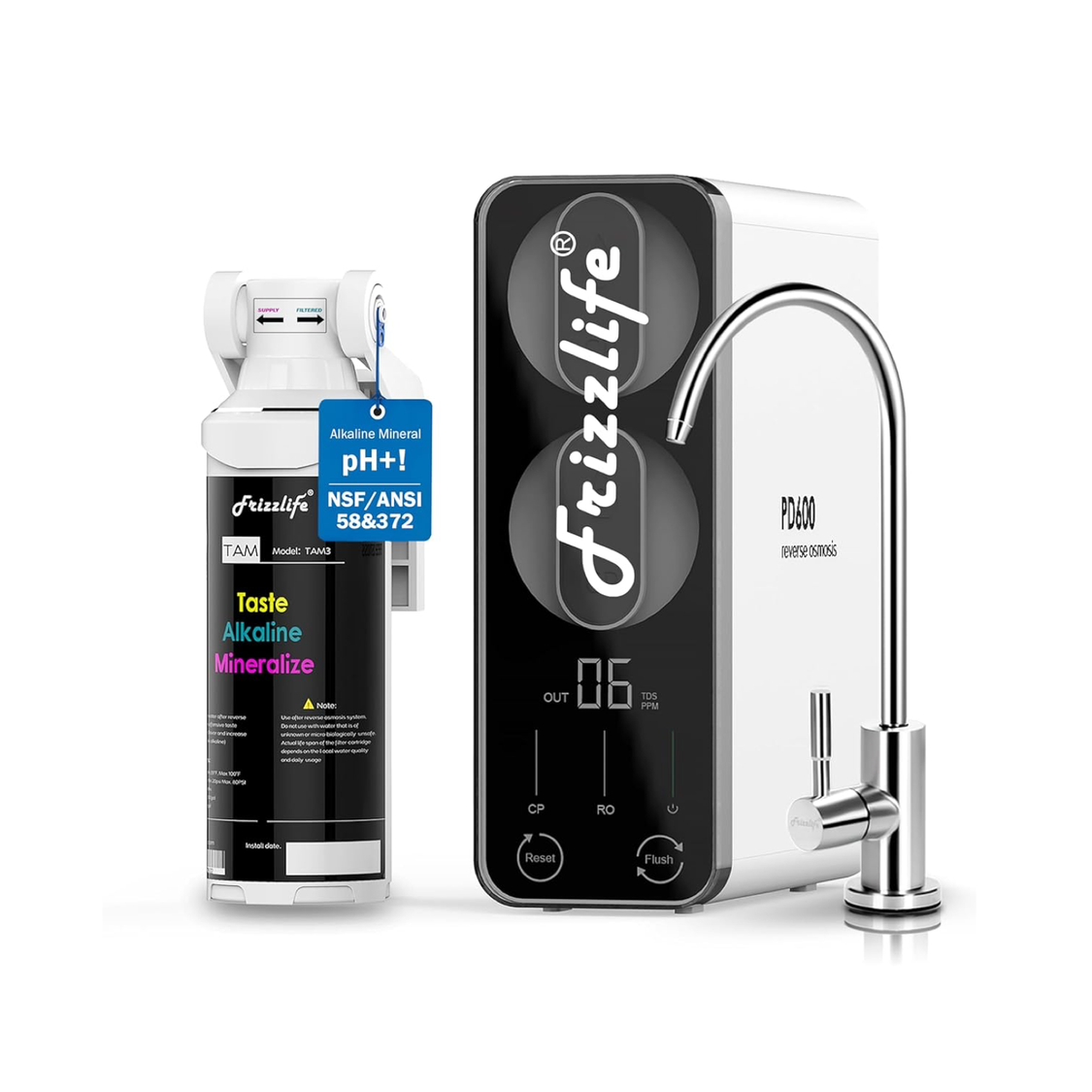
PD600-TAM3 Tankless RO System
A powered 600 GPD under-sink reverse osmosis system with a tankless design, alkaline remineralization, and real-time TDS monitoring. It should be considered only after active iron, manganese, sediment, odor, and microbial problems have been appropriately controlled.
View PD600-TAM3 →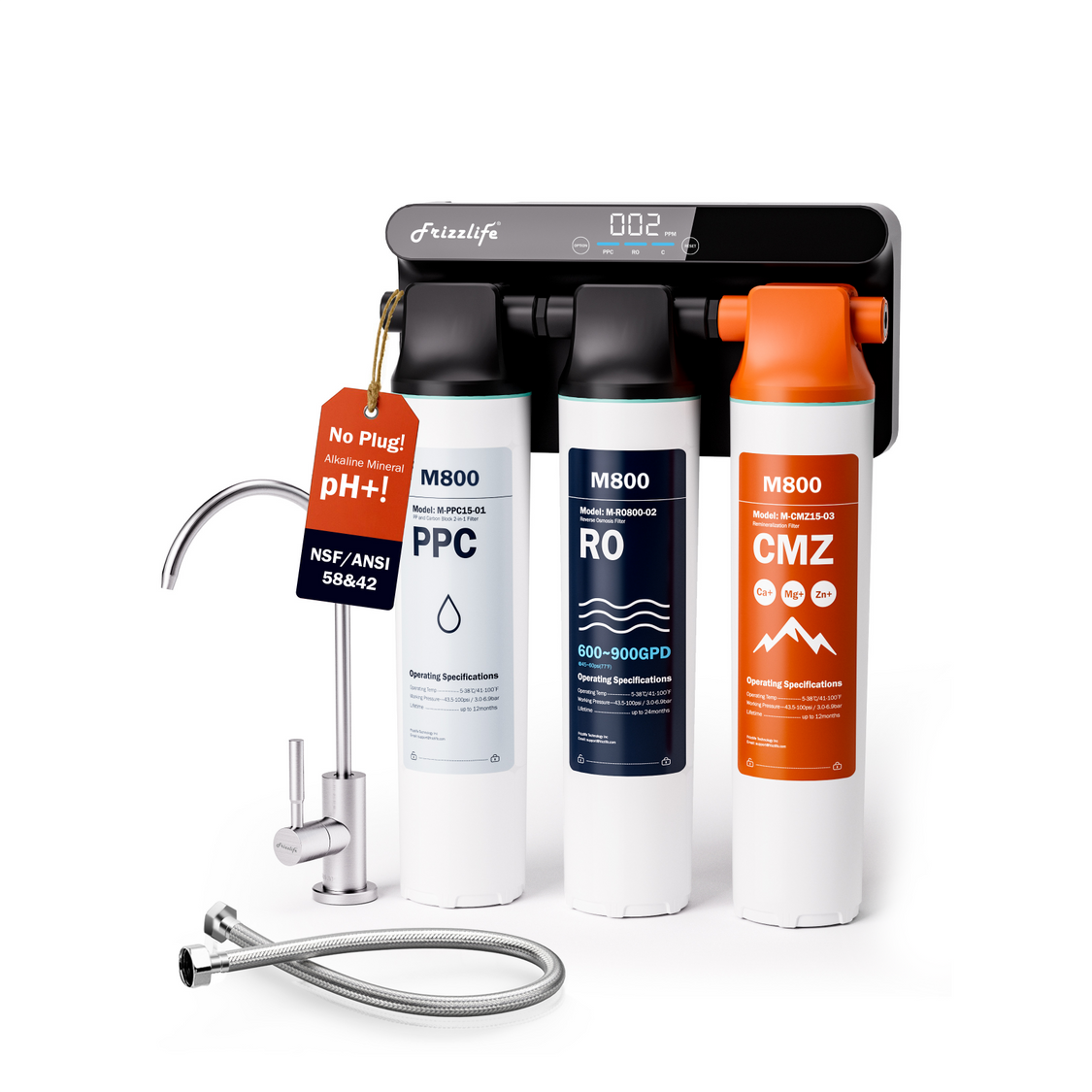
M800 Non-Electric Tankless RO System
A non-electric tankless under-sink reverse osmosis system with up to 900 GPD output. Because it relies on household water pressure, available pressure and pretreated feed-water conditions should be reviewed before selection.
View M800 →Confirm current specifications, pressure requirements, feed-water limits, pretreatment needs, maintenance, and model-specific contaminant-reduction information before installing an RO system on private-well water.
Safety, Storage, and Product Selection
Concentrated Peroxide Is a Strong Oxidizer
Concentrated hydrogen peroxide is not the same as a low-strength household antiseptic. Strong solutions can injure skin and eyes, damage incompatible materials, and react dangerously with contaminants.
Safety planning may include:
- Supplier-required eye, face, skin, and hand protection
- Compatible pumps, tanks, tubing, seals, and fittings
- Secondary containment
- Cool, ventilated storage away from heat and sunlight
- Separation from fuels, oils, organic materials, and incompatible metals
- Written spill, transfer, and emergency procedures
Follow the exact supplier Safety Data Sheet, equipment instructions, local requirements, and trained-professional procedures for transfer, storage, dilution, spill response, and personal protective equipment.
Selecting a Product Grade and Concentration
Product concentration should not be treated as a simple preference. Lower-strength products require more feed volume, while higher-strength products reduce feed volume but increase handling and equipment risk.
For potable-water use, confirm:
- The product is intended for drinking-water treatment
- Applicable certification or approval
- Maximum-use information
- Impurity limits
- Supplier technical documentation
- Compatibility with the feed equipment
- Storage and containment requirements
Do Not Attempt to Concentrate Hydrogen Peroxide
Do not attempt to concentrate hydrogen peroxide at home or on site. Purchase an appropriate product from a qualified supplier and follow its documentation.
Concentrating peroxide can create serious fire, explosion, contamination, and chemical-injury hazards.

Can Hydrogen Peroxide Be Used With Chlorine, UV, or Ozone?
Hydrogen peroxide may appear in the same overall treatment train as chlorine, UV, or ozone, but chemicals should not be casually mixed in the same tank or line.
Combined systems require a defined treatment objective, verified chemical compatibility, controlled reaction conditions, and suitable monitoring.
Homeowners should not experiment with mixing oxidants. Any combined treatment should follow a documented system design and supplier instructions.
Hydrogen Peroxide Compared With Other Oxidants
No oxidant is best for every well. The correct choice depends on laboratory results, treatment objectives, handling capabilities, maintenance, and whether a lasting disinfectant residual is required.
| Factor | Hydrogen Peroxide | Chlorine | Ozone | Permanganate |
|---|---|---|---|---|
| Common residential role | Targeted oxidation | Oxidation and disinfection | Strong onsite oxidation | Iron and manganese oxidation |
| Lasting residual | Low | Possible | No | No disinfectant residual |
| Sulfur odor control | Often suitable | Often suitable | Suitable but equipment-intensive | May fit selected designs |
| Iron oxidation | Requires downstream filtration | Requires downstream filtration | Requires downstream filtration | Requires downstream filtration |
| Manganese control | Chemistry-sensitive | Chemistry-sensitive | Strong oxidation but complex | Common specialized option |
| Equipment complexity | Moderate | Moderate | High | Moderate |
| Handling considerations | Concentrated oxidizer hazards | Oxidizer and disinfectant hazards | Generated onsite | Strong oxidizer and staining risk |
| Typical fit | Controlled odor and metal oxidation | Systems needing oxidation or residual control | Specialized high-performance systems | Selected iron and manganese systems |
When Hydrogen Peroxide May Be a Good Fit
- The main problem is tested sulfur odor or dissolved iron
- The system can provide controlled injection and reaction time
- Suitable downstream filtration is available
- A long-lasting disinfectant residual is not the main objective
- The owner can safely maintain the feed system
- Performance can be monitored and verified
When Another Approach May Be Better
- A persistent disinfectant residual is required
- The well has unresolved surface-water intrusion
- The water contains heavy sediment without pretreatment
- The main concern is nitrate, arsenic, salt, or another dissolved chemical
- The owner cannot safely store concentrated oxidants
- The treatment system will not be monitored or maintained
Maintenance and Performance Records
A hydrogen peroxide injection system should be managed as an ongoing treatment process.
Keep records of:
- Untreated and treated water-test results
- Peroxide product and concentration
- Feed-pump calibration and settings
- Chemical purchase and refill dates
- Filter pressure readings
- Backwash and cartridge-service dates
- Odor or staining changes
- Well, plumbing, and water-heater service
- Any system adjustment and the result
Records help identify seasonal changes, pump drift, increasing contaminant load, exhausted media, or a new well problem before treatment failure becomes severe.
Common Mistakes to Avoid
- Choosing peroxide before testing the water
- Treating hot-water-only odor as a whole-well problem
- Injecting peroxide without downstream filtration
- Copying a universal online dose
- Assuming “food grade” alone proves potable-water suitability
- Using a high-strength product without compatible equipment and containment
- Increasing the feed before checking mixing, flow, and filter condition
- Treating peroxide as a guaranteed pathogen barrier
- Sending untreated iron, manganese, sediment, or biofilm directly into an RO system
- Ignoring wellhead defects and surface-water intrusion
Key Takeaways
- Test the untreated well water before selecting peroxide.
- Define whether the target is sulfur odor, iron, manganese, or another condition.
- Inspect the well, plumbing, and water heater.
- Use controlled injection rather than manual guessing.
- Provide effective mixing and a properly designed reaction stage.
- Install filtration for particles created during oxidation.
- Use a potable-water-appropriate product and compatible equipment.
- Monitor odor, staining, pressure drop, chemical use, and laboratory results.
- Correct well defects and contamination sources instead of relying only on chemical treatment.
- Consider point-of-use RO only after upstream well-water problems have been controlled.
FAQs
1. Is Hydrogen Peroxide Safe for Well Water Treatment?
It can be used safely when the product is intended for potable-water treatment, the system is appropriately designed, dosing is controlled, materials are compatible, and treated-water performance is monitored. High-strength hydrogen peroxide is hazardous and should not be handled casually.
2. How Much Hydrogen Peroxide Should I Use for Well Water?
There is no universal dose. The required feed depends on the contaminant and its concentration, pH, alkalinity, temperature, peak flow, product strength, mixing, reaction time, and downstream filtration. Use laboratory results, calibrated equipment, supplier documentation, and qualified treatment design rather than a fixed online ratio.
3. Does Hydrogen Peroxide Remove Rotten-Egg Odor?
Hydrogen peroxide can oxidize hydrogen sulfide and related reduced sulfur compounds. Successful treatment generally also requires controlled injection, effective mixing, reaction time, and downstream filtration or odor polishing.
4. Can Hydrogen Peroxide Remove Iron From Well Water?
It can help oxidize dissolved iron into particles, but those particles must then be captured by an appropriately sized filter. Peroxide injection alone does not remove the oxidized iron from the water.
5. Does Hydrogen Peroxide Remove Manganese?
It may help under suitable conditions, but manganese treatment is sensitive to pH, temperature, reaction conditions, competing contaminants, and media selection. Do not assume that an iron-treatment setting will also control manganese.
6. Does Hydrogen Peroxide Kill Bacteria in Well Water?
It can contribute to microbial control under engineered conditions, but it should not be treated as a universal stand-alone pathogen barrier. Positive bacteria results may require well repair, cleaning, validated disinfection, and follow-up laboratory testing.
7. Is Hydrogen Peroxide Better Than Chlorine for Well Water?
Neither is universally better. Hydrogen peroxide may fit targeted oxidation and odor control, while chlorine may be preferred when residual disinfection or a different oxidation process is needed. The choice depends on the tested water and treatment objective.
8. Do I Need a Contact Tank With Hydrogen Peroxide?
Many oxidation applications require an effective reaction stage, but the appropriate equipment depends on flow, mixing, contaminant demand, temperature, and filtration. A nominal tank volume alone does not guarantee adequate treatment.
9. Can Hydrogen Peroxide Damage an RO System?
Uncontrolled oxidants, untreated iron, manganese, sediment, and biological fouling can affect downstream equipment. Confirm the RO manufacturer’s feed-water requirements and make sure upstream oxidation and filtration are working before sending the water to an RO system.
10. Can I Use 35% Food-Grade Hydrogen Peroxide in My Well?
Do not select a product based only on concentration or the words “food grade.” Confirm that it is intended and permitted for potable-water treatment, review applicable certification and maximum-use information, and use compatible storage, feed, and safety controls.
11. How Do You Dilute Hydrogen Peroxide Safely?
Follow the exact product Safety Data Sheet, supplier instructions, equipment documentation, and trained-professional procedures. High-strength peroxide should not be diluted using an improvised household method.
12. Can I Mix Hydrogen Peroxide With Chlorine?
Do not casually mix peroxide and chlorine in the same tank or line. They can react and change the treatment result and remaining residual. Combined systems require defined chemistry, compatible equipment, and controlled professional design.
Once sulfur odor, iron, manganese, sediment, microbial risks, and well-integrity problems have been addressed, compare point-of-use RO systems for an appropriate laboratory-confirmed drinking-water need.
View Reverse Osmosis Water Filter Systems →