


Reverse osmosis and ultrafiltration are both membrane-based water treatment methods, but they solve different problems. Reverse osmosis targets dissolved salts, ions, and other small contaminants. Ultrafiltration primarily targets sediment, colloids, turbidity, and microorganisms while allowing most dissolved minerals to remain in the water.
That distinction determines nearly every practical difference in the reverse osmosis vs ultrafiltration comparison: TDS reduction, mineral retention, water pressure, flow rate, wastewater, installation, and suitable applications.
If your main goal is lower-TDS drinking water or reduction of specific dissolved contaminants, reverse osmosis is usually the more appropriate technology. If the source water already has acceptable chemistry and you mainly want high flow, particulate filtration, and minimal wastewater, ultrafiltration may be the simpler choice.
RO vs UF Water Filter Comparison Snapshot
Reverse osmosis vs ultrafiltration side-by-side table
|
Comparison point |
Reverse osmosis |
Ultrafiltration |
|
Typical membrane scale |
Approximately 0.0001 micron, depending on membrane design |
Commonly around 0.01–0.1 micron |
|
Primary separation target |
Dissolved ions, salts, small molecules, particles, and microbes |
Suspended particles, colloids, turbidity, bacteria, protozoa, and some viruses depending on the membrane |
|
TDS reduction |
Yes; substantial reduction is typical |
Generally no meaningful reduction |
|
Dissolved mineral retention |
Most dissolved minerals are reduced |
Most dissolved minerals remain |
|
Sediment and turbidity |
Reduced, usually with prefiltration protecting the RO membrane |
Effectively targeted by the UF membrane |
|
Dissolved contaminants |
Can reduce many, subject to system design and verified claims |
Most dissolved contaminants pass through |
|
Flow |
Slower membrane production; may use a tank or high-output tankless design |
Generally faster direct flow |
|
Wastewater |
Produces a concentrate or reject stream |
Usually no continuous reject stream, though flushing or backwashing may use water |
|
Pressure requirement |
Higher pressure is needed for effective production and rejection |
Usually operates at lower pressure |
|
Drain connection |
Normally required |
Often unnecessary in basic household configurations |
|
Typical household role |
Lower-TDS drinking and cooking water |
Mineral-retaining filtration where source-water chemistry is already acceptable |
The central difference: RO targets dissolved contaminants, while UF targets suspended particles and microbes
A UF membrane acts mainly as a fine physical barrier. It blocks particles and organisms larger than its membrane openings, but dissolved sodium, calcium, magnesium, nitrate, fluoride, and many metal ions are small enough to pass through.
An RO membrane separates water from many dissolved substances at a much smaller scale. Because it rejects a large portion of dissolved ions, RO can substantially lower TDS as well as reduce many contaminants that UF cannot address.
When RO is the stronger choice
Reverse osmosis is generally the stronger option when:
-
TDS reduction is a primary goal.
-
Testing identifies nitrate, arsenic, fluoride, or dissolved metals that a particular RO system is verified to reduce.
-
The water has an objectionable concentration of dissolved salts.
-
Lower-mineral water is preferred for drinking, cooking, coffee, or tea.
-
The household accepts a drain connection and a reject stream in exchange for broader dissolved-contaminant reduction.
When UF is the simpler choice
Ultrafiltration may be more practical when:
-
The source water’s dissolved chemistry and TDS are already acceptable.
-
Sediment, cloudiness, colloids, or microbial barriers are the main concerns.
-
High direct flow is important.
-
The household wants to retain dissolved minerals.
-
Drain access, installation space, pressure, or wastewater is a major constraint.
Why neither technology is universally better
RO is not automatically necessary for every municipal water supply. UF is also not an equivalent substitute when dissolved salts or ions are the problem.
The better choice depends on the source water, target contaminants, inlet pressure, expected flow, available space, and tolerance for wastewater. Water testing should drive the decision—not the assumption that one membrane is universally superior.
How Reverse Osmosis and Ultrafiltration Work
What is reverse osmosis?
Reverse osmosis is a pressure-driven separation process. Feed water is pushed against a semipermeable membrane, allowing a portion of the water to become treated permeate while rejected contaminants leave through a concentrate line.
Household RO membranes are often described as having an effective separation scale around 0.0001 micron. This figure is useful for comparison, but RO does not work only like a simple screen. Solubility, diffusion, membrane chemistry, ion charge, pressure, and water composition all influence rejection.
What is ultrafiltration?
Ultrafiltration passes water through a membrane with openings commonly in the range of approximately 0.01–0.1 micron. Household UF systems frequently use hollow-fiber membranes.
UF retains larger material such as:
-
Sediment and suspended solids
-
Colloids that contribute to cloudiness
-
Protozoa
-
Bacteria
-
Some viruses, depending on membrane characteristics and integrity
It does not normally retain the small dissolved ions responsible for most TDS.
UF membrane vs RO membrane: pore size and separation mechanism
The UF membrane vs RO membrane distinction goes beyond one being “finer.”
UF behaves largely as size-exclusion filtration: material too large to pass through the membrane remains on the feed side. RO uses a dense semipermeable membrane that separates many dissolved solutes from water at the molecular and ionic level.
That is why a glass of water can look perfectly clear after UF while retaining nearly the same TDS reading. The visible particles may be gone, but dissolved salts remain.

Why pressure requirements differ between RO and UF
RO must overcome the natural tendency of water to move toward the side with a higher dissolved-solids concentration. Adequate inlet pressure is therefore necessary to produce permeate and maintain effective rejection.
Residential RO systems commonly operate within household pressure ranges, but exact minimum and rated pressures are model-specific. Low pressure can reduce output and may also lower contaminant rejection.
UF faces less resistance because its membrane openings are larger and it is not designed to separate most dissolved ions. This generally allows faster flow at lower pressure.
Why membrane type alone does not guarantee contaminant reduction
“RO” or “UF” describes a treatment technology, not a complete performance certificate.
Actual reduction depends on:
-
Membrane specifications and condition
-
Pretreatment stages
-
Carbon filter design
-
Feed-water chemistry
-
Pressure and temperature
-
Flow and recovery settings
-
Seal and membrane integrity
-
System-level testing and certification
Check the specific product’s performance data for the contaminant you need to address. A general statement about RO or UF should not be treated as proof that every system reduces every contaminant.
Does Ultrafiltration Reduce TDS?
In normal household applications, ultrafiltration does not meaningfully reduce TDS. Dissolved salts and ions are much smaller than the substances a UF membrane is intended to block.
What total dissolved solids measure—and what a TDS meter cannot identify
Total dissolved solids refers broadly to dissolved inorganic salts and small amounts of dissolved organic matter. Common contributors include calcium, magnesium, sodium, chloride, bicarbonate, and sulfate.
A handheld TDS meter usually measures electrical conductivity and converts it into an estimated TDS value. It cannot identify individual substances.
A reading of 300 ppm, for example, does not tell you whether the dissolved material is mostly calcium and bicarbonate or whether a specific contaminant is present. Laboratory analysis is needed for that information.

Why dissolved salts and ions pass through a UF membrane
Calcium, sodium, chloride, nitrate, and similar ions are dissolved in the water rather than suspended as particles. Their effective size is far below the separation range of a typical UF membrane.
UF may remove material that carries or contains some dissolved substances, but it should not be purchased with the expectation that it will significantly lower overall TDS or hardness.
How reverse osmosis reduces TDS
RO separates a substantial portion of dissolved ions from the product water. Rejected salts become more concentrated in the stream sent to the drain.
TDS rejection can be estimated with inlet and product-water readings:
TDS rejection (%) = [(Feed TDS − Product TDS) ÷ Feed TDS] × 100
This calculation is useful for monitoring general membrane performance. It does not verify reduction of a particular contaminant.
Typical RO rejection rates versus NSF/ANSI 58 minimum test requirements
Household RO systems can substantially reduce TDS under suitable conditions, but the exact reduction varies by system design and operating conditions.
Under NSF/ANSI 58 testing requirements, RO drinking-water treatment systems must demonstrate at least 75% TDS reduction under standardized test conditions. That minimum should not be interpreted as the exact reduction every household will see, because actual performance depends on the system and operating conditions. That is a standardized minimum test condition, not a prediction of the exact result from every tap.
Certification to the standard also should not be interpreted as certification for every optional contaminant claim. Review the certification listing and performance data for the specific model.
Why actual RO TDS reduction varies with pressure, temperature, feed water, and membrane condition
RO performance can change because of:
-
Pressure: Insufficient pressure can lower production and rejection.
-
Temperature: Colder water generally passes through a membrane more slowly.
-
Feed composition: Different ions have different rejection behavior.
-
Membrane condition: Fouling, scaling, age, or damage can affect results.
-
Recovery setting: Product-to-reject water settings influence membrane operation.
-
Testing method: TDS meter accuracy and water temperature can affect readings.
Compare readings only after the system has stabilized and according to the manufacturer’s testing instructions.
TDS, hardness, and safety are not the same thing
TDS is a broad measurement, not a standalone safety score. Low TDS does not prove water is free of harmful substances, and high TDS does not identify which dissolved substances are present.
Hardness is mainly associated with calcium and magnesium. These minerals contribute to TDS, but TDS includes many other ions. RO can reduce hardness ions in drinking water, although an under-sink RO system is not a replacement for whole-house softening when scale control throughout the plumbing is the goal.
When a small change in TDS after UF can be misleading
A minor difference before and after UF may result from meter variation, temperature, sampling, or removal of fine material that affected conductivity. It does not establish that the UF membrane reliably removes dissolved salts.
If meaningful TDS reduction is required, choose a technology designed and verified for that purpose.
What RO Removes That UF Does Not
RO vs UF contaminant-removal comparison table
|
Contaminant category |
Reverse osmosis |
Ultrafiltration |
|
Dissolved salts and TDS |
Substantial reduction is typical |
Generally passes through |
|
Calcium and magnesium ions |
Reduced |
Generally retained |
|
Nitrate and fluoride |
Can be reduced by appropriately tested systems |
Generally not effectively reduced |
|
Dissolved arsenic and metals |
May be reduced; performance depends on contaminant form and system verification |
Generally not a dependable treatment |
|
Sediment and turbidity |
Reduced through prefilters and membrane treatment |
Primary treatment strength |
|
Bacteria and protozoa |
Membrane can provide a barrier when intact |
Primary treatment strength when membrane integrity is maintained |
|
Viruses |
RO can reject viruses when properly designed and intact |
Performance varies with membrane pore characteristics and integrity |
|
Chlorine, taste, and odor |
Usually addressed by carbon stages rather than the RO membrane alone |
Usually requires carbon in addition to UF |
|
Dissolved organic chemicals |
Highly substance- and system-dependent |
Many small dissolved organics may pass through |
Dissolved salts, hardness ions, and other contributors to TDS
RO can reduce sodium, chloride, calcium, magnesium, and other dissolved ions. UF retains most of them. Consequently, an RO vs UF water filter may produce water that looks equally clear but has a very different mineral and TDS profile.
Arsenic, nitrate, fluoride, and dissolved heavy metals
RO is often selected to address dissolved inorganic contaminants such as nitrate, fluoride, arsenic, and certain metals. Performance is not identical for every contaminant or chemical form, however.
For example, arsenic can exist in different forms that behave differently during treatment. A product should have relevant system-level testing or certification for the precise claim rather than relying on a broad statement that “RO removes everything.”
UF is generally not appropriate for these dissolved contaminants unless they are attached to larger particles—and that condition should never be assumed.
Sediment, turbidity, colloids, and suspended particles
UF is particularly effective at physically retaining suspended material. It can provide clear, high-flow water where the underlying dissolved chemistry is already suitable.
RO systems also need sediment control. Prefilters protect the more sensitive RO membrane from particles that could clog or damage it.
Bacteria, protozoa, and viruses
Properly designed UF and RO membranes can provide strong barriers to microorganisms. UF is commonly used for bacteria and protozoa control, while virus performance depends on the membrane’s pore size, integrity, and validated design.
A membrane system should not be treated as an unconditional safeguard for contaminated surface water or an unknown well. Cracks, failed seals, fouling, and poor maintenance can compromise performance. WHO guidance emphasizes evaluating household water-treatment technologies against defined microbiological performance targets, so high-risk water may require validated disinfection and ongoing microbial monitoring.
Chlorine, taste, odor, and organic chemicals: the role of carbon filtration
Neither membrane should be evaluated in isolation. Activated carbon is commonly used to reduce chlorine, taste, odor, and selected organic compounds.
Carbon pretreatment is especially important for many RO membranes because chlorine exposure can damage certain membrane materials. The carbon stage’s capacity and specific reduction claims remain product-dependent.
Why specific contaminant claims require system-level testing or certification
Membrane theory indicates what a technology may be capable of reducing. Certification or verified testing indicates what a specific complete system has demonstrated under defined conditions.
When comparing products, look for:
-
The exact standard and certification body
-
The certified model number
-
Named contaminant claims
-
Tested reduction capacity
-
Required operating pressure
-
Replacement conditions
-
Efficiency and recovery information
Do not infer that certification for TDS reduction automatically includes nitrate, arsenic, lead, fluoride, or other optional claims.
When UF can serve as pretreatment for an RO membrane
UF can be installed upstream of RO to reduce fine particles, colloids, and microbial loading. This may help control fouling where the feed water contains challenging suspended material.
It does not eliminate the need to evaluate hardness, iron, chlorine, or other water-specific risks. A combined treatment train should be designed around test results rather than assembled solely on the assumption that more stages always mean better water.
Flow Rate, Water Pressure, and Wastewater
Why UF generally delivers faster direct flow
UF membranes have larger openings and do not separate dissolved salts. Water can therefore pass through more readily, often allowing tankless direct flow from normal line pressure.
Actual flow depends on membrane area, filter condition, plumbing, inlet pressure, and water temperature.
Why RO permeate production is slower
Only part of the feed becomes purified permeate. The membrane must reject dissolved substances while a concentrate stream carries them away, so production is inherently more restrictive than UF.
Tank-based versus tankless household RO configurations
Traditional under-sink RO systems may store treated water in a pressure tank so it is available quickly at the faucet. The tank occupies additional cabinet space and dispensing pressure can change as it empties.
Tankless RO systems produce water on demand and may use a pump to support higher output. They can save space, but electricity, noise, rated flow, efficiency, and maintenance requirements depend on the specific model.
How low inlet pressure affects RO flow and TDS rejection
When inlet pressure falls below a system’s operating range, permeate output generally declines. TDS rejection may also worsen, and a pressure tank can fill slowly.
Before purchasing an RO system, verify actual static and flowing pressure against the product specification. A booster pump may be appropriate for some low-pressure installations, but it should be matched to the system.
Does ultrafiltration waste water?
Most household UF systems do not produce a continuous reject stream. Nearly all incoming water passes through the treatment path.
Some UF designs require periodic flushing or backwashing to remove accumulated material. That water use should be included when comparing systems, even though it differs from continuous RO concentrate.
Why reverse osmosis produces a reject stream
Rejected salts and contaminants must be carried away from the membrane surface. Without sufficient concentrate flow, dissolved material would accumulate, increasing scaling and fouling risk.
The reject stream is therefore part of how RO works—not merely an optional byproduct.

Understanding RO wastewater ratios without relying on a universal number
RO wastewater ratios vary significantly by system design and operating conditions. EPA notes that a typical point-of-use RO system may generate five gallons or more of reject water for every gallon of treated water, while WaterSense-labeled systems must limit reject water to 2.3 gallons or less per gallon of treated water. Some individual high-efficiency systems may perform better, so compare model-specific efficiency or waste-to-product specifications.
Neither figure is universal. Pressure, temperature, feed TDS, membrane design, pump control, flow restrictors, and system condition affect the ratio. Compare the manufacturer’s stated efficiency or recovery under defined test conditions rather than relying on a category-wide claim.
Periodic UF flushing or backwashing versus continuous RO concentrate
UF water use is usually intermittent: flushing removes particles retained by the membrane. RO concentrate flows while the system is producing purified water.
This difference makes UF attractive where water conservation is a high priority, provided UF can actually treat the identified water-quality problem.
Choosing for low-pressure homes or water-scarce regions
UF is often easier to operate where pressure is limited and dissolved-contaminant reduction is unnecessary. In water-scarce areas, its lack of continuous concentrate is another advantage.
If RO is required because of dissolved contaminants, focus on a system with suitable pressure management and clearly stated efficiency specifications. The need for treatment should be balanced against total water use, not dismissed solely because RO produces concentrate.
Minerals, Taste, Installation, and Maintenance
Mineral retention in UF versus mineral reduction in RO
UF leaves most calcium, magnesium, sodium, and other dissolved minerals in place. RO reduces much of this mineral content along with unwanted dissolved substances.
Mineral retention is not automatically preferable if the same water contains excessive salts or a contaminant of concern. Conversely, mineral reduction may be unnecessary when source-water chemistry is already acceptable.
How RO and UF can change drinking-water taste
UF-treated water generally tastes similar to the source water, especially when no carbon stage is present. With carbon, chlorine-related tastes and odors may be reduced.
RO water has lower mineral content and may taste lighter or less mineralized. Preference varies: some people favor the cleaner profile, while others describe very low-TDS water as flat.
When remineralization may be a preference rather than a necessity
A remineralization stage can alter taste and raise mineral content after RO. It may be desirable for users who prefer a more mineralized flavor.
Whether it is needed should not be decided from taste claims alone. Drinking water is not the only dietary source of minerals, and individual nutrition questions are better discussed with an appropriate healthcare professional.
Space, drain connection, tank, and electricity considerations
Before choosing ultrafiltration vs reverse osmosis, inspect the installation location.
Consider:
-
Available cabinet or counter space
-
Access to the cold-water line
-
Drain connection requirements
-
Room for a storage tank, if used
-
Electrical access for pumped or tankless designs
-
Faucet or countertop configuration
-
Local plumbing requirements
UF is often simpler because it may not need a tank, drain, or electricity. Product-specific requirements still control.
Sediment and carbon prefiltration needs
Both technologies benefit from appropriate pretreatment. Sediment filters protect downstream stages from particles, while carbon can reduce chlorine and selected taste or odor compounds.
RO pretreatment is especially important because sediment, oxidants, and fouling substances can shorten membrane performance. UF may itself serve as particulate pretreatment but does not replace carbon where chlorine reduction is required.
Membrane fouling risks from hardness, iron, sediment, and untreated source water
Hardness can form scale on an RO membrane. Iron, manganese, sediment, and biological growth can also impair either technology.
A TDS reading alone will not reveal these risks. Private wells and untreated sources should be tested for relevant minerals, metals, microbes, pH, turbidity, and other local concerns before system design.
Filter replacement, membrane care, and UF flushing
Maintenance may include:
-
Replacing sediment and carbon cartridges
-
Flushing a UF membrane
-
Sanitizing housings or storage tanks
-
Monitoring product-water TDS from an RO system
-
Checking for leaks and failed seals
-
Replacing a membrane when performance falls outside specification
There is no universal replacement schedule. Water quality, usage, cartridge capacity, and system design all matter.

Why product specifications should determine maintenance schedules
Follow the instructions for the exact model. Do not extend filter life merely because the water still looks clear, and do not replace a membrane based only on a generic online schedule.
A sudden increase in RO product-water TDS may indicate membrane deterioration, seal problems, inadequate pressure, or a testing issue. Diagnosis should precede replacement.
Best Use Cases for Ultrafiltration vs Reverse Osmosis
Municipal water with acceptable TDS but sediment, turbidity, or taste concerns
UF combined with appropriate sediment and carbon filtration can be a practical choice when municipal water chemistry is acceptable and the goals are clearer water, high flow, mineral retention, and improved taste.
Check the utility’s water-quality report rather than assuming acceptable TDS means every other parameter is satisfactory.
High-TDS tap water where dissolved-solids reduction is the goal
Choose RO when the central objective is to lower dissolved salts. UF is unlikely to deliver the expected result and may leave the TDS reading nearly unchanged.
TDS around or above a secondary guideline such as 500 mg/L can affect taste, deposits, and treatment decisions, but it is not by itself a complete safety assessment. Identify what makes up the TDS before selecting treatment.
Private well water with hardness, nitrate, iron, or microbial concerns
Well water usually requires a multi-parameter laboratory test.
-
RO may be suitable for tested nitrate or dissolved-contaminant concerns when the specific system has a relevant reduction claim.
-
A softener or scale-control strategy may be needed for severe hardness.
-
Iron or manganese may require dedicated pretreatment.
-
Microbial contamination may require disinfection and source correction.
Neither a basic UF nor an under-sink RO unit should be expected to solve every well-water problem alone.
Surface water and boil-water scenarios: why testing and disinfection planning matter
Surface water can change rapidly and may contain microorganisms, turbidity, organic matter, and chemical contaminants. Treatment should include source-specific testing, validated disinfection, and a plan for membrane integrity.
During a boil-water advisory, follow instructions from the responsible public authority. Do not assume that an unverified household membrane replaces official guidance.
Apartments and compact kitchens with limited installation space
Compact UF systems can be appealing when a drain connection, tank, or electrical outlet is unavailable. Tankless RO may also reduce storage-space needs, but it can require power and a drain.
Renters should confirm plumbing permissions and restoration requirements before installation.
Homes that prioritize high flow and minimal wastewater
UF is often the stronger fit when source-water chemistry is acceptable and users prioritize direct flow with no continuous reject stream.
Choosing UF only for its water efficiency is a mistake if testing shows that dissolved contaminants must be reduced.
Households seeking lower-TDS drinking and cooking water
RO is the clearer choice for lower-TDS water at a dedicated faucet. Households comparing configurations can review Frizzlife reverse osmosis systems while checking each model’s pressure, flow, efficiency, installation, and verified contaminant-reduction information.
RO Options to Compare
If your water test and treatment goals point toward reverse osmosis, compare the system design, output, installation requirements, and maintenance needs before choosing a model.
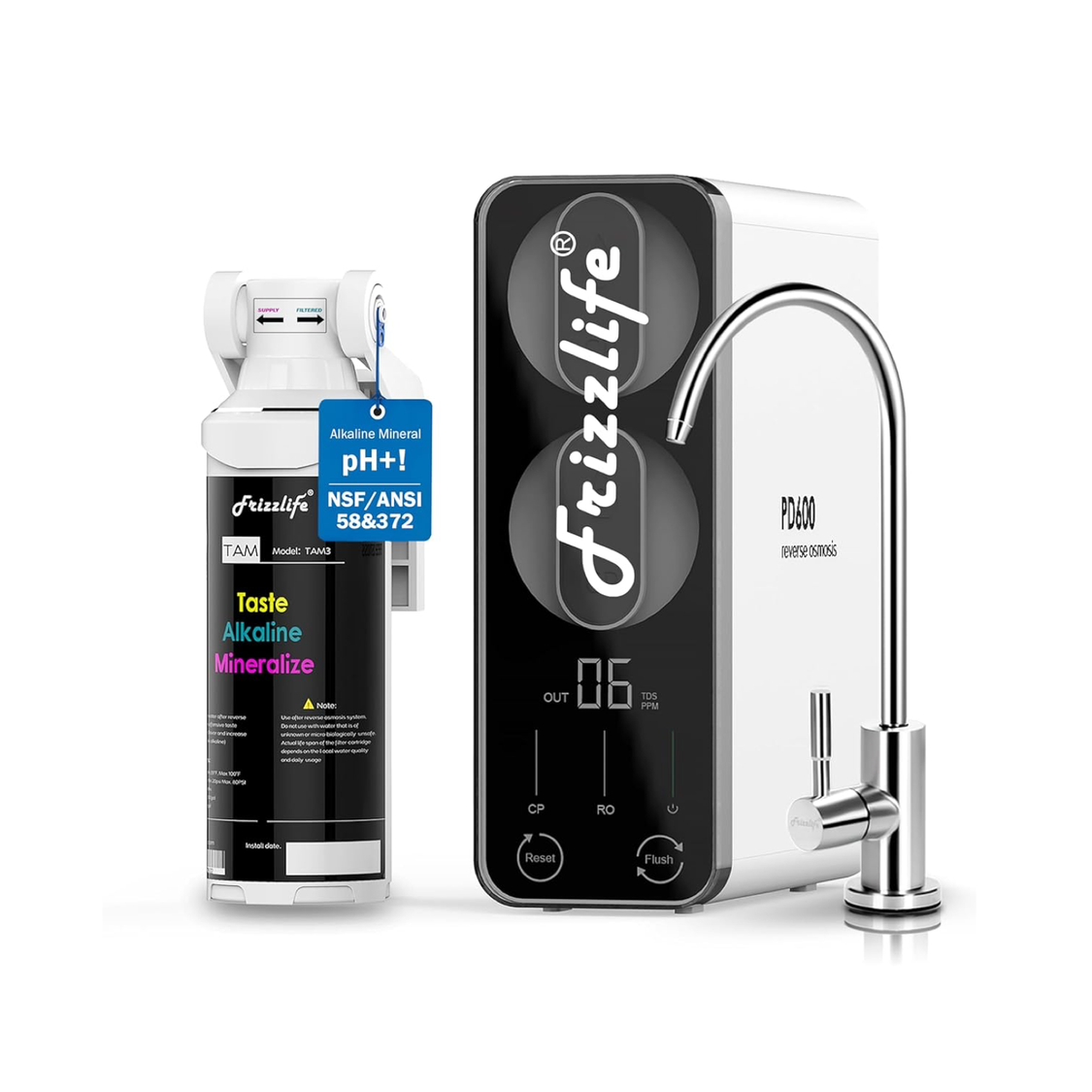
Frizzlife PD600-TAM3
A compact under-sink RO option for households that want lower-TDS drinking water together with alkaline remineralization and smart system monitoring.
- 600 GPD rated output
- Tankless under-sink design
- Alkaline remineralization stage
- Real-time TDS display
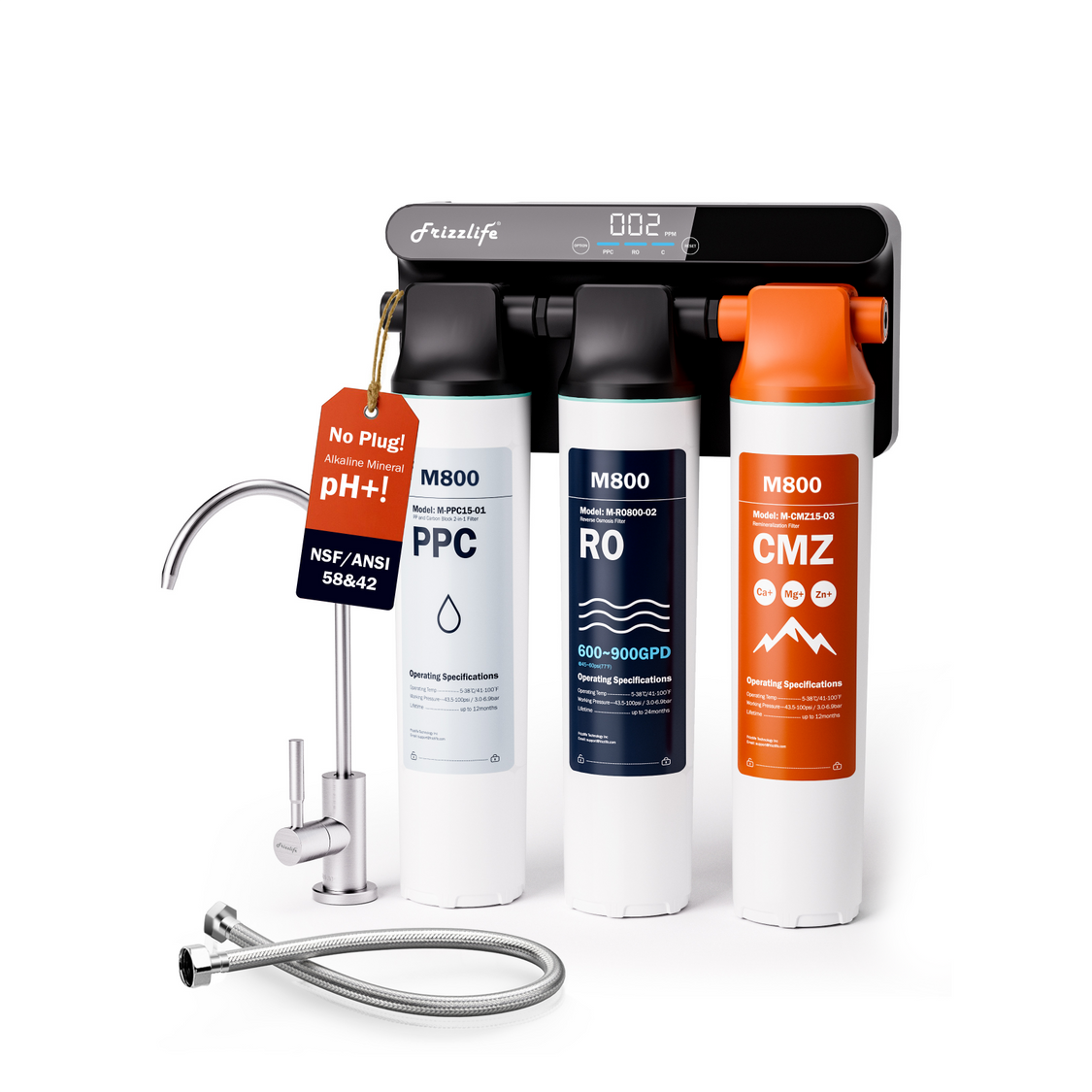
Frizzlife M800
A higher-output tankless RO option for users who want fast filtered-water delivery without an electric pump, while retaining an alkaline remineralization stage.
- Up to 900 GPD rated output
- Non-electric tankless design
- Alkaline remineralization
- Designed for higher-flow RO use
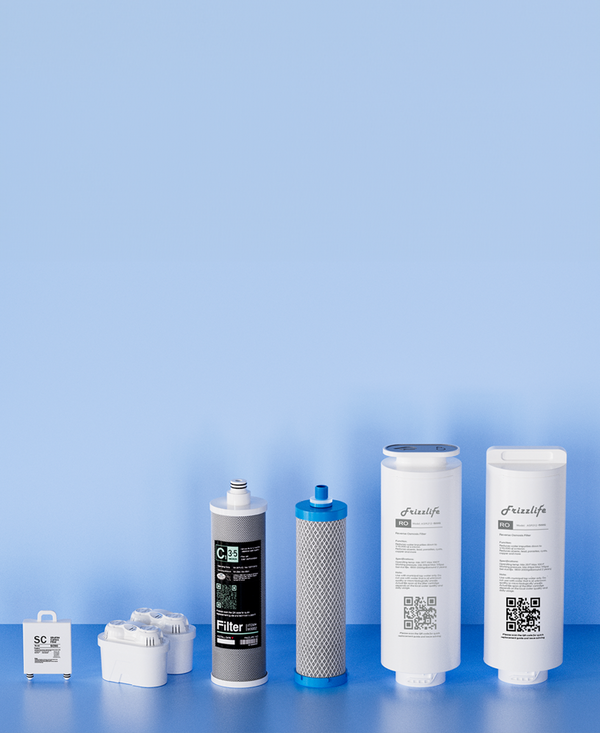
Frizzlife Replacement Filters
Already own a Frizzlife filtration system? Find compatible replacement cartridges for PD600-TAM3, M800, and other Frizzlife systems.
- Find filters by system model
- PD-series replacement options
- M800 replacement options
- Supports ongoing system maintenance
When a combined UF, carbon, and RO treatment approach makes sense
A combined approach can be useful when water contains both suspended material and dissolved contaminants:
-
Sediment or UF treatment reduces particles and colloids.
-
Carbon addresses chlorine and selected organic compounds.
-
RO reduces TDS and targeted dissolved contaminants.
-
Optional post-treatment adjusts taste.
More stages are not inherently better. Each should address a measured problem and be maintained correctly.
Which Is Better, Reverse Osmosis or Ultrafiltration?
Start with a certified water-quality report or laboratory test
For municipal water, begin with the utility’s current consumer confidence or water-quality report. For a private well, use an accredited laboratory and select tests based on local geology, land use, plumbing materials, and known regional risks.
Home TDS meters are useful for screening and monitoring, but they cannot replace contaminant-specific testing.
Decision checklist: TDS, target contaminants, source, pressure, flow, space, and wastewater
Before choosing, answer these questions:
-
What is the water source?
-
What does testing show?
-
Is lower TDS an actual goal?
-
Are the concerns dissolved or suspended?
-
Is microbial risk present?
-
What is the home’s inlet pressure?
-
How much treated-water flow is needed?
-
Is there space for a tank or pump?
-
Is a drain connection available?
-
How important is mineral retention?
-
What wastewater level is acceptable?
-
Does the exact system have verified claims for the target contaminants?
Choose RO when dissolved contaminants or TDS reduction drive the decision
RO is generally the right direction for high-TDS water or tested dissolved contaminants that an appropriately certified system is designed to reduce. It provides a broader separation range, but requires adequate pressure, pretreatment, maintenance, and management of concentrate water.
Choose UF when source-water chemistry is acceptable and mineral retention matters
UF is well suited to water with acceptable dissolved chemistry where suspended solids, turbidity, and microbial barriers are the main treatment objectives. It offers high flow and usually avoids continuous wastewater.
Avoid buying UF if you expect meaningful TDS or hardness reduction
This is the most common mismatch in the reverse osmosis vs ultrafiltration decision. UF can make water look clearer without materially changing its dissolved mineral content.
If a lower TDS meter reading or reduced hardness ions is the goal, UF is not an equivalent alternative to RO.
Avoid choosing RO solely because it sounds more comprehensive
RO may add unnecessary installation, wastewater, and maintenance where the water is already low in dissolved solids and the only concerns are sediment or chlorine taste.
Use the least complex technology that reliably addresses the measured problem.
How to evaluate certifications, performance data, and wastewater specifications
Read beyond general marketing language. Confirm:
-
Whether the complete system is certified or only a component
-
The exact contaminants covered by the certification
-
Test pressure and feed-water conditions
-
Rated production or service flow
-
Efficiency or recovery information
-
Required pretreatment
-
Filter capacities and replacement instructions
-
Whether electricity, a tank, or a drain is required
“Tested to” and “certified to” are not interchangeable. Certification involves independent evaluation and an identifiable listing.
Explore Frizzlife reverse osmosis systems for TDS-focused treatment
For households whose testing and priorities point toward dissolved-solids reduction, the Frizzlife RO system collection provides a relevant next step. Compare individual system specifications rather than assuming every RO configuration has the same flow, efficiency, pressure requirements, or contaminant claims.
Final RO vs UF decision matrix by household condition
|
Household condition |
More likely choice |
Important qualification |
|
Acceptable municipal chemistry; sediment or turbidity concern |
UF |
Add carbon if chlorine taste or odor is also a concern |
|
High TDS and lower-TDS drinking water desired |
RO |
Confirm pressure, efficiency, and feed-water suitability |
|
Tested nitrate, fluoride, arsenic, or dissolved metal concern |
Verified RO system |
Require a specific reduction claim for the target contaminant |
|
High flow and no continuous reject stream are priorities |
UF |
Only if dissolved chemistry is acceptable |
|
Severe hardness throughout the home |
Water-specific treatment plan |
Point-of-use RO can reduce drinking-water hardness but is not whole-house softening |
|
Low inlet pressure |
Often UF, or pumped RO |
Check exact product requirements |
|
Surface water or confirmed microbial contamination |
Engineered multi-barrier plan |
Do not rely on an unverified membrane alone |
|
Sediment plus high TDS |
Pretreatment plus RO |
UF may serve as pretreatment where appropriate |
|
Compact kitchen |
Compact UF or tankless RO |
Compare drain, electricity, pressure, and space requirements |
|
Mineral retention is preferred |
UF |
Confirm that retained dissolved constituents are acceptable |
The practical conclusion is straightforward: choose reverse osmosis when dissolved contaminants or TDS reduction define the problem. Choose ultrafiltration when the source-water chemistry is already acceptable and the priority is particulate removal, mineral retention, direct flow, and minimal wastewater. Test first, then select a system whose verified performance matches the water—not just the technology name.
References
-
https://www.epa.gov/watersense/point-use-reverse-osmosis-systems
-
https://www.epa.gov/sdwa/secondary-drinking-water-standards-guidance-nuisance-chemicals