

 MK99
Filtro de agua debajo del fregadero Frizzlife MK99
NSF/ANSI 42/53$62.99$69.99Precio unitario /AgotadoCode : US7-
NEWSK99 New
Frizzlife Sistema de filtro de agua debajo del fregadero de 3 etapas SK99-NEW, Conexión directa
NSF/ANSI 53/42$106.99$125.99Precio unitario /AgotadoCode : SK19 -
NEWSP99 New
Sistema de filtro de agua para debajo del fregadero Frizzlife con grifo de níquel cepillado SP99-NEW
NSF/ANSI 42/53$109.99$129.99Precio unitario /AgotadoCode : SP20 -
TW10
Frizzlife TW10 Sistema de filtro de agua debajo del fregadero, elementos certificados por NSF/ANSI 53 y 42
NSF/ANSI 372$179.99Precio unitario /Agotado -
MP99
Frizzlife MP99 Filtro de agua debajo del fregadero con grifo para beber
NSF/ANSI 42/53$79.99Precio unitario /Agotado -
FK99
Frizzlife FK99 Sistema de filtro de agua debajo del fregadero de conexión directa
NSF/ANSI 372$79.99Precio unitario /Agotado -
![Sistema de filtro de agua Frizzlife SW10/SW15/SW20 de conexión directa debajo del fregadero. Reduce el 99,99 % de plomo, cloro, mal sabor y olor.]()
![Sistema de filtro de agua Frizzlife SW10/SW15/SW20 de conexión directa debajo del fregadero. Reduce el 99,99 % de plomo, cloro, mal sabor y olor.]() SW10
Sistema de filtro de agua Frizzlife SW10/SW15/SW20 de conexión directa debajo del fregadero. Reduce el 99,99 % de plomo, cloro, mal sabor y olor.
NSF/ANSI 372Desde $69.99Precio unitario /Agotado -
TW15
Frizzlife TW15 Sistema de filtro de agua para debajo del fregadero, elementos certificados NSF/ANSI 53 y 42, reduce el 99,99 % de plomo, cloro, cloramina, fluoruro, mal sabor y olor
NSF/ANSI 372$219.99Precio unitario /Agotado -
![Sistema de filtro de agua Frizzlife SW10F/SW15F/SW20F con conexión directa debajo del fregadero. Reduce el 99,99 % de plomo, cloro, mal sabor y olor.]()
![Sistema de filtro de agua Frizzlife SW10F/SW15F/SW20F con conexión directa debajo del fregadero. Reduce el 99,99 % de plomo, cloro, mal sabor y olor.]() SW10F
Sistema de filtro de agua Frizzlife SW10F/SW15F/SW20F con conexión directa debajo del fregadero. Reduce el 99,99 % de plomo, cloro, mal sabor y olor.
NSF/ANSI 372Desde $74.99Precio unitario /Agotado -
![Sistema de filtro de agua bajo fregadero Frizzlife DW10F/DW15F con grifo de níquel cepillado y elementos con certificación NSF/ANSI 53 y 42]()
![Sistema de filtro de agua bajo fregadero Frizzlife DW10F/DW15F con grifo de níquel cepillado y elementos con certificación NSF/ANSI 53 y 42]() AgotadoDW10F
Sistema de filtro de agua bajo fregadero Frizzlife DW10F/DW15F con grifo de níquel cepillado y elementos con certificación NSF/ANSI 53 y 42
NSF/ANSI 372Desde $134.99Precio unitario /Agotado -
DW10 NEW
Sistema de filtro de agua bajo fregadero Frizzlife DW10/DW15, elementos con certificación NSF/ANSI 53 y 42, filtro de agua de 2 etapas con conexión directa
NSF/ANSI 372$129.99Precio unitario /Agotado -
DW15 NEW
Sistema de filtro de agua bajo fregadero Frizzlife DW10/DW15, elementos con certificación NSF/ANSI 53 y 42, filtro de agua de 2 etapas con conexión directa
NSF/ANSI 372$159.99Precio unitario /Agotado


Activated Carbon Water Filters for Everyday Drinking Water
An activated carbon water filter can be a practical way to improve the taste and odor of everyday tap water. Frizzlife's carbon-based filtration collection includes under-sink systems with different cartridge designs, faucet connections and maintenance needs. Whether you're filling a glass, making coffee or preparing food, the right carbon water filtration system depends on your water-quality concerns and kitchen setup.
Most systems in this collection are non-reverse-osmosis (non-RO) under-sink filters. They are intended for point-of-use filtration rather than whole-house treatment. Compare the exact model's verified reduction claims, installation requirements and replacement cartridges before choosing.
How Does an Activated Carbon Water Filter Work?
Activated carbon is processed to create a porous material with a large internal surface area. As water passes through a carbon filter, certain dissolved compounds attach to its surface through adsorption. This is why carbon filtration is commonly used to address chlorine-related taste and odor. A carbon block water filter can also incorporate fine-particle filtration, depending on its construction.
Not every carbon cartridge performs the same way. Contact time, carbon formulation, filter construction, water conditions and cartridge age affect results. Reduction of chloramine, lead, volatile organic compounds (VOCs) or other substances should only be expected where the specific model has supporting performance documentation.
Better Taste and Odor
Carbon filtration is often chosen to help reduce chlorine taste and unpleasant odors in municipal tap water. Actual results depend on the cartridge and water conditions.
Convenient Kitchen Use
Under-sink systems provide filtered water where it is used most, including for drinking, tea, coffee and food preparation.
Mineral-Retaining Approach
Unlike an RO membrane, conventional carbon filtration generally does not substantially lower dissolved mineral content or total dissolved solids (TDS).
Important: Carbon filtration does not automatically make contaminated water microbiologically safe, and it should not be assumed to remove fluoride, arsenic, nitrates, PFAS or every heavy metal. For a particular concern, review an appropriate water test and the model's independent test or certification details.
Compare Frizzlife Carbon Water Filters
These models represent different ways to use a carbon-based under sink water filter. A direct-connect filter uses your existing kitchen faucet; a dedicated-faucet design provides a separate outlet for filtered water.
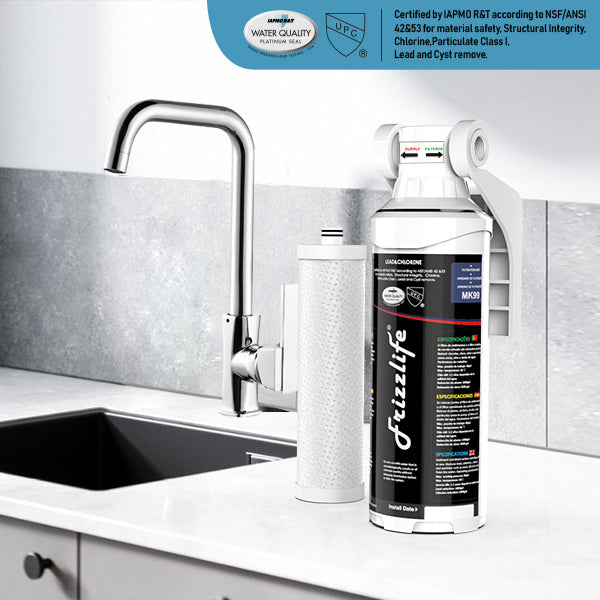
MK99: A Compact Direct-Connect Carbon Filter
MK99 uses a two-stage, carbon-based filtration design and connects to the existing cold-water kitchen line. It suits households that want convenient filtered tap water without adding a separate drinking-water faucet.
Check the available cabinet space, fitting sizes and replacement cartridge requirements before installation.
Explore the MK99 under-sink filter| Frizzlife model | Water outlet | Main distinction | Check before ordering |
|---|---|---|---|
| MK99 | Existing kitchen faucet | Compact, two-stage filtration setup | Under-sink line compatibility and FZ-2 replacement cartridge |
| SK99-NEW | Existing kitchen faucet | Multi-stage direct-connect system | Cabinet clearance and stage-specific replacement filters |
| SP99-NEW | Separate filtered-water faucet | Multi-stage system with a dedicated faucet | Faucet mounting location and installation permission |
| TW10 | Existing kitchen faucet | Three-stage system marketed for chlorine, chloramine and lead concerns | Model-specific tested reduction claims and fittings |
| SW10 / SW15 / SW20 | Existing kitchen faucet | Direct-connect models with composite filtration | Correct size/variant and compatible replacement cartridge |
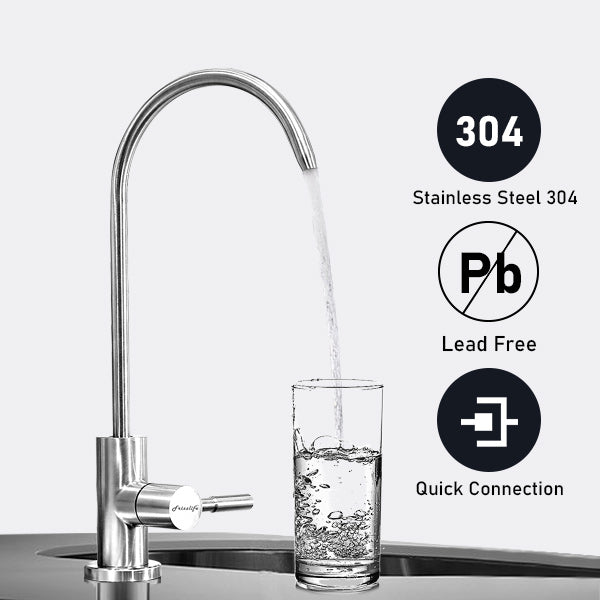
SP99-NEW: A Separate Faucet for Drinking Water
SP99-NEW pairs under-sink filtration with a dedicated brushed-nickel faucet. It is worth considering if you prefer to keep everyday unfiltered tap use separate from water intended for drinking and cooking.
For a multi-stage system that uses the main kitchen faucet instead, compare SK99-NEW. If chloramine is your specific concern, review the documented claims for TW10.
See SP99-NEW faucet and installation detailsWho Is an Under-Sink Carbon Filter Best For?
A Good Fit When
- Your main concern is everyday tap-water taste or odor.
- You prefer a non-RO filter that typically retains dissolved minerals.
- You want filtered water at the kitchen sink without a large storage tank.
- You can install and maintain a model-compatible under-sink system.
Consider Another Solution When
- You need a documented reduction in TDS or other dissolved salts.
- A water test identifies a contaminant your selected carbon filter is not rated to reduce.
- You cannot install an under-sink line or dedicated faucet.
- You need filtration for every fixture rather than one point of use.
Carbon Water Filters vs. Reverse Osmosis: What's the Difference?
Carbon water filters primarily rely on adsorption and, in some designs, particle filtration. They are a useful option when taste, odor and verified model-specific contaminant reduction are the priorities. Reverse osmosis (RO) uses a membrane process designed to reduce a broader range of dissolved substances, including TDS, but often involves a drain connection and additional installation requirements.
Neither technology should be chosen solely by the number of filtration stages. Start with your water test or utility water report, then compare documented contaminant reduction, available space, faucet preferences, flow and upkeep. You can explore the differences further in Frizzlife's reverse osmosis water filter systems.
What to Check Before Buying a Carbon Filtration System
Water Quality and Claims
Check whether you need chlorine taste-and-odor reduction, chloramine treatment or another verified contaminant-reduction capability. Certification numbers alone do not identify every certified claim.
Installation and Faucet Type
Confirm cold-water line dimensions, cabinet clearance and whether the product uses your existing faucet or needs a separate faucet hole.
Replacement and Running Cost
Identify the correct replacement filter for the exact model and follow its service interval. Filter lifespan varies with water use and feed-water quality.
Some Frizzlife models use replaceable inner filter cores instead of requiring the entire housing to be discarded at each service. Always confirm compatible parts. The Frizzlife replacement filters collection can help you find the appropriate cartridge.
Carbon Water Filter FAQs
Does an activated carbon filter improve tap-water taste and smell?
It often can. Activated carbon is commonly used to reduce chlorine-related taste and odor. Performance depends on the filter's design, water chemistry and condition; check the exact product's documented claims.
Can carbon filters remove lead, chloramine or VOCs?
Some specialized carbon-based systems are tested for particular contaminants, but these claims do not apply to every carbon filter. Consult the individual model's certification listing or performance data sheet before relying on it for lead, chloramine or VOC reduction.
Do carbon water filters reduce TDS?
Conventional carbon filtration is not intended to significantly reduce total dissolved solids. If TDS reduction is your priority, compare RO systems and their documented performance instead.
Do I need a separate faucet for an under-sink carbon filter?
Not always. Direct-connect systems such as MK99 and SK99-NEW work with the main kitchen faucet, while SP99-NEW includes a separate filtered-water faucet. Confirm the plumbing setup before purchase.
How often should I replace a carbon filter cartridge?
There is no universal replacement schedule. Follow the specific cartridge's instructions and consider water usage, water quality and any applicable flow or filter-life indicator.
Is a carbon filter enough for untreated well water?
Not necessarily. Untreated water can contain microbial or chemical hazards that ordinary carbon filtration is not designed to address. Test the water and select a treatment system specifically supported for the identified contaminants.
Explore More Water Filter Options
Need to compare a broader range of non-RO kitchen systems or a different direct-connect configuration?