What type of faucet do you have?
A standard threaded faucet may accept a faucet-mounted filter. Pull-out, pull-down and designer faucets often require an under-sink alternative.


You do not need to know the product category before you start. Use your faucet type, available space and water concern to narrow the choice between a faucet-mounted filter, direct-connect under-sink filter, under-sink reverse osmosis system or countertop RO system.
Answer these questions before comparing individual models.
A standard threaded faucet may accept a faucet-mounted filter. Pull-out, pull-down and designer faucets often require an under-sink alternative.
Direct-connect and RO systems keep the countertop clear, but you need enough room for the unit, tubing and future filter changes.
Some under-sink systems use the existing faucet, while RO systems may require a drain connection, power and a dedicated faucet.
Taste and odor concerns may point to carbon-based filtration. TDS or broader contaminant concerns may point to an RO system with verified model-level performance.
Select the description closest to your kitchen and continue to the matching Collection.
Choose a faucet-mounted filter when you want a simple installation and your main goal is everyday taste and odor improvement.
View Faucet Filters →Choose a direct-connect under-sink filter when you want filtered water at the kitchen sink without a countertop device or a full RO installation.
View Under-Sink Filters →Choose an under-sink RO system when dissolved-solids reduction and a permanent kitchen drinking-water station are priorities.
View Under-Sink RO →Choose a countertop RO system when you want an RO format with more flexible placement and minimal permanent installation.
View Countertop RO →The best choice depends on both filtration goals and the practical limits of the kitchen.
| Option | Uses existing faucet | Typical installation | Main advantage | Important limitation |
|---|---|---|---|---|
| Faucet-mounted filter | Yes | Attaches to compatible faucet | Simple, compact and low commitment | May not fit pull-out, pull-down or non-standard faucets |
| Direct-connect under-sink filter | Usually | Connects to cold-water line below sink | Keeps counter clear and may preserve normal faucet use | Not designed for every dissolved-contaminant goal |
| Under-sink RO | Usually uses a dedicated faucet | Connects to feed water, drain and power as required | RO membrane supports broader reduction goals | More installation and maintenance steps |
| Countertop RO | Separate dispenser | Countertop setup varies by model | RO access without a fixed under-sink system | Uses counter space and has a separate dispensing routine |
These four systems represent different ways to access filtered tap water. Compare whether you want to keep the existing faucet, add a dedicated filtered-water faucet, avoid fixed plumbing changes or install a tankless reverse osmosis system.

A compact non-RO system that connects below the sink and sends filtered water through the existing kitchen faucet.

An under-sink filtration option with a separate faucet, keeping filtered drinking water independent from regular kitchen tap use.

A plug-and-use countertop RO system for apartments, offices and kitchens where drilling or permanent under-sink installation is not preferred.
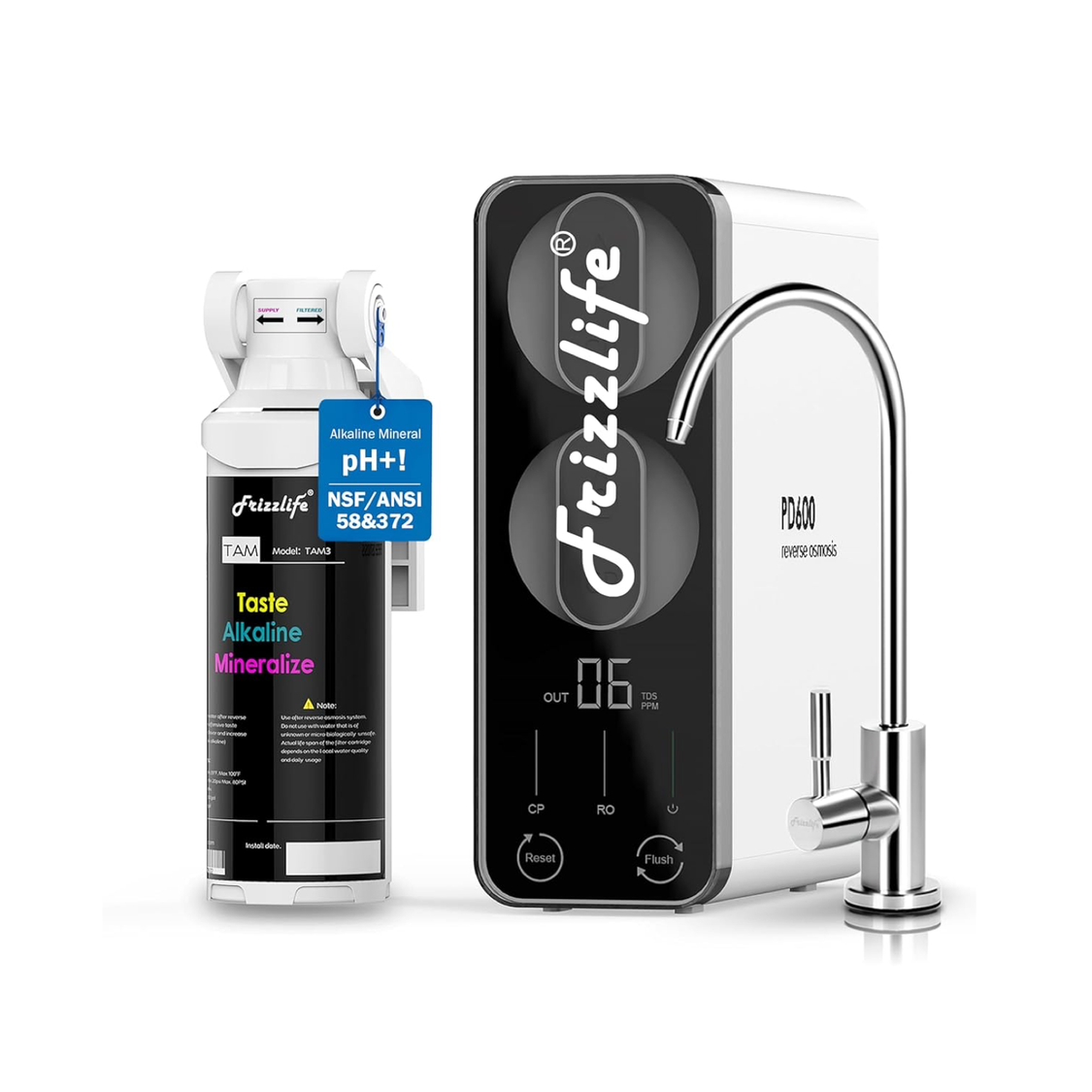
A permanent under-sink RO option for kitchens that prioritize dissolved-solids reduction, fast water delivery and smart system monitoring.
Use a recent water report or laboratory test when a specific contaminant is driving the purchase.
A faucet-mounted or direct-connect carbon-based filter may be a practical starting point. Confirm the model’s exact claims.
Compare Simple Filters →Compare reverse osmosis options and their stated capacity, flow, wastewater ratio and maintenance requirements.
Explore TDS Options →Use verified model-level reduction information and avoid selecting a system based only on generic filter-stage descriptions.
Compare RO Systems →Prioritize installation flexibility, countertop footprint, refill or connection method and ease of moving the system.
Shop Countertop RO →Measure the faucet outlet, cabinet width, cabinet depth, usable height and countertop footprint. Also locate the cold-water valve, drain, electrical outlet and any garbage disposal or stored items that compete for space. Leave enough clearance to remove cartridges without taking the entire system out of the cabinet.
A higher stage count does not automatically mean better performance. Compare the actual filtration media, membrane type, model-level test information, flow rate, filter life, installation requirements and replacement cost.
A faucet-mounted filter often does not fit a pull-out or pull-down faucet. A direct-connect under-sink filter can be a simpler alternative, while an under-sink RO system may use a dedicated drinking-water faucet.
Many direct-connect systems are designed to feed the existing faucet, but plumbing configuration and compatibility vary by model.
A countertop RO system or compatible faucet-mounted filter can reduce the need for permanent plumbing changes. Compare counter space, faucet fit and the system’s setup method.
It depends on the water concern. Carbon filtration may suit taste and odor goals, while reverse osmosis is more relevant for TDS reduction and broader model-specific reduction goals.
Dimensions vary. Measure the usable area and leave room for tubing, valves, filter changes and any existing disposal unit.
Testing is strongly recommended when fluoride, arsenic, lead, PFAS or another specific contaminant is the reason for purchasing a filter.
Match the system to your faucet, space and water concern before comparing individual products.