


A direct connect under sink water filter sits between the cold-water shutoff valve and your kitchen faucet’s cold-water supply hose. Instead of sending filtered water to a second tap, it delivers filtered cold water through the existing faucet.
A dedicated-faucet system works differently. It creates a separate filtered-water branch and sends that water to a small drinking faucet mounted on the sink or countertop. The main kitchen faucet normally continues receiving unfiltered cold water through the main supply branch.
Neither configuration is automatically better. The right choice depends on your plumbing connections, available cabinet space, desired faucet flow, filtration needs, countertop restrictions, and how much cold water you want to filter.
Comparison Snapshot: Which Under-Sink Setup Fits Your Kitchen?
The central decision is simple:
-
Choose direct-connect if you want filtered cold water from your existing kitchen faucet.
-
Choose a dedicated drinking faucet if you want to reserve filtered water primarily for drinking and cooking.
The details—especially plumbing fit and flow—require a closer look.
Direct-Connect vs. Dedicated-Faucet Comparison Table
|
Feature |
Direct-connect under-sink filter |
Dedicated-faucet under-sink filter |
|
Water outlet |
Existing kitchen faucet |
Separate drinking faucet |
|
Water path |
Cold shutoff → filter → main faucet |
Cold shutoff → feed adapter → filter → separate faucet |
|
Filtration coverage |
Typically all cold water used at that faucet |
Only water drawn from the drinking faucet |
|
New countertop hole |
Usually not required |
Required if no suitable existing hole is available |
|
Main faucet flow |
Filter resistance can affect cold-water flow |
Main faucet does not normally route through the filter; a separate filtered-water branch is added |
|
Water counted toward filter usage |
All cold water drawn through the main faucet passes through the filter |
Only water drawn from the dedicated drinking faucet passes through the filter |
|
Installation complexity |
Often simpler if fittings match |
Adds a feed adapter, tubing, faucet installation, and potentially drilling |
|
Cabinet space |
Requires room for the filter and supply hoses |
Requires room for the filter, branching hardware, and additional tubing |
|
Renter fit |
Often attractive because it normally avoids drilling |
Suitable for rentals when an approved existing hole is available or landlord-approved drilling is permitted |
|
Typical non-RO drain requirement |
None |
None |
|
RO considerations |
Most conventional direct-connect filters are not RO systems |
Many RO systems use a dedicated faucet and also require a drain connection |
|
Best use case |
Convenient filtered cold water for drinking, cooking, and food preparation |
Controlled drinking-water filtration with less total water passing through the filter |
Choose Direct-Connect When You Want Filtered Water From the Existing Faucet
A direct-connect configuration is often the practical choice when you:
-
Do not want a second faucet on the sink.
-
Cannot drill into the sink or countertop.
-
Want filtered cold water for cooking, rinsing produce, filling pots, and drinking.
-
Prefer to keep the sink deck uncluttered.
-
Need a removable installation for a rental.
-
Have standard, accessible cold-water plumbing under the sink.
This is the common solution for someone searching for an under sink filter without a separate faucet or an existing faucet water filter. Both phrases generally refer to an inline system that uses the main faucet as the filtered-water outlet.
Choose a Dedicated Drinking Faucet When You Want a Separate Filtered-Water Outlet
A dedicated drinking faucet may be more suitable when you:
-
Want to use filtered water mainly for drinking, coffee, and cooking.
-
Do not want dishwashing or routine rinsing to consume filter capacity.
-
Prefer to keep the filtration system out of the main faucet’s cold-water flow path.
-
Already have an unused accessory hole in the sink or countertop.
-
Need a treatment system designed specifically around a separate faucet.
-
Are installing reverse osmosis or another configuration that requires additional plumbing.
Not every dedicated-faucet filter is a reverse osmosis system. Carbon-based and multi-stage non-RO filters can also use separate drinking faucets.
The Main Trade-Off: Whole-Faucet Convenience vs. Drinking-Water-Only Control
A direct-connect filter provides whole-faucet convenience on the cold side. You do not have to remember which tap to use, but every gallon of cold water drawn at that sink passes through the filter.
A dedicated faucet provides more control. You can use unfiltered water from the main faucet for general cleanup while drawing filtered water only when needed. The trade-off is an additional fixture, more tubing, and possibly a new countertop hole.
What Is a Direct-Connect Under-Sink Water Filter?
A direct-connect under-sink water filter is an inline filtration system installed in the existing cold-water supply path. It does not replace the kitchen faucet. Instead, it filters water before that water reaches the faucet’s cold inlet.
The typical flow path is:
Cold-water shutoff valve → filter inlet → filtration cartridge → filter outlet → faucet cold-water supply hose
When the faucet calls for cold water, incoming water passes through the cartridge and then comes out of the main faucet.
The hot-water line normally remains unchanged. If you use a single-handle faucet at a mixed temperature, the water coming from the spout may combine filtered cold water with unfiltered hot water.
Can an Under-Sink Water Filter Connect to an Existing Faucet?
Yes—if it is a direct-connect model and its fittings are compatible with your cold-water valve and faucet supply hose.
The connection happens below the sink, not at the spout. Pull-down spray heads, high-arc spouts, and similar above-counter faucet features usually do not determine compatibility. The important parts are the cold-water connection under the sink, the available mounting space, and the filter’s approved operating conditions.
A direct-connect kit commonly includes hoses or adapters for widely used plumbing connections, but included parts vary by model. Confirm the connection sizes before purchasing rather than assuming every kit will fit every valve.

Do Under-Sink Filters Need a Separate Faucet?
No. Under-sink filters fall into several configurations:
-
Direct-connect filters use the existing faucet.
-
Dedicated-faucet filters use a separate drinking-water tap.
-
Reverse osmosis systems frequently use a separate faucet, drain connection, storage tank, pump, or power supply, depending on their design.
The phrase “under-sink filter” describes where the equipment is installed. It does not tell you which faucet the system uses or what treatment technology is inside it.
How a Dedicated-Faucet System Creates a Separate Branch
A dedicated-faucet setup normally adds a feed-water adapter or T-valve at the cold-water shutoff. That adapter keeps the original supply path to the main faucet while creating a smaller branch for the filtration system.
The typical path is:
Cold-water shutoff → feed adapter → filter inlet → filter outlet → dedicated drinking faucet
Only water drawn from the dedicated faucet passes through the filter. This can reduce the total amount of water processed by the filter, although actual cartridge life still depends on rated capacity, water quality, household use, and the manufacturer’s replacement guidance.
Direct-Connect, Dedicated-Faucet, and Reverse Osmosis Are Not Interchangeable Terms
These terms describe different characteristics:
-
Direct-connect describes how the filter connects to the faucet supply.
-
Dedicated-faucet describes where filtered water is dispensed.
-
Reverse osmosis describes a treatment process.
A non-RO carbon filter can use either a direct-connect or dedicated-faucet layout if the model is designed for that configuration. An RO system typically has additional requirements, including a drain connection for reject water. Some RO systems also need electrical power, while others do not.
Always follow the approved layout for the specific model. Do not assume a filter can be converted simply because its tubing appears to fit.
Explore Frizzlife Under-Sink RO & Filter Options
Once you know which plumbing layout fits your kitchen, compare under-sink RO systems and replacement filter options based on installation requirements, water demand, and maintenance needs.
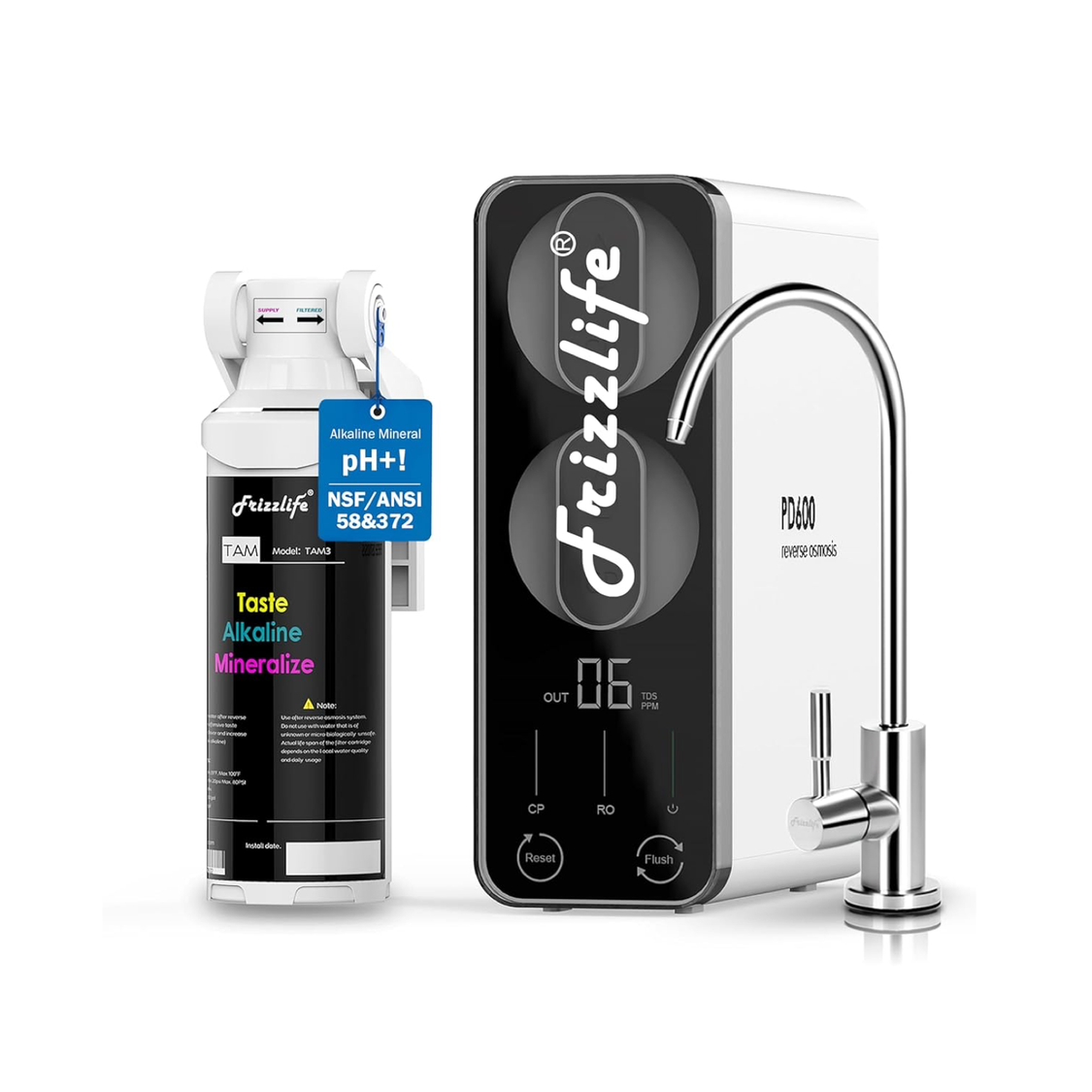 600 GPD Tankless RO
PD600-TAM3 Tankless RO System
A compact tankless reverse osmosis option with alkaline remineralization and real-time TDS monitoring for an under-sink drinking-water setup.
View PD600-TAM3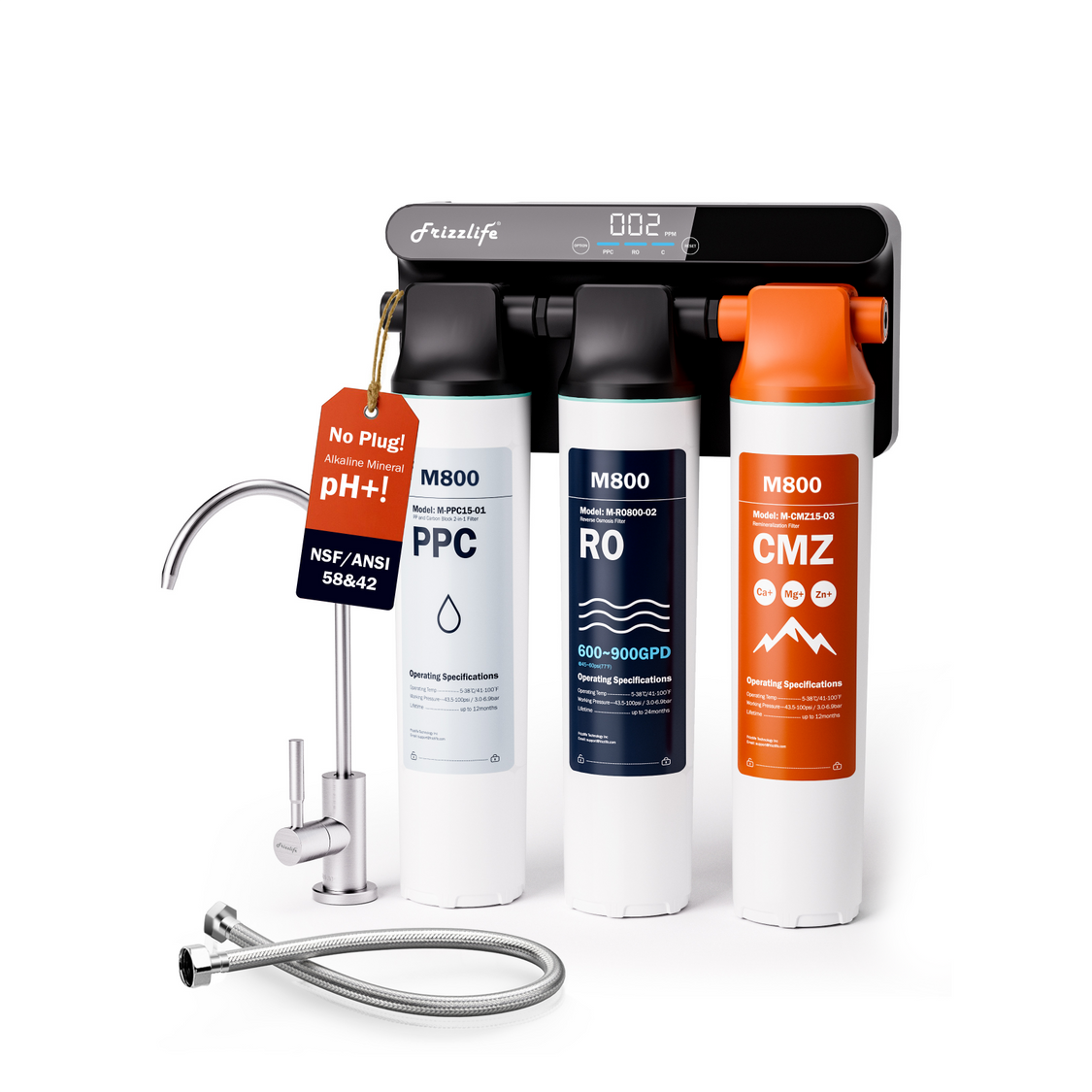 900 GPD Non-Electric RO
M800 Non-Electric Tankless RO
A high-output tankless reverse osmosis system designed to operate without an electric pump, with alkaline remineralization for under-sink drinking-water filtration.
View M800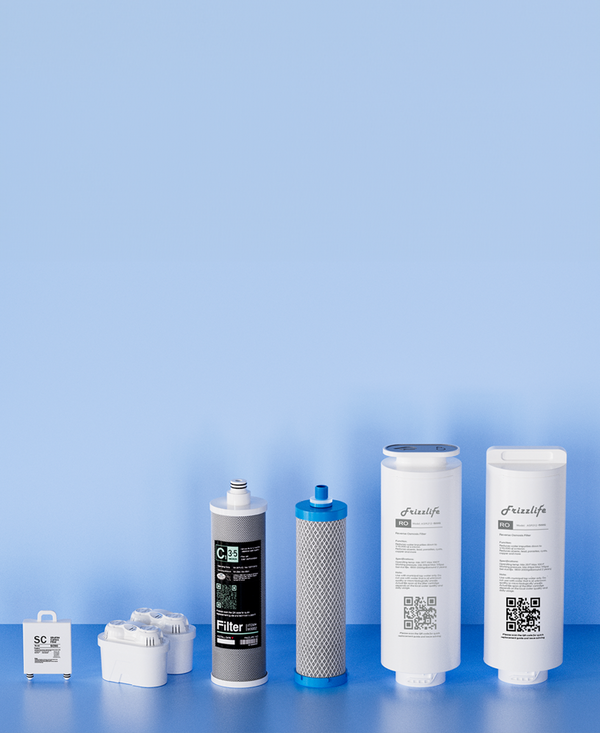 Filter Maintenance
Frizzlife Replacement Filters
Find compatible replacement filters for Frizzlife under-sink and RO systems, including filter options for PD600-TAM3 and M800-new.
Find Replacement FiltersWill a Direct-Connect Filter Work With Your Existing Plumbing?
Compatibility depends less on the visible faucet style than on the components under the sink. Inspect the shutoff valve, faucet supply hose, connection sizes, and available space before choosing a system.
Check the Cold-Water Shutoff Valve and Faucet Supply Hose
Start by identifying the cold-water side. The cold shutoff is usually on the right when facing the sink, but plumbing layouts can vary. If there is any uncertainty, turn off one valve and test the faucet.
Look for:
-
A functional shutoff valve that closes fully.
-
Corrosion, mineral buildup, or visible leakage.
-
The connection between the valve and faucet supply hose.
-
Labels or markings on the supply hose.
-
Enough access for two wrenches without straining nearby pipes.
-
Any proprietary or permanently attached faucet connector.
Older valves may not close completely. A valve can also appear closed while still allowing a slow flow. If the valve is seized, heavily corroded, or leaking around the stem, resolve that problem before installing the filter.
Common 3/8-Inch and 1/2-Inch Connections
Many North American sink installations use 3/8-inch or 1/2-inch connections, and some filter kits include adapters for both. However, a nominal size does not tell the whole story. Compression fittings, threaded fittings, and quick-connect fittings seal differently and are not interchangeable merely because their stated sizes appear similar.
Before purchasing:
-
Read the filter’s connection specifications.
-
Identify both the shutoff-valve outlet and faucet-hose end.
-
Confirm which adapters are included.
-
Check whether additional approved fittings are needed.
-
Avoid assembling mismatched thread types by force.
Do not apply thread-seal tape automatically. Some threaded pipe joints use it, while compression connections and gasket-sealed hoses generally rely on their own sealing surfaces. Follow the system manual and fitting manufacturer’s instructions.
Compatibility With Pull-Down, Touchless, and Single-Handle Faucets
A pull-down or single-handle faucet can often work with a direct-connect filter because filtration occurs upstream of the faucet’s cold inlet. Still, specialty faucets create a few practical considerations:
-
A pull-down sprayer hose and counterweight need room to move.
-
Touchless faucets may have control boxes, batteries, wiring, or solenoid valves under the sink.
-
Some faucets use proprietary supply connections.
-
A single-handle faucet mixes hot and cold water, so the final output may not be entirely filtered when the handle is in a mixed position.
-
Integrated instant-hot or chilled-water equipment may use separate plumbing that should not be rerouted without approval.
Verify the faucet manufacturer’s plumbing requirements if the cold-water connection is unusual.
Measure Cabinet Space and Cartridge-Change Clearance
Do not measure only the filter body. Account for:
-
The mounting bracket or filter head.
-
Hose bends at the inlet and outlet.
-
Vertical or side clearance needed to remove the cartridge.
-
Access to the shutoff valve.
-
Space to inspect fittings for leaks.
-
Movement of pull-out shelves, trash bins, and faucet hose weights.
A filter may physically fit in an empty cabinet yet become inaccessible after the trash can or organizer is returned. Plan for maintenance before drilling mounting holes.
Garbage disposals often occupy the center of the cabinet, making a side wall the most practical mounting location. Instant-hot tanks, dishwasher lines, and drain assemblies can further limit routing options. Keep tubing away from sharp edges, hot surfaces, and moving hardware.

Countertop Holes, Drain Connections, and Power Requirements
A standard non-RO direct-connect filter typically needs:
-
No separate faucet hole.
-
No drain-line connection.
-
No electrical outlet.
A dedicated-faucet filter needs an available sink or countertop hole. If there is no unused hole, drilling may be required. Hole diameter and allowable countertop thickness are model-specific.
RO systems are a separate planning category. Many require a dedicated faucet and drain connection, and certain designs also require power. Review all installation requirements before assuming an under-sink system will fit because the filter housing itself fits.
Pre-Purchase Go/No-Go Compatibility Checklist
Proceed with a direct-connect installation when you can answer “yes” to the applicable questions:
-
Can the cold-water shutoff valve close completely?
-
Do the valve, faucet hose, and supplied adapters match?
-
Is the filter approved for direct connection to the main faucet?
-
Is there enough cabinet space for the system and cartridge changes?
-
Can hoses be routed without kinks or interference?
-
Will the faucet’s moving parts remain unobstructed?
-
Is the incoming water pressure within the model’s specified range?
-
Is the system designed for your water temperature?
-
Can the installation be completed without modifying prohibited rental property?
-
Are the filter’s verified reduction claims appropriate for your water-quality concerns?
Stop and seek plumbing guidance if the valve leaks, fittings are badly corroded, connection types cannot be identified, or the faucet uses a proprietary assembly without an approved adapter.
Installation Differences: Existing Faucet vs. Dedicated Drinking Faucet
Both configurations begin by shutting off the cold-water supply and relieving pressure at the faucet. Their plumbing paths then diverge.

Typical Direct-Connect Installation
The general sequence is:
-
Clear the cabinet and place a towel or shallow container below the valve.
-
Shut off the cold-water valve.
-
Open the faucet to relieve line pressure.
-
Disconnect the faucet’s cold supply hose from the shutoff valve.
-
Connect the filter inlet hose to the shutoff valve using the specified adapter.
-
Connect the filter outlet to the faucet’s cold supply hose.
-
Mount the filter head or system in the approved orientation.
-
Confirm that water will travel through the marked IN and OUT ports correctly.
-
Turn the valve on slowly.
-
Flush the cartridge for the time stated in the manual.
-
Inspect every connection for leaks.
The result is one continuous filtered cold-water path from the shutoff to the main faucet.
Typical Dedicated-Faucet Installation
A dedicated-faucet installation generally adds these steps:
-
Locate an unused sink accessory hole or identify an approved drilling location.
-
Mount the drinking faucet with its supplied washers, gasket, and retaining hardware.
-
Install a feed-water adapter at the cold shutoff.
-
Reconnect the main faucet hose to the adapter.
-
Run tubing from the new branch to the filter inlet.
-
Run outlet tubing from the filter to the dedicated faucet.
-
Secure the tubing so it cannot kink or be pulled loose.
-
Flush and perform a complete leak check.
Although this layout has more components, the main faucet does not normally send its water through the filtration system.
When a Dedicated Faucet Requires Drilling
Do not estimate the faucet hole from appearance. The required diameter varies by faucet and system, and countertop thickness may also be limited.
Before drilling:
-
Read the installation manual.
-
Confirm the required hole size and clearances.
-
Check for clips, sink rims, braces, and plumbing below the proposed location.
-
Verify that the sink or countertop material can be drilled safely.
-
Obtain landlord approval when applicable.
-
Consider professional fabrication for stone or other difficult materials.
An existing soap-dispenser or sprayer hole may be usable if its size and location meet the faucet requirements.
Tools, Fittings, and DIY Skill
A standard installation may require adjustable wrenches, a screwdriver, a towel, and a tubing cutter if the system uses cut-to-length tubing. Dedicated-faucet installations may require drilling tools suited to the sink or countertop material.
The work is often manageable for a careful DIY installer, but it is not always “tool-free.” Success depends on correctly identifying fittings, supporting the valve while loosening connections, seating tubing fully, and avoiding excessive tightening.
Call a plumber when:
-
The shutoff valve will not close.
-
A compression nut or fitting is seized.
-
The valve or supply pipe moves when torque is applied.
-
Corrosion has weakened the plumbing.
-
An adapter solution would involve uncertain or mismatched fittings.
-
The installation requires valve replacement or countertop work beyond your skill level.
Flushing and Performing a Complete Leak Check
New cartridges must be flushed according to the model instructions. Flushing clears trapped air and loose particles from the manufacturing and installation process.
After restoring water:
-
Open the shutoff valve slowly.
-
Check every connection with the faucet off.
-
Run water and check again under flow.
-
Dry each joint, then inspect for fresh moisture.
-
Confirm that quick-connect tubing is fully inserted.
-
Recheck the cabinet after the system has remained pressurized.

A dry paper towel placed around a connection can reveal a slow leak more clearly than a visual inspection.
Renter-Friendly Installation and Removal
A direct-connect system can be renter-friendly because it generally avoids permanent sink or countertop changes. That does not eliminate the need to review the lease or ask permission.
Keep the original hose, fittings, caps, and adapters in a labeled bag. When moving:
-
Shut off the cold-water valve.
-
Relieve pressure.
-
Remove the filter and its hoses.
-
Reconnect the faucet hose in its original configuration.
-
Restore water slowly.
-
Check for leaks before leaving the cabinet unattended.
Wall-mounting screws may still leave holes inside the cabinet. If modifications are prohibited, ask whether a nonpermanent mounting approach is acceptable for the specific system.
Does an Under-Sink Filter Reduce Faucet Flow?
Every filter adds some resistance because water must travel through filtration media, internal passages, tubing, and fittings. Whether the difference is noticeable depends on the system and installation conditions.
How Direct-Connect Filters Affect the Main Faucet
Because a direct-connect filter sits in the main cold-water path, any restriction appears at the main faucet’s cold side. The effect is model-dependent and influenced by:
-
Incoming water pressure.
-
Cartridge design and condition.
-
Tubing and fitting diameter.
-
The number of bends and adapters.
-
Sediment loading.
-
A partially closed shutoff valve.
-
Incorrect installation.
A properly selected and installed system may provide practical kitchen flow, but no filter should be assumed to preserve the exact unfiltered flow rate unless model-specific data supports that conclusion.
Why a Dedicated Faucet Keeps the Filter Out of the Main Faucet Flow Path
A dedicated system creates a separate branch from the cold-water supply. The filter serves the dedicated drinking faucet, while the main kitchen faucet normally continues receiving cold water without that water passing through the filter.
This is helpful if you want normal main-faucet flow for washing dishes and reserve the slower filtered outlet for filling glasses, kettles, and cooking containers.
Filtering All Cold Water vs. Drinking Water Only
Direct-connect filtration processes all cold water at that sink. That means convenient access, but it can also increase cartridge throughput in a high-use kitchen.
A dedicated faucet processes only the water intentionally drawn from it. This may help households use rated filter capacity more selectively. It does not guarantee a specific replacement interval; cartridge life remains dependent on the model, water quality, capacity rating, and actual consumption.
How to Troubleshoot Weak Flow After Installation
If flow drops unexpectedly:
-
Confirm that the cold shutoff valve is fully open.
-
Check that the cartridge is completely locked into the filter head.
-
Verify the IN and OUT connections.
-
Look for kinked, pinched, or sharply bent tubing.
-
Confirm that hoses are not trapped behind an organizer or disposal.
-
Remove trapped air by flushing as directed.
-
Check the faucet aerator for loosened debris.
-
Consider whether the cartridge is loaded with sediment or due for replacement.
-
Compare hot-only and cold-only flow to isolate the affected side.
If flow was weak before installation, adding filtration may make an existing pressure problem more apparent. In that case, investigate the supply valve, faucet, plumbing, and incoming pressure rather than assuming the cartridge is the only cause.
Filtration Performance, Capacity, and Maintenance
Installation style does not determine contaminant reduction. A direct-connect filter is not inherently more or less capable than a dedicated-faucet filter simply because of where its outlet is located.
Match Filtration Media and Verified Claims to Your Water
Begin with your actual water-quality concern. Taste and odor, sediment, lead, specific organic compounds, and dissolved minerals are different issues and may require different treatment approaches.
Review:
-
The contaminants listed in your water utility’s report or laboratory test.
-
The filtration media used by the model.
-
Model-specific reduction claims.
-
Third-party certification or test documentation.
-
Rated operating conditions.
-
Whether the system is intended for treated municipal water, well water, or both.
-
Whether pretreatment is recommended for high sediment.
Do not transfer a claim from one cartridge or model to another. Even products in the same collection can use different media, flow designs, capacities, and certifications.
How to Evaluate NSF/ANSI Certifications and Test Data
A standards reference is meaningful only when it applies to the exact model and claim being considered. Check:
-
The precise model number.
-
The standard named in the listing.
-
The specific substances covered.
-
Whether the product is certified by an accredited third party or only tested by a laboratory.
-
The test conditions and rated capacity.
-
Whether replacement cartridges carry the relevant listing.
“Tested to,” “certified to,” and “meets the requirements of” should not be treated as interchangeable phrases. Read the supporting documentation rather than relying on a general statement about the product family.
Replacement Timing and Cartridge Access
Replace a cartridge according to the model’s rated capacity, recommended service interval, or an earlier point if changing water conditions or performance indicate the need. Heavy use and high sediment can shorten practical service life.
For a direct-connect system, remember that washing produce, filling pots, and other cold-water use contribute to total throughput. A dedicated faucet may process less water because it serves a narrower purpose.
Maintenance is much easier when the filter is mounted with enough clearance. Before finalizing the location, practice the cartridge-removal movement with the cabinet contents in place. Make sure you can reach any release buttons, shutoff controls, or twist-lock mechanisms without dismantling the cabinet.
Common Fit Problems and Edge Cases
Small installation errors can cause leaks, weak flow, or unreliable operation. Most problems are related to fittings, tubing, valve condition, or incorrect routing rather than the visible kitchen faucet.
Mismatched Fittings
If the shutoff valve and filter fittings do not match, do not force them together. Confirm the nominal size, thread type, and sealing method for both components.
Use only approved adapters with adequate pressure and potable-water ratings. Stacking several improvised adapters may create extra leak points and place leverage on an old valve. Replacing the valve or consulting a plumber may be the cleaner solution.
Kinked Tubing, Reversed Connections, and Closed Valves
Three common causes of poor operation are:
-
Tubing bent below its minimum practical radius.
-
Filter inlet and outlet connections reversed.
-
A shutoff or inline valve left partially closed.
Route tubing in broad curves and secure it away from moving parts. Cut tubing squarely when required, and push it fully into quick-connect fittings according to the instructions. Never pull on tubing to test it until the connection has been properly seated and locked as specified.
Diagnosing Leaks by Connection Type
Different connections fail for different reasons:
-
Compression fitting: The tube or sealing surfaces may be misaligned, damaged, or overtightened.
-
Gasket-sealed hose: The washer may be missing, twisted, or damaged.
-
Threaded pipe fitting: The joint may have incorrect sealant, crossed threads, or insufficient engagement.
-
Quick-connect fitting: The tubing may be angled, scratched, cut unevenly, or not fully inserted.
Turn off the water and relieve pressure before correcting a leak. Repeatedly tightening a joint is not a universal solution and can damage plastic components, gaskets, or valve bodies.
Can a Dedicated-Faucet Filter Be Converted to Direct-Connect?
Only if the manufacturer explicitly approves that configuration for the model.
A dedicated-faucet system may use smaller tubing, a different faucet flow control, or components intended for lower drinking-water demand. Connecting it to a full-size kitchen faucet can change the system’s operating conditions.
Likewise, a direct-connect system should not be rerouted to a separate faucet unless the approved instructions provide that option. Similar-looking fittings do not establish compatibility.
Why Hot Water Should Not Be Routed Through a Cold-Water Filter
Most under-sink drinking-water filters are installed on the cold-water line. Hot water can affect filtration media, housings, seals, and performance if the system is not designed for it.
Connect the system only to the approved water supply and stay within the model’s temperature limits. If hot-water filtration is required, choose equipment specifically rated for that application.
Low Pressure or High Sediment
A kitchen with low incoming pressure may be less tolerant of added filter resistance. A high-sediment supply can also load cartridges quickly and cause early flow decline.
Possible responses include:
-
Selecting a system designed for the available pressure and required flow.
-
Correcting a restricted or failing shutoff valve.
-
Addressing clogged faucet components.
-
Adding approved sediment pretreatment where appropriate.
-
Using a dedicated drinking faucet to limit filtered-water demand.
-
Investigating the underlying water supply before installation.
Well-water users should base treatment decisions on current water testing rather than selecting a cartridge solely for taste.
Direct-Connect vs. Dedicated Faucet: Make the Final Choice
Choose a direct-connect under-sink water filter when the priority is convenient filtered cold water from the existing faucet, especially where drilling is not allowed. It is often a strong fit for renters, uncluttered sink decks, and kitchens where filtered water is used throughout food preparation.
Choose a dedicated drinking faucet when you want to control which water is filtered, keep the filtration system out of the main faucet’s cold-water flow path, or install a system designed around a separate outlet. It is also the more common layout for reverse osmosis and other systems with additional plumbing requirements.
Once you know which layout fits, you can compare compatible Frizzlife under-sink water filter configurations by faucet arrangement, installation requirements, filtration media, verified performance information, and maintenance needs. The best-fitting system is the one that matches both your water-quality goals and the plumbing you actually have.