Water testing first
Testing helps identify whether arsenic is present and whether it is a priority for treatment.



Frizzlife

Frizzlife

Frizzlife

Frizzlife
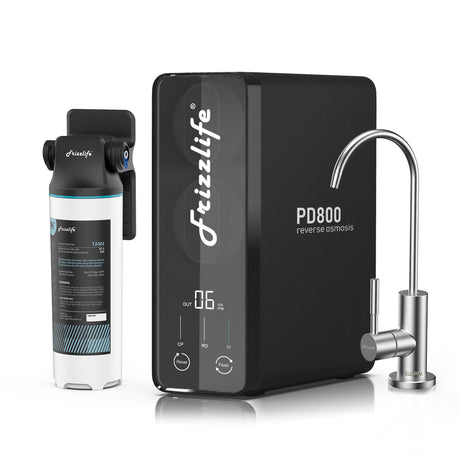
Frizzlife

Frizzlife

Frizzlife

Frizzlife
An arsenic filter page needs to help users compare serious water-quality solutions without overstating product claims. Frizzlife shoppers may be comparing RO systems and specialized filtration choices because arsenic in drinking water is a high-concern issue. This page helps shoppers compare RO systems and specialized filtration choices while keeping product-specific arsenic reduction claims tied to documented testing.
An arsenic filter is a water treatment system selected to help reduce arsenic in drinking water. Arsenic can occur naturally in some groundwater supplies, so users should test their water before choosing a system. Reverse osmosis is often considered for arsenic-related filtration goals, but performance depends on the arsenic form, source water, system design, and tested product claims.
Testing helps identify whether arsenic is present and whether it is a priority for treatment.
Reverse osmosis can support broader contaminant reduction, but claims must be verified by model.
Some systems use adsorptive media designed for arsenic, but it must match the water conditions.
Filter exhaustion can reduce performance, so replacement schedules matter.
This collection helps users who are not just browsing general taste filters.
It explains why testing and product-specific proof matter.
RO systems may be part of a broader arsenic reduction strategy.
The copy avoids unsupported medical or absolute safety claims.
Do not choose an arsenic filter based only on taste, odor, or visual appearance.
Verify the exact contaminant reduction claim for each model.
Under-sink and tankless RO systems are usually more relevant than simple faucet filters.
Follow replacement schedules and retest when needed.
| Use Case | RO-Based System | Specialized Arsenic Media | Basic Taste Filter |
|---|---|---|---|
| Best for | Households comparing broad drinking-water reduction | Situations where media is tested for arsenic | Taste and odor improvement only |
| Proof needed | Model-specific test data or certification | Media-specific performance data | Not usually suitable for arsenic claims |
| Installation | Usually under sink or tankless RO | Varies by system | Simple faucet or pitcher |
| Maintenance | Membrane and filter replacement | Media replacement based on capacity | Routine cartridge change |
| Better choice if | You want a dedicated drinking-water system | Your water test supports that media choice | You only dislike chlorine taste |
Water can look and taste normal even when testing shows a concern.
RO can be part of the solution, but exact arsenic claims require proof.
Different forms of arsenic may require different treatment approaches.
Use these related collections to continue product selection after reviewing this guide.
Yes. Testing is strongly recommended because arsenic is not reliably identified by taste, smell, or appearance.
RO may support arsenic reduction depending on the model and water conditions, but exact claims should be verified with product-specific data.
Do not assume a basic carbon filter is suitable for arsenic unless it has tested claims for that contaminant.
A home filtration system can be part of the solution, but high arsenic levels may require professional guidance and retesting.
Follow the product schedule and consider water testing to confirm ongoing performance.
Only if the specific countertop system is tested and documented for arsenic reduction.