


Water makes up most of every cup of coffee or tea, so its chemistry can matter as much as the beans, leaves, grind, temperature, and brewing time. The best water filter for coffee is not necessarily the system that produces the lowest total dissolved solids. It is the one that removes chlorine and unwanted tastes while leaving—or restoring—a moderate, consistent mineral profile.
For many homes with municipally treated water and acceptable hardness, carbon filtration may be enough. Hard water may require softening or scale control, especially for an espresso machine. Water with variable chemistry, significant taste problems, or a broader range of unwanted dissolved substances may be a better candidate for reverse osmosis followed by controlled remineralization.
The right choice therefore starts with two questions: What is in your source water, and what brewing equipment are you trying to protect?
What Type of Filtered Water Is Best for Coffee and Espresso?
Decision Snapshot: Choose Filtration That Removes Off-Tastes While Retaining Moderate Minerals
For most coffee drinkers, the best filtered water has three qualities:
-
No detectable chlorine, objectionable odor, or obvious off-taste
-
Moderate calcium and magnesium content to support extraction
-
Controlled alkalinity and hardness to balance flavor and limit scale
If your tap water already has moderate hardness and tastes acceptable apart from chlorine, a carbon-based pitcher or under-sink filter may be the simplest choice. If it is very hard, carbon alone will not solve the scale problem. If the source water is inconsistent or has high dissolved solids, reverse osmosis can provide a more controlled starting point—but coffee generally tastes better when very low-mineral RO water is remineralized.
A water filter for coffee machine use must also meet the equipment manufacturer’s water requirements. Espresso boilers and internal plumbing can be more sensitive to both scale-forming water and excessively low-mineral water than a manual pour-over brewer.
Best Water for Coffee Brewing: Clean, Chlorine-Free, and Not Mineral-Free
Good brewing water should be clean, fresh, and free from noticeable disinfectant taste. Specialty coffee guidance commonly calls for no detectable chlorine because even a small sensory presence can compete with delicate coffee aromas.
Minerals are not automatically undesirable. Calcium and magnesium help water interact with soluble flavor compounds during brewing. Bicarbonate alkalinity buffers coffee’s acids. The goal is balance: enough mineral content for satisfying extraction, but not so much hardness that scale accumulates quickly.
That is why “purest” and “best tasting” are not interchangeable. Distilled water and highly purified RO water may contain too few minerals for balanced coffee. On the other hand, untreated hard water can create scale and make flavors seem harsh, chalky, or muted.
Coffee Water Targets for TDS, Hardness, Alkalinity, and pH
Specialty Coffee Association-derived guidance commonly uses the following reference points:
-
TDS: approximately 150 mg/L as an ideal, with a commonly cited acceptable range of 75–250 mg/L
-
Calcium hardness: approximately 68 mg/L as CaCO₃ as a frequently cited target
-
Total alkalinity: approximately 40 mg/L as CaCO₃
-
pH: close to neutral, with approximately 6.5–7.5 commonly used as a practical range
-
Chlorine: not detectable by taste or smell
These are brewing targets, not health standards or universal pass/fail limits. Published interpretations differ, particularly for acceptable hardness and alkalinity ranges. Espresso machine manufacturers may also specify their own requirements.
Use the figures as a starting framework rather than assuming every coffee, tea, and machine must use the same exact profile. Your preferred roast, recipe, and flavor balance may lead you toward the softer or more mineral-rich side of an acceptable range.
Why the Best Water Filter for Coffee Depends on Your Starting Water
A filter can only be evaluated in relation to its input water. The same carbon filter that works well in one city may do little to prevent scale in a nearby hard-water area.
Before choosing a system, find out:
-
Whether your supply uses chlorine or chloramine
-
Your general hardness and alkalinity
-
Whether the source is municipal water or a private well
-
Whether taste changes seasonally
-
Whether sediment or unusually high TDS is present
-
What water specifications your coffee machine requires
Municipal water reports can provide useful background, but they may not describe the exact water reaching your faucet on a particular day. A basic hardness test at the tap gives you more direct decision support. If you use an espresso machine, test the filtered output as well.
Filtered Water vs. Tap Water vs. Bottled Water for Coffee
Tap water can make excellent coffee when it tastes clean and has moderate hardness and alkalinity. The problem is variability: disinfectant taste, high hardness, or seasonal source changes can produce inconsistent results.
Filtered water for coffee offers more control. A suitable filter can reduce unwanted taste while allowing you to use the same water for brewing, tea, and everyday drinking. The result still depends on what the filter is designed to change.
Bottled water can be useful while traveling or troubleshooting a poor source supply, but mineral content differs substantially among products. Choosing bottled water simply because it has a low TDS does not guarantee better coffee. It also offers less control if the mineral profile or source changes.
For daily brewing, a correctly selected home filtration system is generally easier to monitor than repeatedly comparing bottled-water labels.
Can Water Hardness or Mineral Content Affect Coffee Taste?
How Calcium and Magnesium Influence Coffee Extraction
Calcium and magnesium contribute to hardness, but they also interact with flavor compounds during extraction. Water with some hardness can produce greater flavor definition and body than nearly mineral-free water.
The exact result depends on the coffee. A bright light roast may respond differently from a darker espresso blend, and magnesium-rich water may emphasize different characteristics than calcium-dominant water. A household filter usually does not provide laboratory-level control over the ratio, but it should avoid pushing mineral content to either extreme without a specific reason.
If a familiar coffee suddenly tastes weak despite unchanged beans, grind, ratio, and temperature, test the water before changing the recipe. A depleted cartridge, new filter, or changed municipal supply may have altered its mineral profile.
Why High Hardness Can Create Scale and Harsh or Dull Flavors
Hard water contains elevated concentrations of calcium and magnesium compounds. When heated, some of these compounds can form deposits on kettles, heating elements, valves, and boiler surfaces.
Scale can:
-
Restrict internal water paths
-
Reduce heating efficiency
-
Interfere with temperature stability
-
Increase maintenance needs
-
Affect the long-term performance of coffee equipment
High alkalinity often accompanies hard water, although the two are not identical. Excessive buffering can suppress the lively acidity of coffee, making a cup taste dull even when extraction is otherwise adequate.
A carbon-only filter may improve chlorine taste while leaving hardness largely unchanged. In a hard-water area, that can result in better-tasting tap water but continued scale inside the machine.
Why Very Soft Water Can Produce Thin, Flat Coffee
Very soft or near-zero-mineral water often produces coffee that seems thin, empty, or unusually sharp. With too little calcium and magnesium, the water may not extract flavor compounds in the same balanced way as moderately mineralized water.
Low alkalinity also leaves acids with little buffering. The cup may taste aggressively sour rather than pleasantly bright. This is one reason straight distilled water or aggressively purified RO water is not automatically the best water for coffee brewing.
Very soft water may also be outside an espresso machine manufacturer’s specifications. Before connecting any low-mineral supply directly to a machine, check the manual and warranty conditions.
How Alkalinity Can Sharpen or Mute Acidity
Alkalinity describes water’s ability to buffer acids. In coffee brewing, bicarbonate is usually the main contributor.
-
Low alkalinity: Acidity may seem sharp, sour, or poorly integrated.
-
Moderate alkalinity: Acidity can remain clear while tasting more balanced.
-
High alkalinity: Bright flavors may become muted, dull, or indistinct.
This is why two water samples with identical TDS readings can brew very different coffee. One may contain a useful balance of hardness and alkalinity, while another may contain dissolved material that contributes little to desirable extraction.
Why TDS Alone Cannot Tell You Whether Water Is Good for Coffee
A TDS meter estimates the total concentration of dissolved ionic material. It does not identify which minerals are present or distinguish hardness from alkalinity.
For example, a reading near 150 mg/L may look ideal on paper, but it does not tell you:
-
How much calcium or magnesium the water contains
-
Whether alkalinity is too high
-
Whether sodium makes up a large share of the reading
-
Whether chlorine or an off-odor is present
-
Whether the water will create excessive scale
Use TDS to monitor broad changes and compare water before and after treatment. Use a hardness test—and, when greater precision is needed, an alkalinity test—to understand brewing and scale implications.
Chlorine, Chloramine, and Other Sources of Unwanted Taste and Odor
Municipal disinfectants serve an important treatment role, but their taste is undesirable in coffee and tea. Activated carbon is commonly used to reduce chlorine-related taste and odor.
Chloramine can be more difficult to address than free chlorine, and performance depends on the carbon media, contact time, flow, cartridge condition, and specific product design. Do not assume every carbon filter treats chloramine equally. Verify the manufacturer’s documentation for the exact model and substance of concern.
Sediment, plumbing-related tastes, and seasonal changes in source water can also affect a brew. When the problem is broader than hardness or chlorine, more comprehensive water filtration for coffee may be appropriate.
Is Reverse Osmosis Water Suitable for Coffee Brewing?
Yes, reverse osmosis water can be suitable for coffee, but straight RO output is often better treated as a clean starting point than as the finished brewing profile. Because RO can substantially reduce dissolved minerals, the output may need remineralization or controlled blending before it is appropriate for flavor or a particular coffee machine.
Taste vs “purity”: why RO can make tea and coffee taste flat without remineralization
RO is useful when source water contains excessive or inconsistent dissolved material. However, removing nearly all hardness and alkalinity can create a new problem: water that is clean but poorly balanced for extraction.
Coffee made with very low-mineral RO water may taste:
-
Thin or hollow
-
Sour without sweetness
-
Less aromatic
-
Weak despite a normal coffee-to-water ratio
Tea can also lose aromatic depth or taste sharp when the water has almost no buffering capacity. The effect varies by tea type, but the central lesson is the same: maximum mineral reduction is not always maximum flavor.
Remineralization adds a controlled amount of mineral content back to purified water. The actual output depends on source conditions, treatment design, water temperature, flow, and the remineralization stage. A system should not be assumed to reach coffee-specific targets without testing.
When RO Is a Practical Starting Point for Coffee Water
RO is worth considering when:
-
Source-water TDS or hardness is very high
-
Mineral composition changes noticeably over time
-
The water has multiple dissolved-water concerns beyond taste
-
You want a consistent base for manual remineralization
-
Carbon and simple scale control do not address the source-water profile
It can also be useful for households that want one treated-water source for coffee, tea, cooking, and drinking. The output still needs to be evaluated for mineral content and equipment compatibility.
RO is less compelling when tap water already has moderate hardness and only needs chlorine or odor reduction. In that situation, carbon filtration may preserve a useful mineral profile with less complexity.
Remineralized RO Water vs. Straight RO Water
Straight RO water generally offers the lowest mineral content. That can reduce scale potential, but it may fall below desirable brewing-water ranges and may not meet machine instructions.
Remineralized RO water aims to restore enough mineral content for better flavor and a more suitable water profile. It provides greater control than simply accepting highly variable hard tap water, but “remineralized” does not describe one fixed chemistry. Test the final output rather than relying only on the label.
Explore Remineralized RO Options for Coffee, Tea, and Daily Drinking
If reverse osmosis is the right starting point for your source water, a system with a remineralization stage can provide a more practical finished-water profile than straight low-mineral RO water.
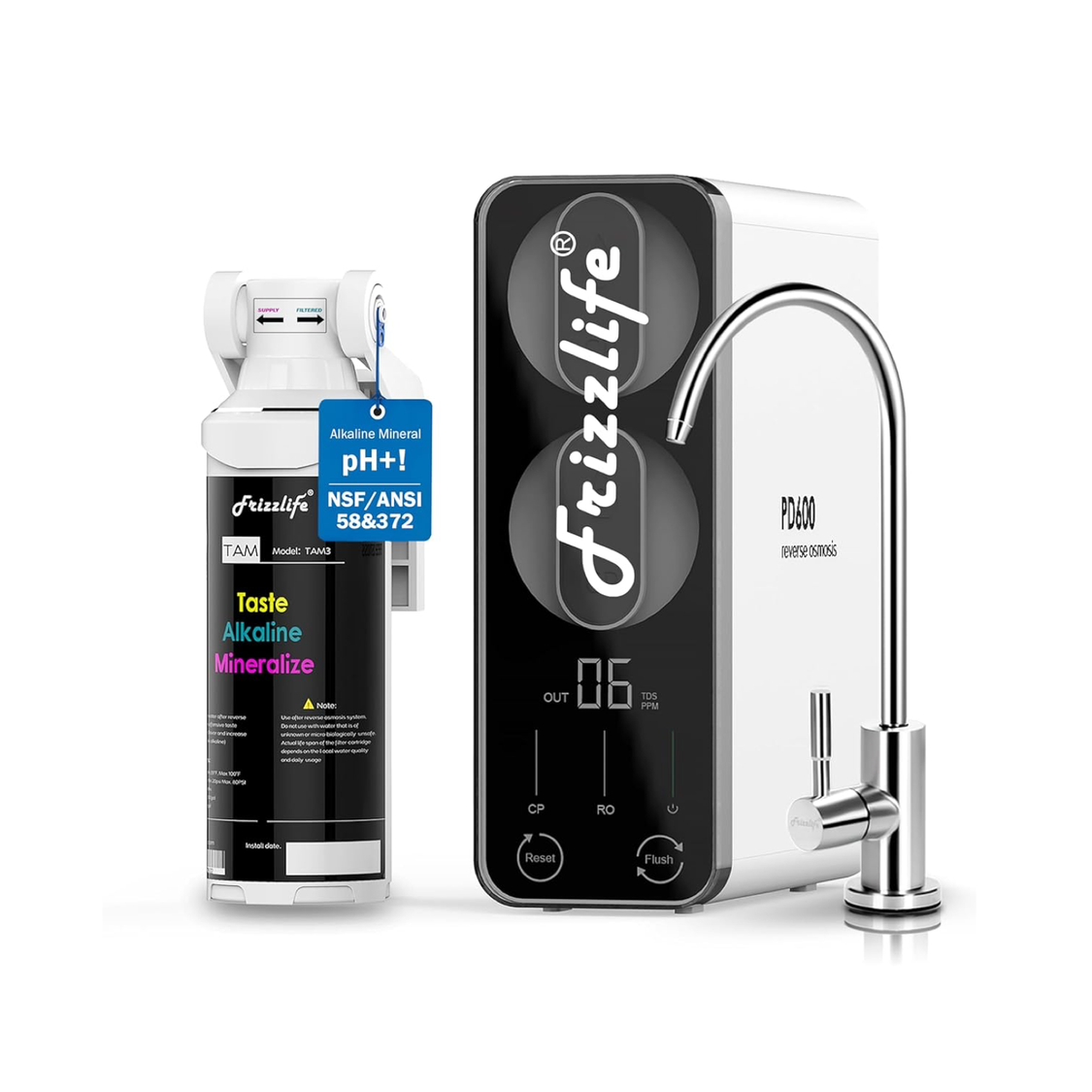
Frizzlife PD600-TAM3
A 600 GPD tankless under-sink RO system with alkaline remineralization, designed to add minerals back after reverse osmosis for a smoother finished-water taste suitable for drinking, coffee, tea, and cooking.
View PD600-TAM3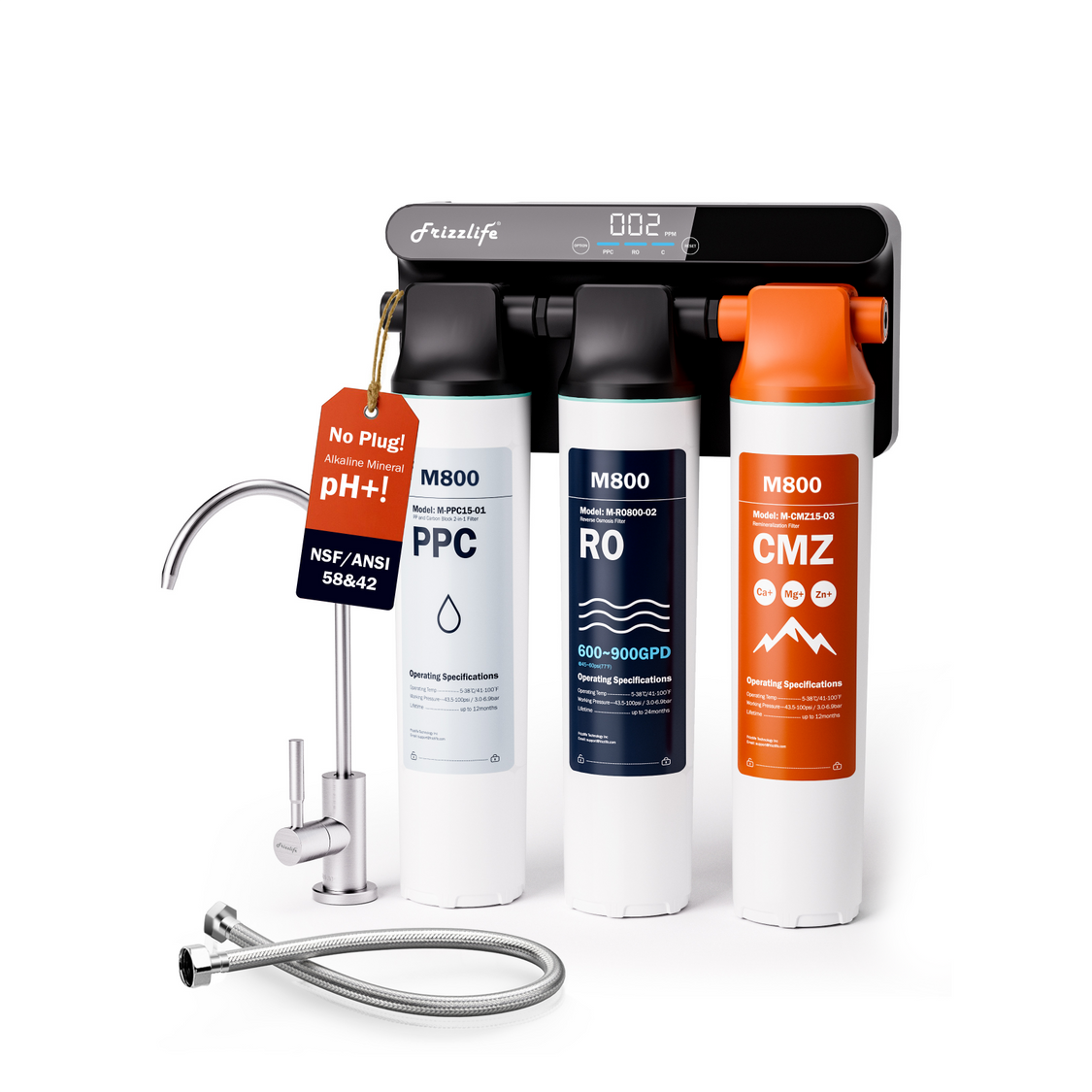
Frizzlife M800
A non-electric tankless under-sink RO system with up to 900 GPD flow and alkaline remineralization, suited to households that want mineralized RO water without relying on an electrical connection.
View M800Advanced brewers sometimes blend treated water with a measured amount of suitable source water. This can raise hardness and alkalinity, but it should only be done when the source water is appropriate and the blend can be measured consistently.
Countertop RO for Renters, Small Kitchens, and Manual Brewing
Countertop RO can be practical when permanent plumbing changes are undesirable. It is particularly relevant for renters, small households, and people preparing water for pour-over, French press, immersion brewing, or a kettle rather than supplying a plumbed-in machine.
When comparing Frizzlife countertop RO systems, review the documentation for the specific model, including installation needs, treatment stages, output-water characteristics, maintenance, and any remineralization function. Do not assume that every countertop RO system creates the same final mineral profile.
For manual brewing, test a small batch before changing every other recipe variable. If the coffee becomes flat after switching to RO, the first suspect should be mineral balance—not necessarily the beans.
Troubleshooting Coffee That Tastes Flat After Switching to RO
Use a controlled process:
-
Measure the RO water’s TDS. A very low result suggests that mineral reduction may be contributing to the flavor change.
-
Check hardness separately. A TDS meter cannot show whether useful calcium and magnesium remain.
-
Confirm whether remineralization is installed and functioning. Review the instructions for the exact system.
-
Compare one brew with your previous water. Keep coffee dose, grind, temperature, time, and ratio unchanged.
-
Check the machine manual. Do not feed low-mineral water to an espresso machine unless it is within the manufacturer’s requirements.
-
Adjust the water before changing the coffee recipe. Otherwise, multiple simultaneous changes make the real cause difficult to identify.
Which option produces the best taste for coffee vs tea (not the same target)
Coffee and tea overlap in their need for clean, odor-free water, but they do not always taste best with identical mineral profiles. Coffee extraction depends heavily on hardness and alkalinity. Tea is often especially sensitive to aroma clarity, surface film, color, and astringency.
Tea Water Priorities: Aroma, Clarity, Color, and Controlled Astringency
Tea can reveal water problems quickly. Excessive hardness may contribute to cloudiness, surface film, darker color, or muted aroma. High alkalinity can soften desirable brightness, while very low-mineral water may make some teas taste thin or sharply astringent.
Delicate green and white teas often favor softer, clean-tasting water. Robust black teas may tolerate somewhat more mineral content. These are preferences rather than absolute rules, and leaf type, temperature, and steeping time remain important.
When the Same Filtered Water Works Well for Both Drinks
One supply can work well for both coffee and tea when it is:
-
Free of detectable chlorine and objectionable odor
-
Moderately mineralized
-
Not highly alkaline
-
Consistent over time
-
Suitable for the kettle or coffee equipment being used
For most households, a balanced shared profile is more practical than maintaining separate water recipes. Start with water that makes good coffee without creating tea cloudiness or excessive kettle scale, then make small brewing adjustments.
When Coffee and Tea Benefit From Different Mineral Profiles
Separate profiles become useful when a household regularly brews both specialty coffee and delicate tea. Coffee may benefit from enough hardness to support body and extraction, while a light tea may show clearer aroma and color with somewhat softer water.
Different water may also help when:
-
A bright pour-over tastes sour in water preferred for black tea.
-
Tea develops film in water that produces satisfying espresso.
-
Straight RO tastes acceptable with one beverage but flat with another.
-
One appliance has strict water requirements.
The solution does not always require two filtration systems. A controlled remineralization or blending approach may provide enough flexibility, provided the final water is tested.
Best Water Filter for Coffee by Water Condition and Brew Method
|
Starting water and use |
Most practical filter category |
Why it fits |
Main caution
|
|---|---|---|---|
|
Municipal water with acceptable hardness; drip or manual coffee |
Carbon pitcher or under-sink carbon filtration |
Reduces chlorine taste while generally preserving existing minerals |
Carbon alone does not reliably solve high hardness |
|
Moderate municipal water; daily coffee, tea, and drinking water |
Multi-stage under-sink filtration selected for the measured water |
Convenient treated water at the sink with more capacity than a small pitcher |
Verify the exact model’s treatment claims and output |
|
Hard water; espresso machine or heated reservoir |
Softening, hardness reduction, or machine-appropriate scale-control treatment |
Helps manage scale while retaining a usable brewing profile |
Scale inhibition and true hardness reduction are not the same |
|
High or highly variable dissolved solids; manual brewing |
RO followed by measured remineralization |
Creates a consistent starting point and allows mineral control |
Straight RO may taste flat |
|
Renter or small kitchen; pour-over, tea, or batch preparation |
Countertop RO with suitable final mineral adjustment, or a pitcher chosen for the source water |
Avoids permanent installation and supports small-volume brewing |
Capacity, maintenance, and final water chemistry are model-dependent |
|
Plumbed-in espresso equipment |
Equipment-compatible inline treatment based on hardness and alkalinity tests |
Supports steady flow and machine protection |
Confirm pressure, flow, water chemistry, and warranty requirements before installation |
How Roast Level and Brew Method Can Shift Taste Preferences
Light roasts often reveal water chemistry more clearly because acidity and aromatic detail are central to the cup. Moderate mineral content can support extraction, but excessive alkalinity may mute the brightness that makes the coffee distinctive.
Dark roasts may taste harsh when water strongly emphasizes extraction or when hardness is excessive. Some drinkers prefer slightly softer water for darker coffee, provided it still contains enough minerals to avoid a thin result.
Espresso concentrates these effects. Pour-over highlights clarity, while immersion methods may be more forgiving. Treat published water targets as a stable baseline, then adjust within a reasonable range according to taste and equipment guidance.
Choosing the Right Water Filtration System: Who Gets the Best Water for Coffee Brewing or Tea
Carbon Filtration for Acceptable-Hardness Municipal Water
Carbon filtration is often the most direct solution when the main problem is chlorine taste or odor. It can improve coffee and tea without intentionally stripping away all dissolved minerals.
However, carbon should not be confused with softening. If white scale appears quickly in your kettle, measure hardness before assuming a carbon system will protect an espresso boiler. Also verify model-specific documentation if chloramine reduction is important. If testing shows that taste and odor are the main concerns and hardness is already acceptable, compare water filter options for the kitchen sink by treatment method, installation format, and model-specific documentation.
Pitcher Filters for Low-Volume Brewing and Simple Setup

Pitchers suit people who brew a few cups per day, rent their home, or want to test whether filtration improves flavor before installing a larger system.
Their limitations include small capacity, slower preparation, and output that can change as the cartridge ages. Some pitcher media may affect hardness, while others primarily address taste and odor. The category alone does not reveal the result.
Test both source and filtered water. If the pitcher improves flavor but scale still returns quickly, you may need a different treatment strategy.
Under-Sink Water Filters for Daily Coffee, Tea, and Drinking Water
An under-sink system is a practical step up for households that use filtered water throughout the day. It avoids repeatedly filling a pitcher and can provide a dedicated source for coffee, tea, cooking, and drinking.
Selection should still be based on water chemistry. A carbon-focused system may suit moderate municipal water, while very hard or variable water may require a different approach. Frizzlife offers several categories of under-sink water filtration systems to compare by treatment method and installation format. Check the documentation for the exact model rather than generalizing performance across the category.
Scale-Control or Softening Options for Hard-Water Areas
Hard-water treatment can involve several different mechanisms. Ion exchange reduces hardness by exchanging calcium and magnesium ions. Other scale-control media may change how deposits form without actually lowering the hardness reading.
That distinction matters. A scale-inhibition cartridge may help equipment but leave the brewing mineral profile largely unchanged. A softener may substantially reduce hardness but increase sodium, depending on its design. Neither should be treated as complete filtration unless the system includes appropriate stages for the other water issues being addressed.
Test the output and confirm machine compatibility instead of relying on the word “scale” on a product description.
What Should I Consider When Choosing a Water Filter for a Coffee Machine?
Use this checklist before purchasing:
-
Source water: Test hardness and review available water-quality information.
-
Primary problem: Separate chlorine taste, scale, sediment, and high TDS rather than treating them as one issue.
-
Machine instructions: Follow the manufacturer’s water limits and warranty requirements.
-
Treatment mechanism: Confirm whether a system uses carbon, softening, scale control, RO, remineralization, or a combination.
-
Final mineral profile: Evaluate hardness and alkalinity, not only TDS.
-
Usage: Account for coffee, tea, cooking, and drinking-water demand.
-
Installation: Check model-specific space, plumbing, flow, and pressure requirements.
-
Maintenance: Consider how easily you can monitor and replace filters as directed.
-
Documentation: Verify exact treatment claims and certifications for the model under consideration.
The best choice is the least complicated system that reliably moves your actual source water toward a suitable profile.
What do you give up by choosing the cheapest option for coffee and tea brewing?
A low-cost filter can be perfectly reasonable when your water only needs basic taste improvement. The trade-off is usually less control, not necessarily poor performance.
Depending on the product, the cheapest option may give up:
-
Meaningful hardness management
-
Stable output as the cartridge ages
-
Capacity for high daily use
-
Convenient flow for cooking and drinking
-
Treatment for water problems beyond chlorine taste
-
Remineralization after aggressive purification
-
Compatibility with plumbed-in equipment
-
Clear documentation for machine-specific use
The greater regret comes from buying for price before identifying the problem. A basic carbon pitcher cannot be expected to solve severe scale, while an inexpensive RO setup without appropriate mineral adjustment may produce water that tastes worse in coffee.
Common Water-Filter Mistakes for Coffee and How to Avoid Them
Choosing Carbon-Only Filtration Without Checking Hardness
Carbon is effective for many taste and odor concerns, but it is not a universal hard-water solution. Test hardness if your kettle or brewer develops visible deposits. If the number remains high after filtration, address scale separately.
Assuming the Lowest TDS Produces the Best-Tasting Coffee
Low TDS does not reveal whether the remaining mineral balance supports extraction. Judge water by taste, hardness, alkalinity, odor, and equipment requirements—not one meter reading.
Feeding an Espresso Machine Straight RO Water Without Checking Manufacturer Guidance
Before connecting RO water to an espresso machine, verify its mineral content and the machine’s instructions. If remineralization is required, test the finished water after that stage.
Ignoring Seasonal Changes in Municipal Water
Utilities may blend sources or adjust treatment throughout the year. If coffee suddenly changes despite a stable recipe, compare current source and filtered water with previous readings.
Confusing Scale Protection With Complete Water Filtration
Scale control addresses a specific equipment problem. It does not automatically remove chlorine, sediment, dissolved substances, or unwanted odors. Likewise, a taste-and-odor filter does not automatically prevent scale.
Changing Beans or Grind Settings Before Troubleshooting the Water
When flavor changes unexpectedly, hold the recipe constant and compare water first. Check filter condition, hardness, TDS, odor, and visible scale. Change one variable at a time so you can identify the cause.
Maintaining Consistent Filtered Water for Coffee
Test Source and Filtered Water Before Choosing a System
A baseline test shows what the filter needs to accomplish. Measure at least hardness and TDS, and review local information for disinfectant type and other known conditions. More detailed testing may be appropriate for private wells or unusual water concerns.
Use Hardness Tests and TDS Readings for Different Purposes

Use a hardness test to estimate scale potential and the concentration of calcium and magnesium. Use a TDS meter to spot broad changes in dissolved material. Neither replaces alkalinity testing when precise coffee-water adjustment is the goal.
Replace Filters According to Verified Product Guidance and Actual Usage
Replacement schedules are model-specific and affected by usage and input-water conditions. Follow the documentation for your exact system rather than assuming a universal interval. Record installation and replacement dates so changes in taste or flow have context.
Watch for Taste Changes, Reduced Flow, and Returning Scale
Possible signs that a system needs attention include:
-
Chlorine taste or odor returning
-
Coffee becoming dull or inconsistent
-
Reduced faucet or system flow
-
Scale appearing more quickly
-
A sudden change in TDS or hardness
-
Tea becoming cloudy or developing more surface film
These signs do not prove that a cartridge is exhausted, but they are good reasons to inspect the system and retest the water.
Recheck Water After Filter Changes or Municipal Supply Changes
A fresh cartridge can alter output compared with an older one. Test after replacement, after a system adjustment, or whenever the municipal supply changes noticeably. Consistent measurement is particularly helpful for espresso and light-roast coffee.
Confirm Coffee-Machine Water Requirements and Warranty Conditions
The final authority for machine compatibility is the equipment manufacturer. Confirm acceptable hardness, treatment restrictions, maintenance procedures, and warranty terms before connecting a new supply.
The best water filter for coffee is ultimately the system that solves the problems your water actually has: carbon filtration for unwanted disinfectant taste, hardness treatment for scale, or RO with suitable remineralization when greater control is necessary. Test first, preserve a moderate mineral balance, and verify the final water against both your taste and your machine’s requirements.
References
https://coffeegeek.com/wp-content/uploads/2023/10/SCAGoldCupStandard.pdf