


Introduction to Stainless Steel Filters
A stainless steel drinking water mechanical filter uses a physical barrier to capture suspended particles as water passes through the system. Depending on the design and micron rating, that barrier may intercept sand, rust flakes, silt, fibers, pipe scale, and other sediment before the water reaches a faucet or a finer treatment stage.
These filters are commonly used as prefilters. Installed upstream of activated carbon, ultrafiltration, or reverse osmosis, a mechanical filter can reduce the amount of particulate matter reaching those more specialized stages. That helps maintain water flow and limits premature sediment loading, although the actual effect on service life depends on the water quality and system design.
What Is a Stainless Steel Filter?
In drinking water applications, a stainless steel filter is a device that uses stainless steel in the housing, filtration element, or both. Its function depends on where the stainless steel is used.
A stainless steel water filter housing is the pressure-bearing shell that holds a replaceable or reusable cartridge. The housing provides structural support and keeps water contained, but it may not perform the filtration itself. The cartridge inside could be a sediment element, activated carbon block, ultrafiltration membrane, or another treatment technology.
A stainless steel mesh element, by contrast, is an active mechanical filter. Water flows through openings in the mesh while particles larger than the effective pore size are retained. Some elements are removable and washable; others are incorporated into self-cleaning or flushable designs.
For that reason, the phrase mechanical water filter stainless steel does not identify one universal product. It may describe a filter with:
- A reusable stainless mesh screen
- A stainless filter housing with a mechanical sediment cartridge
- A self-cleaning prefilter with a stainless internal element
- A drinking water system that combines a mechanical stage with carbon or membrane treatment
What mechanical filtration can capture
Mechanical filtration works against suspended solids rather than substances dissolved at the molecular or ionic level. Depending on the model and its micron rating, it may capture:
- Sand from a private well or water supply line
- Rust particles from aging plumbing
- Pipe scale and mineral fragments
- Silt and visible sediment
- Fibers and other debris
- Particulate matter released during utility or plumbing work
Some documented stainless steel mesh prefilters use ratings around 90 or 100 microns. These values are examples from specific products, not a standard for all stainless filters. Finer and coarser configurations may be available, and two filters with similar stated ratings may not perform identically if their construction or rating methods differ.
A lower micron number generally indicates smaller openings and the potential to retain finer particles. However, finer filtration can also increase pressure drop and cleaning demand, particularly when the incoming water carries a heavy sediment load. The goal is not automatically to select the lowest number. It is to match the filter to the particles present, required flow, downstream equipment, and acceptable maintenance level.
What it does not automatically remove
A mechanical screen does not inherently remove contaminants merely because it is made from stainless steel. Standard sediment filtration should not be assumed to reduce:
- Dissolved lead or other dissolved metals
- Chlorine and chloramine
- PFAS
- Pesticides or volatile organic compounds
- Salts and total dissolved solids
- Dissolved hardness minerals
- Most microorganisms
- Unpleasant tastes or odors caused by dissolved substances
A mechanical filter may capture particulate material containing certain compounds, but that is not the same as certified reduction of the dissolved contaminant. For example, rust-colored particles can be physically screened, while dissolved iron can pass through and later oxidize. Treatment for dissolved contaminants generally requires activated carbon, ion exchange, reverse osmosis, or another technology selected for the specific concern.
Stainless steel also does not disinfect water. Its relatively smooth, cleanable surface can be useful in hygienic equipment design, but maintenance, drainage, and the avoidance of stagnant zones remain important. If the safety of a private water source is uncertain, testing the water is more informative than selecting a filter based only on housing material.
Overview of Stainless Steel Water Filtration Technology
A stainless steel mechanical filter usually operates through surface filtration. Water moves through a screen or mesh with defined openings, and larger solids remain on the upstream surface. As particles accumulate, the open area decreases and resistance to flow increases.
That behavior is different from depth filtration. A depth-style sediment cartridge captures particles throughout a thicker media structure rather than mainly at its surface. Depth cartridges may handle a range of particle sizes, but they are often replaced rather than washed. A stainless housing can hold either type, so the housing material does not tell you whether the system uses surface or depth filtration.
Understanding micron ratings
The micron rating is one of the most useful specifications for a mechanical filter, but it must be read in context. A rating indicates the particle-size range the element is designed to address; it does not describe chemical treatment or microbial purification.
Before choosing a filter, verify:
- The stated micron rating
- Whether the rating is nominal or defined by another method
- Whether the element is mesh, screen, or depth media
- The manufacturer’s specified flow and pressure conditions
- Whether the element is washable, replaceable, or self-cleaning
- Which performance claims, if any, are independently certified
A coarse filter can be an effective first stage where sand or rust flakes are the primary problem. Fine silt or persistent cloudiness may need a finer cartridge or staged sediment filtration. Trying to capture everything with one very fine screen can lead to rapid fouling and an inconvenient loss of flow.
Washable, flushable, and self-cleaning designs
Reusable stainless mesh is appealing because retained sediment can often be removed instead of sending the entire element to the trash. However, “washable,” “flushable,” and “self-cleaning” do not necessarily mean the same thing.
A washable element generally must be removed after the housing is isolated and depressurized. The screen is cleaned according to the manufacturer’s instructions, inspected, and reinstalled with seals correctly seated.
A flushable filter may have a valve that releases collected debris without fully opening the housing. Flushing can simplify routine maintenance, but adhered scale or heavily embedded material may still require manual service.
A self-cleaning design uses a flushing or cleaning mechanism intended to clear the filter surface. The process and effectiveness are model-dependent. It should not be interpreted as maintenance-free: valves, seals, screens, and drain arrangements still require inspection.
Not every stainless steel drinking water filter includes a reusable element. Some have a durable stainless housing around a disposable cartridge. Check the internal media rather than relying on the exterior appearance.

Where a mechanical filter belongs in the treatment sequence
A mechanical filter is usually installed before stages that address finer particles or dissolved contaminants. A typical treatment sequence may be:
- Coarse mechanical sediment control
- Finer sediment filtration, when necessary
- Activated carbon or other adsorptive media
- Ultrafiltration or reverse osmosis, where appropriate
- Final polishing or dispensing stage, depending on the system
The correct sequence is system-specific. A stainless mechanical prefilter at the point of entry may protect plumbing and downstream equipment throughout a home. A compact mechanical stage at the point of use may protect a drinking water cartridge below the sink.
If the goal is broader drinking water treatment rather than sediment control alone, compare the complete treatment process. Frizzlife’s under-sink filtration options can be evaluated by their model-specific media, installation requirements, and contaminant-reduction information rather than by housing material alone.
Explore Filtration Beyond Sediment Removal
A stainless steel mechanical prefilter helps capture sediment. If you also want to address dissolved substances or improve drinking water taste, explore additional treatment options and the replacement filters needed to maintain them.
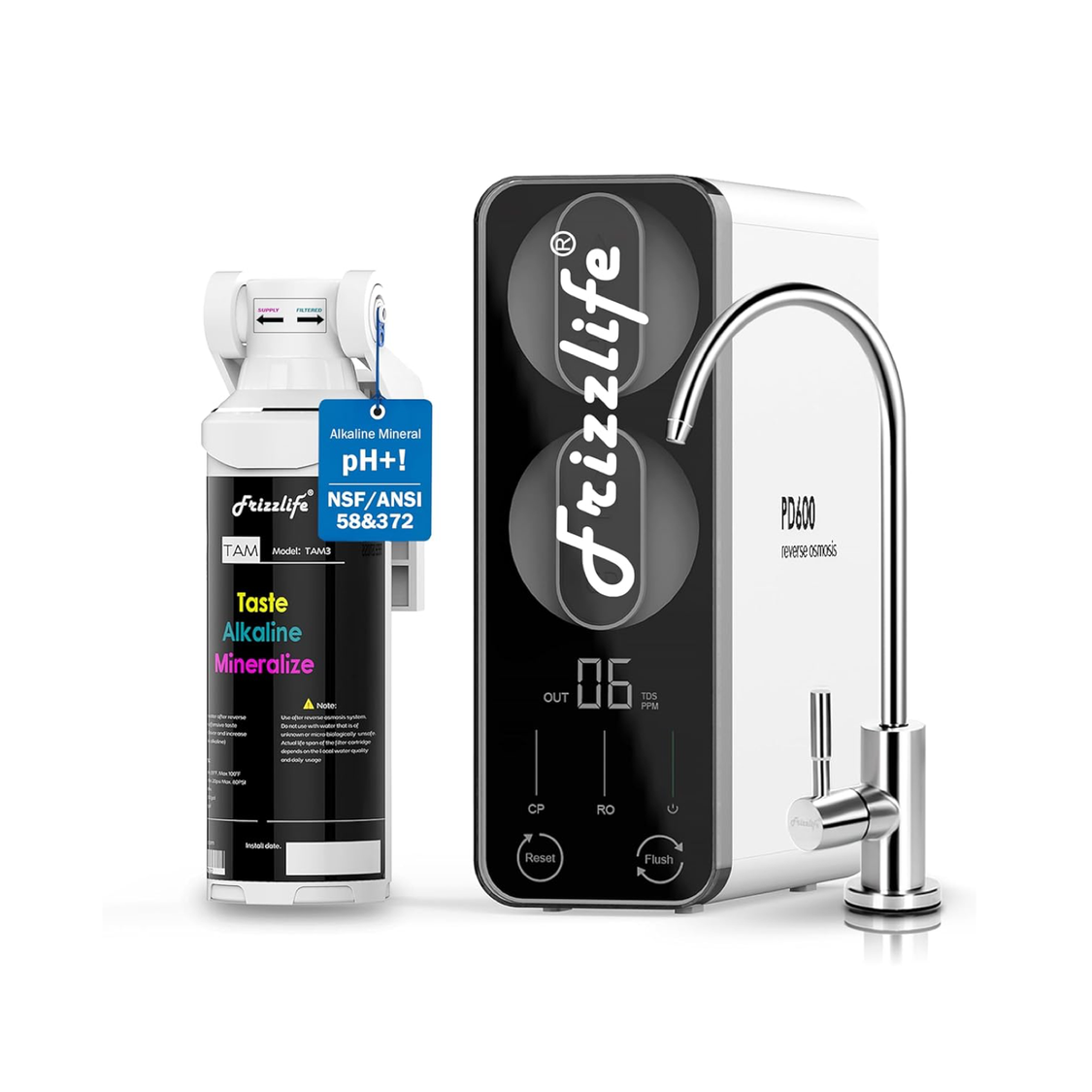
Frizzlife PD600-TAM3
A tankless under-sink RO system with alkaline remineralization for drinking water treatment beyond basic sediment screening.
Explore PD600-TAM3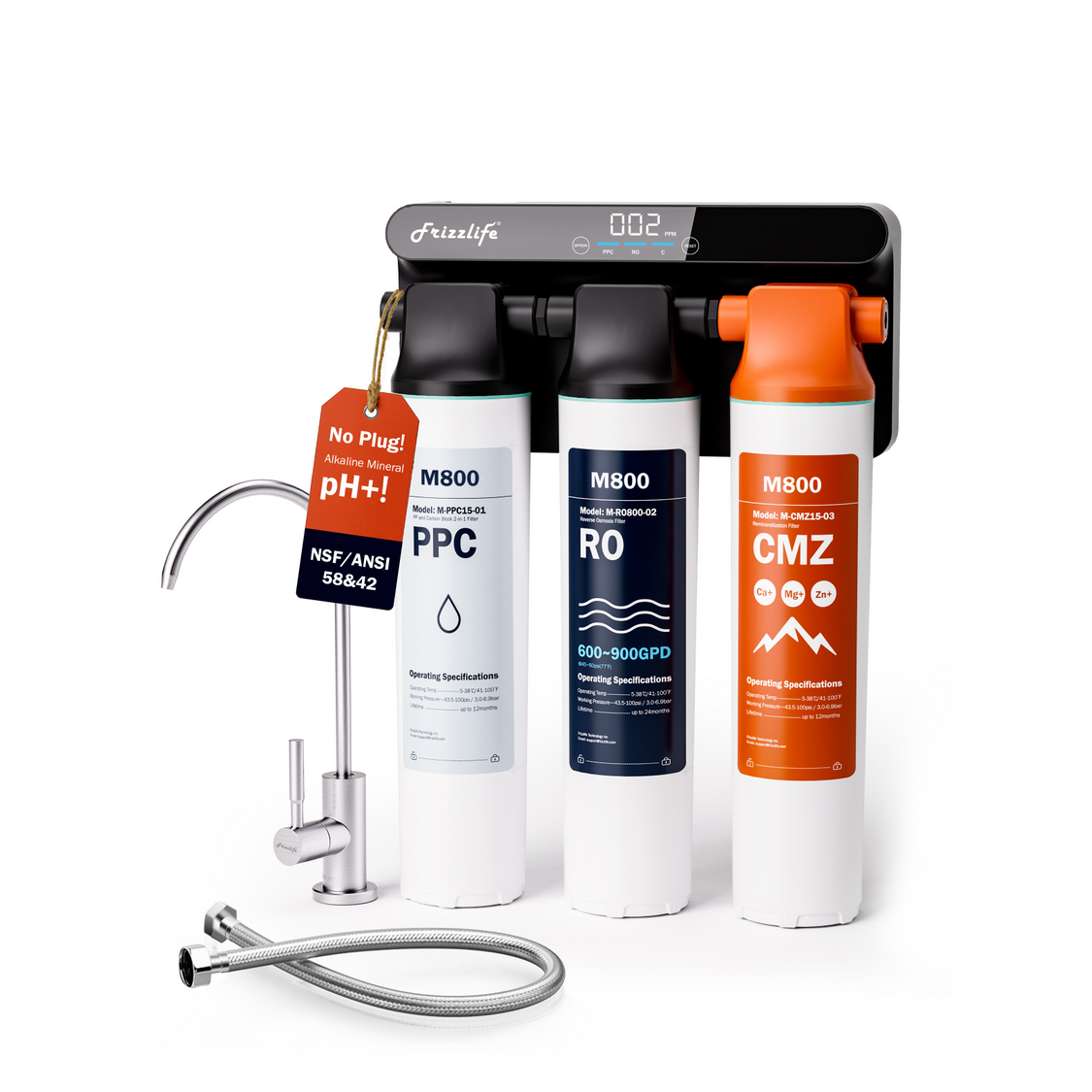
Frizzlife M800
A tankless under-sink RO option designed to use incoming water pressure, with remineralization for drinking water taste.
Explore M800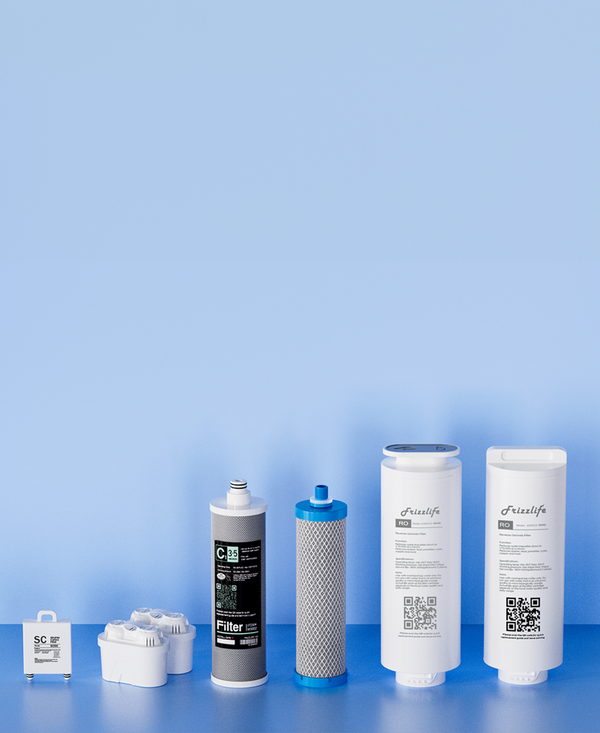
Replacement Filters
Already own a Frizzlife filtration system? Find model-compatible cartridges and plan routine filter maintenance.
Find Replacement FiltersThese RO systems and replacement cartridges are not substitutes for a stainless steel mesh prefilter. Confirm water quality needs, product specifications, and cartridge compatibility before choosing a system.
Choosing a configuration for the sediment problem
|
Water condition or goal |
Practical filter approach |
Typical placement |
Maintenance considerations
|
|---|---|---|---|
|
Visible sand or coarse debris from a well |
Coarse stainless mesh or screen prefilter selected for the observed sediment |
Near the point of entry, before finer treatment |
Inspect and clean when debris is visible or flow begins to decline |
|
Intermittent rust flakes from older plumbing |
Mechanical sediment filter matched to the particle size |
Before drinking water treatment or sensitive equipment |
Check after plumbing work, utility disturbances, or discoloration events |
|
Heavy sediment with mixed particle sizes |
Staged filtration, starting coarse and becoming finer |
Point of entry or before a larger treatment train |
Multiple stages may reduce rapid clogging, but each stage needs service |
|
Fine silt or persistent turbidity |
Finer sediment media may be needed instead of relying only on coarse mesh |
Before carbon, UF, or RO stages |
Expect more frequent servicing if the incoming sediment load is high |
|
Mainly chlorine, taste, odor, or dissolved-contaminant concerns |
Mechanical filtration only as a prefilter; use appropriate certified treatment downstream |
Usually point of use for drinking water |
Follow the maintenance schedule for both the sediment and treatment cartridges |
|
Desire to reduce disposable sediment cartridges |
Washable or flushable stainless element, where compatible with the application |
Point of entry or upstream of finer filtration |
Reuse still requires cleaning, seal inspection, and eventual component replacement |
This table is a starting point, not a substitute for water testing or product specifications. Sediment varies by source and may change after storms, well work, utility maintenance, or pipe repairs.
Installation factors that affect performance
A filter can have suitable media and still perform poorly if it is incorrectly sized or installed. Before purchasing or fitting a stainless steel filtration system, confirm:
- Plumbing connection size and thread type
- Intended flow direction
- Available mounting and service space
- Cold- or hot-water suitability
- Maximum and minimum operating conditions
- Required drain access for flushable models
- Cartridge or screen compatibility
- Access to shutoff and pressure-relief controls
- Local plumbing code requirements

Never assume that a stainless housing is suitable for every temperature or pressure. Those limits depend on the complete assembly, including welds, seals, valves, fittings, and cartridge components. A housing made from stainless steel may still contain elastomers or plastics with different operating limits.
Installation position also matters. A filter should be accessible enough to isolate, depressurize, open, clean, and reassemble safely. A reusable element offers little practical advantage if routine service requires removing cabinetry or dismantling nearby plumbing.
How often should a mechanical stainless steel filter be serviced?
There is no universal cleaning interval. Service frequency depends on sediment concentration, particle size, flow demand, screen area, micron rating, and the filter’s design. Manufacturer instructions should take priority over a generic calendar schedule.
Useful maintenance cues include:
- Lower flow at faucets or appliances
- Increasing pressure difference across the filter, if gauges are installed
- Visible sediment buildup in a transparent inspection area
- Reappearance of particles downstream
- Incomplete flushing during a cleaning cycle
- Changes in water color following plumbing or utility work
- Leakage around the housing, valve, or seal
A filter handling occasional rust may go longer between services than the same filter on a sand-producing well. Conversely, an undersized fine screen can clog quickly even when the water does not look severely contaminated.
When servicing a mechanical filter, follow the manufacturer’s shutdown and depressurization procedure. Inspect the screen for deformation, torn mesh, blocked openings, or corrosion. Seals should be checked for wear, debris, and correct seating before repressurizing the system. Avoid cleaning methods that could damage the mesh or leave unsuitable chemical residue on drinking water contact surfaces.
Troubleshooting reduced flow or recurring sediment
Reduced flow usually indicates accumulated solids, an overly fine or undersized element, or a restriction elsewhere in the system. A practical troubleshooting sequence is:
- Check whether the change is limited to one fixture. A clogged faucet aerator may be the problem rather than the main filter.
- Review the filter’s service status. Clean, flush, or replace the element according to its instructions.
- Inspect the captured material. Sand, rust flakes, fine mud, and biological-looking deposits can point to different source-water issues.
- Confirm valve positions. A partially closed isolation valve can imitate filter blockage.
- Consider the micron rating. A screen that is too fine for the sediment load may foul repeatedly.
- Evaluate filter size and surface area. Frequent clogging can indicate that the element is too small for the flow demand or incoming solids.
- Check downstream stages. Carbon cartridges and membranes can also become restricted.
- Investigate sudden changes at the source. New sediment may follow well disturbance, pipe work, or utility maintenance.
If particles continue to appear after cleaning, inspect the mechanical element and its seals. Damaged mesh, an incorrectly seated cartridge, or an internal bypass path can allow sediment through. Particles can also originate downstream of the filter from aging pipes, a water heater, or plumbing components.
Why Choose Stainless Steel Filters Over Other Materials?
The main advantages of stainless steel water filter housings are mechanical strength, corrosion resistance in suitable water conditions, cleanability, and the potential for long service life. Stainless steel is also recyclable at the end of use.
Those advantages should be considered alongside cost, weight, installation conditions, water chemistry, and the quality of the complete filter assembly. Stainless steel is not universally superior to plastic, and plastic housings can be appropriate when they are properly designed, certified, installed, and operated within their specified limits.
Stainless steel versus plastic filter housings
|
Factor |
Stainless steel housing |
Plastic housing
|
|---|---|---|
|
Mechanical strength |
Often selected where durability and mechanical stress are important |
Performance depends on polymer, wall design, age, and rated operating conditions |
|
Corrosion behavior |
Resists corrosion in many drinking water environments when the correct grade and design are used |
Does not rust, but chemical, thermal, and aging resistance are material-dependent |
|
Temperature and pressure |
Some models are engineered for demanding service, but ratings must be verified |
Suitable limits vary by model and must also be verified |
|
Inspection |
Opaque unless the design includes an inspection feature |
Some housings are transparent, making sediment buildup easier to see |
|
Weight |
Generally heavier |
Generally lighter and often easier to handle during installation |
|
Cleaning |
Smooth, durable surfaces can support repeated cleaning |
Cleaning method must be compatible with the polymer |
|
Longevity |
Can provide a long service life under appropriate conditions |
Can also last when correctly specified and protected from incompatible conditions |
|
End-of-life considerations |
Stainless steel is recyclable |
Recyclability varies by plastic type and local facilities |
|
Filtration performance |
Determined by the internal media, not the steel shell |
Also determined by the internal media, not the plastic shell |
The fair comparison is between complete, properly specified products—not simply “metal versus plastic.” A poorly selected stainless housing can be less suitable than a correctly rated plastic assembly, especially if the water chemistry, temperature, seals, or installation conditions are incompatible.
Corrosion resistance and stainless steel grades
Stainless steel develops a passive chromium-rich oxide layer that helps protect the underlying metal. This is why stainless grades such as 304 and 316 are widely used in water equipment.
Corrosion resistance is not absolute. Performance depends on:
- Stainless steel grade
- Chloride concentration and overall water chemistry
- pH
- Temperature
- Fabrication and weld quality
- Surface condition
- Crevices and stagnant zones
- Contact with dissimilar metals
- Cleaning chemicals and procedures
Grade 304 is common in consumer equipment and performs well in many drinking water applications. Grade 316 generally offers additional resistance in some more demanding environments, particularly where chloride exposure is a concern. That does not mean every household requires 316, nor does a grade designation alone establish that the completed filter is appropriate for a particular water supply.
If the source water is unusually acidic, saline, high in chlorides, or otherwise aggressive, grade and component compatibility deserve closer review. The seals, drain valve, fittings, and fasteners matter alongside the main housing.
Durability without universal-superiority claims
Stainless steel is often chosen where users want a rigid, impact-resistant enclosure or where equipment must tolerate demanding service. Certain stainless housings are engineered for elevated pressures and hot or cold water applications, but those capabilities are model-specific.
A metal housing should never be installed based on general assumptions about steel strength. Its actual rating is determined by the entire assembly. Altering fittings, using incompatible cartridges, overtightening connections, or operating outside the stated temperature and pressure range can compromise an otherwise durable system.
Plastic housings have their own practical advantages. They are lighter, can be less expensive, and may allow visual inspection when made from transparent material. The appropriate choice depends on the application rather than a blanket material ranking.
Cleanability, reuse, and environmental considerations
Stainless steel’s durability and recyclability can support an environmentally conscious filtration strategy. A reusable mesh element may reduce the number of disposable sediment cartridges used over time, and a long-lived housing can reduce material turnover.
Still, a stainless steel water filter is not automatically the more sustainable choice in every case. A responsible comparison should consider:
- Whether the element is actually reusable
- Water and energy used during cleaning
- Frequency of replacement parts
- Expected housing life in the specific application
- Transportation and material use
- Availability of metal recycling
- Whether downstream cartridges remain disposable
“Eco-friendly” is most defensible when it refers to concrete features such as recyclability, repeated cleaning, or long service potential—not an unsupported claim that every stainless product has a lower total environmental impact than every plastic alternative.
Washable screens also require proper disposal of collected sediment. Flushing debris into a drain may be acceptable for some systems, but installation instructions and local requirements should be followed, particularly when sediment may contain material from a contaminated source.
Drinking water standards and certification
Certification terms are frequently misunderstood when evaluating a stainless steel drinking water filter.
NSF/ANSI/CAN 61 addresses the health-effects requirements for materials and components that contact drinking water. A housing certified under this standard has been evaluated within that scope. The certification does not, by itself, demonstrate sediment reduction, lead reduction, or removal of other contaminants.
NSF/ANSI 42 covers aesthetic effects and includes certain particulate-reduction claims, as well as claims related to substances affecting taste and odor. The exact certified claim must be checked; a reference to Standard 42 does not mean a product has every possible claim under that standard.
NSF/ANSI 53 addresses specified health-effect contaminant-reduction claims. NSF/ANSI 401 covers certain emerging-contaminant claims. These standards apply only where the individual product is certified for a named reduction claim under defined conditions.
When comparing systems, keep these terms separate:
- Manufacturer claim: A statement made by the product manufacturer
- Tested: Evaluated under stated conditions, which may or may not involve independent testing
- Certified: Independently evaluated under a defined certification program for specific listed claims
- Meets a standard: Wording that should be supported by clear documentation but is not necessarily equivalent to third-party certification
The presence of stainless steel does not establish any of these performance claims. Look up the exact model, certification standard, and certified reduction rather than accepting a broad certification logo as proof of comprehensive treatment.
This is especially important for health-related concerns such as lead. A mechanical sediment screen should not be selected as a lead-reduction solution unless the complete product has an applicable, verifiable certification for that specific claim.
A practical selection checklist
Before choosing a stainless steel filtration system, answer these questions:
-
What is in the water?
Visible sand, rust flakes, and silt suggest a mechanical problem. Dissolved contaminants require testing and different treatment technologies. -
Where do the particles originate?
Sediment may come from a well, municipal work, aging service lines, household plumbing, or a water heater. Placement should account for the source. -
What particle size needs to be captured?
Select a model-specific micron rating that balances sediment removal and acceptable flow. -
Is the filter a prefilter or the complete treatment system?
A stainless mesh prefilter does not replace carbon, UF, RO, or other stages when broader treatment is required. -
Is the element reusable?
A stainless exterior does not guarantee a washable cartridge. -
How will the filter be serviced?
Check shutoff access, drainage, clearance, cartridge availability, and cleaning procedures. -
Is the complete assembly compatible with the installation?
Verify connection size, orientation, pressure, temperature, seals, and local code requirements. -
Which claims are certified?
Match certification to the contaminant or performance concern instead of relying on general “tested” language.
After identifying the required filtration stages, homeowners can review Frizzlife’s stainless steel filter systems and verify the media, certifications, installation limits, and maintenance requirements for each model.
Closing Perspective
A stainless steel drinking water mechanical filter is primarily a sediment-control device. Its physical barrier can capture sand, rust, silt, fibers, and other suspended particles according to the model’s micron rating, making it useful as a first stage before finer drinking water treatment.
Stainless construction can add strength, corrosion resistance, cleanability, recyclability, and long service potential. It does not automatically provide chemical, dissolved-metal, or microbial reduction. The most reliable choice comes from matching the mechanical element to the sediment problem, verifying the complete system’s operating conditions, and selecting separately certified treatment stages for any additional contaminants of concern.